
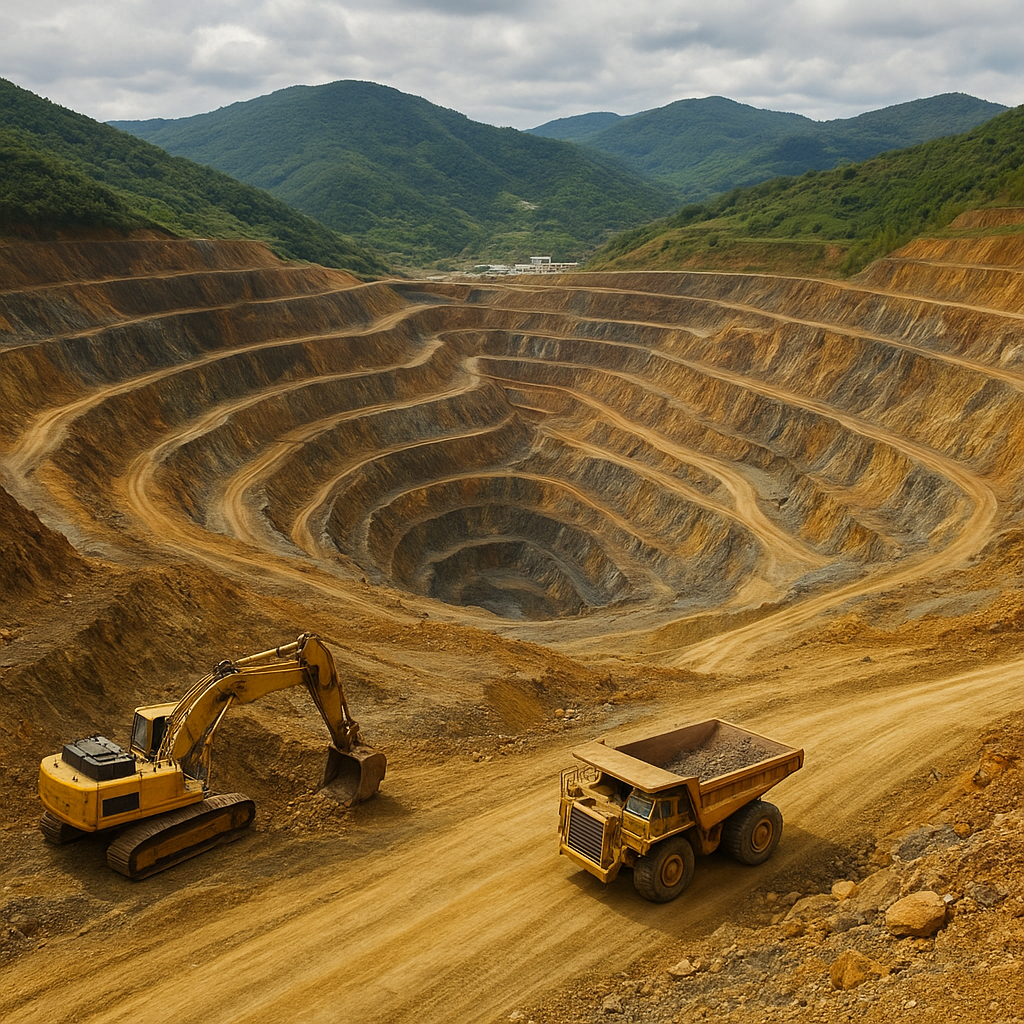
The Zijinshan Gold & Copper Mine is a prominent mining complex in China known for its combination of rich mineralization and significant industrial importance. Situated within a geologically favorable region, the mine has played a major role in the development of a leading Chinese mining company and in supplying metals critical to both domestic industry and global markets. This article explores the mine’s location and geology, its extraction and processing activities, economic and social roles, environmental and technological considerations, and several notable and interesting aspects that make Zijinshan stand out in the world of modern mining.
Location and geological setting
The Zijinshan operation is located in southeastern China, within a province that hosts a variety of mineral deposits and a long history of mineral exploitation. The mine sits in a terrain shaped by complex tectonic events and magmatic activity, which produced the kinds of mineral systems favorable for both gold and copper accumulation. The local geology is typical of porphyry and hydrothermal systems, where intrusive rocks injected mineral-bearing fluids into surrounding host formations, precipitating concentrations of sulfide and native metal phases.
Geologically, the deposit at Zijinshan can be described as a multi-phase, polymetallic system. The dominant minerals mined are copper-bearing sulfides (such as chalcopyrite) and native or alloyed gold, often occurring together in disseminated and vein-hosted forms. Such deposits commonly yield other by-product metals — for instance silver, lead, zinc, and occasionally molybdenum — which the complex can recover economically during processing. The variability of ore types in a single mining district requires flexible mining and metallurgical strategies to maximize recovery and value.
Mining methods and processing
Extraction techniques
At Zijinshan, extraction has historically combined both open-pit and underground approaches, chosen according to orebody depth, geometry, and economics. Open-pit methods allow large-scale removal of near-surface, lower-grade ore, while underground mining targets higher-grade zones at depth. Modern operations increasingly implement selective underground methods where precision and safety are priorities, and mechanization is applied to improve efficiency.
Comminution and metallurgical flowsheets
Following extraction, the ore undergoes a series of processing steps designed to liberate and concentrate the target metals. Typical flows include comminution (crushing and grinding), followed by separation techniques such as flotation, gravity concentration, and sometimes heap leaching for oxide-gold zones. For polymetallic copper–gold ores, flotation is particularly important to produce concentrates rich in copper and gold, which are then sent to smelters or further refined. The mine’s processing circuit is engineered to maximize metal recovery while managing mineralogical complexity and minimizing energy consumption.
Recovery of precious and base metals at Zijinshan has been improved over time by incorporating geometallurgical data into plant design and ore scheduling. This integration allows operators to predict how different ore types will behave in the mill and to adapt reagent schemes, grinding profiles, and separation settings accordingly. Such refinements enhance the overall value recovered from the orebody.
Economic and social significance
The mine has had a profound effect on the regional economy. As a major industrial enterprise, it provides direct employment in mining, processing, engineering, and administration, and supports a broader supply chain of contractors, service providers, and local businesses. The presence of the mine stimulates demand for transportation, construction, and housing, thereby raising levels of economic activity in the surrounding communities. For many local residents, employment at the mine or in related services represents a stable and often higher-paying alternative to traditional rural livelihoods.
On a national level, Zijinshan contributes to China’s strategic supply of critical metals. Gold plays a role both as a financial asset and as an industrial metal (electronics, dentistry, etc.), while copper is indispensable for electrical wiring, electronics, construction, and renewable energy infrastructure. By producing significant quantities of these metals, mines like Zijinshan help reduce dependence on foreign sources and support industrial policy goals for raw material security.
- Revenue generation: Mineral sales contribute to company revenues and local tax bases, enabling public investment in infrastructure and services.
- Value chain stimulation: Concentrates and refined metals feed downstream industries, supporting smelters, fabricators, and technology manufacturers.
- Export earnings: When produced volumes exceed domestic demand or when concentrates are sold on international markets, the mine adds to foreign-exchange earnings.
Environmental management and sustainability efforts
Large-scale mining inevitably raises environmental and social challenges. Tailings storage, water management, land disturbance, and potential chemical emissions are among the issues that require careful management. In response, modern operations at Zijinshan and similar mines emphasize structured environmental programs that include:
- Engineered tailings storage facilities with monitoring and progressive rehabilitation plans.
- Water management systems to treat process water, control runoff, and limit impacts on downstream ecosystems.
- Progressive land reclamation, including revegetation and restoration of disturbed areas.
- Air quality controls to limit dust and emissions from processing and transport.
Technological investments also play an important role in reducing the mine’s environmental footprint. Advances such as improved flotation reagents, energy-efficient comminution circuits, and automation reduce energy use and waste generation per unit of metal produced. Increasingly, mining companies reinvest profits into environmental remediation and community development programs to maintain their social license to operate and to align with global expectations for corporate responsibility and sustainability.
Labor, community relations and local development
Beyond direct employment, the Zijinshan mine has influenced education, healthcare and infrastructure in its region. Many mining companies, often in collaboration with local governments, invest in schools, clinics, road upgrades, and municipal services. These investments can transform small towns by improving access to services and raising standards of living. In parallel, maintaining positive community relations requires transparent communication on environmental performance, opportunities for local hiring, and mechanisms for grievance resolution.
Skilled labor development is another important aspect. The complex technical demands of modern mineral processing require training programs in metallurgy, geology, mechanical maintenance, and environmental engineering. Partnerships with technical colleges and vocational schools help create a pipeline of trained workers and support long-term regional capacity building.
Technological innovation and operational safety
To remain competitive and to meet stricter safety and environmental standards, mining operations at Zijinshan have adopted numerous technological innovations. These include:
- Digitization and remote monitoring systems for real-time control of processing plants and tailings facilities.
- Automation of underground equipment and haulage fleets to reduce risk exposure and improve productivity.
- Advanced geological modeling that integrates drilling, assay and geophysical data to optimize mine planning.
- Improvements in smelting and refining to increase metal recovery and reduce emissions.
Rigorous safety management systems and emergency response planning are integral to operations. Training, personal protective equipment, and strict procedural controls help mitigate the risks associated with heavy machinery, explosives, and sometimes hazardous materials used in processing.
Interesting facts and historical notes
The story of the mine is entwined with the rise of a major private mining company that began as a regional effort and expanded into a multinational group. Its origins illustrate how a single, high-quality deposit can catalyze corporate growth, technology adoption, and outward investment. The mine’s evolution reflects broader trends in the global mining sector: consolidation, international expansion, and increasing attention to environmental and social governance.
Some notable and compelling aspects include:
- Zijinshan as a namesake: The mine’s name became synonymous with the company that grew around it, and that brand is now recognized in multiple countries where the company operates.
- Polymetallic opportunity: Because it hosts both gold and copper in economically recoverable quantities, the site exemplifies how mixed deposits offer diversified revenue streams, stabilizing economics across commodity cycles.
- Technological adaptation: The mine has served as a testing ground for process innovations that were later applied in other operations owned by the company domestically and overseas.
- Local transformation: Communities around the mine have experienced rapid modernization linked to the mine’s presence, demonstrating both the opportunities and responsibilities that come with resource development.
Geopolitical and market context
The global markets for gold and copper are driven by diverse factors — from monetary policy and investor sentiment for gold to infrastructural demand and electrification trends for copper. Mines like Zijinshan are therefore sensitive to macroeconomic cycles as well as to specific shifts such as the global push for low-carbon technologies, which increases demand for copper in electrical grids, electric vehicles, and renewable energy installations.
At the geopolitical level, domestic production strengthens supply security for critical metals. Mines with integrated processing capabilities can add value locally rather than exporting raw ore, supporting national industrial strategies. Furthermore, companies that grow from local operations to international players carry with them technical know-how and capital that can be redeployed into new mining jurisdictions.
Challenges and future outlook
Like all mature mining districts, Zijinshan faces challenges including ore depletion in higher-grade zones, fluctuating commodity prices, and the need to balance growth with stricter environmental and community expectations. The future viability of the mine depends on continued investment in exploration to extend reserves, optimization of processing to handle variable ore types, and on maintaining strong community and regulatory relationships.
Exploration programs in nearby areas and at depth can extend the mine’s life by identifying new mineralized zones. At the same time, enhancing metallurgical recovery and reducing costs through automation and energy efficiency will be critical to sustaining profitability. In this way, Zijinshan exemplifies a modern mining enterprise that must integrate geology, engineering, economics, and social responsibility to remain a significant producer.

