
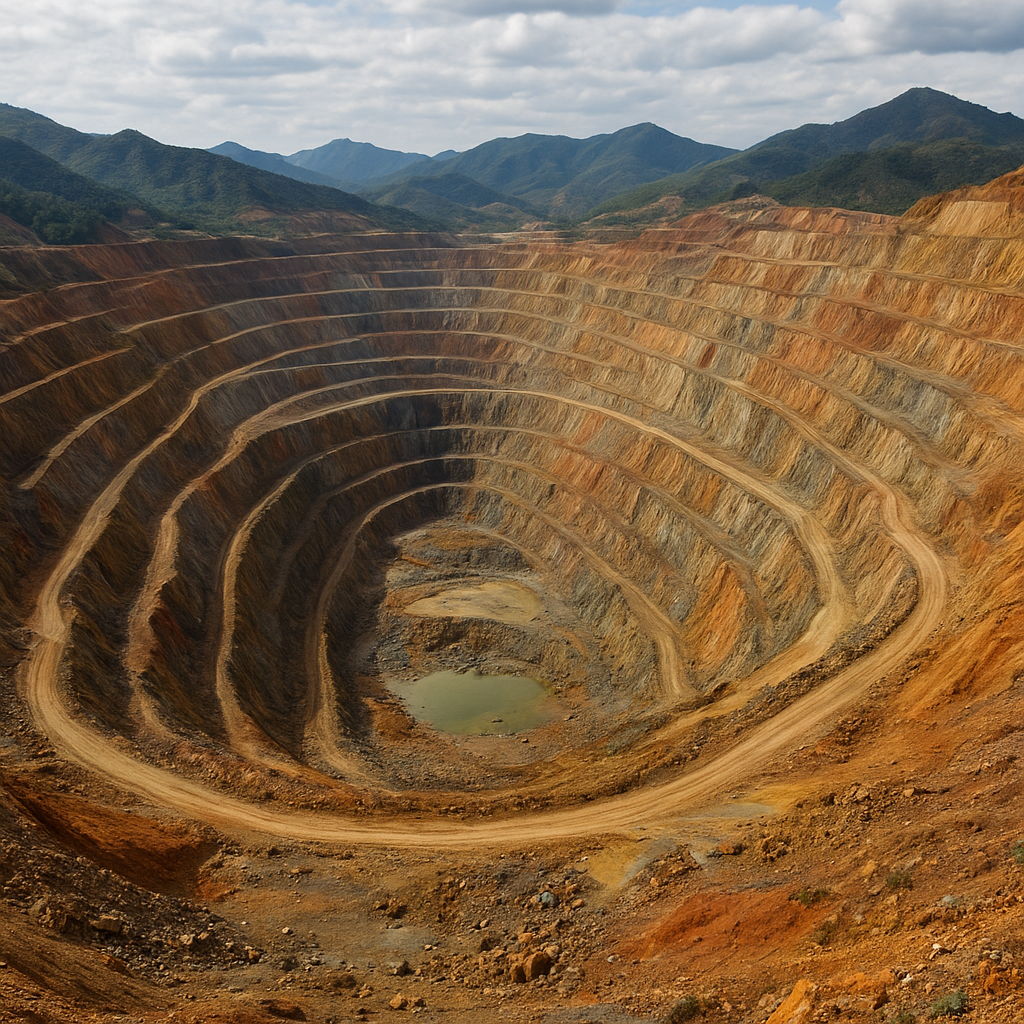
The Zijinshan Gold & Copper Mine occupies an important place among China’s mineral assets. Located in southeastern China, this mining area is best known for its combined production of **gold** and **copper**, with significant regional economic and strategic impact. The deposit has shaped the identity and growth of the company that carries its name and has influenced local communities, infrastructure and environmental policy. Below are detailed descriptions of where the mine is, what is extracted there, its economic role and several interesting features that make the site noteworthy.
Location and Geological Setting
The Zijinshan deposit is situated in the southeastern provinces of China, within the broader mineral-rich belt that runs through the region. The mine sits in a landscape of rolling hills and low mountains typical of this part of the country. The local topography and the presence of igneous intrusions helped create a favorable environment for mineralization. The name Zijinshan (literally “Purple-Gold Mountain”) is shared with a number of places in China; in this context it denotes the historic mining locality that gave rise to the modern industrial operation and the national mining company that uses the same name.
Geologically, the deposit belongs to a class of magmatic-hydrothermal mineral systems that commonly produce both **copper** and **gold**. Mineralization typically occurs where intrusive bodies interacted with surrounding host rocks, driving hot, metal-bearing fluids into fractures and permeable zones. These fluids deposited sulphide minerals (which host copper) and native or electrum-gold, commonly accompanied by other elements such as **silver** and **molybdenum**. In many such deposits the dominant ore types are porphyry-style or skarn-style mineralization, both of which can sustain very large tonnages and substantial metal yields when developed at industrial scale.
What Is Mined and How It Is Processed
The principal products of the site are **gold** and **copper**, but mining and processing typically yield a number of by-products that add to the economic value of the operation. Common secondary recoveries include **silver**, molybdenum and occasionally other trace metals. Ore types at the Zijinshan area require a combination of beneficiation processes to extract the various metals efficiently. Typical industrial processing flowsheet elements for a combined gold-copper operation include:
- Crushing and grinding — large-scale comminution to liberate mineral grains from host rock;
- Flotation — to produce copper‑gold concentrates by separating sulphide minerals from gangue;
- Gravity/CIL (carbon-in-leach) or CIP — for the recovery of free or liberated gold particles not reporting to copper concentrates;
- Concentrate drying and transport — copper-gold concentrates are commonly shipped to smelters for further refining;
- Smelting and refining — external smelters or integrated facilities convert concentrates into refined metals and refine by-product streams.
Mining methods at Zijinshan typically combine both surface (open-pit) operations for near-surface ore and underground workings for higher-grade or deeper ore bodies. Open-pit approaches allow high-throughput extraction when ore bodies are near the surface, whereas underground development is used to follow lenses and veins at depth. Tailings management, water treatment and waste-rock handling are critical parts of operational practice because of the sulphide-rich nature of ores which can generate acid drainage if not managed carefully.
Economic Significance
The economic importance of the Zijinshan mine can be considered across several dimensions. At the local and regional level, it is a major employer and a catalyst for related economic activity. The presence of the mine stimulates demand for infrastructure — roads, power lines, water supply and worker housing — and supports a network of suppliers, contractors and service providers. For many communities in the vicinity, the mine provides stable employment opportunities and contributes substantially to municipal revenues through taxes and royalties.
At the national level, the site contributes to China’s strategic mineral supply. **Copper** is a fundamental industrial metal used in electrical equipment, construction, transport and renewable-energy systems, while **gold** plays multiple roles as a monetary asset, industrial raw material and jewelry feedstock. By producing both, the Zijinshan operation supports manufacturing supply chains and helps China meet domestic demand for critical commodities. Because of this dual production, the mine can also offer operational flexibility: when metal prices shift, management can optimize recovery and concentrate handling to favor the higher-value product mix.
On an economic scale, the mine typically delivers multiple streams of value: direct sales of metal production (or of concentrates), contributions to local fiscal revenue, and indirect economic effects such as local procurement and the spending of employee wages in regional markets. The scale and longevity of a deposit like Zijinshan mean these economic benefits can compound over decades, enabling sustained development programs and infrastructure upgrades in the surrounding counties.
Environmental and Social Considerations
Large metal mines present environmental and social challenges that require careful management. A site producing **gold** and **copper** from sulphide-rich ores must robustly manage risks associated with acid rock drainage, heavy-metal mobility and the safe containment of tailings. Modern operations apply a mix of engineering design, monitoring and mitigation measures to reduce those risks:
- Engineered tailings storage facilities (TSFs) with liners, seepage collection and controlled deposition plans;
- Water treatment plants that neutralize acidity and remove dissolved metals before discharge or reuse;
- Progressive reclamation and re-vegetation to stabilize disturbed land;
- Community engagement programs to identify local concerns, provide timely information and deliver socioeconomic benefits such as training, local hiring or community development projects;
- Regular environmental monitoring and public reporting to maintain transparency and regulatory compliance.
Historically, high-profile mining operations in China have faced scrutiny over environmental performance; such scrutiny has driven both regulators and companies toward stricter controls and improved practices. Operators at mines like Zijinshan have had to invest in upgraded tailings management, effluent treatment and emergency preparedness to meet evolving national standards and community expectations. Because of the visibility of mining impacts and the value of local water resources, environmental management is not only a compliance cost but a strategic necessity for the long-term social license to operate.
Infrastructure, Employment and Regional Development
The operation of a major gold-copper mine requires significant infrastructure, including quarrying and ore-handling facilities, concentrators, waste storage areas and transport links. Investment in such infrastructure frequently has spillover benefits: roads built to service the mine improve connectivity for local villages; electrification projects may be expanded; and improved communications facilitate other business activities. The mine also generates a labor market for a range of skills — from heavy-equipment operators and metallurgists to environmental scientists, accountants and administrative staff.
Local economic development can be supported through formal agreements between the mining company and government entities. These arrangements sometimes include revenue-sharing, joint investments in schools and clinics, and preferential procurement of local goods and services. With sustained operation, a mine of this profile can become a cornerstone of a regional economy, supporting small and medium enterprises that supply meals, transportation, construction services and other everyday needs.
Technology, Innovation and Interesting Facts
One of the interesting aspects of the Zijinshan site is how a single deposit helped spark the growth of a major mining enterprise. The company that carries the name of the mountain has grown from a local operation into a diversified global miner through acquisitions and capital expansion — a story that mirrors China’s broader push to become more self-sufficient in raw materials and to take leading roles in the global mining sector. The brand recognition of the site is tied closely to the company’s identity.
From a technical perspective, modern mines in this class deploy a range of innovations. Digitization and automation improve safety and efficiency: fleet management systems, remote monitoring of key process variables, and data-driven predictive maintenance reduce downtime and operating costs. Advances in mineral processing — improved flotation reagents, more efficient gravity circuits, or optimized cyanidation for gold recovery — can incrementally increase recoveries and reduce environmental footprints. Water recycling and closed-circuit water management reduce freshwater demands and limit effluent volumes. When combined, these measures make operations more resilient and more acceptable to stakeholders concerned about sustainability.
Another notable point is the multi-commodity nature of the deposit. Mines that produce both copper and gold are valuable because they diversify revenue streams. Seasonal or cyclical price changes for one metal can be partially offset by the other, making operations less vulnerable to commodity volatility. Many such operations also produce **concentrates** that are shipped to regional smelters or refineries, integrating the mining region into broader metallurgical value chains.
Community Relations, Culture and the Mine’s Identity
The social dimension of the mine’s footprint is complex. Mines bring jobs and development but also social change; towns grow, new services appear and traditional land uses can be altered. Positive community relations are built through programs that prioritize local hiring, offer skills training, and support health and education initiatives. Equally important is transparent communication around environmental monitoring results, operational schedules and any potential disruptions. When managed well, the net result is a partnership that allows mining revenues to help fund local aspirations while protecting natural resources that communities rely on.
On a cultural note, the name Zijinshan resonates beyond the mine itself. “Zijin” is a poetic Chinese place name often rendered in English as “Purple-Gold,” and it has historical and cultural connotations in various regions. For the mining community and the broader industry, the name symbolizes the intersection of geology, local identity and the commercial importance of mineral resources.
Challenges and the Road Ahead
Looking forward, mines like Zijinshan face a mixture of enduring and emerging challenges. Environmental regulation continues to tighten, and stakeholders demand higher standards for water stewardship, tailings safety and greenhouse gas management. Social expectations are evolving; local communities increasingly expect tangible, lasting benefits and meaningful participation in decisions that affect their lives. Economically, the mining sector must navigate commodity cycles and manage cost pressures associated with deeper mining and lower-grade ores.
At the same time, opportunities arise from global trends. The transition to low-carbon energy systems is increasing demand for **copper** (used extensively in electrification, wind and solar systems, and electric vehicles). Gold remains an important financial and industrial metal, while technology improvements can extend the life of existing deposits and lower unit costs. By adopting recognized best practices in environmental management, engaging constructively with communities, and investing in efficient, modern processing and mining techniques, operations tied to Zijinshan-type deposits can remain productive and relevant for many years.
Noteworthy Technical and Historical Points
- Origin of the name: Zijinshan literally evokes the color and value traditionally associated with rare metals — a cultural point that links geology to local identity.
- Company genesis: The site gave its name to a major mining group, illustrating how a single resource can seed a large industrial enterprise.
- Multi-metal value: The co-occurrence of copper and gold, plus silver and other by-products, creates a robust economic profile for the deposit.
- Engineering focus: Modern tailings, water treatment and progressive reclamation methods are central to ongoing environmental management.
- Strategic relevance: Metals produced support both domestic manufacturing and broader strategic objectives tied to resource reliability.
The story of the Zijinshan Gold & Copper Mine is thus a multifaceted one: it combines geology and engineering, local livelihoods and national industrial strategy, and the ongoing dialogue between resource use and environmental stewardship. Its name has both technical meaning and cultural resonance, and the mine continues to be an important node in the network of mineral production that underpins modern economies.

