
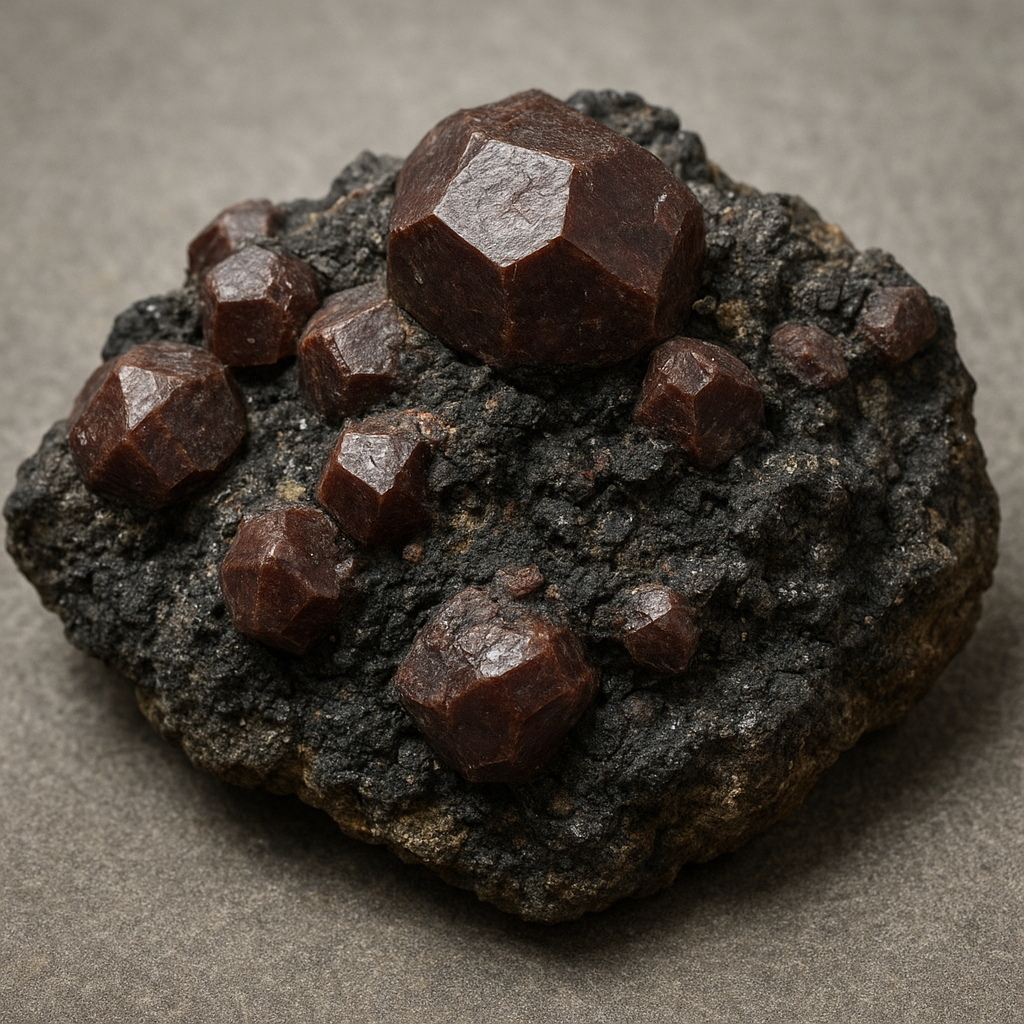
Yttrium Iron Garnet is a remarkable synthetic material that has shaped many areas of magnetics, photonics, and microwave engineering. Known for its unusual combination of magnetic, optical, and low-loss properties, YIG appears repeatedly in both fundamental experiments and practical devices. This article explores what YIG is, where it is found or fabricated, how it is used across disciplines, and some of the most interesting research directions that surround it.
What is Yttrium Iron Garnet?
The compound commonly called Yttrium Iron Garnet has the chemical formula Y3Fe5O12. It belongs to the garnet family of oxides and crystallizes in a cubic structure where the iron and yttrium occupy distinct crystallographic sites. YIG is a ferrimagnetic insulator: the iron sublattices are magnetically ordered but their moments do not completely cancel, producing a net magnetization. Two defining attributes of YIG are its extremely low-damping of magnetization dynamics and a very narrow ferromagnetic resonance line width. These properties make YIG unprecedentedly efficient for coherent magnetic excitations.
Crystal and Magnetic Structure
The garnet structure of YIG comprises tetrahedral and octahedral iron sites, plus dodecahedral sites occupied by yttrium. Magnetic moments on different iron sites align antiparallel, resulting in a net moment typical of ferrimagnetic materials. The cubic symmetry and well-defined anisotropies contribute to reproducible magnetostatic modes in spheres, films, and patterned elements.
Optical and Magneto-Optical Features
YIG is optically transparent in large parts of the visible and near-infrared spectrum, while also exhibiting strong magneto-optical effects such as the Faraday rotation. That combination allows YIG to be used simultaneously as a magnetic medium and an optical component, enabling devices where light and spin dynamics interact.
Occurrence and Fabrication Methods
Natural occurrences of pure YIG are essentially nonexistent—YIG is primarily a man-made material grown in laboratories and industry. The practicality of YIG arises from well-established growth and processing techniques that yield high-quality single crystals, spheres, and thin films. Below are the main fabrication routes and contextual details about substrates and doping.
Bulk Single Crystals and Spheres
- Bulk YIG crystals and precision spheres for microwave research are often produced by high-temperature melt growth techniques, including the Czochralski method and flux growth.
- High-quality spheres exhibit exceptionally narrow ferromagnetic resonance and are commonly used in fundamental magnetodynamics experiments and microwave resonators.
Thin Films and Epitaxial Growth
Modern applications require thin films of YIG, sometimes only a few tens of nanometers thick. The dominant industrial and research technique for producing high-quality epitaxial films is liquid phase epitaxy (LPE). LPE-grown films on lattice-matched substrates can preserve the low-damping characteristics of bulk YIG.
- Other deposition methods include pulsed laser deposition (PLD), sputtering (RF and magnetron), and molecular beam epitaxy (MBE). Each method has advantages: PLD and sputtering enable thinner films and patterning, while LPE often yields the lowest magnetic losses for slightly thicker films.
- The most common substrate is gadolinium gallium garnet (GGG), whose lattice constant closely matches YIG and supports epitaxial growth with minimal strain.
Doping and Chemical Variations
YIG can be doped by substituting other rare-earth or transition metal ions for yttrium or iron. Doping tunes magnetic anisotropy, magneto-optical coefficients, and damping. Substitutions open pathways to multifunctional garnets with engineered properties for particular devices.
Applications and Technological Uses
YIG has had a long and evolving list of practical uses. Some applications exploit its magnetic microwave behavior, others its magneto-optical activity, and many contemporary uses arise where these properties intersect with modern fields such as magnonics and spintronics.
Microwave Components and Ferrite Devices
- YIG is widely used in microwave isolators, circulators, phase shifters, and tunable filters because of its field-dependent permeability and low microwave loss.
- YIG spheres and resonators are standard components in cavity experiments, frequency-stable oscillators, and magnetron tuning circuits.
Magneto-Optical Devices
- Exploiting its Faraday rotation, YIG films are foundational in optical isolators and circulators for fiber-optic systems and laser setups.
- Magneto-optical modulators and sensors also utilize YIG’s ability to modulate light polarization with magnetic fields.
Magnonics, Spin Waves, and Spintronics
One of the most dynamic application areas is magnonics, the field that seeks to use spin waves (collective excitations of the magnetic order) to carry and process information. YIG’s low-damping enables spin waves to travel long distances with low loss, a property exploited in magnonic waveguides, logic elements, delay lines, and magnon interferometers.
- Spin pumping and the inverse spin Hall effect are often studied with YIG in bilayers with heavy metals. These experiments underpin developments in spin-current generation and detection.
- Patterned YIG structures—stripes, disks, antidot lattices—create magnonic crystals that manipulate spin-wave dispersion for selective filtering or waveguiding.
Quantum and Hybrid Systems
YIG plays a central role in emerging hybrid quantum systems. Coupling YIG resonators to microwave cavities, superconducting qubits, or optical resonators enables study of strong light-matter and magnon-photon interactions. The field of cavity magnonics explores coherent exchange between magnons and microwave photons, reaching regimes where quantum coherence and entanglement become relevant.
- Hybrid devices are investigated for quantum transduction—converting quantum information between microwave and optical domains—using YIG as a mediating magnetic medium.
- Experiments have demonstrated magnon-polaritons, coherent coupling with superconducting circuits, and prospects for magnon-based quantum memories.
Interesting Phenomena and Research Frontiers
Beyond established applications, YIG has inspired new science. Its near-ideal properties make it a model system for studying coherent magnetization dynamics, nonlinear spin-wave phenomena, and thermally driven spin currents.
Nonlinear Dynamics and Magnon Condensation
Under intense microwave driving, magnons in YIG can exhibit nonlinear behavior, including parametric amplification and Bose–Einstein–like condensation of magnons. These effects provide a laboratory for studying nonequilibrium many-body physics in a controllable solid-state system.
Topological Magnonics and Nonreciprocity
Recent work explores topologically protected spin-wave modes and nonreciprocal propagation in YIG-based structures. By careful patterning or combining YIG with other magnetic textures, researchers can realize edge-localized magnon modes immune to scattering—an avenue toward robust magnonic circuits.
Spin Caloritronics and Thermal Effects
YIG is central to spin caloritronics: the interplay of heat and spin transport. The spin Seebeck effect, where a temperature gradient in YIG generates a spin current, has been widely studied and suggests opportunities for thermal energy harvesting and temperature-sensitive spintronic sensors.
Integration Challenges and Material Engineering
Despite many strengths, integrating YIG into standard semiconductor or photonic platforms poses materials challenges. Achieving ultrathin films (<20 nm) with the same low damping as bulk often proves difficult. Strain, defects, and interfacial chemistry with substrates or adjacent metals can degrade magnetic quality. Addressing these issues demands improved deposition processes, interface control, and compatible substrate engineering.
Practical Considerations and Typical Device Designs
Designers working with YIG must balance thickness, crystalline quality, and patterning requirements. Choices depend on whether the priority is lowest possible damping (often achieved in thicker LPE films) or nanoscale integration (requiring sputtered or PLD films). Typical design elements include:
- Using GGG substrates to minimize lattice mismatch and reduce dislocations.
- Choosing sphere resonators for laboratory microwave measurements where mode cleanliness and ultra-low loss are essential.
- Layer stacks that include heavy metals (Pt, Ta) to detect spin currents via the inverse spin Hall effect or to exert spin-orbit torques for magnetization control.
Metrology and Characterization
Key characterization techniques for YIG are ferromagnetic resonance (FMR) to quantify linewidth and damping, Brillouin light scattering (BLS) to map spin-wave spectra, and magneto-optical Kerr or Faraday measurements to probe magnetization and magneto-optical coefficients. Electron microscopy and x-ray diffraction verify crystalline quality and interface integrity.
Final Notes on the Broader Impact
Because it blends magnetic, optical, and low-loss microwave properties, YIG occupies a unique niche in modern condensed matter science and engineering. It underpins established microwave components and simultaneously enables bleeding-edge research in magnonics and hybrid quantum systems. Continued improvements in thin-film fabrication and interface control are likely to broaden YIG’s role in integrated photonic and spintronic technologies, and the material will remain a testbed for fundamental discoveries about coherent spin dynamics and light-matter interaction.