
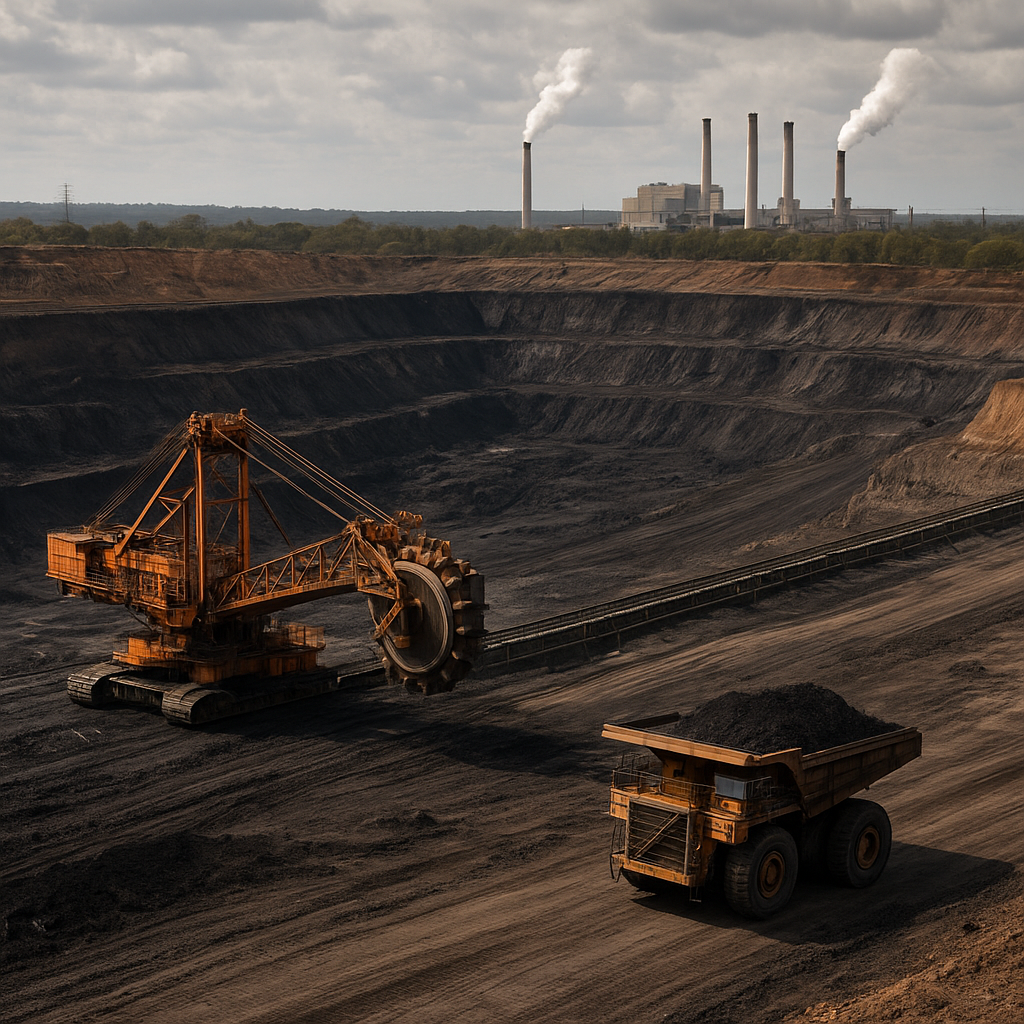
The Yallourn mine, located in the heart of Victoria’s Latrobe Valley, is one of Australia’s most prominent sources of brown coal. For decades it has been central to regional industry, providing the fuel that powered a string of nearby thermal power stations and shaping the economic and social life of the surrounding communities. This article examines where the mine sits geographically, what is extracted there, its economic importance, and several notable and sometimes surprising aspects of its history, operations and future prospects.
Location and geological setting
The Yallourn site sits in southeastern Australia within the Latrobe Valley of the state of Victoria. The Latrobe Valley itself is a broad, low-lying plain east of Melbourne, carved by ancient rivers and underlain by significant deposits of soft brown coal — technically known as lignite. These coal seams formed during the Tertiary period when the region was covered by peat-forming wetlands and forests. Over millions of years, with burial and compaction, these peat layers became the extensive lignite seams that are now mined.
Geographical context
From a practical standpoint, Yallourn is easily identified by the large open-cut pits and the adjacent thermal generation complex that historically depended on a steady coal supply. The mine is located inland enough to avoid coastal saltwater intrusion but close enough to transmission lines and industrial customers to make on-site power production economical. Because brown coal has a high moisture content and relatively low energy density compared with black coals, it tends to be used close to its source; this geography explains why the Latrobe Valley evolved into a concentrated area of coal extraction and power generation.
Geology and coal characteristics
The coal extracted at Yallourn is characteristically soft, dark brown to black, and contains significant moisture — sometimes more than half its weight. This low calorific value requires high throughput in the power stations and special handling systems in the mine. As a result, the mining and processing facilities at Yallourn are designed to move huge volumes of material rather than small quantities of very high-grade coal. The nature of the deposit has influenced the mine’s layout, the design of conveyor networks, and the techniques used for land rehabilitation once areas are mined out.
Mining operations and the product
Yallourn operates as an open-cut or surface mine. Rather than underground tunnels, miners remove overburden and then extract broad swathes of lignite using heavy earthmoving equipment. The mining operation emphasizes continuous high-volume extraction to feed the nearby thermal facility’s steady demand for fuel.
Extraction and handling
- The mine uses large-scale excavators, draglines and conveyor belts to move material from pit to power station.
- Because of the high moisture content, coal is often dried and dewatered as part of handling before combustion.
- On-site processing is minimal compared with black coal mines — the primary product is fuel for local electricity generation.
Yallourn’s coal is not widely exported due to its bulk and poor suitability for long-range transport. Instead, it has been a reliable direct feedstock for thermal power generation. The close physical integration between mine and power station reduces logistics costs and allows the station to operate with predictable fuel supply.
Supporting infrastructure
To function efficiently, the mine is linked to a constellation of infrastructure: long conveyors, rail or road access for equipment and personnel, offices and workshops, and water and ash management systems. The connected power station uses the coal hydraulically or mechanically fed into boilers where it is burned to generate steam, which then drives turbines to produce electricity. This direct, integrated model has made Yallourn a hub of industrial activity in the region.
Economic significance
The economic role of the Yallourn mine extends beyond the tonnes of coal it produces. It has been a major employer in the Latrobe Valley, supporting miners, plant operators, engineers, transport workers, and a wide range of service industries. The mine’s presence underpins local businesses, from cafes and shops to accommodation and skilled trades.
Contribution to regional economy
- Employment: The mine and adjacent power facilities have been significant local employers, offering both manual and professional roles.
- Supply chain: Local contractors provide maintenance, equipment, and services, creating secondary jobs.
- Revenue: Fiscal contributions come through royalties, taxes and local procurement, supporting municipal budgets and public services.
Beyond direct and indirect employment, the mine has contributed to Victoria’s broader energy security. For decades, coal from Yallourn provided predictable baseload power that supported industry, households and public services across the state. That reliable supply helped attract manufacturers and contributed to stable electricity prices for long stretches.
Economic transition and challenges
As energy markets evolve, the economic weight of coal mines like Yallourn has become a focal point for policy and investment discussions. With global and national pressure to reduce greenhouse gas emissions, ageing thermal plants face closures and replacement by renewable generation. This raises complex questions about employment, retraining, and the future of local economies that were previously anchored by coal mining.
Local planners and policymakers have been pursuing strategies for a just transition, including redevelopment of industrial land, investment in new industries, and programs to reskill workers. The scale of transformation required is significant but also opens opportunities for innovation, including green hydrogen, advanced manufacturing, and renewable energy projects that leverage existing transmission infrastructure.
Environmental and social impacts
Mining and burning brown coal have substantial environmental footprints. Yallourn’s operations have sparked debate and policy responses around emissions, water use, air quality, and land rehabilitation. Understanding these impacts is essential for assessing the mine’s long-term role and the costs of continuing or winding down operations.
Air emissions and climate impact
Burning lignite produces higher greenhouse gas emissions per unit of electricity than many other fossil fuels because of the coal’s low energy density and high moisture. For this reason, coal-fired generation at Yallourn has been a major contributor to regional and national emissions inventories. Policymakers and industry have therefore focused on emissions reduction pathways, including efficiency improvements, carbon capture trials (where feasible), and eventual replacement with renewables.
Land disturbance and rehabilitation
Open-cut mining necessarily disturbs large areas of land. At Yallourn, extraction is undertaken in stages, and areas that are no longer needed are progressively rehabilitated. Rehabilitation is a legal and practical requirement and can include reshaping the landscape, replacing topsoil, planting native vegetation, and establishing land uses such as grazing or revegetated reserves. The success of rehabilitation programs varies with soil conditions, water availability and ongoing management, and it often takes decades to restore ecological function.
Water management is another environmental challenge. Mining and power generation are water-intensive, and the region must balance industrial water needs with those of agriculture and ecosystems. Ash and waste management also require careful containment to prevent contamination of groundwater and surface waters.
Social and cultural effects
Yallourn’s presence reshaped local communities in tangible ways. The mine prompted the development of worker housing, schools and hospitals and a distinct regional culture tied to coal energy. There is also cultural heritage associated with the land prior to mining, including sites of importance to Indigenous Australians. Negotiation of land use, compensation, and preservation of cultural values remains an ongoing process, informed by community consultation and heritage assessments.
History and some interesting facts
The history of Yallourn is intertwined with the story of Victoria’s electrification and industrial development. The original township of Yallourn was built in the early 20th century as a planned company town to house workers for the state electricity enterprise. Over time, as the mine expanded, parts of the town were relocated and eventually removed — a striking example of how industrial needs can reshape human settlements.
Unique historical notes
- The town of Yallourn was notable for being a model company town with planned amenities — parks, housing and community facilities designed to support the workforce.
- As the mine grew, entire streets and buildings were moved or demolished to make way for excavation — an unusual form of planned displacement driven by resource extraction.
- Yallourn and the wider Latrobe Valley have been the site of pioneering work in converting local coal into electricity at scale, influencing energy policy across Victoria for decades.
Operational anecdotes and scale
The mine’s operational scale is often surprising to people unfamiliar with surface coal operations. Moving millions of tonnes of overburden and lignite annually requires continuous logistics, round-the-clock maintenance, and coordinated equipment fleets. Conveyor belts several kilometres long, large bucket-wheel excavators in some periods, and complex material handling systems are all part of the industrial choreography that keeps the mine and connected power plant running.
Another point of interest is how the physical properties of brown coal shape local engineering solutions. Because lignite is so wet and fragile, it cannot be easily stored in the same way as harder coals; this has led to on-site coal dewatering facilities, covered conveyors and specially designed fuel handling systems.
Future prospects
The future of Yallourn is tied to national energy policy, market economics and environmental objectives. As Australia moves toward lower emissions, long-established patterns of coal mining and coal-fired power generation are changing. Some likely trajectories include phased closure of existing thermal units, site rehabilitation and repurposing, and leveraging existing industrial land and transmission infrastructure for new clean energy projects, such as large-scale solar, battery storage, or hydrogen production.
Opportunities and challenges
- Site reuse: The mine and power site could be attractive for renewable projects or industrial precincts that benefit from existing grid connections.
- Employment transition: Re-skilling programs are needed to move workers into emerging industries and services.
- Community planning: Long-term planning must address housing, health, and social needs as the regional economy evolves.
While the decline of coal presents economic and social challenges for the Latrobe Valley, it also creates room for innovation and reinvestment. The region’s industrial heritage, skilled workforce and strategic infrastructure are assets that can support a diversified, lower-carbon future.
Concluding observations
Yallourn exemplifies the complex relationship between natural resources, regional development and technological systems. It has been a source of power, employment and identity for the Latrobe Valley while also generating environmental and social questions that must be addressed. The mine’s legacy is visible in the landscape and in local communities, and the choices made now — about rehabilitation, economic diversification and energy transition — will determine whether that legacy becomes the foundation for renewal or a reminder of past trade-offs.
Throughout its history, Yallourn has illustrated the practical realities of using lignite as a fuel: proximity matters, volumes, not calorific value, are decisive, and the environmental costs are tangible. As the energy era changes, Yallourn’s story will continue to offer lessons about the balance between immediate economic needs and long-term sustainability, about how communities adapt, and about how infrastructure can be shifted from old purposes to new ones.

