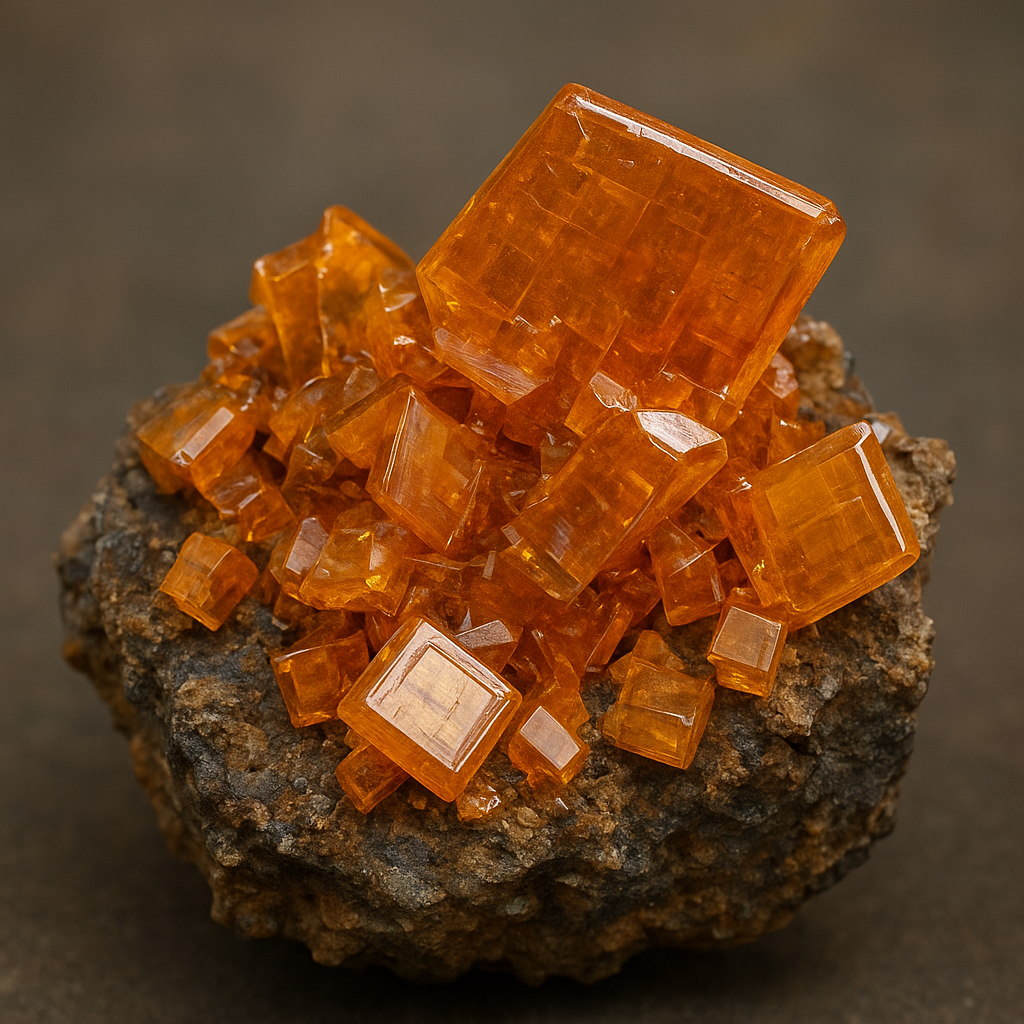
Wulfenite is an eye-catching secondary mineral prized by mineralogists and collectors for its striking colors and thin, tabular crystals. As a member of the molybdate family, it links the chemistry of lead deposits with the geochemical mobility of molybdenum. This article explores the mineral’s chemistry, formation environments, notable occurrences, practical and scientific uses, and aspects of care and identification that every enthusiast should know.
Composition, Structure and Physical Properties
The chemical formula of wulfenite is PbMoO4, commonly described as lead molybdate. Its crystal system is tetragonal, which often produces thin, plate-like or tabular forms. These plates can be simple squares, short prisms, or pyramidal and are typically only a few millimeters to several centimeters across.
Key physical properties include:
- Mohs hardness: about 2.5–3 — which makes the mineral quite soft and easily scratched.
- Specific gravity: relatively high (often between 6.5 and 7.1) because of the lead content.
- Luster: adamantine to resinous, creating brilliant reflections on well-formed faces.
- Transparency: ranges from transparent to opaque.
- Color: commonly bright orange, yellow, amber, red, brown, gray, or even colorless; subtle color zoning is often visible in thin crystals.
Because of its composition, wulfenite is brittle and frequently occurs as thin, delicate plates that can chip easily. Cleavage is not typically perfect but crystals can break along planar directions, so careful handling is essential. Many specimens also show minor fluorescence under UV light, a trait that adds to their appeal for collectors and for laboratory study.
Formation and Geological Settings
Wulfenite forms in the oxidized zones of hydrothermal lead-bearing deposits. The primary lead sulfide in such deposits is galena (PbS). When galena and other sulfides are exposed to oxygenated groundwater and weathering, oxidation reactions liberate lead ions into solution. If molybdenum is present — either from the oxidation of molybdenite (MoS2) or from molybdenum-bearing fluids — the resulting molybdate anions can combine with lead to form wulfenite.
Typical paragenesis
- Oxidation of sulfide minerals (galena, molybdenite) in the presence of oxygen-rich groundwater.
- Precipitation in cavities, vugs, fractures and porous zones where conditions favor the stability of molybdate minerals.
- Association with other secondary minerals such as cerussite (lead carbonate), anglesite (lead sulfate), vanadinite (lead vanadate), limonite (iron oxides), and various carbonates and sulfates.
Climate and local geochemistry influence wulfenite formation: arid to semi-arid climates often promote preservation of brightly colored, well-crystallized specimens because limited weathering reduces alteration; however, local redox conditions and the availability of molybdenum sources are the decisive factors.
Distribution: Where Wulfenite Occurs
Wulfenite has a global distribution but is relatively rare as an abundant ore mineral. It is most often encountered as attractive crystalline specimens in old, oxidized lead mines rather than as a major component of modern industrial deposits.
Notable localities
- Bleiberg, Carinthia, Austria — historically significant and often cited as the type locality; early descriptions of wulfenite came from the Austrian lead mines.
- Red Cloud Mine, Arizona, USA — famous for brilliant orange-red tabular crystals that are highly sought after by collectors.
- Los Lamentos, Chihuahua, Mexico — celebrated for intense red and orange crystals on matrix, often with excellent form.
- Tsumeb Mine, Namibia — produced a wide variety of mineral species, including rare color variants and superb crystal habits of wulfenite.
- Mibladen, Morocco — important source of well-formed yellow to orange wulfenite, frequently reaching fine sizes.
- Other occurrences: various lead districts in Europe, North Africa, Mexico and the southwestern United States produce fine specimens; historic mines across South America and Australia have yielded notable crystals.
Collectors prize locality information because the value of a specimen depends heavily on provenance: certain mines are renowned for particular colors, crystal sizes, or associated minerals.
Uses and Economic Importance
Wulfenite is not a primary ore of molybdenum or lead in modern industrial practice because it rarely occurs in sufficient abundance to be economically mined for these elements. In most deposits, molybdenum occurs in other phases (e.g., molybdenite) that are much more important for extraction.
Nevertheless, wulfenite has several categories of use and importance:
- Collectors and gem cutting — The dominant “use” of wulfenite is as a mineral specimen. High-quality, aesthetic crystals command strong prices in the collector market. Due to its softness and fragility, gem use is limited but faceted and cabochon stones are occasionally produced from exceptional clear pieces.
- Scientific and educational — Wulfenite serves as an instructive example in mineralogy and geochemistry classes for secondary mineral formation, paragenesis in oxidation zones, and crystal habit studies. It also provides insights into the mobility of molybdenum in near-surface environments.
- Research material — Synthetic lead molybdate and natural wulfenite attract attention in materials science research for their optical and luminescent properties. Researchers study doped PbMoO4 compounds for photoluminescence, scintillation, and other electronic or optical behaviors, although most of these applications use synthetic analogues rather than natural specimens.
- Historical curiosity — Some historic mines produced wulfenite in quantities that drew attention to their molybdenum content, but by the time molybdenum became a major industrial metal, more suitable ores were known and wulfenite remained primarily a collector’s mineral.
Collecting, Care and Identification
Because wulfenite is soft, brittle, and often mounted on delicate matrices, collectors must practice careful handling and storage. Proper care preserves the color and sharpness that give wulfenite its appeal.
Handling and storage tips
- Store specimens individually padded in soft foam or tissue to prevent chipping.
- Avoid exposure to humid or chemically reactive environments; some wulfenite can alter when exposed to acids or to prolonged moisture.
- Do not clean wulfenite in ultrasonic baths — mechanical vibration can fracture thin crystals.
- Use gentle brushing and distilled water for light cleaning; never use strong acids or alkaline solutions that can attack the surface.
- Label specimens with locality and date of acquisition: provenance affects scientific and commercial value.
Identification pointers
- Look for thin, tabular, often square plates with bright luster and vivid colors; these habits are highly indicative of wulfenite.
- Test hardness cautiously: wulfenite is soft enough to be scratched by a copper coin or fingernail pressure (careful).
- High specific gravity due to lead content helps distinguish it from look-alike minerals.
- Associated minerals commonly found in the same vugs — such as cerussite, anglesite, and vanadinite — support identification in field specimens.
- Under UV light some specimens show characteristic fluorescence, but this is variable and not definitive on its own.
Famous Specimens, Market and Value Determinants
The market for wulfenite is driven by the same basic quality factors as other collector minerals: color intensity, crystal form and perfection, size, clarity, and provenance. Red and deep orange crystals with sharp edges and minimal matrix can fetch high prices. Small mounds of gemmy crystals from classic localities often appear in mineral shows and auctions, and their value can escalate quickly.
Because wulfenite crystals are often thin, larger intact specimens are rarer and more desirable. Unusual habits — such as complex stepped growth, contacts between crystals, or attractive contrasts with matrix minerals — further enhance value. Modern collecting ethics emphasize documented provenance and responsible acquisition from legal sources; reputable dealers provide certificates or locality data when available.
Scientific Interest and Current Research Directions
Beyond aesthetic appeal, wulfenite is of interest in geochemical and materials research. Studies examine:
- The mobility and partitioning of molybdenum in oxidizing environments, which has implications for ore genesis, environmental monitoring, and remobilization of trace elements.
- Crystallographic structure and substitution mechanisms — for instance, how other cations may substitute into the PbMoO4 lattice and affect optical or electronic properties.
- Photoluminescence and spectroscopic behavior of lead molybdate, especially in synthetic forms where controlled doping can produce useful optical responses for sensors or scintillators.
Although natural wulfenite itself is not commonly employed in industrial devices, its chemical analogue and synthetic derivatives are valuable for research into luminescent materials and for fundamental studies in solid-state chemistry.
Interesting Facts and Historical Notes
- Wulfenite is named after the Austrian mineralogist Franz Xaver von Wulfen. Early records and the naming history tie the mineral to European mining districts where it was first described.
- Despite being a lead-bearing mineral, wulfenite’s contribution to lead production has historically been minor compared with primary ores like galena.
- Some localities are known for their uniquely colored specimens: intense red wulfenite is particularly prized and is often associated with specific geological conditions and geochemical signatures.
- Collectors prize the balance between fragility and brilliance: the very thinness of many crystals produces exceptional light transmission and luster, but it also makes cutting and mounting difficult.
Associated Minerals and Paragenetic Relationships
Typical mineral associations help place wulfenite within the paragenetic sequence of oxidized lead deposits. Common associates include:
- Cerussite (lead carbonate) — formed by carbonation of lead-bearing solutions.
- Anglesite (lead sulfate) — often forms in proximity to wulfenite in oxidation zones.
- Vanadinite (lead vanadate) — another colorful lead mineral sometimes found with wulfenite, particularly in arid deposits.
- Limonite and other iron oxides — common gangue minerals in near-surface oxidation zones.
- Residual molybdenum phases, including altered molybdenite, which may be the ultimate source of molybdate.
The intimate relationships among these minerals record the evolving chemistry of the deposit during weathering and near-surface alteration: shifts in pH, redox state, and available anions determine whether lead precipitates as carbonate, sulfate, vanadate or molybdate.
Final Notes on Appreciation and Study
Wulfenite remains one of the more visually arresting minerals from oxidized lead deposits. For scientists, the mineral offers a window into the geochemical behavior of molybdenum and lead under near-surface conditions. For collectors, a fine wulfenite crystal is both a scientific specimen and a work of natural art. Whether encountered in a museum case, a field pocket, or a research laboratory, wulfenite’s bright plates continue to attract interest for their beauty and their ability to tell a story about the geological processes that concentrate and transform elements in the Earth’s crust.