The following article explores the fascinating mineral known as wulfenite, tracing its geological origins, physical and chemical characteristics, practical applications, cultural significance, and the scientific and collecting communities that surround it. Rich in color and crystalline habit, this mineral has attracted attention not only from miners and geologists but also from jewelers and collectors worldwide. In the sections that follow you will find descriptions of where wulfenite is found, how to identify and preserve it, its uses and limitations, and interesting anecdotes from notable localities.
Geological occurrence and notable localities
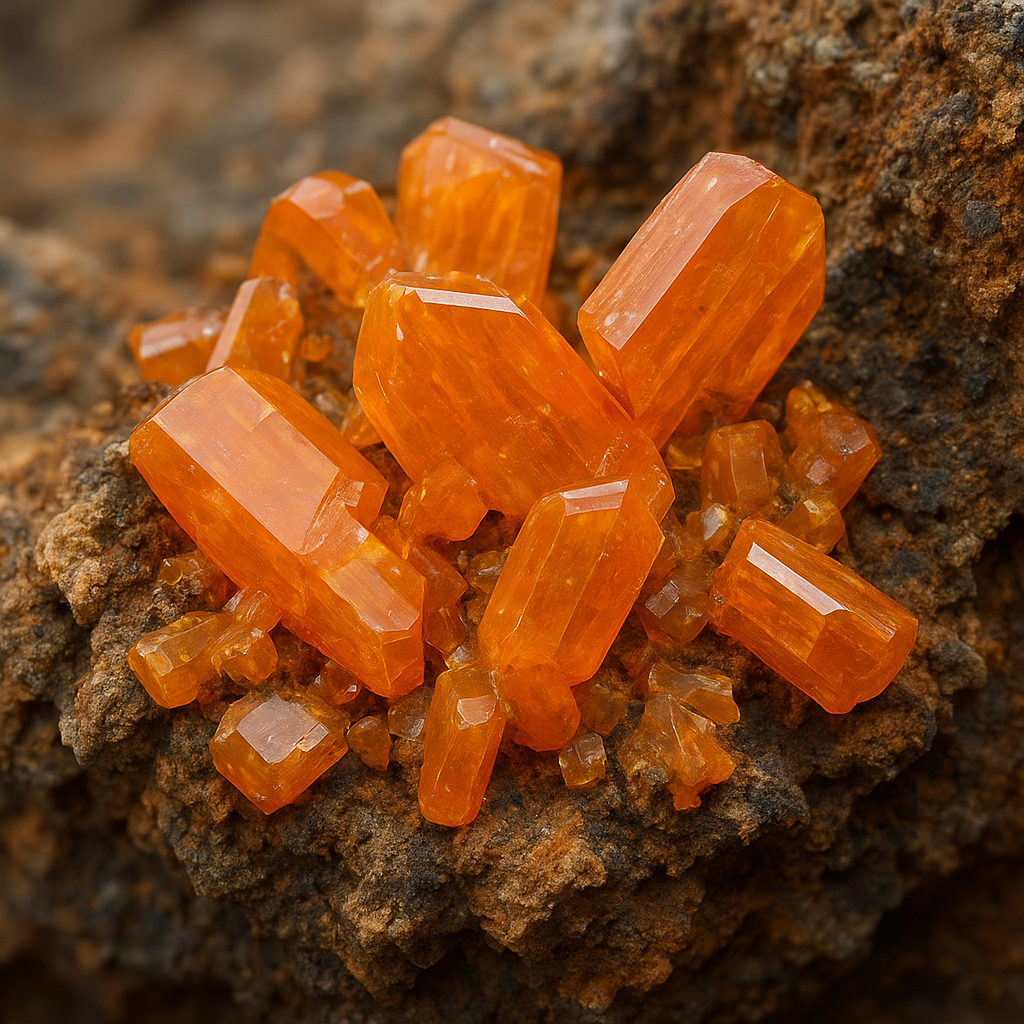
Wulfenite is a secondary mineral that typically forms in the oxidized zones of lead-bearing hydrothermal deposits. Its chemical formula is PbMoO4, representing a combination of lead and molybdate ions that crystallize in the tetragonal system. The mineral is most often encountered as thin tabular crystals or as powdery crusts, and its colors range from vivid orange and yellow to brown, red, and even colorless or white variations. The classic, highly sought-after orange-red crystals are commonly associated with arid or semi-arid climates where oxidation and supergene enrichment create the conditions needed for wulfenite to develop.
Important localities for collectors and researchers include:
- Mina Los Lamentos, Chihuahua, Mexico — renowned for large, brilliant orange crystals.
- Tsumeb, Namibia — historic mine producing an array of rare mineral associations and exceptional specimens.
- Mina Red Cloud, Arizona, USA — classic locality for flat, red-orange crystals.
- Mina Mibladen, Morocco — known for yellow to orange wulfenite and associated vanadates and arsenates.
- Various European occurrences including Austria, Slovenia, and the Czech Republic — historically significant finds in old lead mines.
Wulfenite often occurs alongside other secondary minerals such as cerussite, smithsonite, vanadinite, and mimetite. The mineral habit and crystal size are strongly influenced by the chemistry of the host rock and the local geochemical environment during oxidation. In some deposits, thick, gemmy crystals form in cavities, while in others only crusts or microscopic grains are present.
Chemistry, crystal structure, and physical properties
The formula PbMoO4 indicates that wulfenite contains lead (Pb) and molybdenum (Mo) in a molybdate anion (MoO4) arrangement. It crystallizes in the tetragonal system, typically forming tabular, plate-like crystals that may be extremely thin. The crystallographic symmetry and strong cleavage tendencies are responsible for its characteristic blade- or plate-like shapes. Key physical properties include:
- Color: commonly orange, yellow, red, brown, or colorless; color intensity depends on trace elements and exposure to weathering.
- Luster: adamantine to resinous on fresh crystal faces.
- Hardness: relatively soft, typically around 2.5–3 on the Mohs scale, making it fragile and unsuitable for heavy wear in jewelry.
- Density: high because of lead content, usually around 6.5–7.1 g/cm³.
- Cleavage: distinct in one direction, contributing to its tendency to form thin, flat plates.
Trace elements and structural defects can influence optical behavior; some specimens display interesting pleochroism or changes in transparency. Fluorescence is not typical for wulfenite itself, but associations with fluorescent minerals in the same specimen can create striking display combinations under ultraviolet light.
Formation processes and environmental context
Wulfenite forms through a series of geochemical steps in the oxidation zone above sulfide-rich ore bodies. When primary sulfide minerals such as galena (lead sulfide) are exposed to oxygenated waters, lead is mobilized and can combine with molybdate ions derived from the breakdown or hydrothermal alteration of molybdenum-bearing minerals. The precipitation of molybdate under favorable pH and redox conditions leads to the crystallization of wulfenite.
Because the formation environment favors oxidation near the Earth’s surface, wulfenite is commonly associated with weathered mine dumps and secondary mineral layers. The presence of molybdenum at appreciable concentrations is less common than lead, which explains why wulfenite is rarer than purely lead-based secondary minerals. Hydrothermal fluids, groundwater chemistry, host rock permeability, and climatic conditions (dry climates slow dissolution and promote preservation) all impact the development of gemmy crystals versus powdery coatings.
Uses and economic relevance
Although wulfenite contains molybdenum and lead, it is rarely used as a major ore of either element on an industrial scale. There are several reasons for this:
- Wulfenite typically occurs in small quantities and often as thin, aesthetically valuable crystals rather than massive, easily processed ore.
- The mineral’s softness and brittleness complicate extraction and processing for metal recovery.
- Molybdenum and lead are more commonly extracted from other, more abundant minerals such as molybdenite (MoS2) for molybdenum and galena (PbS) for lead.
Nevertheless, wulfenite has niche applications and values:
- Mineral collecting: The most significant economic role is as a collector’s mineral. Fine, gemmy crystals fetch high prices at auctions and in mineral markets.
- Educational specimens: Museums and universities value wulfenite for teaching about supergene mineralization and lead-molybdate chemistry.
- Decorative and lapidary use: In rare cases, stable fragments are used in jewelry or as cabochons, though such pieces require protective settings due to the mineral’s fragility.
Because of its rarity in large, mineable quantities, wulfenite is not a priority source of molybdenum for industry. Its true market niche remains aesthetic and scientific.
Collecting, care, and conservation
Collectors prize wulfenite for its brilliant colors and well-formed crystals. To preserve the value and integrity of specimens, careful handling and storage are essential. Guidance for collectors includes:
- Handle specimens gently: crystals are brittle and can chip or break if dropped or bumped.
- Avoid water and chemical cleaners: wulfenite can be sensitive to acids and prolonged moisture, which can alter surface luster or cause damage.
- Store away from direct sunlight: intense, prolonged sunlight can fade colors in many minerals.
- Use padded mounts: support plates and thin crystals on soft mounts to reduce mechanical stress.
- Document provenance: locality and mining history affect both scientific interest and market value.
Conservation efforts for important historic localities sometimes involve restricting specimen removal and promoting legal, sustainable collecting practices that keep significant finds in public collections rather than being lost to private sales abroad. Museums often negotiate with mining companies or local authorities to secure representative samples, educational displays, and documentary records of mining heritage.
Identification methods and distinguishing characteristics
Identifying wulfenite requires attention to several diagnostic traits:
- Crystal habit: thin, tabular, tetragonal crystals are a strong clue.
- Color and luster: bright orange-red to yellow with adamantine luster is characteristic, though not definitive alone.
- Hardness: soft (Mohs 2.5–3); a scratch test can distinguish it from harder orange minerals like topaz or garnet.
- Specific gravity: relatively high due to lead content; hefting a specimen can provide preliminary information.
- Associations: presence with other lead secondary minerals such as cerussite supports identification.
For conclusive identification, professional laboratories use methods such as X-ray diffraction (XRD), scanning electron microscopy (SEM), and energy-dispersive X-ray spectroscopy (EDS) to determine crystal structure and composition. Raman spectroscopy and infrared methods can also identify the characteristic molybdate groups in the mineral.
Historical notes and cultural interest
The mineral was named after Franz Xavier von Wulfen, an 18th-century Austrian mineralogist, and its discovery and early study were tied to the development of modern mineralogy. Historic collections from European mines contributed to the early understanding of the mineral’s crystallography and associations. Over the centuries, wulfenite has been admired by collectors and scientists alike for its delicate beauty and the insights it offers into oxidation and secondary mineral formation processes.
Culturally, striking specimens have been displayed in museums as accents in mineralogy exhibits. High-profile auction sales and exhibitions of exceptional crystals have helped cement wulfenite’s reputation among collectors. The bright orange and red crystals are often used in photographs and publications to illustrate secondary mineral paragenesis and the interplay between chemistry and environment in the formation of minerals.
Scientific research and modern interest
Contemporary research on wulfenite focuses on several fronts:
- Understanding supergene geochemistry: studies of wulfenite formation help clarify how elements like molybdenum and lead behave during weathering and groundwater transport.
- Crystal growth mechanisms: laboratory and field observations of growth habits elucidate how environmental parameters control morphology.
- Materials science curiosity: while not a major industrial mineral, the unique electronic and structural properties of molybdate compounds make them of occasional interest in niche research.
Additionally, interdisciplinary studies connect mineral occurrence with mining history, environmental remediation, and museum conservation practices. In regions where old mines are reopened or repurposed, wulfenite-bearing oxidized zones present both opportunities and challenges for responsible resource management and heritage preservation.
Related minerals and comparisons
Wulfenite belongs to a wider family of molybdate and tungstate minerals. Comparative context helps collectors and geologists place it among similar species:
- Mimetite and vanadinite: both are lead-based secondary minerals that can occur in similar environments; their chemistry differs (arsenate or vanadate groups) and their crystal habits and colors provide distinguishing clues.
- Powellite (CaMoO4): a calcium molybdate with similar structural motifs but different chemistry and physical properties.
- Molybdenite (MoS2): the primary ore of molybdenum, with very different appearance (metallic, flaky) and industrial importance.
Such comparisons guide identification and indicate potential paragenetic relationships in ore deposits.
Health, safety, and environmental aspects
Because wulfenite contains lead, handling large quantities of raw material or processing ore without appropriate controls could pose health risks. For typical collectors who keep individual specimens, the risks are minimal with sensible precautions such as washing hands after handling and avoiding ingestion or inhalation of dust. In mine reclamation and environmental remediation contexts, lead- and molybdenum-bearing wastes require proper assessment to prevent contamination of soils and water.
Regulatory frameworks in many countries set guidelines for sampling, transport, and sale of lead-bearing minerals. Museums and educational institutions that display wulfenite follow conservation and safety standards to protect staff and the public while preserving specimens for research and education.
Interesting anecdotes and notable finds
Collectors and historians recount several striking stories that highlight the allure of wulfenite. For example, a single cavity in a Mexican deposit produced dozens of gemmy, palm-sized orange crystals that later became centerpieces for private and museum collections around the world. In other cases, old mine dumps yielded unexpected specimens decades after closure, reminding the mineral community that historic sites can still reveal surprises.
Field reports often emphasize the excitement of spotting a flash of bright orange on a weathered rock face or in tailings — an emotive reminder of why mineral collecting continues to captivate enthusiasts. Scientific expeditions to classic localities sometimes combine geological mapping with community outreach to document both geological and cultural dimensions of mineral sites.
Practical tips for enthusiasts
If you are interested in acquiring or studying wulfenite, consider these practical tips:
- Research locality and provenance; specimens with clear locality data are more valuable scientifically and monetarily.
- Prioritize well-formed crystals with intact faces over damaged plates for long-term value.
- Join local mineral clubs or online forums to learn about ethical collecting practices and legal restrictions.
- Visit museum collections and exhibitions to compare top-quality specimens and learn identification skills from experts.
Whether you approach wulfenite as a scientific curiosity, aesthetic object, or both, the mineral rewards attention with striking examples of nature’s ability to combine chemistry and crystallography into objects of enduring fascination.