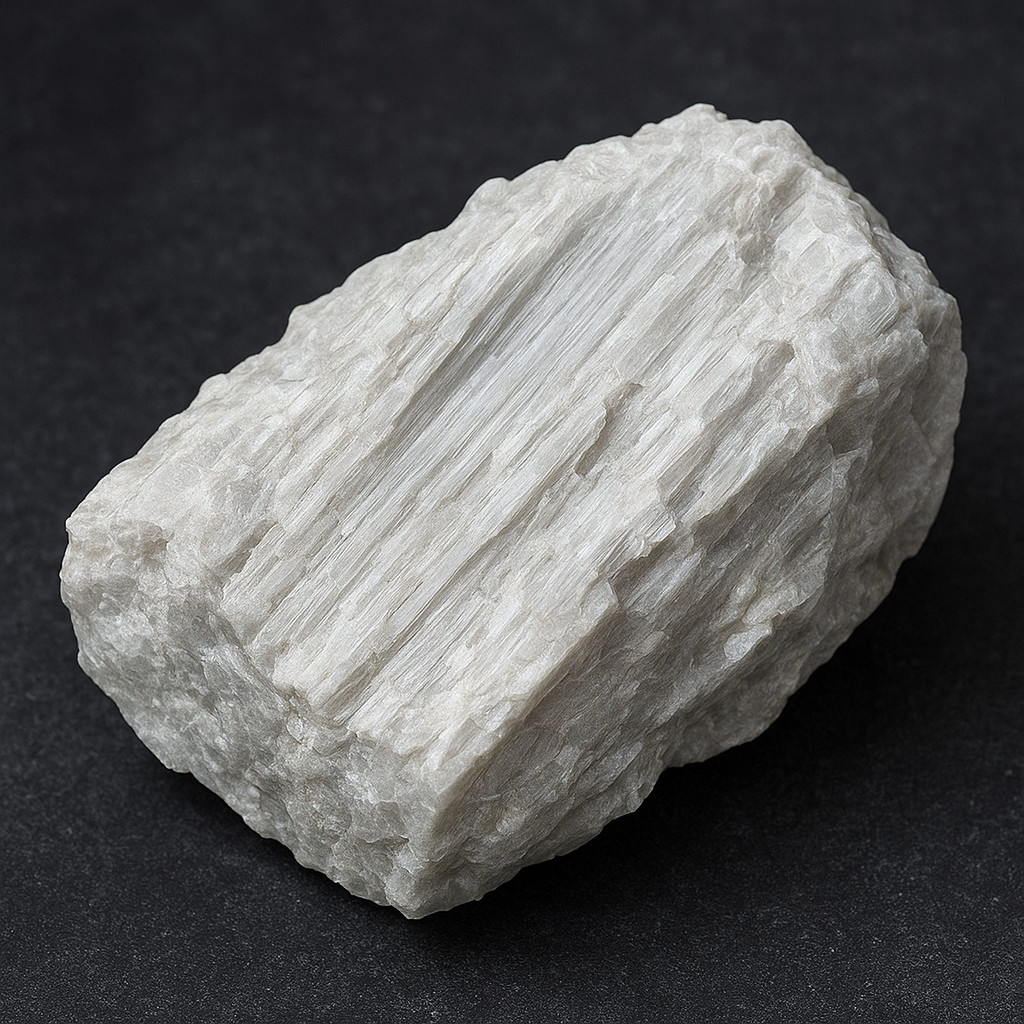
Wollastonite is a naturally occurring calcium inosilicate mineral with the nominal chemical formula CaSiO3. Its distinctive needle-like crystal habit, broad range of physical and chemical properties, and compatibility with many industrial processes make it an important raw material across multiple sectors. This article explores where wollastonite is found, what makes it useful, how it is processed and applied, and some of the more intriguing scientific and commercial developments connected to this versatile mineral.
Geology and Global Occurrence
Wollastonite forms primarily through contact metamorphism of carbonate rocks (limestones and dolomites) in the presence of silica-bearing fluids or through metasomatic processes where silica is introduced into a calcium-rich protolith. Common geological settings include skarns associated with igneous intrusions, low-grade metamorphic environments, and some hydrothermal veins. The mineral often appears with other calcium silicates and accessory minerals such as garnet, epidote, diopside, and calcite.
Typical geological formation processes
- Contact metamorphism: Silica-rich magmatic fluids react with limestone near intrusive bodies, producing wollastonite and other skarn minerals.
- Metasomatism: Chemical replacement of carbonate rocks by silica-bearing fluids under varying temperature-pressure conditions.
- Regional metamorphism and recrystallization: In some cases, pre-existing calcium silicates recrystallize into acicular wollastonite under directed pressure and temperature.
Major wolastonite-bearing deposits are geographically widespread. Notable producing regions and countries include:
- North America: United States (California, New York, Nevada) and Canada (Quebec).
- Latin America: Mexico (notable production), as well as smaller deposits in Brazil and other countries.
- Europe: Italy (historical occurrences), Finland, Sweden, and Turkey.
- Asia: China (large-scale production and processing), India (significant deposits), and Iran.
- Russia and some Central Asian localities.
Each deposit differs in purity, crystal habit (acicular vs. blocky), and associated gangue minerals—all factors that influence the beneficiation and commercial uses of the material.
Physical and Chemical Properties Relevant to Uses
Wollastonite is prized for a combination of properties that make it attractive to industrial formulators. Key attributes include its chemical composition, crystal morphology, thermal behavior, mechanical hardness, and chemical inertness.
Chemical and structural characteristics
- Chemical formula: CaSiO3 (calcium silicate) — the presence of calcium and silicate is central to many of its applications.
- Polymorphism: Wollastonite can occur in different structural forms depending on thermal history; thermal treatments can alter crystalline ordering.
Physical properties
- Crystal habit: Frequently acicular (needle-like), which imparts reinforcement effects in matrices.
- Density: Typically around 2.8–3.1 g/cm3 depending on impurities and porosity.
- Hardness and abrasion resistance: Values adequate to improve wear resistance when used as filler or reinforcement.
- Thermal properties: High thermal stability and low thermal expansion compared to some fillers, helpful in high-temperature ceramics and refractory applications. The thermal conductivity can also assist heat dissipation in certain formulations.
These properties collectively enable wollastonite to act as both a functional filler and a reinforcing phase, improving the mechanical performance and processability of composite systems.
Major Industrial Applications
Wollastonite’s unique combination of chemistry, shape, and thermal stability creates a wide application window. The following sections outline principal industrial uses and the reasons behind their effectiveness.
Ceramics and porcelains
- Low-iron wollastonite is used extensively in ceramics to promote vitrification, reduce firing temperatures, and improve strength and glaze fit. It acts as a flux in glazes and bodies and can substitute for feldspar in some formulations.
- Its high-temperature stability helps control thermal expansion and reduce crazing in ceramic glazes.
Plastics and polymer composites
- As a mineral filler and reinforcement, wollastonite increases stiffness, tensile strength, and dimensional stability in thermoplastics and thermosets. The needle-like morphology provides a pseudo-fiber reinforcement effect without the need for organic fibers.
- Wollastonite is used in PVC, polypropylene, nylon, and other engineering polymers to lower cost, reduce shrinkage, improve heat deflection temperature, and enhance scratch resistance.
- Surface treatments (e.g., silane coupling agents) enhance interfacial bonding with polymer matrices, amplifying mechanical gains.
Paints, coatings, and sealants
- In paints and coatings, wollastonite improves rheology, durability, and mattifying effects. It can impart improved adhesion and resistance to cracking while also acting as a low-dusting extender.
- Its inert nature and chemical stability give long-term color and gloss retention.
Friction products and metallurgy
- Brake pads, clutch facings, and other friction materials use wollastonite to tailor friction coefficients and thermal stability, replacing or supplementing asbestos and other fibers.
- In metallurgy and foundry sands, wollastonite contributes to mold strength and thermal properties, improving casting quality.
Construction materials
- Wollastonite is used in cementitious products, plasterboard, paints for drywall, and specialty concretes. It reduces shrinkage, improves toughness, and enhances fire resistance.
- Its calcareous nature can partially contribute to the cementitious system chemistry when used appropriately.
Specialty uses and advanced materials
- Wollastonite’s acicular crystals are explored in engineered composites, ceramic matrix composites, and as a reinforcement in high-performance polymer systems.
- Research investigates synthetic or thermally modified wollastonite as a precursor for calcium silicate hydrates, CO2 mineralization pathways, and as a support or filler in battery and catalyst applications.
Processing, Grades, and Surface Modifications
Raw wollastonite ore undergoes multiple processing steps to produce grades tailored to specific industries. Typical processing includes crushing, milling, magnetic separation (to remove iron-bearing contaminants), flotation, and classification by particle size and aspect ratio. Particle size and shape distribution are critical quality parameters: finer powders are used in paints and plastics, while coarser acicular grades are preferred for reinforcement.
Commercial grades
- Ceramic-grade: low-iron, controlled particle size, minimal reactive impurities to avoid color changes.
- Industrial/mineral filler-grade: broader tolerance on iron and other impurities, optimized for cost-performance balance.
- High-aspect ratio grades: processed to preserve needle-like crystals for reinforcement applications.
Surface treatments and chemical modification
To improve compatibility with organic matrices, wollastonite particles are often surface-treated with coupling agents (silane, titanate), organic coatings, or polymer grafts. These treatments enhance interfacial bonding, dispersion, and long-term performance in humid or chemically aggressive environments.
Health, Safety, and Regulatory Considerations
Compared to asbestos, wollastonite is a non-amphibole calcium silicate and generally considered to present lower chronic respiratory risks. However, any respirable mineral dust can cause lung irritation and long-term exposure has to be controlled. Industrial hygiene measures and regulations address dust levels, exposure limits, and safe handling.
- Occupational exposure limits: Many jurisdictions set permissible exposure limits for respirable dust, and employers must control airborne concentrations through ventilation, dust suppression, and personal protective equipment.
- Fiber morphology concerns: Needle-like particles can raise concern due to superficial resemblance to asbestos fibers. Distinctions are made by mineralogical analysis (XRD, SEM) and regulatory classifications often treat wollastonite differently from regulated asbestos minerals.
- Product stewardship: Suppliers provide safety data sheets and guidelines for safe use in processing and manufacturing.
Environmental and Sustainability Topics
Wollastonite mining and processing have environmental footprints typical of industrial minerals, including land disturbance and energy use. Initiatives to improve sustainability focus on improved mining practices, efficient beneficiation to reduce waste, and recycling within industrial processes.
Potential for carbon-related applications
One interesting avenue of research involves the use of calcium silicate minerals in carbon capture and storage (CCS) pathways through accelerated mineral carbonation. Wollastonite can react with CO2 to form stable carbonate minerals (e.g., calcite), sequestering CO2 in a mineral form. While not yet a large-scale commercial route for CO2 mitigation, laboratory and pilot projects explore reaction kinetics, energy balances, and integration with industrial flue gas streams.
Life cycle and circularity
- Use of wollastonite as a long-lived filler in durable goods can be seen as a form of embodied material that extends product life and reduces need for more energy-intensive alternatives.
- Research into recycling polymer composites containing mineral fillers includes separation methods and potential reuse of mineral fractions.
Market Dynamics and Economic Factors
The global wollastonite market is influenced by demand in ceramics, plastics, paints, and construction sectors. Price and supply depend on deposit quality, processing capacity, and regional manufacturing trends. China and India are large both in production and consumption, while Mexico and the U.S. are significant producers for North American and international markets.
- Price drivers: ore grade (iron content), particle morphology, and grinding energy required to reach desired fineness.
- Supply chain considerations: proximity to major polymer and paint manufacturers can influence commercial viability due to transportation costs.
- Substitutes: talc, calcium carbonate, kaolin, and other fillers compete with wollastonite but may not replicate its combined reinforcement and thermal properties.
Research Trends and Innovations
Academic and industrial research on wollastonite spans multiple domains. Highlights include tailoring crystal aspect ratios during grinding, synthesizing high-purity wollastonite from industrial by-products, exploring nano-structured calcium silicates, and developing composite architectures that harness wollastonite’s needle-like morphology.
Notable experimental directions
- Biomaterials: Evaluating wollastonite-based ceramics and glasses for bone grafts and tissue scaffolds due to calcium release and biocompatibility in certain formulations.
- Functional coatings: Using wollastonite as a carrier for biocidal or catalytic species in specialty coatings.
- Battery and energy materials: Investigating calcium silicate matrices as supports or precursors in certain energy storage and conversion technologies.
Interesting Historical and Cultural Notes
Wollastonite is named after the English chemist and mineralogist William Hyde Wollaston, who first described the mineral in the early 19th century. Historically, its identification helped broaden understanding of silicate mineral chemistry in metamorphic terrains. Over time it shifted from a geological curiosity to an industrial mineral with broad utility.
Wollastonite
The underline above emphasizes a single-word term that has travelled from early mineralogical literature into the modern lexicon of materials science. Its journey illustrates how a naturally occurring mineral can evolve into a globally traded industrial resource.
Practical Considerations for Industry Users
When selecting wollastonite for a given application, formulators consider several practical factors:
- Purity and iron content: Critical for whiteness and performance in ceramics and paints.
- Aspect ratio and particle size distribution: Determines reinforcement potential and rheological effects.
- Surface treatment availability: Pre-treated grades simplify incorporation into organic matrices.
- Consistency and supply security: Long-term contracts with reliable producers reduce process variability.
- Regulatory compliance: Ensure material safety data and workplace controls align with local regulations.
Concluding Observations
Wollastonite occupies an interesting niche among industrial minerals: chemically simple, geometrically distinctive, and functionally versatile. Whether enhancing the mechanical properties of a polymer composite, improving the glaze behavior of a ceramic body, aiding friction and thermal stability in brake formulations, or participating in experimental carbon sequestration schemes, wollastonite continues to attract attention from engineers and scientists. Ongoing improvements in extraction, processing, surface modification, and application design suggest the mineral will remain relevant as industries seek materials that balance performance, cost, and environmental considerations.