
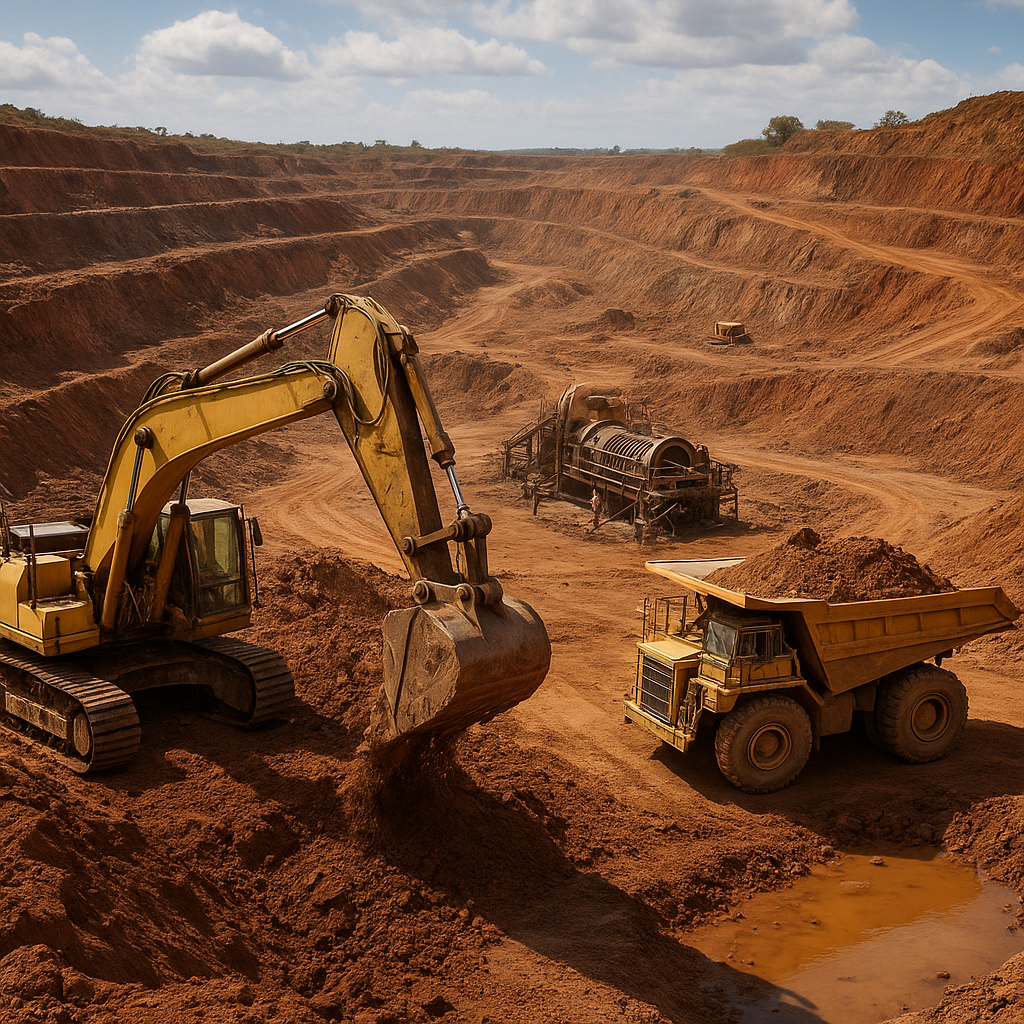
The Williamson mine, commonly known as the Mwadui mine, is one of Africa’s most historically significant and geologically remarkable diamond deposits. Located in northern Tanzania, it has been a focal point for diamond extraction, economic development, and scientific study since its discovery in the early 20th century. This article explores the mine’s location and geology, its history of production and ownership, its economic and social importance to Tanzania and the surrounding region, and a selection of notable and curious facts that together illustrate why the Williamson mine remains an important chapter in the global story of natural resources.
Location and Geological Setting
The Williamson mine is situated near the village of Mwadui in the Shinyanga Region of northern Tanzania, roughly 25 kilometers northwest of the town of Shinyanga and about 640 kilometers west of Dar es Salaam. The mine sits on a prominent geological feature: a volcanic pipe of kimberlitic origin that cuts through the ancient crust of the East African plateau. This formational pipe is the primary host of primary diamondization in the area, which is uncommon in many parts of southern and eastern Africa where alluvial deposits dominate.
Kimberlite Pipe: A Window into Deep Time
The source rock at Mwadui is a classic example of a kimberlite pipe. Kimberlite is an igneous rock that originates deep in the Earth’s mantle and is capable of bringing diamonds to the surface during rapid, explosive eruptions. The Williamson pipe is relatively shallow but broad, creating a mineable body that has allowed extensive underground and open-pit operations. Its preservation in the local geology has provided scientists with samples not only of gem-quality stones but also of mantle xenoliths and minerals that help reconstruct the Earth’s deep processes.
Surface and Subsidiary Deposits
Apart from the kimberlitic core, the region around Mwadui contains secondary concentrations of transported diamonds in lateritic soils and river gravels. Historically, these alluvial finds sometimes guided prospectors to the primary pipe. The mix of primary and secondary deposits has influenced the mining methods used at different times in the mine’s life, alternating between open-pit and underground techniques, and sometimes prompting artisanal extraction in peripheral areas.
History, Discovery, and Production
The story of the Williamson mine begins in 1907 when the British geologist and prospector John Williamson discovered the sparkling stones on the surface at Mwadui. His discovery quickly attracted attention, and he established mining operations that eventually became known as the Williamson Diamond Mine. Over the decades the mine operated under various organizational structures, including private ownership, colonial enterprise, and later partnerships with Tanzanian national interests.
Twentieth-Century Milestones
- 1907: Discovery by John Williamson; initial small-scale extraction and surface recovery.
- 1919–1950s: Expansion of operations, construction of industrial-scale facilities, and establishment of open-pit mining techniques.
- 1940s–1960s: Williamson became one of the world’s more reliable sources of gem-quality diamonds, including several notable large stones.
- 1970s–1990s: Changing political and economic circumstances in Tanzania affected operations; increased state interest and regulatory impact.
Throughout the twentieth century the mine accounted for a significant portion of Tanzania’s diamond output. While production has fluctuated, Williamson contributed a stream of gem-quality and industrial diamonds that found markets in Europe, India, and beyond. The mine’s output was notable not only for quantity but for relatively consistent quality when compared with other African deposits.
Notable Diamonds and Finds
Williamson’s fame is partly due to several exceptional stones recovered there. Large, clear stones suitable for gem cutting appeared at intervals, bringing international attention. Some noteworthy characteristics of Williamson diamonds include a tendency toward high clarity and color grades that made them prized in jewelry markets. Over time, however, most diamonds recovered were small to medium-sized stones used both in the gem and industrial markets.
Ownership, Management, and Modern Operations
Ownership of the Williamson mine has changed multiple times, reflecting broader shifts in Tanzanian resource policy and the global diamond industry. For much of the twentieth century, the operation was controlled by private enterprise under colonial and post-colonial arrangements. Later, the Tanzanian government negotiated varying degrees of participation and control, aiming to secure greater national benefit from mineral resources.
Modern Corporate Structures
In recent decades the mine has been operated under companies that have pursued modern mining methods and rehabilitation plans. These operators have focused on optimizing recovery rates, reducing environmental impact, and improving worker safety. Mechanized extraction and processing, combined with geological mapping and sampling, have allowed sustained production even as the most easily accessible ore was depleted.
Technological and Methodological Advances
Williamson has benefited from technological improvements in diamond recovery and ore sorting. Advances include more efficient crushing and screening technologies, improved X-ray and optical sorting systems, and better tailings management approaches. These improvements aim to maximize recovery while limiting waste and environmental disturbance. At various times, pilot projects have explored secondary recovery of diamonds from tailings, reflecting both economic opportunity and environmental responsibility.
Economic Importance and Community Impact
The economic role of the Williamson mine extends beyond the value of diamonds themselves. As one of the earliest large-scale mines in Tanzania, it has played a part in local employment, infrastructure development, and regional commerce. For many decades the mine provided direct jobs to hundreds of workers and indirect employment to thousands more through supply chains, transport services, and local businesses.
Employment and Skills Development
Beyond direct wage employment, the mine contributed to skills training in geology, heavy equipment operation, and industrial maintenance. Local residents acquired technical competencies that were transferable to other sectors of the Tanzanian economy. The presence of a stable industrial employer in a predominantly rural region also encouraged secondary investment in housing, retail, and education.
Fiscal and National Contribution
Diamonds from Williamson generated export earnings and tax revenues that supported national budgets and local services. Over the years, the Tanzanian government’s evolving policy frameworks sought to capture more of the mineral rent through taxation, royalties, and equity participation in mining ventures. Those policy shifts have at times caused friction with foreign investors but also reflect a broader global trend toward ensuring that resource extraction contributes to national development goals.
Environmental and Social Challenges
Mining at Mwadui has posed environmental challenges typical of long-running extractive projects. Disturbance of land, creation of pits and tailings, changes to local hydrology, and dust and noise pollution have required mitigation efforts. Rehabilitation of mined areas has become a priority in modern operations, with programs to regrade and revegetate disturbed land and to manage water and soil contamination risks.
Community Relations and Social Responsibility
Social impacts have included displacement issues, changes in local livelihoods, and cultural shifts due to in-migration of mine workers and contractors. Mining companies operating at Williamson in recent years have undertaken community engagement programs aimed at improving education, health services, and community infrastructure. Efforts to recruit and train local staff, support local schools, and sponsor community health initiatives represent attempts to align mining benefits with local needs.
Artisanal Mining and Regulation
As with many major mineral deposits, peripheral artisanal mining has occurred around Williamson. Informal miners have sought surface and near-surface stones, sometimes clashing with formal operations and raising safety and regulatory issues. The Tanzanian government and operators have periodically launched efforts to formalize artisanal activity, providing training and licensing pathways to reduce conflict and enhance safety and traceability.
Cultural, Historical, and Scientific Significance
Beyond economics, the Williamson mine holds cultural and historical resonance. It is part of Tanzania’s industrial heritage and a testament to early twentieth-century exploration in East Africa. Museums and exhibitions have occasionally featured Williamson diamonds and artifacts, presenting the mine’s role in global gem markets and colonial history.
Scientific Contributions
Geologists and mineralogists value Williamson for the clarity it provides into kimberlite processes and mantle sourcing. Samples from the pipe have contributed to studies of deep Earth composition and to the classification of kimberlite types. The mine’s samples have also informed our understanding of diamond genesis and the ways in which diamonds are preserved or degraded in shallow crustal environments.
Heritage and Identity
For local communities, the mine is both a source of livelihood and a symbol. The name Mwadui is synonymous with the mine in regional memory, and structures built during early mining eras remain landmarks. When discussing the mine’s legacy, it is important to recognize the dual nature of extractive sites: places of economic possibility and sources of contested social memory.
Interesting Facts and Lesser-Known Details
- Williamson is one of the world’s older continuously known diamond sites, discovered in the early 1900s and producing for over a century.
- The mine is often called Mwadui after the village where the kimberlite pipe was first recognized.
- Williamson diamonds have been used in both jewelry and industrial applications, demonstrating the range of diamond markets from gem to grit.
- Some of the recovery methods at Williamson were innovative for their time, adapting European mining technology to East African conditions.
- The mine has been subject to shifting governance models, reflecting Tanzania’s post-independence efforts to increase local control over natural resources.
- Geologically, Williamson offers rare access to mantle-derived rocks and mineral inclusions that help scientists reconstruct deep Earth processes.
- Local folklore and oral histories include stories of the mine’s discovery and the early years when small stones were traded locally before international markets formed.
Unexpected Legacies
One less obvious legacy of Williamson is its contribution to institutional capacity in Tanzania. The need to regulate, tax, and manage diamond production helped spur the development of mineral ministries, geological surveys, and regulatory frameworks. In this sense, the mine influenced not only local economies but also the architecture of national governance related to natural resources.
Outlook: Challenges and Opportunities
The future of the Williamson mine depends on geological realities, market conditions, and policy choices. As high-grade ore becomes scarcer, operators may invest in deeper and more technical extraction methods, or in reprocessing tailings to capture previously unrecovered stones. Global diamond demand—affected by jewelry trends, synthetic diamonds, and economic cycles—will shape the mine’s viability.
Balancing Economic Gain with Sustainability
To remain relevant and accepted, future operations at Williamson must emphasize sustainability: environmental rehabilitation, fair labor practices, and equitable community benefit-sharing. Integrating modern mineral traceability systems can help ensure diamonds from the mine enter legitimate supply chains, enhancing market value and reducing the risk of illicit trade.
Williamson’s story is multifaceted: a tale of geological fortune, colonial-era entrepreneurship, national policy evolution, and local community adaptation. It remains an emblematic site in Tanzania’s mineral landscape, illustrating both the promise and the complexity of diamond mining in Africa. Its long history and ongoing evolution make it a compelling subject for anyone interested in geology, economic development, and the human dimensions of natural resource extraction.

