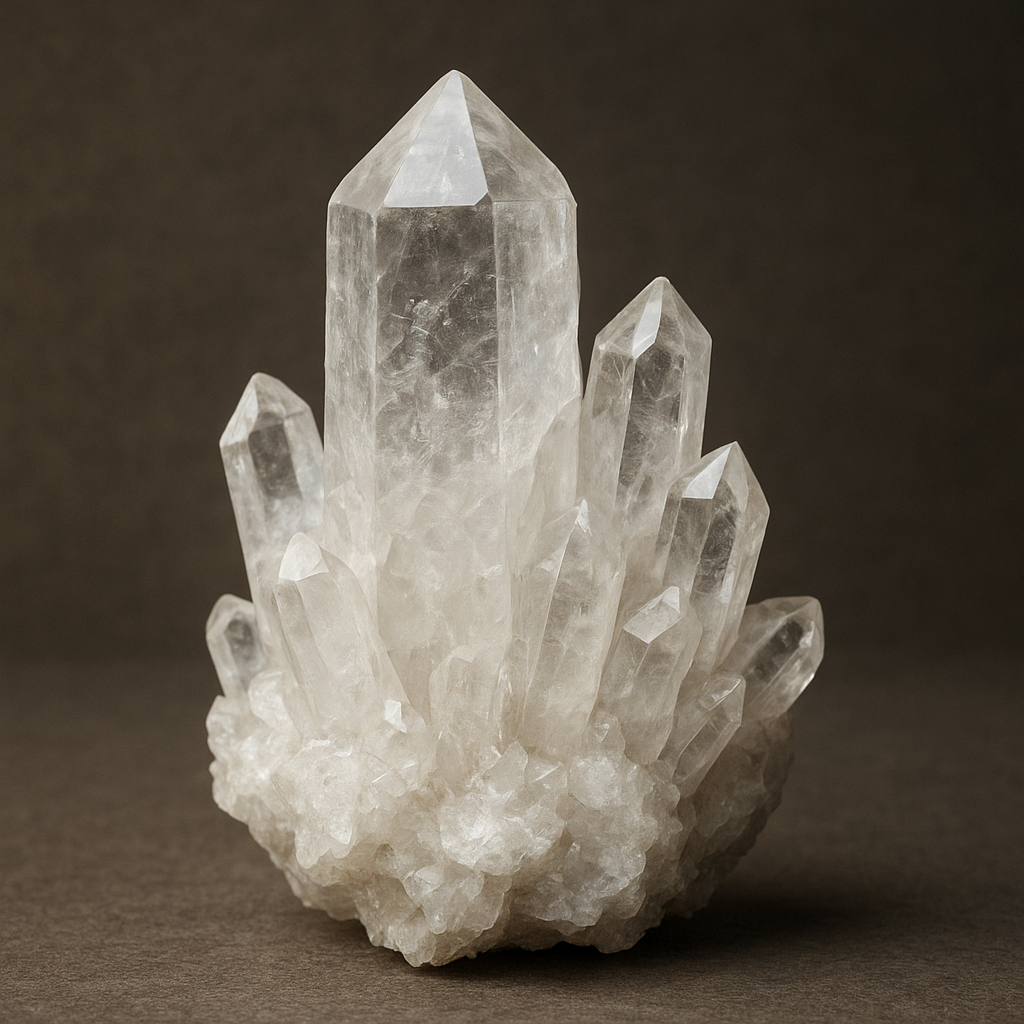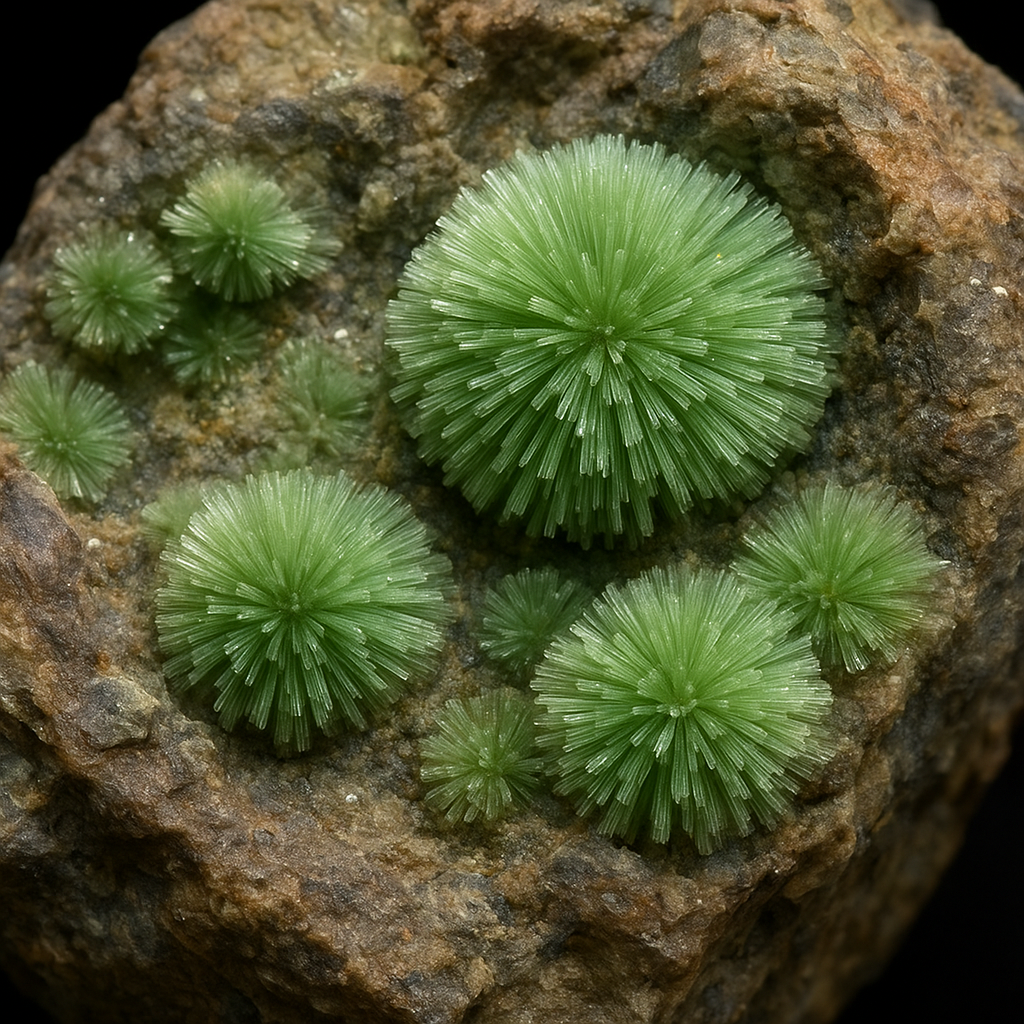
Wavellite is a visually striking and scientifically intriguing mineral prized by collectors and studied by geoscientists. Known for its distinctive radiating bundles and often vivid shades of green, yellow-green or blue-green, this secondary phosphate mineral forms in a variety of low-temperature environments and offers insight into phosphate geochemistry and mineral growth processes. The following sections explore its physical and chemical characteristics, typical environments and global distribution, practical applications and uses, and a range of curious or lesser-known aspects that make wavellite an interesting subject both for hobbyists and researchers.
Physical and chemical characteristics
Wavellite is best characterized as a hydrated aluminum phosphate whose idealized chemical formula is commonly written as Aluminum phosphate hydrate: Al3(PO4)2(OH)3·5H2O. As a hydrated phase, its stability depends on ambient temperature and humidity; heating can remove structural water and alter its appearance and mechanical properties. The mineral most often presents as compact, globular aggregates composed of many needle-like crystals that radiate from a central point, producing the classic spherical or hemispherical clusters that collectors prize.
Appearance and mechanical properties
- Color: typically pale to bright greens and yellow-greens, sometimes bluish-green, pale brown, or nearly colorless. The color often reflects minor chemical substitutions and included impurities.
- Habit: acicular (needle-like) crystals grouped into radial sprays and spherulitic aggregates; individual crystals may be fibrous to prismatic.
- Luster: vitreous to resinous or slightly greasy on broken surfaces.
- Hardness: relatively soft, generally around Mohs 3.5–4, so it is easily scratched by common materials.
- Specific gravity: low to moderate, reflecting its hydration; typical values are in the approximate range of 2.3–2.4.
- Cleavage and fracture: cleavage is poor; fracture tends to be uneven or conchoidal in broken masses, but the radiating aggregate habit strongly influences how specimens break.
Wavellite crystals may display interesting optical effects in polished sections or cabochons because of the radiating internal structure. Under magnification these radiating fibers can show variations in transparency and color, creating eye-catching patterns. Some specimens exhibit fluorescence under ultraviolet light due to trace activators or associated minerals.
Where wavellite forms and typical associations
Wavellite is primarily a secondary mineral that forms by the alteration of primary phosphate-bearing materials or by the precipitation of aluminum and phosphate-bearing solutions in cavities and fractures. It commonly occurs in the near-surface, low-temperature environment of weathering zones and in veins or vugs where phosphate-rich fluids can concentrate and react with aluminum-bearing host rocks.
Paragenesis and typical host environments
- Weathering zones above phosphatic deposits or aluminous rocks: Chemical weathering liberates phosphate and aluminum which can recombine to form hydrated aluminum phosphates.
- Hydrothermal or epithermal veins at low temperatures: Cool, phosphate-bearing solutions can precipitate wavellite in open spaces and fractures.
- Cavities in sedimentary rocks and in nodules: Voids within shales, siltstones or sandstones can host spherical wavellite growths.
- Associated mineral assemblages: sales often occur with other secondary phosphates such as variscite, strengite, crandallite-group minerals, turquoise in oxidized zones, and sometimes with iron phosphates such as rockbridgeite.
Because wavellite is intimately tied to the mobility and concentration of phosphate in natural waters, it is particularly informative for studies that investigate how phosphorus is cycled and immobilized in soils, sediments and mine-impacted landscapes. Its formation signals local geochemical niches where phosphate, aluminum, pH and water activity have combined in just the right way to precipitate this hydrated phase.
Geographic distribution and notable localities
Wavellite has been reported from a wide range of countries and regions, reflecting the global ubiquity of the conditions that produce secondary phosphates. It is found in Europe, North and South America, parts of Asia, and Australia. Many classic specimens originate from small mines, roadcuts and phosphate nodules where conditions favored the growth of radial aggregates in open cavities.
- United Kingdom: historical occurrences in parts of England and Wales have long been recognized by mineral collectors and early mineralogists.
- United States: wavellite is known from several states where phosphatic or aluminous host rocks and weathering have combined to produce good specimens; collectors often seek out vuggy outcrops and old quarries.
- Brazil and other South American localities: produce colorful and well-formed clusters that are in demand for display pieces.
- Australia: occurrences within phosphate-bearing sediments and altered rocks occasionally yield fine specimens.
Collecting guides and regional mineralogic literature provide more precise locality information for those seeking wavellite specimens. Many famous museums and private collections house outstanding examples that showcase the radial crystal habit and strong color that make the mineral so recognizable.
Uses, applications and economic significance
Wavellite has no major industrial role like bulk phosphates or aluminum minerals. Its primary value is as a collector and lapidary material, and as a subject for scientific research. That said, some practical and research-related applications are worth noting.
Collector and ornamental use
- Specimens: The most important use of wavellite is as a mineral specimen; large, well-formed radial clusters command attention and can be significant in the collector market.
- Lapidary and jewelry: Because it is relatively soft and often brittle, wavellite is not a mainstream gemstone, but some stabilized or particularly attractive pieces are cut into cabochons or used as small inlays; the radiating patterns can create attractive visual effects when skillfully cut and stabilized.
Scientific and environmental relevance
- Geochemical indicator: The occurrence of wavellite indicates localized geochemical environments where phosphate is available and interactions with aluminum occur; this makes it useful in reconstructing weathering histories.
- Research material: Scientists study wavellite to understand nucleation and growth of radial aggregates, hydration-dehydration behavior of aluminum phosphate phases, and the solid-solution relationships among secondary phosphates.
- Environmental phosphate immobilization: Interest in aluminum phosphate phases—broadly speaking—exists in remediation contexts because phosphate can be immobilized by forming stable mineral phases. While synthetic materials are usually preferred for engineered remediation, natural analogs like wavellite inform those approaches.
Collecting, preparation and care
Collectors prize wavellite for the dramatic radiating sprays and the range of subtle to bright colors. However, handling and preparing wavellite requires care because of its hydration, softness and fragile habit.
Field collecting tips
- Look for vugs, cavities and pocket-like structures in phosphatic horizons or altered aluminous rocks. Wavellite often occupies spaces where fluids could concentrate and precipitate crystals.
- Excavation should be gentle: because radial aggregates can detach in delicate layers, careful chiseling and bracing with plaster or aluminum foil-wrapped supports can protect specimens in situ.
- Label provenance: record exact locality, matrix and orientation. This information adds scientific and market value.
Preparation and conservation
- Cleaning: avoid aggressive acids or ultrasonic baths that could strip structural water or damage fragile fibers; gentle brushing and low-pressure water rinsing (if the specimen is not extremely fragile) is usually adequate.
- Stabilization: for thin or flaking specimens, consolidants may be used by experienced preparators to preserve form; this is common practice for delicate mineralogic material but must be disclosed if the piece is sold.
- Avoid heat and prolonged dehydration: because wavellite is hydrated, heating can cause irreversible changes. Store specimens in stable humidity conditions and avoid direct sunlight or hot display lights that produce heat buildup.
Interesting scientific and cultural aspects
Wavellite intersects several topics that extend beyond simple identification. Below are a few facets that collectors, educators and researchers find especially compelling.
Growth patterns and crystallography
The spherical and hemispherical clusters of wavellite provide clear examples of radial crystal growth driven by diffusion-limited precipitation in a cavity. Studying these growth patterns helps mineralogists and materials scientists understand how morphology is controlled by parameters such as supersaturation, impurity concentration and the presence of organic or inorganic templates. The way tiny acicular crystals assemble into large, coherent spheres is a vivid illustration of self-organizing processes found both in geology and materials science.
Educational and exhibit value
Because wavellite demonstrates dramatic morphology with relatively simple chemistry, it is an excellent specimen for teaching. Museum exhibits often use radial minerals like wavellite to explain nucleation and growth, mineral paragenesis, and the role of water in controlling mineral stability. The visual appeal of well-formed clusters makes wavellite a natural draw for public audiences.
Related minerals and mineral groups
Wavellite belongs to a broader suite of secondary phosphate minerals. Comparing wavellite with close relatives such as variscite, strengite, crandallite-group minerals and apatite-group phases helps geologists interpret environmental and paragenetic conditions. In some deposits, wavellite forms sequentially or in association with these phases, recording changes in fluid composition over time.
Practical considerations for buyers and collectors
If you are interested in acquiring wavellite, consider the following practical aspects to ensure a good purchase and long-term preservation of the specimen:
- Authenticity and documentation: well-documented locality and provenance adds scientific and monetary value. Ask sellers for clear information about the source and any treatments applied.
- Condition: inspect for obvious damage, repair or stabilization. Small fractures or repairs reduce aesthetic and resale value but may be acceptable for study pieces.
- Display and storage: use padded supports and avoid strong direct lighting; consider a display case with ventilation to prevent overheating and a stable indoor relative humidity to reduce the chance of dehydration or cracking.
Current research directions and open questions
Active research involving wavellite and related aluminum phosphates includes kinetic studies of crystal growth, investigations of thermal stability and dehydration pathways, and exploring the role of impurities and organic molecules in morphogenesis. Researchers also use synthetic analogs of wavellite to probe catalytic or sorption properties of aluminum-phosphate frameworks, though practical applications typically favor engineered materials. From a geologic perspective, scientists remain interested in how phosphate mobility is controlled in surficial and near-surface systems, and natural wavellite occurrences provide ground-truth case studies for modeling phosphate retention and release.
Wavellite sits at the crossroads of aesthetic appeal and geoscientific relevance. Its radial clusters embody elegant crystal growth processes, while its chemistry highlights the interplay of phosphorus, aluminum and water in natural systems. For collectors, educators and scientists, wavellite is more than a pretty mineral: it is a small, tangible archive of geochemical history and a continuing subject of study that connects mineralogy to environmental science, materials research and the enduring fascination with how ordered structures arise in nature.