Vivianite is a quietly intriguing mineral whose deep blues and greens can seem almost alive: it changes color when exposed to air, forms in surprising places from bogs to archaeological sites, and has captured the attention of collectors, conservators, and environmental scientists alike. This article explores the mineral’s physical nature, geological settings, practical applications, and the surprising roles it plays in modern research and heritage science.
Appearance and Physical Properties
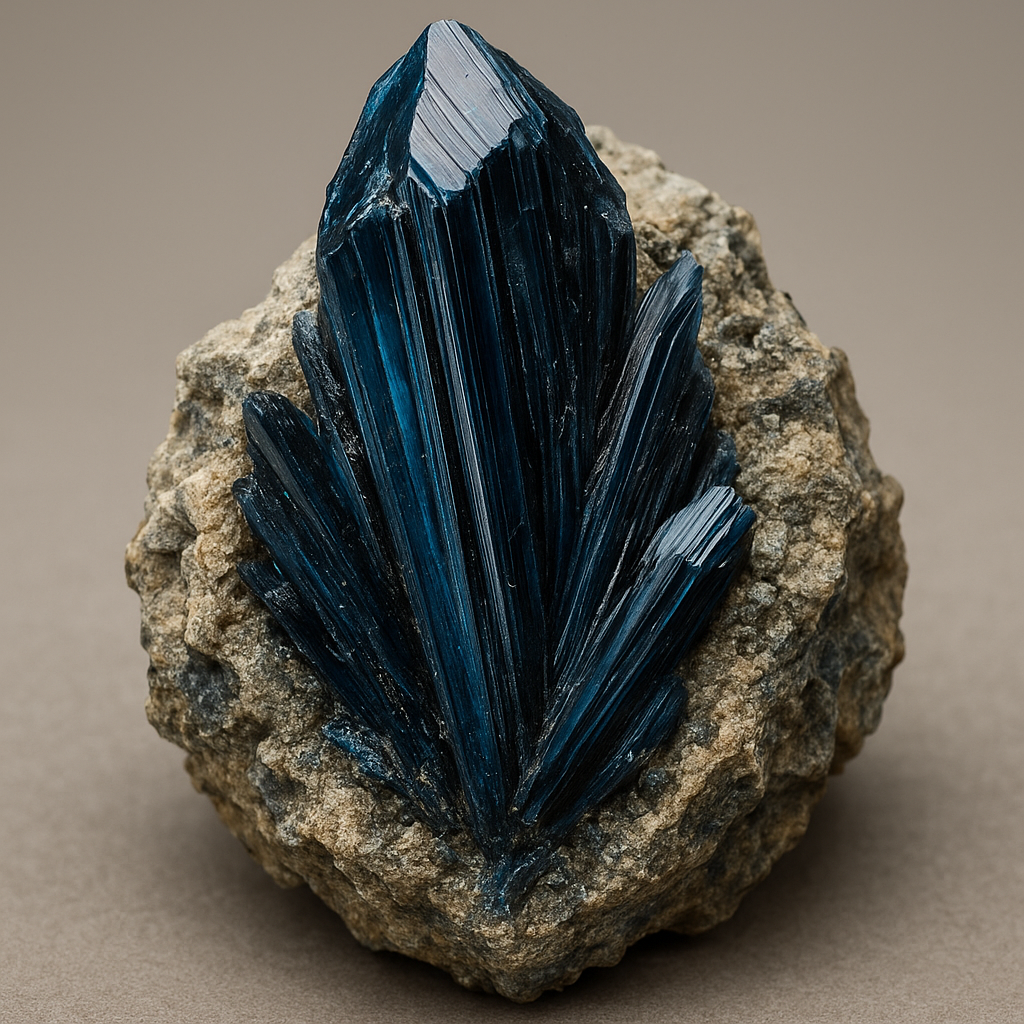
Vivianite is a hydrated iron phosphate most often recognized by its striking coloration and delicate crystal habits. Freshly exposed vivianite crystals are typically colorless to pale green, but upon exposure to oxygen they darken to intense blues and bluish-greens because of partial oxidation of ferrous iron to ferric iron. The mineral commonly occurs as elongated, tabular or prismatic crystals, as well as in fibrous, radiating aggregates, earthy masses, and rounded concretions.
Key physical and chemical characteristics include:
- Chemical formula: typically written as Fe3(PO4)2·8H2O (a phosphate containing ferrous iron).
- Softness: vivianite is relatively soft, typically 1.5–2 on the Mohs scale, so it is fragile and easily scratched.
- Luster: vitreous to pearly on cleavage surfaces.
- Cleavage: perfect in one direction, which often gives thin tabular fragments.
- Specific gravity: low to moderate because of hydration.
Where Vivianite Occurs
Vivianite forms in a variety of environments but is especially associated with low-oxygen (reducing), phosphate-rich conditions. It is not limited to a single geological setting; instead, it appears wherever the right chemical ingredients — available iron in the ferrous state, dissolved phosphate, and reducing conditions — come together.
Typical natural settings
- Bogs, marshes and peatlands: Organic-rich, waterlogged sediments that are anoxic are prime environments for vivianite formation. Decomposing organic matter releases phosphate, and the low-oxygen conditions stabilize Fe(II), allowing vivianite to precipitate in pore waters and form nodules or coatings.
- Sediments and concretions: Many sedimentary deposits — including lake and marine sediments rich in organic matter — host vivianite concretions and nodules. These can be preserved in the sedimentary record and later exposed by erosion.
- Decomposition zones of fossils and bones: the phosphate released during decay can react with iron, producing vivianite that sometimes forms blue-green stains or encrustations on archaeological materials.
- Oxidation zones of some ore bodies and hydrothermal deposits: although less common, vivianite can appear as an alteration product in some sulfide-bearing deposits where phosphate is available.
Notable occurrences
Vivianite is found worldwide. Museums and collectors often highlight specimens from European peat bogs, sedimentary basins, and mine localities. Examples include now-classic specimens from wetlands and mines across Europe, North and South America, Africa and Asia. The mineral’s most prized specimens are well-formed crystals with vivid blue or green coloration, typically caused by surface oxidation.
Formation Processes and Geochemistry
The formation of vivianite is governed by the interplay of redox chemistry, phosphate availability, pH, and microbiological activity. Under reducing conditions, iron is present predominantly as Fe(II), which can bond with phosphate to form vivianite. The presence of organic matter is often crucial: microbial decomposition releases phosphate and can consume oxygen, creating the reducing conditions necessary for Fe(II) stability.
Important geochemical points:
- Vivianite precipitates when the activity of Fe(II) and phosphate is sufficiently high and when pH ranges favor the stability of the mineral.
- When exposed to oxygen, Fe(II) oxidizes to Fe(III), which changes the electron structure and color of vivianite; the oxidation products are sometimes called metavivianite or related phases.
- Microbial processes — especially those involving iron-reducing and sulfate-reducing bacteria — can either promote or inhibit vivianite formation, depending on competing reactions (for example, sulfide formation can sequester iron).
- Vivianite can incorporate other cations and trace elements, making it a potential recorder of local geochemical conditions during precipitation.
Applications and Practical Uses
Vivianite’s direct commercial uses are limited because the mineral is relatively soft and unstable at the surface. Nonetheless, it has several important and growing applications in scientific research, environmental management, and heritage studies.
Environmental and engineering applications
- Phosphorus recovery: One of the most active research areas involves intentionally promoting vivianite formation in wastewater treatment systems. By creating reducing conditions and supplying iron, treatment processes can precipitate phosphate as vivianite, allowing recovery of phosphorus — a finite nutrient essential for agriculture. Recovered vivianite can potentially be converted into phosphate fertilizers or otherwise managed to recycle phosphorus.
- Contaminant immobilization: vivianite can co-precipitate or incorporate certain trace metals, thereby immobilizing them in sediments. This property has implications for natural attenuation of pollutants and engineered stabilization.
Cultural heritage, archaeology and conservation
Vivianite appears frequently in archaeological contexts and must be understood by conservators:
- It forms on or within organic archaeological materials such as waterlogged wood, bones, and textiles when phosphate-rich decomposition products meet iron-bearing sediments. The resulting blue-green stains may be visually striking but can indicate ongoing chemical changes that threaten preservation.
- Conservators monitor vivianite because its oxidation can continue after excavation, darkening specimens and altering surface chemistry. Controlled storage (reduced oxygen, controlled humidity) is often recommended.
- Archaeological researchers use the presence of vivianite as a paleoenvironmental proxy: its formation indicates prolonged anoxic, phosphate-rich conditions at the site, which helps reconstruct burial environments and taphonomic histories.
Academic and analytical uses
Vivianite serves as a useful indicator mineral in geochemical studies and is of growing importance in environmental science. Techniques such as X-ray diffraction (XRD), Raman spectroscopy, scanning electron microscopy with energy-dispersive X-ray spectroscopy (SEM–EDS), and Mössbauer spectroscopy are commonly employed to identify and characterize vivianite in research and conservation laboratories. These methods reveal composition, oxidation state, crystal structure, and microtextures that record formation conditions.
Vivianite and Heritage Science: Challenges and Opportunities
In museum and archaeological science, vivianite presents both a conservation challenge and a research opportunity. When excavated artifacts that host vivianite are exposed to air, the mineral can continue oxidizing, which changes colors and can initiate mechanical and chemical deterioration of host materials. Managing these specimens requires specialized protocols:
- Immediate protection in low-oxygen packaging or inert atmospheres can slow oxidation.
- Analytical documentation on-site helps conservators make informed decisions about excavation, transport, and storage.
- Because vivianite formation points to particular burial chemistry, its detection contributes to broader reconstructions of past landscapes and human activity, making it an interdisciplinary tool for archaeologists, geologists, and conservators.
Interesting Scientific Research and Current Trends
Several contemporary research themes highlight vivianite’s relevance beyond mineralogy:
- Phosphorus management: With global concerns about finite phosphate rock resources and eutrophication of water bodies, vivianite-based phosphorus recovery from wastewater is a promising technology that couples pollution control with resource recycling.
- Biogeochemical cycling: Studies examine how microbial communities and seasonal redox changes drive vivianite formation and dissolution in wetland sediments, lakes, and estuaries.
- Geoarchaeology: Vivianite occurrences in burial contexts are used to infer paleohydrology and post-depositional processes.
- Analytical developments: Improved micro-analytical tools allow researchers to read vivianite’s microstratigraphy — tiny growth layers that can record changing environmental conditions during the mineral’s formation.
Identification, Handling and Care of Specimens
For collectors and curators, identifying vivianite requires attention to color, habit, softness, and reaction to exposure. Because vivianite darkens on exposure to air, a freshly broken surface may appear much lighter than museum-displayed specimens. Practical care tips:
- Store specimens in airtight containers or under inert gas if long-term preservation of the original color is desired.
- Avoid unnecessary handling because oils from skin and mechanical abrasion can accelerate surface changes.
- Document specimens with photography and non-destructive analyses (Raman, XRD) before treatment or prolonged exhibition.
Related Minerals and Varieties
Vivianite belongs to a broader family of phosphate minerals and is often discussed alongside its oxidized relatives and coexisting phases.
- Metavivianite: a partially oxidized product with different optical and structural properties that often forms during exposure of vivianite to air.
- Other iron phosphates: minerals such as strengite and ferric phosphate phases can appear in related settings where iron is present in the +3 oxidation state rather than +2.
- Pseudomorphs and replacements: vivianite can form pseudomorphs after organic or carbonate substrates, preserving shapes of fossils or concretions while replacing original materials.
Collector Notes and Aesthetic Appeal
Collectors prize vivianite for its rare and vibrant colors, delicate crystals, and the dramatic transformations it sometimes undergoes. Important considerations when acquiring vivianite specimens include provenance (which provides geological context), documentation of any treatments (many specimens are stabilized or capped to reduce oxidation), and awareness that some vivid colors may result from partial oxidation — meaning the specimen’s appearance can continue to change.
Techniques for Scientific Study
Modern mineralogical and conservation analysis of vivianite often combines multiple techniques. A typical analytical workflow might include:
- X-ray diffraction (XRD) to determine crystal structure and confirm mineral identity;
- Raman spectroscopy and infrared (IR) analysis to detect phosphate vibrational modes and hydration;
- SEM–EDS for morphology and elemental mapping to identify iron and phosphorus distributions;
- Mössbauer spectroscopy or X-ray absorption techniques to determine iron oxidation state and fine structural details.
Ecological and Environmental Insights
Because vivianite records conditions of low oxygen and abundant phosphate, its presence in sediments provides ecological insights. For instance, widespread vivianite formation in a lake’s sediments can indicate prolonged anoxia and internal phosphorus cycling — conditions that often accompany eutrophication. Conversely, the intentional formation of vivianite in engineered systems is being developed to remove excess phosphorus from effluents, closing a nutrient loop.
Points of Curiosity and Lesser-Known Facts
- Color change as a natural clock: While not a true dating tool, the degree and pattern of vivianite oxidation on exposed surfaces can sometimes reveal post-excavation environmental history and handling.
- Biomineral-like behavior: In some peat and soil environments, vivianite forms in ways that mimic biological textures, blurring lines between purely geological and biogeochemical processes.
- Interdisciplinary reach: Vivianite’s significance spans mineralogy, archaeology, environmental engineering, and conservation science, demonstrating how a single mineral can link disparate fields.