Villiaumite is a striking and uncommon mineral that has fascinated mineralogists, gem collectors, and geochemists for more than a century. Its vivid colors and unusual occurrence in highly alkaline igneous rocks set it apart from more familiar fluorine-bearing minerals. Although it is chemically simple, villiaumite’s physical behavior, geological setting, and the practical implications of its fluoride content make it a subject of interest across several fields. This article explores where villiaumite is found, its mineralogical characteristics, practical and scientific uses connected with its chemistry, and a selection of interesting facts and safety notes for anyone who encounters this fragile, radiant mineral.
Overview and mineralogical identity
At its core, villiaumite is a rare fluoride mineral composed of sodium and fluorine. The mineral’s chemical identity can be expressed succinctly as NaF, the same formula as the synthetic compound sodium fluoride used in a number of industrial and public-health applications. In mineral classification terms villiaumite is a halide mineral and belongs to the family of simple fluoride minerals. Its crystals often adopt cubic shapes consistent with its isometric symmetry, and the mineral typically forms as isolated crystals or in veins and cavities within certain silica-poor igneous rocks.
What distinguishes villiaumite?
- Uncommon occurrence: it is not widely distributed and appears almost exclusively in specialized, nepheline syenite-type and other peralkaline igneous complexes.
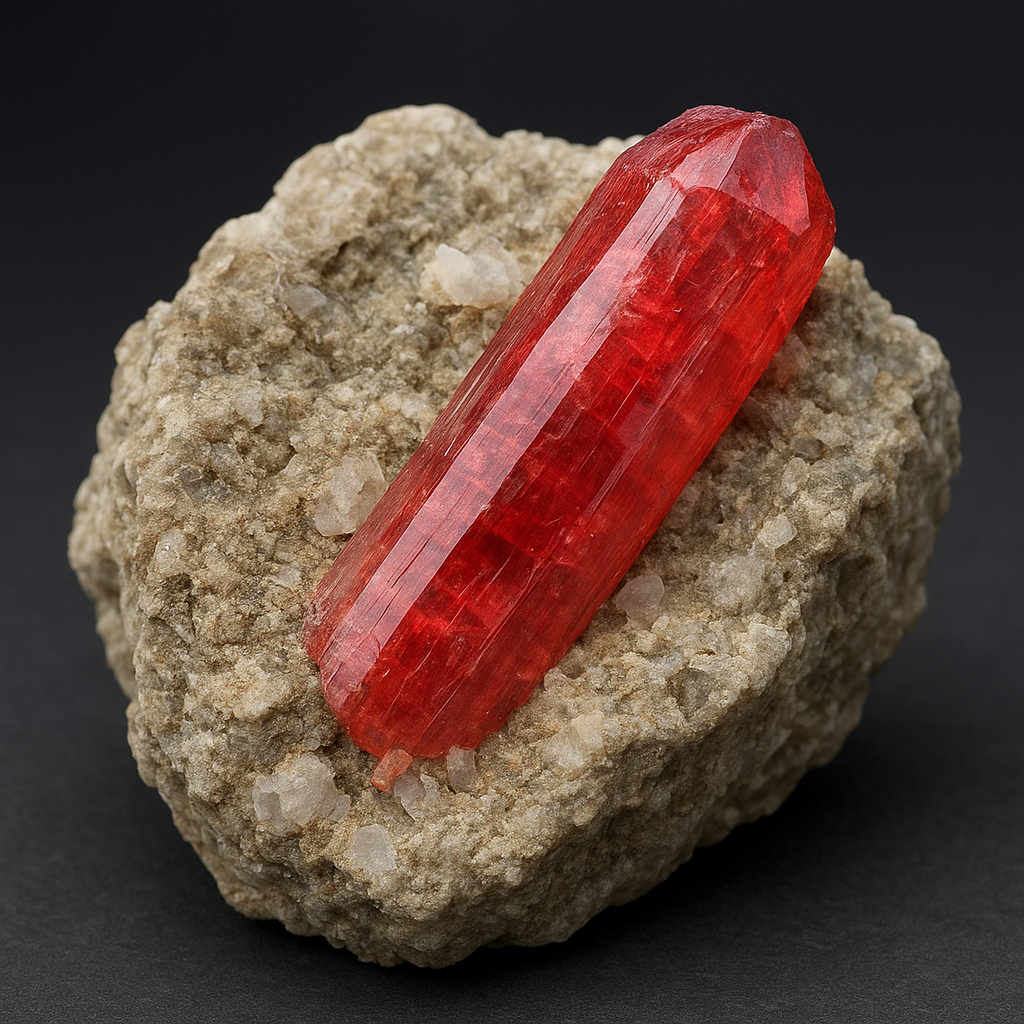
- Color and optical effects: villiaumite is often vividly colored—reds, oranges, and pinks—due to radiation-induced defects known as color centers.
- Solubility and reactivity: unlike many silicate minerals, villiaumite is soluble and chemically reactive under weathering, which affects both its preservation in nature and its handling by collectors.
Geological occurrence and notable localities
Villiaumite is a mineral of highly alkaline, silica-undersaturated igneous environments. It tends to occur where magmas are enriched in sodium and fluorine and where complex fractional crystallization or late-stage hydrothermal activity concentrates volatile elements. Because these conditions are rare, villiaumite’s distribution is restricted to a handful of well-known igneous complexes worldwide.
Typical geological settings
- Peralkaline nepheline syenite and related intrusive bodies, where crystallization of alkaline minerals leaves a residual melt enriched in volatile elements including fluorine and sodium.
- Alkaline pegmatites and late-stage veins within those complexes, where low-temperature fluids can precipitate fluoride minerals.
- Metasomatic zones adjacent to such intrusions, where fluids alter host rocks and deposit unusual mineral assemblages.
Important localities and examples
- Ilímaussaq complex, Greenland — one of the classic localities for rare alkaline minerals; villiaumite is part of a remarkable suite of fluorine- and sodium-rich minerals here.
- Mont-Saint-Hilaire, Quebec, Canada — celebrated for a diversity of rare minerals, including well-formed villiaumite crystals and associated sodalite-group minerals.
- Kola Peninsula and Lovozero Massif, Russia — Russian alkaline complexes are famous for hosting exotic mineral assemblages where villiaumite has been found.
- Langesundsfjord area, Norway — historic finds of colorful fluoride minerals, villiaumite included.
- Scattered occurrence in other alkaline intrusions and pegmatites worldwide, although nowhere is it abundant enough for large-scale extraction.
These localities often produce the best specimens for museums and collectors, each showing characteristic crystal habits, color zoning, and associations with minerals such as sodalite, tugtupite, eudialyte, and various zeolites.
Physical and chemical properties
Villiaumite’s chemical simplicity belies an array of interesting physical properties. The mineral is generally soft and brittle, and because it contains the light element fluorine paired with sodium it has a relatively low density compared to many rock-forming minerals. Its cleavage and fracture behavior are consistent with halide minerals, and the crystals are commonly cubic, reflecting the mineral’s symmetric internal structure.
Color, luminescence, and radiation effects
One of the most remarkable aspects of villiaumite is its range of intense colors—deep red, orange, salmon, and pink are typical—often caused by the presence of color centers. These centers are defects in the crystal lattice produced by natural radiation (from uranium and thorium-bearing minerals nearby) or by slight departures from stoichiometry. The color can change or fade when irradiated in the laboratory or exposed to sunlight and heat; some villiaumite specimens are photochemically sensitive and may slowly alter their hue after prolonged exposure.
Additionally, villiaumite may show fluorescence under ultraviolet light, although this effect can be variable. The luminescence and color-center properties make villiaumite valuable for research into solid-state physics and mineral irradiation effects.
Chemical stability and weathering
Because it is composed of sodium and fluorine, villiaumite is relatively reactive compared with silicate minerals. It is soluble in water to an extent and will be altered or leached during weathering, often disappearing from surficial exposures. This solubility also means that villiaumite is rarely preserved in sedimentary deposits and is typically encountered only in fresh rock or protected cavities within host intrusions.
Uses, applications, and limitations
Despite containing the same chemical species as industrial sodium fluoride, villiaumite itself is not a significant industrial resource. Its rarity, solubility, and tendency to form small crystals restrict large-scale exploitation. However, there are several domains where villiaumite or the chemistry it represents is relevant.
Scientific and academic uses
- Mineralogical research: villiaumite serves as a natural example of simple halide crystal chemistry and is used to study color centers, radiation damage, and luminescence in minerals.
- Geochemical indicators: its presence is a marker of extreme alkalinity and fluorine enrichment in magmatic systems, helping geologists reconstruct the late-stage evolution of unusual intrusions.
- Solid-state physics: the radiation-sensitive coloration of villiaumite can be informative for understanding defect structures and charge-trapping mechanisms in ionic crystals.
Industrial and practical considerations
Industrial uses of fluorides are numerous—ranging from metal fluxes to chemical intermediates and dental applications—but natural villiaumite is not typically used as a commercial source because the mineral is too rare and often contaminated or altered. Instead, other fluoride minerals and synthetic compounds are preferred:
- Synthetic NaF is used in dentistry, water fluoridation, and some chemical syntheses.
- Larger fluoride minerals such as fluorite (CaF2) and cryolite (Na3AlF6) have historically been more important in industrial processes like aluminum smelting and metallurgy.
Collecting, display, and lapidary use
Villiaumite is primarily valuable to mineral collectors and museums. Well-crystallized or richly colored specimens command attention, and some pieces are cut and polished for collectors. However, the mineral’s softness, cleavage, and solubility impose restrictions on lapidary use: polished pieces can fade or be damaged if exposed to acids, sunlight, or repeated cleaning with water. For display, caretakers often keep specimens in controlled, low-light conditions and avoid high humidity to slow alteration.
Handling, safety, and environmental notes
Although villiaumite is aesthetically appealing, it requires respectful and careful handling. The mineral contains fluorine in ionic form, and while touching a specimen is not likely to cause acute harm, ingestion or inhalation of dust or finely powdered material is hazardous. When villiaumite dissolves or reacts with acids, it can release fluoride ions that in concentrated form are toxic and can form hydrofluoric acid under the right chemical circumstances—this is a potent and dangerous acid that attacks glass and biological tissue.
- Wear gloves and avoid creating dust when handling or preparing specimens for study.
- Store villiaumite away from acids and strong light to minimize color alteration and chemical reaction.
- Do not attempt to dissolve or chemically treat villiaumite at home; laboratory procedures for fluoride analysis should be left to trained personnel with proper ventilation and protective measures.
Associated minerals and paragenesis
Villiaumite rarely occurs alone. Its paragenesis—i.e., the sequence and conditions of mineral formation—links it to a suite of other alkaline and fluoride-rich minerals. Common associates include sodalite-group minerals, tugtupite, aegirine, eudialyte, nepheline, and various zeolites. These associations reflect the highly specialized chemistry of the host magmas: low silica, high alkali (sodium and sometimes potassium), and enrichment in volatiles such as fluorine and chlorine.
What its presence tells geologists
Finding villiaumite in a rock signals that the local magmatic system experienced significant enrichment in volatile elements and evolved unusual chemistry late in its crystallization history. Geologists studying these systems use villiaumite and its mineral neighbors to infer magma differentiation trends, fluid evolution, and the potential for other rare-element mineralization. In some cases, these alkaline intrusions also host rare-earth element (REE) mineralization, niobium, and other economically interesting commodities, though villiaumite itself rarely factors directly into economic evaluations.
Notable scientific observations and curiosities
Villiaumite offers several fascinating touches that attract curiosity beyond basic mineralogy:
- Its intense colors are often more vivid than those of many other minerals, making it a subject for photography and museum displays.
- Color centers can be altered experimentally: irradiating or annealing samples in the lab can change or remove the coloration, giving insight into defect chemistry and natural irradiation histories.
- Some specimens show zonation, with color intensity varying within a single crystal, preserving a record of changing environmental conditions during crystal growth.
- Because it is soluble and reactive, villiaumite is often absent from weathered outcrops; well-preserved specimens typically come from recent excavations or protected pockets inside fresh rock.
Conclusion: why villiaumite matters
Although not a backbone of industrial mining, villiaumite occupies a special niche in mineralogy and geoscience. As a natural form of NaF, it ties together simple ionic chemistry with the complexity of specialized igneous systems. Its vivid appearance, sensitivity to radiation and light, and restricted occurrence in well-defined alkaline environments make it an excellent mineral for teaching about crystal defects, magmatic differentiation, and the diversity of halide minerals. For museums and collectors its aesthetic and scientific value is clear; for researchers, it remains a small but informative window into the extreme chemical states that Earth’s magmas can attain.