Variscite is an often-overlooked but captivating mineral prized for its vibrant green hues and delicate textures. It occupies a special place among collectors and jewelers alike, admired for its aesthetic qualities and its geological story. This article explores the mineral’s chemistry and formation, principal localities where it occurs, its uses in jewelry and lapidary arts, and several intriguing facets of its natural history and cultural significance.
Chemistry, Appearance and Formation
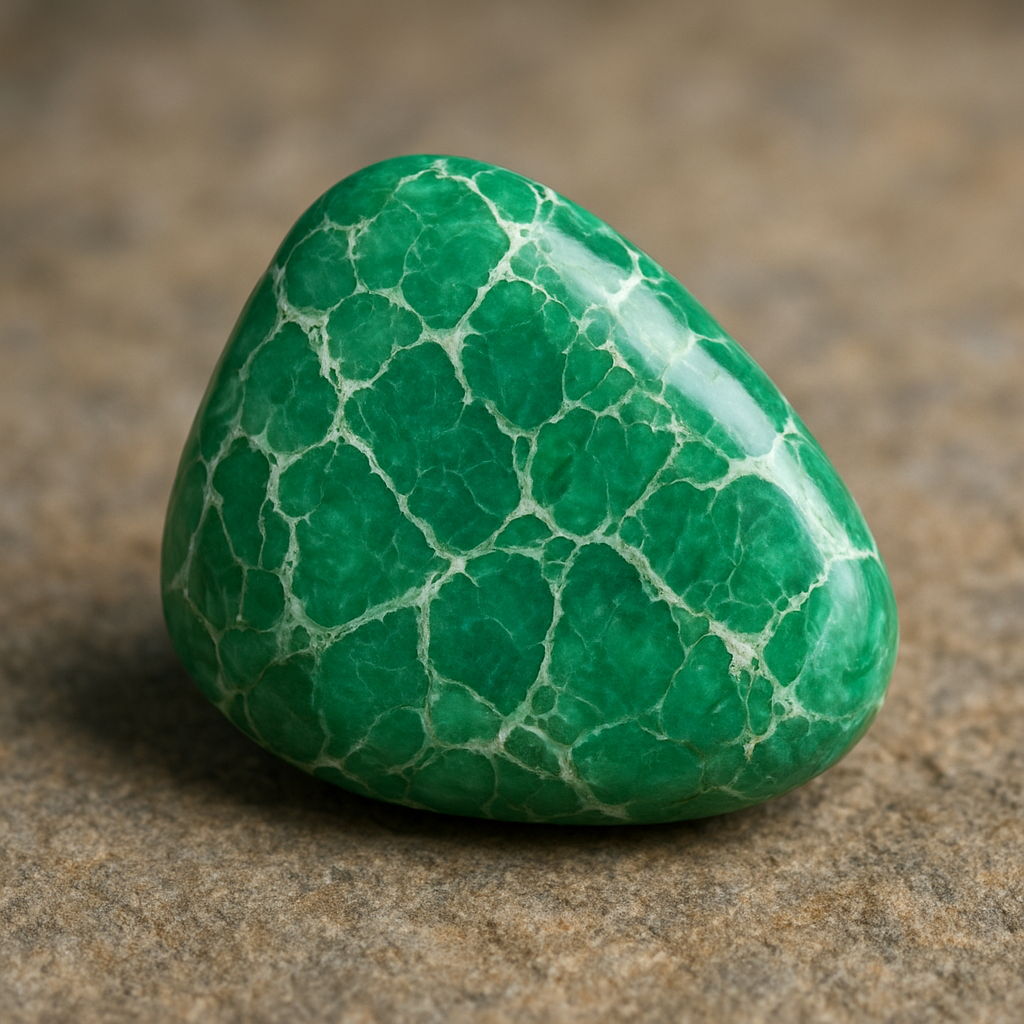
Variscite is a hydrated aluminum phosphate with the ideal chemical formula AlPO4·2H2O. It typically occurs as compact, cryptocrystalline masses, botryoidal coatings, or nodular fillings in cavities and fractures. The mineral’s most striking feature is its range of green colors, from pale mint to deep apple green, which are often unevenly distributed and offer unique patterns sought after in ornamental stones.
Coloration in variscite is usually due to trace elements such as chromium and vanadium, which substitute into the structure and impart green tones. Unlike turquoise, which owes its blue to copper, variscite’s greens are subtler and can be accented by matrix veins of host rock, brown limonite stains, or white calcite seams. The luster is typically waxy to sub-vitreous, and the mineral often exhibits a smooth, satiny texture when polished.
Geologically, variscite forms in low-temperature, near-surface environments. It is a secondary mineral created by the interaction of phosphate-rich fluids with aluminum-bearing host rocks. These environments can include weathering zones of aluminous rocks, the alteration of phosphate nodules, and fillings in fractures of silicic volcanics or sedimentary strata. Because of these conditions, specimens often present in nodules, crusts, and vein-like masses rather than as well-formed crystals.
Where Variscite Occurs
Variscite has a global but patchy distribution, appearing in discrete deposits that are prized for their color and workability. Notable localities include North America, Europe, Australia, South America and Asia. The stone’s name reflects its European origins: it was first described from the Variscia region, the Latin name associated with the ancient Variscan mountain belt in central Europe.
- United States: The American West is particularly famous for high-quality variscite. Utah produces some of the most collectible material, with the Clay Canyon and Fairfield areas historically providing deep-green, dense nodular variscite prized by jewelers. Nevada and New Mexico also yield attractive specimens, often with distinctive matrix patterns.
- Europe: Early occurrences were documented in central Europe. Various deposits in Germany and other parts of the Variscan belt have produced historical material. European specimens are valued for their connection to the mineral’s discovery and naming.
- Australia: Several Australian localities have produced variscite, often in shades ranging from pale green to bluish green. These specimens sometimes have unique textures and are used in the local lapidary market.
- South America and Asia: Occurrences are also reported from Brazil, Argentina, and China, among other countries. Each locality brings characteristic appearances—some with dense uniform color, others with dramatic matrix patterns that appeal to collectors.
Because variscite tends to occur in limited, localized pockets, individual mines and dig sites often develop reputations for specific color and pattern characteristics. Collectors may pay premiums for material from celebrated localities, and museum specimens can represent historically important finds.
Uses and Lapidary Practices
Variscite has long been used as an ornamental stone and in jewelry, though its physical properties require thoughtful lapidary techniques. With a Mohs hardness that generally falls in the range of about 4.5 to 5.5, variscite is softer than many common gemstones and can scratch if not handled carefully. Its compact, fine-grained nature makes it ideal for cabochons, beads, inlays, and carvings rather than faceted gems.
Common lapidary treatments and practices include:
- Cutting and shaping into cabochons to highlight the stone’s color and matrix.
- Polishing to a smooth, waxy shine that emphasizes subtle color variations.
- Stabilization, where necessary, using resins or polymers to strengthen porous or fragile material for durable jewelry use. Stabilized variscite accepts polish well and becomes more resistant to wear.
- Inlay work combining variscite with metals and other stones to create striking contrasts.
Because variscite can be sensitive to acids, strong chemicals, and prolonged exposure to moisture, jewelers recommend routine care including gentle cleaning with a soft cloth and mild soap. Avoid ultrasonic cleaners and harsh chemicals which can damage the stone or its stabilization.
Identification and Imitations
Identifying variscite requires attention to color, luster, hardness, and matrix patterns. It is often compared to turquoise due to similar coloration and use as a gemstone, but several distinguishing characteristics exist:
- Chemistry: Variscite is an aluminum phosphate; turquoise is a copper-bearing phosphate, and the presence of copper tends to produce bluer hues in turquoise versus greener tones in variscite.
- Hardness and texture: Variscite usually tests softer and has a smoother, waxier feel when polished.
- Matrix patterns: Variscite matrices can be brown, black, or cream and often appear as fine veinlets or brecciated patterns; turquoise matrices often contain more iron or copper staining.
Because attractive green stones are in demand, variscite can be imitated by dyed materials such as howlite or magnesite, and sometimes by dyed jasper or chalcedony. Testing via hardness, streak, and sometimes simple chemical spot tests can help distinguish natural variscite from dyed imitations. Advanced laboratory techniques—X-ray diffraction, electron microprobe, or infrared spectroscopy—are definitive but generally unnecessary for common trade purposes.
Historical and Cultural Context
Although variscite has not historically matched the fame of stones like turquoise or jade, it has played a role in human adornment and artifact production for centuries in regions where it occurs. Small beads, inlays and amulets made of variscite have been found in archaeological contexts, indicating local use of the mineral for decorative and possibly symbolic purposes.
Modern appreciation grew in the late 19th and 20th centuries as more localities were discovered and as lapidary techniques improved. Today the stone is especially popular among artisan jewelers and collectors who value its natural, earthy greens and unique patterns. Some Native American artists and Southwest jewelers, for example, incorporate variscite into designs alongside turquoise and other materials, creating pieces that celebrate local mineral resources.
Interesting Scientific and Collecting Notes
Variscite offers several points of interest for mineralogists and collectors beyond its visual appeal:
- Variscite often forms in microcrystalline masses, which makes it a subject of interest for studies on mineral nucleation and growth under low-temperature, near-surface conditions.
- The mineral’s sensitivity to trace element substitution (chromium, vanadium, iron) provides an opportunity to study geochemical signatures of the fluids that formed it and to reconstruct paleo-environmental conditions.
- Because deposits are frequently small and localized, variscite can serve as a marker for specific hydrogeological events or weathering processes in a region.
- Collectors prize certain patterns—such as vivid, even color and attractive matrix contrasts—which can make a single specimen significantly more valuable than chemically similar material without such aesthetics.
Market and Collectability
In the gemstone market, variscite occupies a niche between common semiprecious stones and rarer collector minerals. High-quality, deeply colored pieces from renowned localities command interest from designers and collectors and may fetch premium prices. Because many mines are small and non-continuous in output, supply can be intermittent, contributing to the desirability of specimens from specific localities or mine runs.
Enthusiasts often collect variscite for its variety: some prefer the stable, uniform greens, while others prize dramatic, patterned pieces that read almost like miniature landscapes. The stone’s ability to take a fine polish and its relatively gentle aesthetic make it well-suited to artisan and ethical jewelry markets that value uniqueness and natural beauty.
Practical Tips for Buyers and Enthusiasts
If you are seeking variscite for collection or jewelry, consider these practical guidelines:
- Ask about origin: locality can influence color, pattern, and value. Material from well-known Utah localities often has a distinct collector appeal.
- Inspect or request photographs: look for even polish, attractive color, and secure mounting if already set.
- Inquire about treatment: stabilization is common and acceptable in trade, but you should know whether a piece is stabilized, dyed, or otherwise treated.
- Care for variscite gently: avoid chemicals, extended water exposure, and rough wear. Clean with a soft cloth and mild soap when necessary.
For lapidaries planning to work with variscite, plan on gentle cutting speeds, careful sanding and polishing with fine abrasives, and consider stabilization for very porous material. Pre-stabilizing rough pieces can preserve color and reduce the risk of cracking during cutting.
Concluding Remarks on Variscite’s Appeal
Variscite may not dominate mainstream gemstone charts, but its subtle beauty, geological story, and the intimacy of its deposit occurrences give it a special charm. From the hands of collectors and artisans to the studies of mineralogists investigating its origins, variscite continues to reveal facets of earth processes and human appreciation for color and form. Whether admired on a small pendant, held as a polished specimen, or examined under a microscope, variscite remains a gemstone that rewards curiosity and careful observation.