Uvarovite is a striking and rare member of the garnet family, celebrated for its brilliant, chrome-induced green color and its role as both a scientific indicator and a sought-after specimen among collectors. This article explores the mineral’s chemical identity, geological environments, global occurrences, practical and aesthetic uses, and a few intriguing stories that illustrate why uvarovite continues to fascinate mineralogists and lapidaries alike. Throughout the text you will find details that connect the mineral’s composition to its appearance and applications, and why it remains an important piece in the broader narrative of chromium-bearing minerals.
Mineralogy and physical characteristics
The chemical formula of uvarovite is Ca3Cr2(SiO4)3, which places it squarely in the garnet group as the chromium-dominant member of the calcium garnets. The presence of chromium is the defining factor behind uvarovite’s vivid emerald-like hue; chromium substitutes into the crystal lattice in place of aluminum, producing intense absorption in the visible spectrum. Despite the similarity in color, uvarovite is structurally and optically distinct from beryl varieties such as emerald.
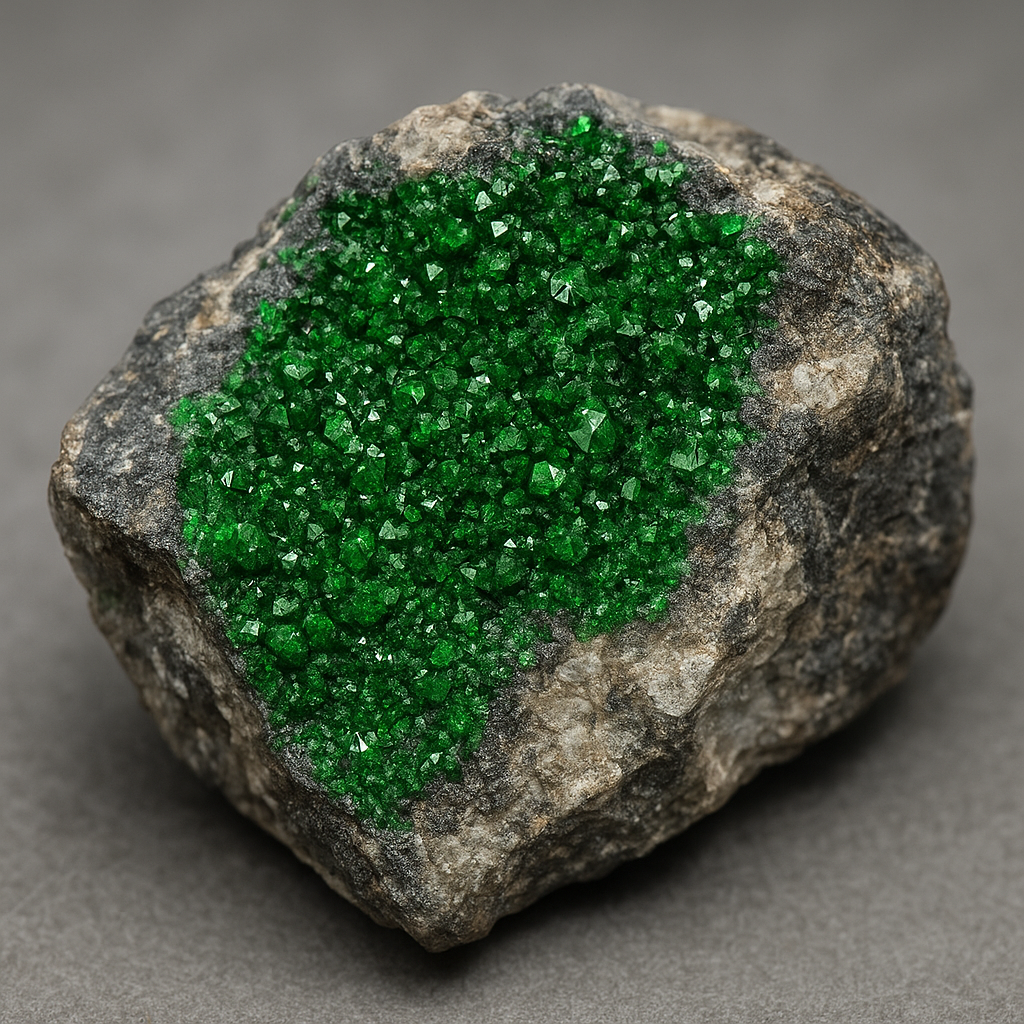
Crystallographically, uvarovite belongs to the isometric system and commonly forms small dodecahedral crystals, radial aggregates, or drusy crusts coating other rocks and minerals. High-quality, transparent crystals suitable for faceting are exceedingly rare; most specimens are brilliant but translucent to opaque. Like other garnets, uvarovite exhibits no cleavage and has conchoidal to uneven fracture, lending it durability for certain lapidary treatments.
In terms of hardness, uvarovite typically falls within the general garnet range, meaning it is relatively resistant to abrasion and well-suited for use in jewelry when gem-quality material is available. Its specific gravity and refractive properties mirror those of other calcium-rich garnets, but the most recognizable diagnostic feature remains the unmistakable green coloration caused by chromium.
Geological settings and formation processes
Uvarovite forms under specialized geological conditions that concentrate chromium and calcium while allowing silicate structures to develop. Two principal environments produce uvarovite:
- Metamorphosed ultramafic rocks and serpentinite-hosted assemblages, where chromium is derived from the alteration or metamorphism of chromite-bearing peridotite.
- Contact-metasomatic zones such as skarn deposits and altered limestones, where silica-rich and calcium-rich fluids interact with chromium-bearing host rocks to precipitate chromium-bearing garnet phases.
Uvarovite is therefore a useful indicator mineral in studies of metamorphism and metasomatism where chromium mobility and fluid-rock interaction are important. Unlike some garnets that form during regional metamorphism of aluminous sediments, uvarovite requires a chromium source—commonly chromite or chromium-rich ultramafic protoliths—and conditions that stabilize the chromium in a trivalent state within a calcium silicate framework.
Where uvarovite is found: notable localities
The mineral was first described from localities in Russia and named in honor of a Russian noble and patron of the sciences, a historical detail that highlights the mineral’s Eurasian roots. Today, uvarovite is considered rare, but carefully targeted searches in appropriate lithologies can yield remarkable specimens. Notable occurrences include:
- Russia — including the Ural Mountains region, which provided the type material and retains a reputation for classic uvarovite specimens.
- Finland — particularly from zones with complex metamorphic and hydrothermal histories where chromium was locally concentrated.
- Italy — alpine localities such as those in Lombardy have produced attractive microcrystalline crusts and small crystals.
- Pakistan and China — mountainous terrains with complex magmatic and metamorphic histories have yielded pockets of uvarovite, sometimes associated with other rare minerals.
- North America — sporadic finds in Canada and the United States occur in specific chromite-bearing or skarn-related contexts, and specimen hunters occasionally uncover gemmy material.
Because uvarovite commonly occurs as small crystals in drusy coatings or in vugs, the best specimens are often those that show a clean, lustrous surface of tiny, gemmy crystals on an attractive matrix. Collector markets prize well-formed crystals and drusy crusts for display, scientific study, and occasional lapidary work.
Uses and applications
Uvarovite’s applications fall into three broad categories: scientific, ornamental, and educational/collectible. Each use is informed by the mineral’s rarity, color, and physical characteristics.
Scientific and geological utility
As a chromium-rich garnet, uvarovite serves as a marker for certain geological processes. Petrologists and geochemists study uvarovite to:
- Trace chromium mobility during metamorphism and metasomatism.
- Identify past fluid compositions and temperatures in skarn and contact metasomatic systems.
- Constrain pressure-temperature histories where chromium-bearing phases coexist with other index minerals.
Because uvarovite can encapsulate tiny inclusions and record element partitioning, it contributes to models of ore genesis in chromium-rich systems and helps map mineral paragenesis in complex terrains.
Ornamental and lapidary use
Although gem-quality uvarovite is rare, attractive material is occasionally cut for cabochons or fashioned into beads and small faceted stones. When transparent fragments are available, their intense green tone can rival other chrome-bearing gems, offering a unique aesthetic due to the garnet’s refractive and brilliance characteristics. However, most uvarovite remains in the realm of collector pieces or is admired as drusy crusts rather than centerpieces in high-end jewelry.
Collectors and museums
Collectors prize uvarovite for its vivid coloration and the unusual habit in which it often occurs. Museum specimens illustrating radial sprays, botryoidal aggregates, or sparkling druses of tiny crystals provide excellent teaching material to demonstrate how trace elements such as chromium can dramatically alter a mineral’s appearance. The combination of rarity and visual appeal makes uvarovite a staple in curated mineral displays.
Identification, treatment, and care
Identifying uvarovite in the field or from a specimen requires attention to several diagnostic features. The bright green color alone is suggestive but not definitive, since several other minerals can be green. Key identification criteria include:
- Association with chromium-bearing host rocks or skarn assemblages.
- Typical garnet crystal habit (isometric dodecahedra) or drusy crusts of tiny equant crystals.
- Absence of cleavage and conchoidal/uneven fracture consistent with garnet group minerals.
- Supporting mineralogical tests, including hardness and, when possible, chemical confirmation of chromium content.
Because uvarovite is durable relative to many other green minerals, ordinary jewelry care is generally sufficient for pieces that incorporate it. Avoid harsh chemical cleaners and sudden temperature changes, and clean gently with mild soap and water. For museum-quality specimens, careful dusting and control of humidity and light exposure preserve color and surface luster.
Related minerals and comparisons
Uvarovite should be considered alongside other chromium-bearing minerals and garnet species when interpreting a deposit or building a collection. Important comparisons include:
- Emerald (beryl) — both owe their green color to chromium, but their structures, hardness, and optical behaviors differ significantly.
- Other garnets such as grossular and andradite — uvarovite is the chromium analog of the calcium garnets and may occur in assemblages where chemical substitutions produce a continuum of garnet compositions.
- Chromite — as a primary chromium-bearing ore, chromite-hosted environments can be precursors to uvarovite formation through later metamorphic or hydrothermal processes.
These comparisons are helpful for both field geologists and gemologists trying to distinguish visually similar materials or reconstruct the paragenesis of complex mineral assemblages.
Cultural notes, historical anecdotes, and market aspects
Uvarovite carries a certain romanticism because of its rarity and naming history: it commemorates a historical figure connected to scientific patronage, and its discovery in classic mineral provinces of Europe ties it to the golden era of mineralogy. In the collector market, prize specimens—particularly those with a vivid drusy surface of tiny, glassy crystals—can command high prices relative to their size. Because gem-quality pieces are rare, gem markets for uvarovite are niche; more commonly the mineral appears in private and museum collections.
From an educational perspective, uvarovite often serves as an accessible example of how trace elements can dramatically influence mineral color and properties. Its presence in textbooks and exhibitions helps communicate broader concepts in geochemistry and mineral formation.
Interesting facts and curiosities
Collectors and enthusiasts often highlight several features that make uvarovite memorable:
- The mineral’s name honors a patron of science, giving it a human historical connection uncommon among many descriptive mineral names.
- Uvarovite is one of the few garnets whose color is dominated by chromium rather than iron or manganese, producing an especially pure green tone.
- It commonly forms as tiny, lustrous crystals that can present an almost gemmy appearance en masse despite the individual crystals being too small for traditional faceting.
- Because it often coats other minerals, uvarovite can transform an otherwise plain rock into a visually dazzling specimen that catches the light like a bed of miniature emeralds.
For anyone interested in mineralogy, uvarovite is a vivid reminder that trace elements like chromium and tectonic or hydrothermal contexts can create spectacular and scientifically informative minerals. Its enduring appeal links aesthetic beauty with geological significance, ensuring that uvarovite will remain a topic of interest for collectors, researchers, and jewelers exploring the rarer corners of the garnet family.