
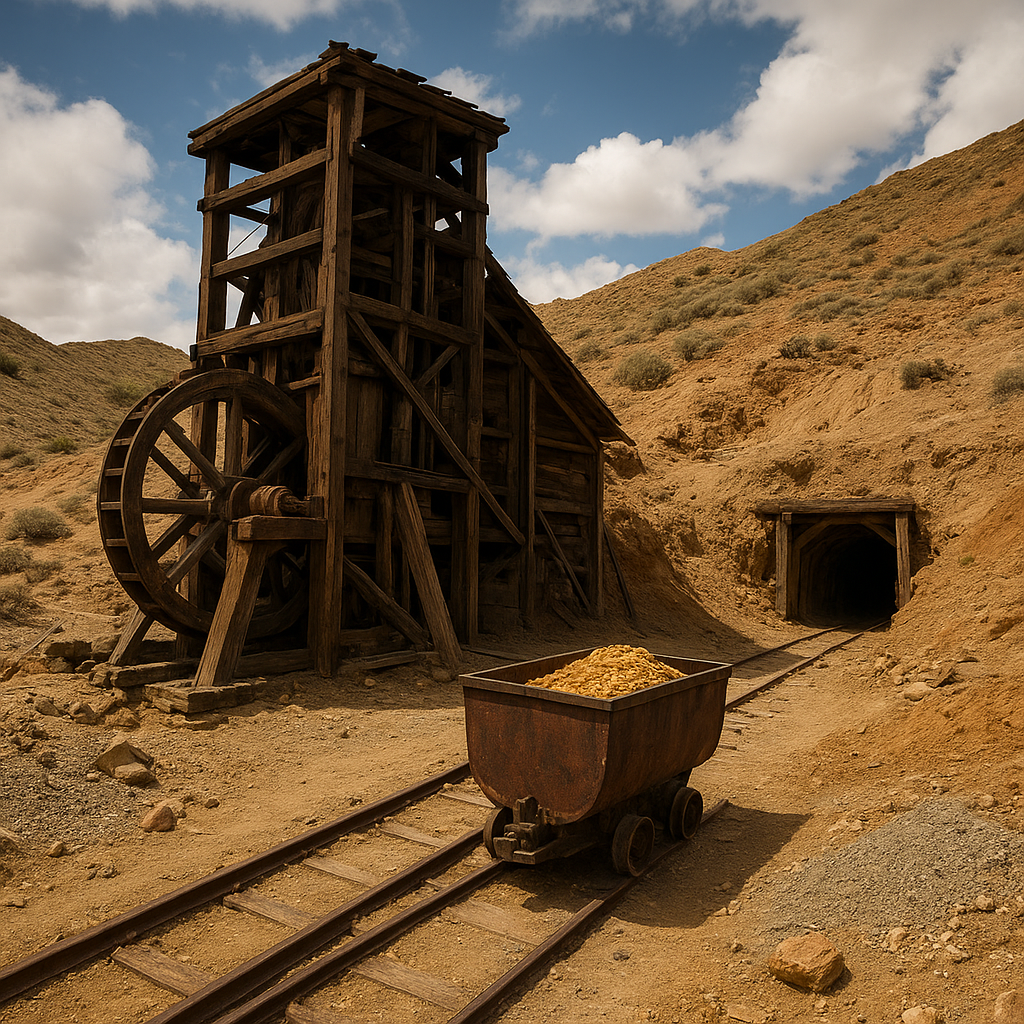
Turquoise Ridge is one of the notable gold mining operations in the United States, occupying a strategic place within Nevada’s prolific mineral belt. The mine complex combines modern underground mining techniques with decades of exploration knowledge to produce gold from a classic Nevada deposit type. Its role stretches beyond simple commodity extraction: Turquoise Ridge contributes to regional employment, technological innovation in underground mining, and ongoing geological discovery that continues to attract attention from industry observers.
Location and geological setting
Turquoise Ridge sits in northern Nevada, within Nevada’s famous gold-producing province known as the Carlin Trend. The Carlin Trend is one of the most economically important gold belts in the world, characterized by a cluster of sediment-hosted, fine-grained gold deposits often described as Carlin-type mineralization. These deposits host gold that is commonly “invisible” to the naked eye, occurring in microscopic particles disseminated through host rocks and associated sulfide minerals.
Geologically, the Turquoise Ridge area is defined by carbonate host rocks and a structural framework of faults and folds that focused hydrothermal fluids during mineralization. Those fluids introduced gold and other elements into permeable horizons and structural traps. The deposit’s geology makes it amenable to underground extraction because the mineralization typically forms tabular, continuous zones at depth rather than near-surface, scattered veins.
Ownership and operational structure
Turquoise Ridge is part of a larger portfolio of operations in Nevada managed under the cooperative structures that the industry has developed to optimize capital and operational efficiency. The site operates within the framework of modern corporate partnerships that combine technical and financial resources to run multiple mines as a coordinated system. These joint ventures aim to streamline processing, reduce costs, and apply shared best practices across proximate assets.
Under these arrangements, Turquoise Ridge benefits from access to shared processing and logistics infrastructure, and from centralized planning that can accelerate exploration and resource development. Centralized management often leads to improved safety programs, standardized environmental controls, and consolidated procurement, all of which affect the mine’s long-term viability.
Mining methods and processing
The primary commodity mined at Turquoise Ridge is gold. The operation uses conventional underground mining techniques tailored to the geometry of the ore zones. Methods commonly include drift and bench development, long-hole stoping, and cut-and-fill in tighter, irregular areas. Modern mechanization—such as high-capacity loaders, trackless haulage systems, and remote monitoring—helps maintain productivity and reduces exposure to hazardous conditions.
Ore from underground workings is transported to on-site processing facilities where it undergoes crushing, grinding, and extraction. Depending on ore characteristics, processing streams may include gravity recovery for coarse gold particles, followed by chemical extraction methods such as carbon-in-leach (CIL) or flotation-to-leach flowsheets to maximize recovery. Tailings management and water recycling are integral parts of the processing cycle, reflecting regulatory and social expectations for environmental stewardship.
Advances and technology
Turquoise Ridge and similar operations have increasingly embraced technology to boost safety and efficiency. Real-time monitoring of ventilation, equipment telemetry, and fleet management systems cut costs and environmental footprints. Automation and remote-control equipment reduce personnel exposure in challenging parts of the mine and improve productivity during shift changes and maintenance periods. These technological adaptations form part of a broader industry trend toward digital transformation in underground mining.
Economic significance
The economic footprint of Turquoise Ridge extends well beyond on-site production. As a source of employment, the mine supports a workforce of mine operators, geologists, engineers, technicians, and administrative staff. Local suppliers, contractors, and service companies also benefit from contracts for maintenance, fuel, equipment, and other goods and services. In rural Nevada communities, a large mine often represents one of the primary stable employers, contributing to local tax bases and municipal services.
At a regional and national level, gold production contributes to export revenues and helps meet demand for a globally traded commodity that acts as a store of value. The mine’s operations stimulate secondary economic activity through wages that are spent locally and through taxes and royalties that support public infrastructure. Additionally, mining investments often spur improvements in transportation, communications, and community facilities.
Investment and market role
Mines such as Turquoise Ridge influence investor perceptions of the broader mining sector. A stable, well-managed operation can attract capital for exploration, reserve expansion, and technological upgrades. Because gold plays a dual role—both as an industrial commodity and a financial asset—consistent production and proven reserves at a site enhance corporate balance sheets and can help secure funding for further development.
Environmental management and community relations
Environmental management is central to modern mining operations. At Turquoise Ridge, best-practice programs typically target water management, dust control, waste rock and tailings stability, and progressive reclamation of disturbed areas. Water recycling and treatment systems aim to minimize freshwater consumption and protect local aquifers. Dust suppression, noise mitigation, and habitat protection are common elements of environmental plans to reduce impacts on surrounding ecosystems.
Community engagement forms another pillar of a responsible operation. Companies operating such sites commonly invest in local hospitals, schools, road improvements, and training programs to support workforce development. A sustained dialogue with ranchers, local governments, indigenous groups, and other stakeholders helps identify concerns early and create frameworks for benefit sharing and conflict mitigation.
Regulatory context
In Nevada, mining is regulated by a combination of state and federal agencies that monitor environmental compliance, workplace safety, and land reclamation. Adhering to these regulations requires detailed reporting, regular audits, and sometimes independent monitoring. This regulatory environment has pushed many operators to adopt more transparent practices and to invest in technologies that reduce emissions and the surface footprint of operations.
Exploration, reserves and future potential
Exploration remains a continuous activity around established mines like Turquoise Ridge. Geologists use a combination of surface mapping, geochemical sampling, and advanced geophysical techniques to delineate extensions of known zones and to discover new ones. Because Carlin-type deposits can extend laterally and at depth, targeted drilling programs often yield incremental increases in resources that can justify extending the mine life.
The future potential of Turquoise Ridge depends on several factors: the success of exploration in identifying additional mineralization, the metal price environment, technological advances that lower extraction costs or allow recovery of previously uneconomic material, and the ability to maintain social license to operate. Even modest increases in contained gold or improvements in recovery rates can materially affect the economics of underground operations.
Interesting aspects and lesser-known details
- Invisible gold: Much of the gold in Carlin-type deposits exists at a microscopic scale, locked in sulfide minerals or hosted inclusions, which challenges detection and processing and encourages innovation in beneficiation techniques.
- Complex logistics: Operating an underground mine in a semi-arid region demands careful coordination of fuel, power, and water supplies, and often spurs infrastructure development that benefits communities beyond the mine site.
- Adaptive reuse: Reclamation plans commonly include returning disturbed land to grazing, wildlife habitat, or other productive uses, demonstrating how mine closure can be planned from the outset rather than treated as an afterthought.
- Shared infrastructure: In multi-mine districts, shared milling, tailings facilities, and access roads reduce capital intensity and environmental footprint compared with standalone operations.
- Workforce skills: Underground operations cultivate a pool of specialized labor—diesel mechanics, ventilation engineers, and geotechnical specialists—that underpins the regional mining economy and supports knowledge transfer to other projects.
Challenges and considerations
Operating an underground gold mine poses technical and non-technical challenges. Geotechnical stability, groundwater control, ventilation, and maintaining safe working conditions at depth are ongoing technical priorities. Economically, the volatility of gold prices can compress margins and delay investment in exploration or capital projects. Socially, maintaining community trust and meeting expectations for environmental protection require continuous effort and transparent communication.
Moreover, evolving regulatory frameworks and heightened attention to climate-related risks push operators to reckon with emissions from diesel fleets and to consider electrification and renewable energy integration. Transitioning to lower-carbon operations often involves capital expenditure and operational changes that must be balanced against tight cost controls typical of commodity cycles.
Conclusion: the broader role of Turquoise Ridge
Turquoise Ridge exemplifies the multifaceted nature of modern mining: a technical enterprise rooted in detailed geological science, a significant economic actor in its region, and a participant in broader conversations about environmental stewardship and sustainable development. As exploration continues and technologies evolve, sites like Turquoise Ridge will likely remain important contributors to the global gold supply while also serving as laboratories for improved mining practices. The interplay of geology, engineering, economics, and community relations at such a site highlights why gold mining in Nevada continues to be both commercially important and intellectually engaging.

