
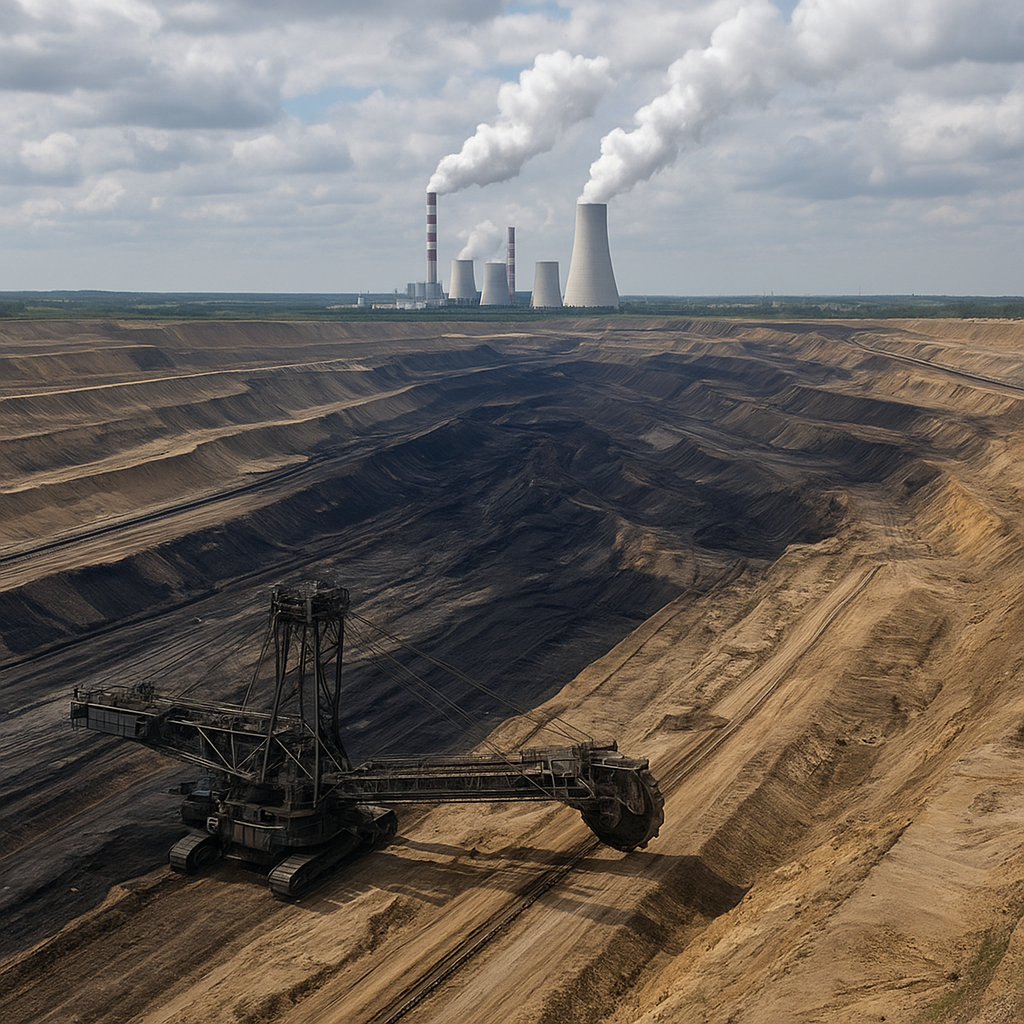
The Turów lignite complex is one of Central Europe’s most prominent fossil fuel operations, combining an extensive open-pit mine with a large thermal power plant and a dense network of infrastructure that links natural resources to industry and households. Located at the southwestern edge of Poland, close to the borders with the Czech Republic and Germany, the site has long been a focal point for regional energy security, economic activity and environmental debates. This article explores where the mine is situated, what it produces, its economic significance, the technical and social features of its operation, and several notable or surprising aspects that help explain why Turów continues to attract attention.
Location, geology and physical characteristics
The Turów complex sits in the Polish part of the historic Upper Lusatia region, near the town of Bogatynia. Its proximity to the international borders with the Czech Republic and Germany makes it geopolitically sensitive: operations and environmental impacts can, and do, cross national lines. The deposit exploited at Turów is a deposit of lignite (brown coal), a low-rank coal with relatively high moisture content and lower calorific value than hard coal. Lignite in this part of Europe formed in shallow basins during the Neogene and Quaternary periods and is found in thick, relatively shallow seams that make surface mining both feasible and economically attractive.
Turów is operated as an open-pit mine, which means that massive sections of overburden are removed to access continuous coal seams. Typical open-pit features present at Turów include large spoil heaps, vast excavation faces, conveyor-belt systems connecting the mine to the adjacent power plant, and a complex water management regime to control groundwater inflows into the pit. The scale of the mine is large by Polish standards and comparable to many of the lignite operations elsewhere in Germany and the Czech Republic.
What is extracted and how it is used
The primary product of the Turów site is lignite, mined and transported directly to the neighboring Turów Power Station. Lignite from this mine is predominantly used for the production of electricity and heat in a combined heat and power configuration: the plant burns the mined coal to generate steam for turbines, producing electricity for the national grid and heat for local district-heating networks. Because lignite is bulky and relatively low in energy density, most of it is consumed close to the mine, which explains the co-location of mine and power plant.
Operationally, the mine employs heavy mechanized equipment: bucket-wheel excavators, large dump trucks, and extensive conveyor systems that carry coal to the plant 24/7. Material handling also includes overburden removal, stockpiling, coal crushing and quality control processes to ensure the lignite meets the plant’s fuel specifications. The proximity of mine and power station reduces transport costs and logistical complexity, making the system a vertically integrated energy complex.
Economic significance for the region and Poland
The Turów complex carries substantial economic weight both locally and nationally. At regional level, the mine and power plant are among the largest employers in the area, providing direct jobs in mining, power generation, maintenance and administration, as well as indirect employment in services, transport and supply chains. Local budgets benefit from taxes, royalties and municipal payments that help fund schools, roads and other public services.
- Employment: The mine and power plant together sustain thousands of jobs, including numerous skilled positions in heavy industry and engineering.
- Energy security: Turów contributes to Poland’s domestic generation capacity, reducing the need for importing fuels or electricity and supporting grid stability in the southwest region.
- Industrial supply: Consistent, predictable output from the mine supports industry and households that depend on stable power and heat supplies.
At the national level, the site has been part of broader discussions on Poland’s energy mix. Lignite-fired stations like Turów have historically helped Poland maintain a high degree of energy sovereignty by relying on domestic resources. However, balancing that advantage with environmental and climate commitments presents policy challenges that reach beyond the mine itself.
Operational and technical features
Turów operates on a large scale, with continuous excavation and material-handling processes designed for uninterrupted fuel supply. The mining method is open-pit, involving systematic benching and the use of heavy equipment that can move millions of cubic meters of material annually. Conveyor belts and overland conveyors form the backbone of the logistics system, delivering fresh coal to the power plant in near real time.
Key technical features include:
- Integrated conveyor systems linking pit to power station to minimize truck transport.
- Groundwater control systems such as dewatering wells and channels to maintain dry working conditions in the pit.
- Dust suppression measures and noise mitigation to reduce local environmental nuisance.
- Continuous monitoring of air, water and soil quality as part of regulatory compliance.
Modern sections of the operation also incorporate computerized fleet management, remote monitoring of heavy machinery and predictive maintenance to boost uptime and safety. Nevertheless, the basic mechanics of removing overburden and accessing lignite seams remain physically intensive and space-demanding.
Environmental and social impacts
Large-scale surface mining brings a variety of environmental and social challenges. At Turów, these include alteration of local groundwater regimes, impacts on springs and wells in nearby communities, dust and noise from blasting and excavation, and landscape changes from the creation of open pits and spoil heaps. Because the site is near international borders, concerns raised by neighboring countries about transboundary environmental effects have led to diplomatic and legal engagement.
Key environmental concerns include:
- Lowering of water tables and changes in river baseflow patterns due to dewatering of the pit.
- Dust emissions affecting air quality, vegetation and local health.
- Noise and vibrations from heavy machinery and blasting.
- Loss of agricultural land and natural habitats as the pit expands.
In response, the operator and regulators have implemented measures such as dust control systems, buffer planting, controlled blasting schedules and detailed water management plans. Reclamation work—transforming mined-out areas into new landforms, often including lakes, parks or agricultural land—is a long-term feature of mine planning and has been proposed as a post-mining vision for Turów. Such plans require significant investment and long-term stewardship to be effective.
Cross-border relations and legal disputes
Because of its location, Turów has been at the center of international attention. Neighboring communities across the Czech and German borders have reported effects attributed to the mine, most notably changes in groundwater levels that affected wells and springs. These cross-border impacts have led to formal complaints, bilateral talks and, at times, legal actions at the European level. The situation highlights how environmental externalities from large industrial projects can become geopolitical issues when they affect populations in more than one country.
Disputes have typically focused on:
- Groundwater and surface water impacts and the adequacy of mitigation measures.
- Transparency and access to environmental data for cross-border communities.
- Permitting for mine expansions and the adequacy of strategic environmental assessments.
These disputes underscore the complex balance between local economic interests and transnational environmental protection obligations. Negotiations, technical studies and legal processes have all formed part of the response to cross-border concerns.
History and evolution of the site
The Turów operation has evolved over more than a century, reflecting shifting economic, political and technological contexts. Initially developed to meet regional fuel needs, the site expanded in the decades after World War II as Poland industrialized and centralized its energy system. Over time technological upgrades to the power plant and changes in mining equipment increased efficiency and output. The relationship between mine and community has oscillated between dependence on the economic benefits and concern about environmental and social impacts.
Through the late 20th and early 21st centuries, the Turów complex mirrored broader trends in European energy policy: heavy reliance on domestic lignite for energy mix, followed by increasing scrutiny under environmental and climate agendas. The site has undergone periodic modernization efforts, including upgrades to emissions control at the power station and investments in safety and monitoring at the mine.
Future prospects and transitions
The future of Turów will be shaped by a combination of market forces, national energy policy, international environmental commitments and local political dynamics. In many European countries, lignite and other coal-fired generation face pressure from decarbonization policies, EU emissions targets, and economics favoring lower-carbon sources and renewables. For Turów, that means planning for a gradual transition could involve steps like efficiency improvements, fuel-switching technologies (where feasible), and long-term closure and reclamation plans.
Key issues that will influence the site’s future include:
- National energy policy and timelines for coal phase-out.
- Investment decisions by the operator and state authorities regarding modernization or replacement of capacity.
- Outcomes of environmental monitoring, cross-border negotiations and regulatory decisions.
- Economic alternatives for workers and communities dependent on the complex.
Successful transition planning would ideally combine clear timelines, retraining and economic diversification initiatives for the local workforce, and well-funded reclamation projects to restore and repurpose mined land.
Interesting and lesser-known aspects
Certain features make Turów especially noteworthy beyond its raw output. The site’s position near an international tripoint makes it a rare example of a heavy industrial operation with immediate cross-border environmental implications. This has led to unusually intense scrutiny and a need for international cooperation in environmental monitoring and mitigation.
- Integrated logistics: The contiguous mine-to-plant conveyor system means that coal-fed power is delivered with minimal road transport, reducing one class of emissions and congestion while concentrating environmental impacts on the pit and immediate surroundings.
- Technological scale: The operation uses massive earthmoving equipment and continuous-process handling, which is visually and technically striking to observers more familiar with smaller-scale mines.
- Post-mining vision: Reclamation proposals have included converting the exhausted pit into recreational water bodies or wetland habitats—an idea that, if realized, would create a dramatic landscape transformation over decades.
- Cross-border science: Because of the international interest, Turów has become a focal point for collaborative hydrogeological and environmental research involving Polish, Czech and German experts.
Another intriguing dimension is how local identity and culture interact with the mine. For many residents, the complex is both a source of livelihood and a defining landscape feature. Events, local media and town planning reflect a community negotiating the benefits and costs of living beside one of the region’s largest industrial sites.
Managing the balance: economy, energy and environment
The case of Turów encapsulates broader dilemmas many regions face when balancing immediate economic needs with long-term environmental sustainability. The mine supplies fuel that supports power generation, jobs and municipal revenues, yet it also produces externalities that affect ecosystems and neighboring communities. Policies that aim to manage these trade-offs typically involve:
- Rigorous environmental monitoring and transparent data-sharing with stakeholders.
- Compensation and mitigation measures for affected communities, including water supply alternatives and ecosystem restoration.
- Economic diversification programs to prepare the local workforce for change.
- Phased transition plans that align energy security goals with decarbonization commitments.
Ultimately, the Turów site will likely remain a reference point in discussions about how to reconcile legacy energy infrastructure with modern environmental and geopolitical realities.

