
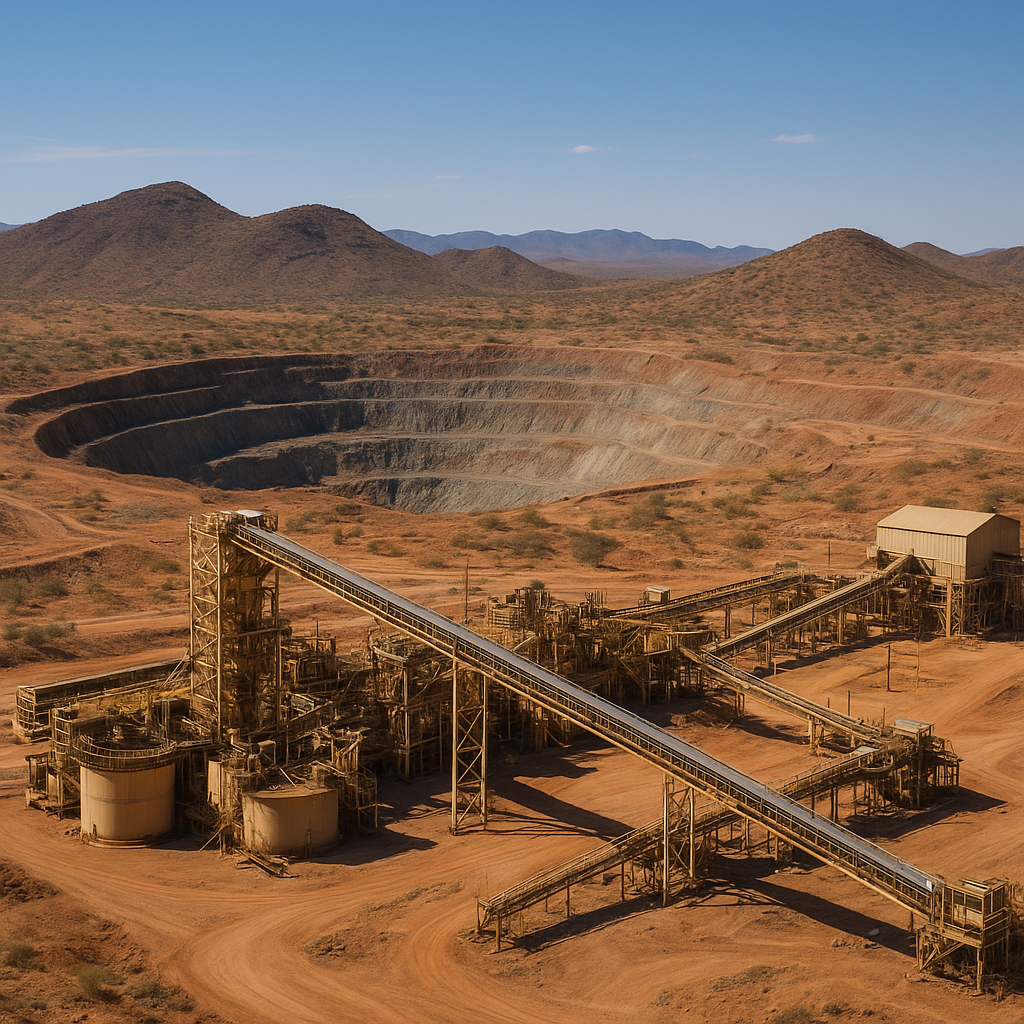
The Tumas Mine is a noteworthy uranium project located in central coastal Namibia. Situated within a prolific uranium province, Tumas has attracted international attention for its potential to contribute to global nuclear fuel supplies as well as to Namibia’s economic development. This article examines where the deposit sits geographically and geologically, what is extracted there, its economic importance, and several aspects that make the project especially interesting from technical, environmental and geopolitical perspectives.
Location and geological setting
The Tumas area lies in the western part of Namibia, in the Erongo Region, relatively close to the Atlantic coast and within the broader corridor that hosts several of the country’s major uranium operations. The site is located inland from coastal towns such as Swakopmund and the important export hub of Walvis Bay, which together provide logistical and port services that are critical for shipping mineral exports.
Geologically, Tumas is part of the coastal uranium province that includes a mix of deposit styles. Much of the near-coast uranium in Namibia occurs in shallow, surficial deposits and palaeochannel or calcrete systems, as well as in deeper granitoid- and metamorphic-hosted deposits elsewhere. The Tumas mineralization is characterized by relatively shallow horizons that are amenable to conventional surface-mining approaches, which reduces stripping and underground complexity compared with deep-hosted ore bodies.
That geological context gives Tumas a strategic advantage: the combination of accessible mineralization and proximity to existing mining infrastructure eases development pathways and lowers capital-expenditure hurdles, relative to more remote or deeper projects. The region’s established mining services, skilled labour pool and transportation links further enhance the site’s viability as a uranium operation.
What is mined at Tumas
At its core, the Tumas project targets uranium — the metallic element that is central to nuclear energy and certain high-tech industrial uses. Uranium from Tumas would typically be produced as a concentrated product such as uranium oxide (often referred to in the industry as “U3O8” or “yellowcake”), which is then exported and refined downstream in the nuclear fuel cycle.
The form and concentration of uranium at Tumas often determine the most suitable mining and processing route. Because the mineralization is relatively shallow and continuous, processing can be conducted using conventional milling techniques that include crushing, grinding and leaching, followed by precipitation to produce a saleable concentrate. The relatively simple metallurgy commonly associated with surficial uranium deposits means that recovery rates can be attractive and processing facilities do not necessarily need the complexity required for refractory or deep-granite-hosted ore types.
Beyond the uranium itself, uranium projects commonly encounter associated minerals and elements (for example, vanadium can occur with some uranium deposits elsewhere), but the economic focus at Tumas is squarely on uranium as a key export commodity for Namibia.
Ownership, development history and current status
Tumas has been explored and developed within a framework of international investment and domestic regulation. Australian and other international junior and mid-tier mining companies have been active in Namibia, often partnering with local stakeholders and working within Namibian mining legislation to progress exploration to resource definition and then to feasibility and permitting stages.
Development timelines for uranium projects typically include extensive drilling programs, resource estimation, baseline environmental studies, community consultations, and feasibility studies before a final investment decision is taken. For Tumas, the proximity to other operating mines and established processing capacity in the region has allowed developers to explore options for shared infrastructure, reduced capital expenditure and synergies in workforce and supply chains.
Regulatory and permitting environment
Namibia has a structured regulatory framework for mining, overseen by national authorities that manage licensing, environmental approvals and royalty collection. Permitting for uranium projects involves additional layers of environmental and radiological oversight because of the potential health and ecological implications of radioactive materials. Compliance with international best practices in radiation protection, tailings management and water use is therefore a core part of project execution at Tumas.
Economic significance for Namibia and global markets
Uranium is one of Namibia’s major mineral exports and plays an outsized role in the country’s mining portfolio. The development of projects such as Tumas contributes to national objectives including foreign-exchange earnings, employment, and the strengthening of local supply chains. The project can stimulate local economies through direct jobs, procurement from Namibian businesses and investments in infrastructure.
Globally, uranium is central to the nuclear energy sector. Nuclear power plants require a steady, long-term supply of uranium for fuel fabrication. The global market for uranium is influenced by factors such as nuclear capacity additions or retirements, government energy policy, prices of alternative fuels, and strategic stockpiling by utilities and states. New mines like Tumas can help diversify supply, improve market resilience and reduce reliance on a small number of large suppliers.
For Namibia, the export earnings from uranium also translate into royalty and tax revenues for the government, which can be allocated to public services and development programs. Local content policies often require or encourage mining companies to engage local contractors, invest in workforce training and support community development projects — amplifying the socioeconomic benefits.
Employment, skills and local industry stimulation
Beyond direct employment, a uranium project can spur industry development in areas like transportation, catering, maintenance services, and technical training. Mining operations often bring technical skills and operational standards that can be transferred to other Namibian industries, lifting overall capacity and resilience of the local economy.
Environmental and social considerations
Mining uranium carries environmental and social responsibilities that receive heightened attention given the element’s radioactive nature. For Tumas, good practice includes careful baseline studies, continuous environmental monitoring, robust tailings and waste-rock management, and strict control of dust and water quality. Modern uranium operations typically implement engineered tailings facilities, water recycling systems and progressive rehabilitation plans to minimize long-term impacts.
Water is a particularly sensitive resource in Namibia’s arid environment. Mining operations must manage both consumption and potential contamination of groundwater. As a result, water-efficient processing, closed-circuit systems and careful hydrogeological studies are integral to project approvals and ongoing operations.
Social license to operate is another key pillar. Companies developing Tumas must engage with local communities, traditional authorities and municipal entities to ensure that impacts and benefits are understood, fair compensation is provided where needed, and opportunities for employment and procurement are maximized. Transparent revenue reporting and local investment programs help build trust and long-term acceptance.
Health, safety and radiological protection
Protecting the health and safety of workers and nearby populations is non-negotiable. Radioactive materials require stringent controls including monitoring of workplace exposure, protective equipment, training, and environmental radiation surveys. International standards and IAEA guidance inform best practice, and many Namibian projects adopt these to maintain high safety and environmental performance.
Infrastructure, logistics and operational advantages
Tumas benefits from being located within a mineral-rich region that already supports sizeable mining activity. Shared infrastructure such as roads, power lines and access to the Walvis Bay port can significantly reduce development costs. The port provides vital export capacity for mined uranium concentrates destined for international markets.
Proven regional expertise in uranium mining and processing also shortens the learning curve for project developers. Namibia’s experienced workforce and local service providers facilitate faster ramp-up during construction and operation compared with greenfield sites in less developed jurisdictions.
- Proximity to ports and established mines reduces logistical complexity.
- Shallow mineralization supports lower-cost surface-mining methods.
- Existing regional skills and suppliers expedite project development.
Interesting aspects and wider implications
Several features make Tumas particularly interesting beyond its immediate commercial value. First, the project sits within the broader narrative of Namibia as a key global uranium supplier. With some of the world’s largest uranium mines, Namibia plays a strategic role in the nuclear fuel market, and projects like Tumas can reinforce that position.
Second, the juxtaposition of modern mining in an ancient desert landscape presents unique engineering and environmental challenges. Operators must reconcile intensive industrial activity with fragile ecosystems, cultural sites and scarce water resources. This results in innovative technical solutions — for example, highly efficient water management systems, dust suppression technologies, and adaptive rehabilitation techniques that aim to restore desert surfaces after closure.
Third, Tumas exemplifies how junior mining companies can progress discoveries by leveraging global capital markets and partnering with local stakeholders. The project highlights the interplay between exploration success, commodity cycles and the policy environment: favorable uranium prices and supportive government policies accelerate development, while lower prices force developers into additional optimization and efficiency measures.
Technological, strategic and geopolitical notes
Uranium’s role in energy security is another compelling angle. As countries consider energy mixes that reduce carbon emissions, nuclear power often re-enters policy discussions, potentially increasing long-term demand for uranium. Projects like Tumas therefore have strategic value: they can help diversify supply sources for utilities and nations seeking stable fuel commitments.
Finally, the presence of multiple uranium projects in the same region encourages knowledge sharing, improved environmental standards and coordinated regional planning. When companies, regulators and communities collaborate, the aggregate outcome can include safer operations, enhanced economic benefits and better-managed ecological footprints.
Future prospects and development potential
The future trajectory for Tumas depends on a mix of technical progress, market conditions and regulatory processes. If uranium prices remain supportive and development milestones such as feasibility studies and permitting are achieved, the project could move into construction and production phases within a predictable timeframe. Conversely, lower commodity prices typically compel developers to optimize designs and defer large capital commits until market conditions improve.
Exploration upside is another critical factor. In many mineral provinces, initial deposits serve as a foothold for further discoveries — additional satellite deposits or extensions of the resource can be found through continued exploration and drilling campaigns. Tumas’s geological setting suggests potential for such incremental growth, which could extend mine life and improve the project’s economics.
In summary, Tumas represents a modern uranium development embedded in one of the world’s most significant uranium-producing regions. Its combination of geology, proximity to infrastructure, and the broader market context make it a project of interest to investors, policymakers and communities alike. The technical and social frameworks applied during development will determine how much the mine contributes to Namibia’s long-term sustainable development while meeting global demand for nuclear fuel.

