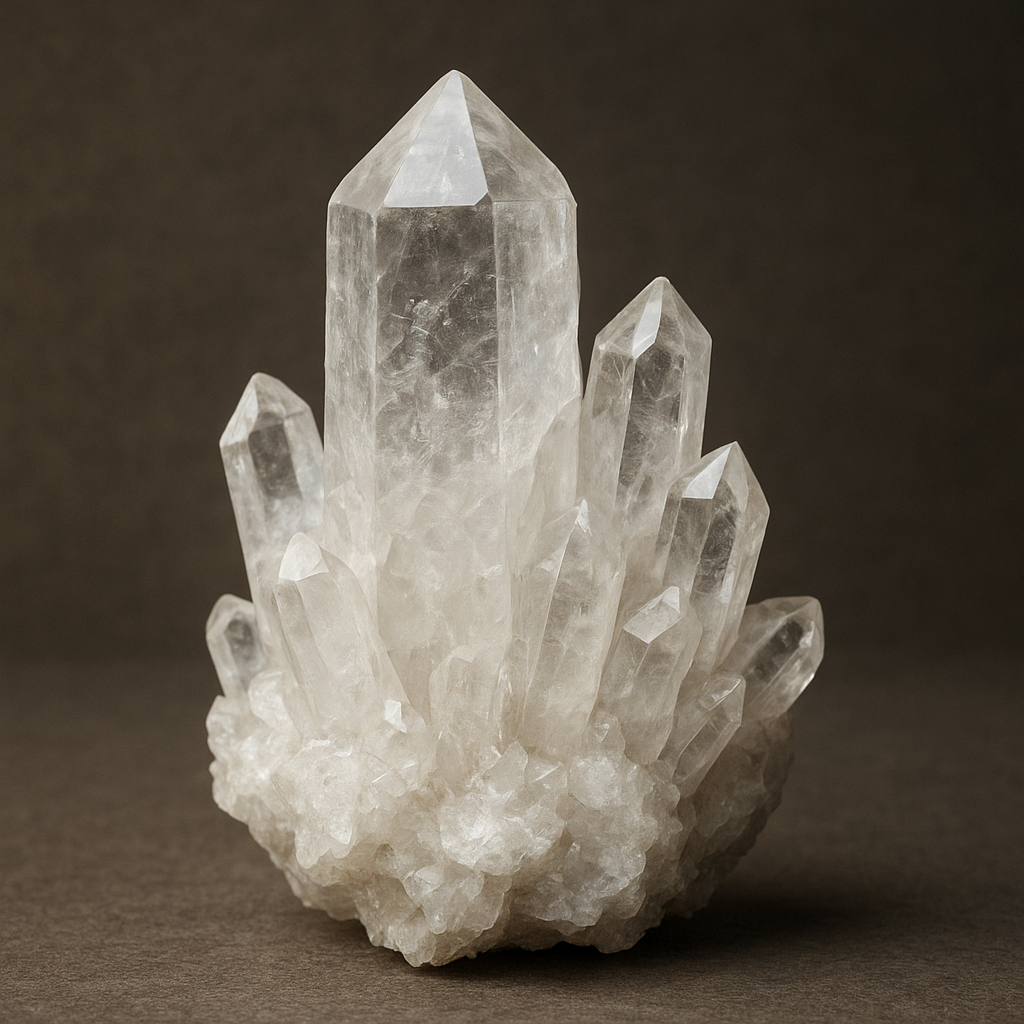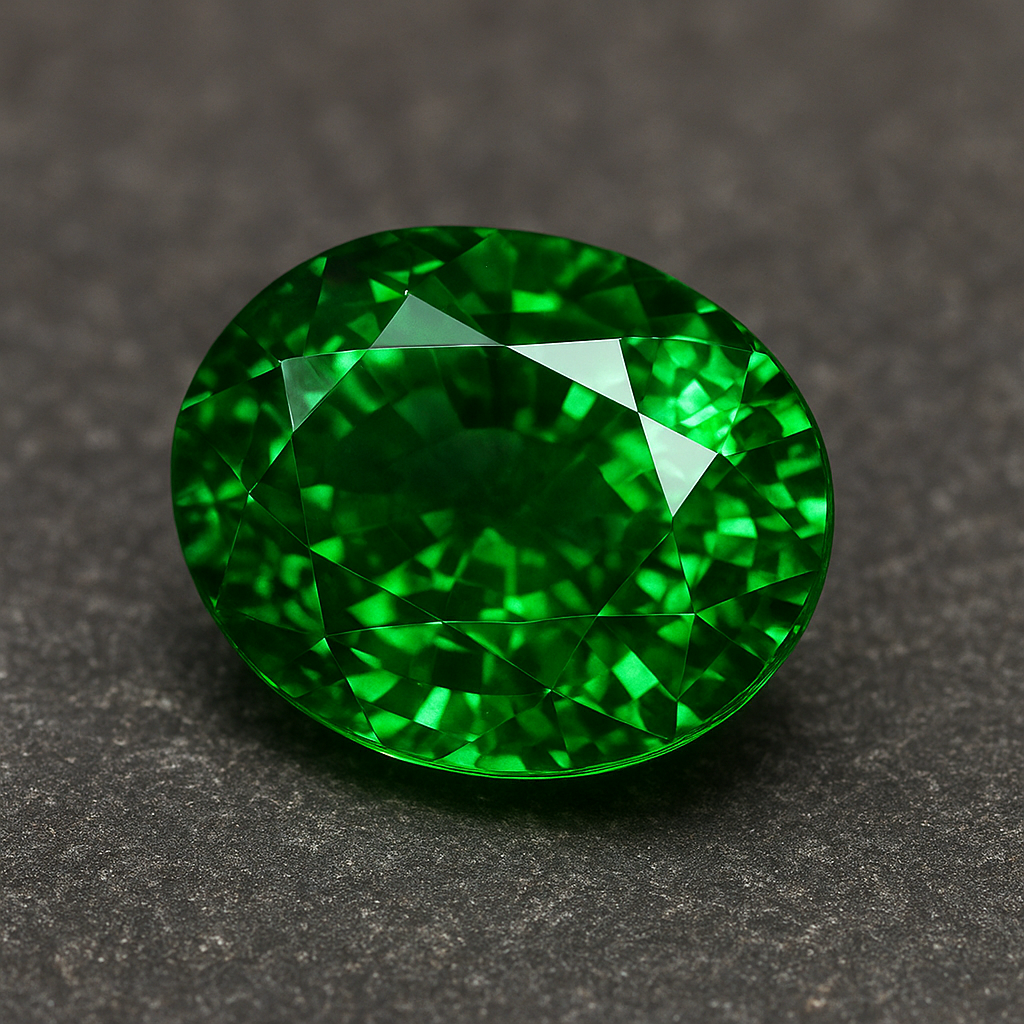
Tsavorite is one of the most striking green gemstones discovered in the 20th century: a vivid, lively variety of grossular garnet prized by gemologists and jewelers alike. Combining the toughness of garnet with an emerald-like hue, this stone has gained an enthusiastic following among collectors and designers. The following article explores its origins, chemistry, geological settings, gemological characteristics, uses in jewelry, market dynamics, and a few lesser-known facts that make tsavorite a fascinating subject for anyone interested in gems.
Geology and Chemistry
Tsavorite is a green variety of grossular garnet, a member of the garnet group whose general chemical formula can be written as Ca3Al2(SiO4)3. The vivid green color that defines tsavorite is caused primarily by trace amounts of chromium and vanadium substituting for aluminium in the crystal lattice. Because garnets crystallize in the isometric system, tsavorite occurs as dodecahedral or trapezohedral crystals and is optically isotropic, meaning it does not display birefringence.
From a physical standpoint, tsavorite combines a relatively high refractive index and dispersion with good durability. Typical gemological ranges for tsavorite are a refractive index in the neighborhood of about 1.740–1.760, a specific gravity roughly around 3.60–3.68, and a Mohs hardness between 7.0 and 7.5. These properties give tsavorite a brilliant, lively appearance while still being robust enough for daily wear in most jewelry settings.
Where Tsavorite Is Found
While green grossular occurrences have been known for a long time, what we recognize specifically as tsavorite gained attention after noteworthy discoveries in East Africa. The most significant and well-known deposits are in Kenya and Tanzania, particularly in regions adjacent to the Tsavo National Park (from which the trade name derives) and in pockets of metamorphosed rocks and contact-metamorphic zones. These East African deposits have produced the finest and most commercially important material.
Secondary occurrences of green grossular similar to tsavorite have been reported from other countries, including Madagascar and Pakistan, among others, but these are generally less consistent in quality or quantity. Because the geological settings that produce high-quality tsavorite—specific combinations of host rocks, metamorphic conditions, and chromium/vanadium availability—are relatively uncommon, the gem remains rarer than many other green gem varieties.
Discovery, Naming, and Historical Context
The modern commercial history of tsavorite is tied to a few key figures and institutions. In the late 1960s and early 1970s, the Scottish gem prospector Campbell Bridges (later Sir Campbell to some circles) is credited with bringing commercially viable deposits to light in East Africa. The name tsavorite was coined by the American jeweler Tiffany & Co., referencing the Tsavo region in Kenya, and was promoted in the trade as an attractive alternative to emeralds, emphasizing its clarity and brilliance as advantages.
Tsavorite’s rise in popularity was partly due to this successful marketing and partly due to its gem-quality characteristics. Unlike many emeralds, which commonly display significant inclusions and often are oiled to enhance appearance, tsavorites are frequently eye-clean and do not require such treatments. This combination of natural beauty and relative purity helped establish tsavorite as a desirable gem among collectors and designers in the late 20th century.
Gemological Properties and Identification
Identifying tsavorite requires an understanding of its optical and physical characteristics. As an isometric garnet, tsavorite is typically singly refractive and does not show pleochroism. Under magnification, tsavorites often appear eye-clean to slightly included; inclusions when present are usually mineral crystals, tiny fractures, or growth features rather than the dense syringes or three-phase inclusions often seen in emeralds.
- Refractive Index: approximately 1.740–1.760 (single reading typical for garnets)
- Specific Gravity: approx. 3.60–3.68
- Hardness: 7.0–7.5 on the Mohs scale
- Crystal System: isometric (cubic)
Because many green gems exist—emerald, demantoid garnet, green sapphire, peridot, and tourmaline among them—gemologists rely on a combination of tests (refractive index, specific gravity, magnification, spectroscopic analysis) to differentiate tsavorite from look-alikes. In particular, the absence of pleochroism and the typical garnet refractive index are clues pointing toward tsavorite. Advanced instruments may reveal absorption features linked to chromium and vanadium, further supporting identification.
Color, Clarity, and Value Factors
Color is the paramount value factor for tsavorite. The most desirable tsavorites show a pure, vivid green that leans neither too yellow nor too blue; the most prized tone is often described as a medium to medium-dark, highly saturated green, comparable in intensity to high-quality emeralds. Stones that are too dark lose brilliance, while those too light may be valued less.
Clarity is another important determinant of price. Because tsavorites are more commonly eye-clean than emeralds, larger eye-clean stones command high premiums. Size also plays a major role: gem-quality tsavorites over 2 carats are uncommon, and stones in the 5–10 carat range are rare and therefore can be extremely valuable. Cut quality influences how well the stone reflects light; well-cut tsavorites maximize brilliance and color and will be priced accordingly.
In valuation, color is typically followed by clarity, cut, and carat weight. A top-color, eye-clean tsavorite will usually attract much higher prices than a similar-sized stone with weaker color or visible inclusions.
Cutting, Styles, and Jewelry Applications
Because tsavorite tends toward strong brilliance and good durability, it adapts well to a variety of jewelry settings. Common uses include rings, pendants, earrings, and bracelets. Designers often set tsavorite as a center stone in halo styles to emphasize color, or pair it with diamonds and other gems for color contrast.
Popular cuts for tsavorite are those that balance color saturation with sparkle: oval, cushion, and brilliant round cuts are frequent choices. Step cuts such as emerald cuts may be used for larger, high-clarity stones, offering a more geometric, classical look. Cabochons are rare for tsavorite since the faceted cut enhances its brilliance.
Tsavorite’s hardness and toughness make it reasonably suitable for everyday wear, though settings that protect prongs and edges—particularly for rings—are commonly recommended. Thanks to its clarity, tsavorite also photographs beautifully, which has contributed to its appeal in bespoke and high-fashion jewelry.
Comparisons with Other Green Gems
Tsavorite is frequently compared to emerald because of the similarity in color, but several important distinctions are worth noting. Emeralds are beryl minerals and are typically softer (Mohs 7.5–8) but often more included; they are commonly treated with oils or resins to improve visual appearance. Tsavorite, being a garnet, is generally more brilliant and less included, and it usually requires no treatment.
Compared with demantoid, another green garnet variety, tsavorite tends to have a different green tone: demantoid often shows a more yellowish-green tone with exceptional dispersion and fire, while tsavorite typically displays a vivid, slightly bluer pure green. Peridot, green sapphires, and green tourmalines each occupy different niches in the color spectrum and pricing, with tsavorite prized for its particular balance of brilliance, clarity, and pure green coloration.
Mining, Ethics, and Sustainability
Most tsavorite production has historically come from small-scale and artisanal mining operations. Such mining can bring economic opportunity to rural communities but also raises concerns about environmental impact, worker safety, and traceability. Unlike diamonds, gemstones like tsavorite are not covered by a single globally recognized certification scheme analogous to the Kimberley Process, so ethical sourcing often depends on individual companies and third-party initiatives.
In response to these concerns, some dealers and jewelry houses emphasize traceability and engage in local development projects, fair labor practices, and environmental rehabilitation. Responsible buyers increasingly seek documentation or assurances regarding origin and ethical practices. Certifications from reputable gemological laboratories about natural, untreated material also carry weight in the market.
Care, Treatment, and Longevity
Tsavorite is typically sold in its natural, untreated state, which appeals to collectors who prefer untreated stones. Because of its durable nature, tsavorite can usually withstand standard cleaning procedures; warm, soapy water and a soft brush are safe for routine care. As with most gemstones, if the stone has significant fractures or is mounted in heavily repaired settings, professional advice is recommended before using ultrasonic cleaners or steam cleaning.
- Avoid prolonged exposure to extreme heat, which can damage some gemstones or settings.
- Remove substantial-tsavorite rings during abrasive work to prevent scratches to the mounting or accidental knocks.
- Store tsavorite separately from harder stones like diamonds to prevent abrasion of the mounting or other components.
Market Trends and Collectibility
Tsavorite’s market presence has grown steadily since the 1970s, aided by its association with high-quality jewelry houses and its reputation as an attractive emerald alternative. Supply is limited by the relatively small number of productive deposits and the scarcity of large, high-quality stones, so prices for top material have appreciated over time, particularly for eye-clean stones above a few carats.
Collectors value tsavorite for its natural color and brilliance, while designers appreciate the gem’s ability to deliver vivid green hues in a durable, wearable format. The stone’s rarity in larger sizes, combined with increasing demand for ethically sourced and traceable gemstones, suggests that tsavorite will remain a sought-after gem for both the trade and private collectors.
Interesting Facts and Cultural Notes
Several points about tsavorite that often surprise enthusiasts:
- Its name comes from a conservation area—Tsavo National Park—linking the gem to a distinct geographic identity.
- Tsavorite is prized for being largely untreated. Unlike emeralds, it seldom requires oiling or other enhancements to display its best color.
- Although high-quality tsavorites are brilliant and vivid, they are often smaller than comparably priced emeralds; large, top-color tsavorites are unusually rare.
- Because it is a garnet, tsavorite displays isotropic optical behavior—an identification point when distinguishing it from pleochroic green gems.
Final Thoughts on Appreciation and Use
For connoisseurs of colored stones, tsavorite offers a compelling combination of intense green hue, optical brilliance, and relative durability. Whether chosen as a center stone for a unique engagement ring, as vibrant accent stones in high-fashion jewelry, or acquired as part of a gem collection, tsavorite occupies a distinct and desirable niche. Its geological story—rooted in rare geochemical conditions in East Africa and carried forward by skilled cutters and jewelers—adds layers of appeal for anyone who values both beauty and provenance in their gemstones.