
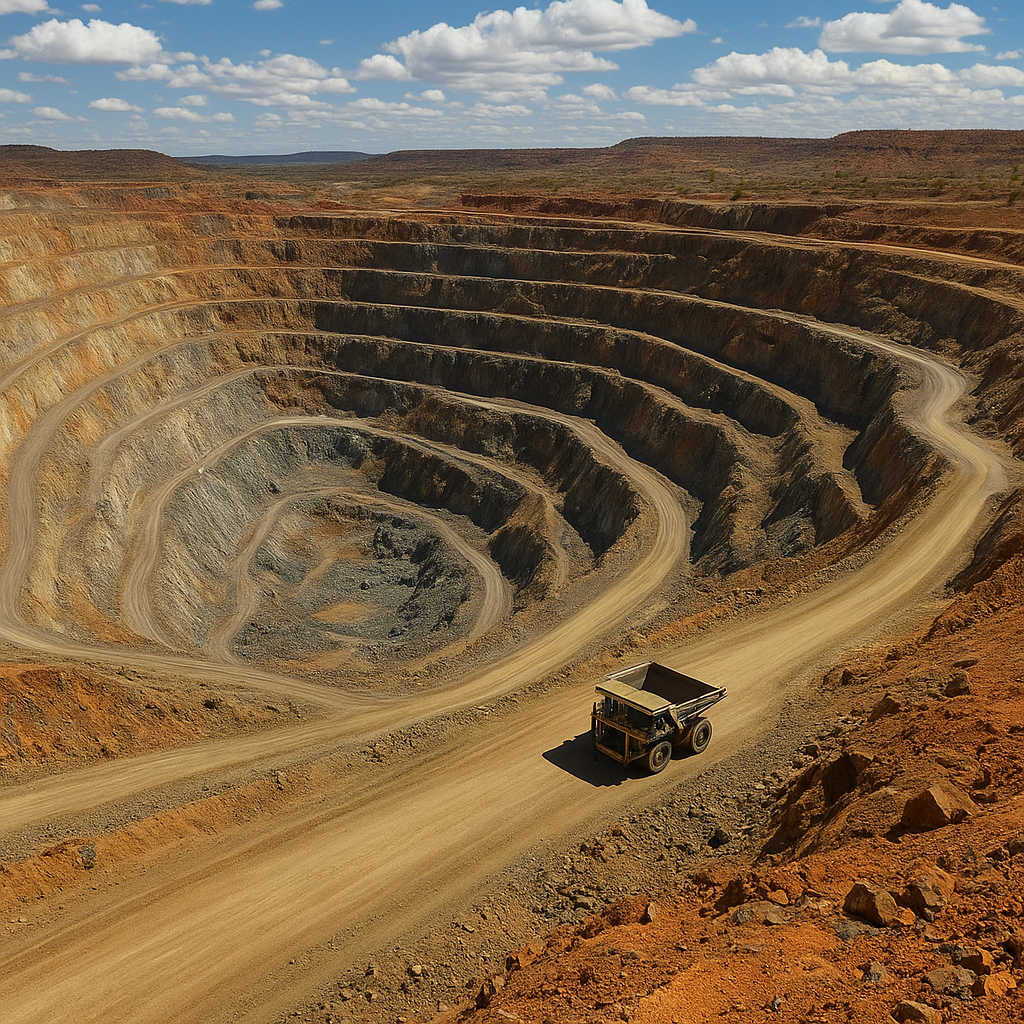
The Tropicana Mine is one of Australia’s most prominent modern gold operations, notable for its remote location, large-scale production and role in expanding Australia’s gold-bearing frontier. Located in a sparsely populated area of Western Australia, Tropicana combines cutting-edge exploration, large open-pit mining and a centralized processing plant to recover gold from Archean greenstone-hosted deposits. This article examines where Tropicana is situated, what is extracted there, its broader economic importance, and several technical and human-interest details that make the project noteworthy.
Location and geological setting
Tropicana sits in the eastern part of Western Australia within the Yamarna greenstone belt, an area of ancient rocks that has become a focus for exploration in the 21st century. The operation is positioned in a remote desert environment: roughly several hundred kilometres east-northeast of the regional centre of Kalgoorlie and several hundred kilometres east of Perth, connected to major centres by sealed and unsealed roads and serviced by an airstrip. The deposit lies within the broader Archean terranes that form part of the Yilgarn Craton, one of the world’s most prolific gold provinces.
Geologically, Tropicana is hosted in complex greenstone sequences and structurally controlled quartz- and sulfide-bearing veins and shear zones. The mineralisation style is consistent with orogenic-gold systems, where fluids migrated along fault zones during deep crustal tectonics and precipitated gold in structurally prepared sites. This structural control and the presence of multiple stacked zones have allowed Tropicana to be developed as a large, bulk-minable open-pit operation.
History, ownership and development
The Tropicana discovery and development story is a relatively recent chapter in Australian mining. Exploration activity in the area intensified in the early 2000s, and the key discoveries that underpin the operation were delineated through systematic drilling and geological mapping. Following resource definition and feasibility studies, construction of the mine and processing infrastructure proceeded in the early 2010s.
The mine is operated by the Tropicana Joint Venture. The operation has been principally developed and managed by a major international miner in partnership with an Australian-listed company. This joint-venture structure combined international mining expertise with local market knowledge and exploration capability, providing the capital and technical resources necessary to bring a remote deposit into commercial production.
Infrastructure and logistics
Because of its remote setting, Tropicana required substantial infrastructure during development: a central processing plant, extensive haul roads, a workers’ accommodation village (camp), an airstrip for fly-in–fly-out (FIFO) operations, and onsite services such as water, power generation and waste management. To ensure round-the-clock operation, a robust logistical chain supplies fuel, reagents and parts from regional hubs and ports. Over time the project has also invested in technologies and systems to reduce the logistical footprint and improve operational efficiency.
Mining method and processing
The dominant mining method at Tropicana is conventional open-pit mining. Large-scale drill-and-blast cycles are followed by load-and-haul with a fleet of hydraulic shovels and large dump trucks. The ore is transported to a central processing facility designed to treat tens of millions of tonnes of material per year. Crushing, grinding and gravity concentration are typically paired with carbon-in-leach (CIL) or similar cyanide-based circuits to extract gold from the ore.
Key metallurgical considerations for Tropicana include the variability in ore types across different deposits in the mining area and the presence of refractory zones that may require tailored processing approaches. The centralized mill provides economies of scale; processing multiple deposits through a single plant reduces capital intensity and allows flexible sequencing of feed sources to maintain steady production profiles.
Production profile and reserves
Since commencement of operations in the early 2010s, Tropicana has contributed materially to Australia’s annual gold output. The mine’s production profile is shaped by pit sequencing, ore quality and market conditions, but over its operating life it has delivered several hundred thousand ounces of gold per year on average. The project is underpinned by a substantial resource base with exploration programs continuing to extend the mine life through discovery and resource conversion.
Economic significance
Tropicana’s economic footprint reaches beyond the immediate mine site. At the operational level, the mine provides direct employment for hundreds of people and supports a wider network of contractors and suppliers across Western Australia. The project’s capital and operating expenditures have generated business opportunities for engineering, construction, transport, hospitality, equipment suppliers and specialist service providers.
On a regional and national scale, Tropicana contributes to export earnings and government revenues through taxes and royalties. Gold production adds to Australia’s position as one of the world’s leading gold producers, supporting balance-of-payments inflows and making gold an important commodity for the domestic mining industry. Payments associated with land access, local procurement policies and community programs further circulate economic benefits into nearby towns and Indigenous communities.
Local and Indigenous engagement
Operating in remote Western Australia places a premium on strong community relations and responsible land stewardship. Tropicana has entered into agreements and consultations with traditional owners and Indigenous groups to establish land access terms, cultural heritage protections and community development initiatives. These arrangements often include employment and training commitments, business opportunities for Indigenous suppliers, and funding for local projects such as education, health and cultural programs.
Environmental management and sustainability efforts
Mining in a sensitive and remote environment demands rigorous environmental management. Tropicana’s operators implement measures to minimise disturbance, manage water and tailings responsibly, and progressively rehabilitate disturbed land. Environmental monitoring programmes track biodiversity, air and water quality, and the effectiveness of rehabilitation, while adaptive management allows responses to emerging issues.
In recent years, there has been increasing emphasis on lowering the carbon footprint of remote mines. Tropicana has explored and adopted technologies to improve fuel efficiency in haulage, incorporate higher-efficiency power generation and trial renewable energy integrations. Waste management, reduction of freshwater usage and improved tailings handling are other priorities that feed into the operation’s sustainability profile.
Socio-economic and regional impacts
Beyond direct employment and supplier spend, Tropicana influences regional labour markets and services. The use of FIFO workforces affects housing, transport and social dynamics in fly-in centres. Local towns can benefit from increased demand for goods and services, but there are also challenges related to workforce accommodation, health services and infrastructure capacity. Responsible operators work with regional governments and communities to align mine operations with broader regional development goals.
Royalties and taxes paid by the operation contribute to state revenues, which can be directed to public services and infrastructure. Additionally, the mine’s presence stimulates secondary industries—maintenance yards, supply depots, and specialist consultancy services—that can persist beyond the life of the mine if managed strategically.
What makes Tropicana interesting
Tropicana stands out for several reasons:
- Discovery-driven development — Tropicana is an example of how modern exploration techniques and aggressive ground testing in underexplored terranes can yield world-class discoveries in the 21st century.
- Remote-scale mining — Building and operating a large open-pit mine and central mill in a remote setting demonstrates logistical and engineering achievement.
- Joint-venture model — The partnership between international and Australian entities illustrates how capital, technical expertise and local knowledge are combined to bring a project to commercial reality.
- Community engagement — The project has had to create robust frameworks for Indigenous engagement, cultural heritage protection and local benefits, reflecting modern standards for social licence to operate.
- Exploration potential — Surrounding greenstone belts continue to host exploration targets; ongoing drilling can materially extend mine life and underpin future production.
Technical and operational features
From a technical perspective, Tropicana uses best-practice approaches to ore handling, processing and mine planning. The centralized processing strategy is efficient for a cluster of nearby deposits. Operational innovations include optimised pit designs to reduce waste stripping, staged rehabilitation to minimise long-term liabilities, and the selective use of gravity recovery ahead of CIL circuits to maximise total gold recovery.
Human stories and workforce culture
Operating in remote Australian deserts shapes a unique workplace culture. Fly-in–fly-out rotations, onsite camps, and the shared experience of working in a rugged environment create tight-knit teams. The mine has invested in training and skills development to provide employees with career pathways within the operation and in the broader mining sector.
Challenges and future outlook
Like all mining projects, Tropicana faces ongoing challenges: commodity price volatility, the need to manage environmental and cultural heritage impacts responsibly, and the imperative to extend the life of the operation through exploration and optimisation. Mechanically, remote operations must constantly tighten logistics and reduce operating costs while maintaining high safety and environmental standards.
The future outlook depends on exploration success, economic conditions and the operator’s ability to innovate. Continued discoveries in the wider Yamarna belt or improvements in metallurgical recovery could sustain or even grow production. At the same time, industry-wide trends towards decarbonisation and more stringent environmental requirements will shape capital allocation and operational choices.
Why it matters beyond gold
Tropicana is more than a gold mine; it is a case study in bringing modern mining to remote regions while balancing technical, social and environmental responsibilities. The project demonstrates how a single large operation can generate long-term economic value through jobs, local procurement and government revenues, while also presenting a template for community engagement and environmental management in sensitive landscapes.
Key words emphasised in this article include: Tropicana, gold, Australia, Yamarna, AngloGold Ashanti, IGO, open-pit, mill, production, and royalties.

