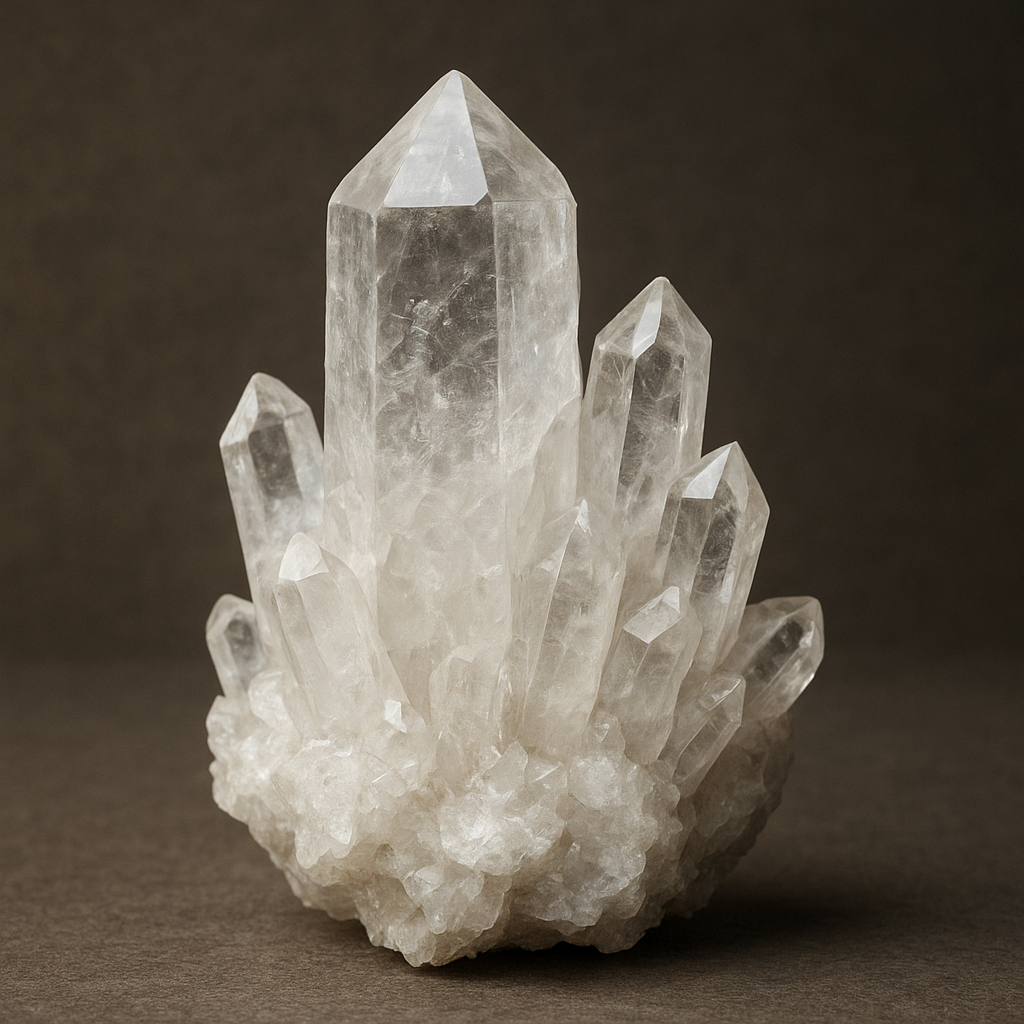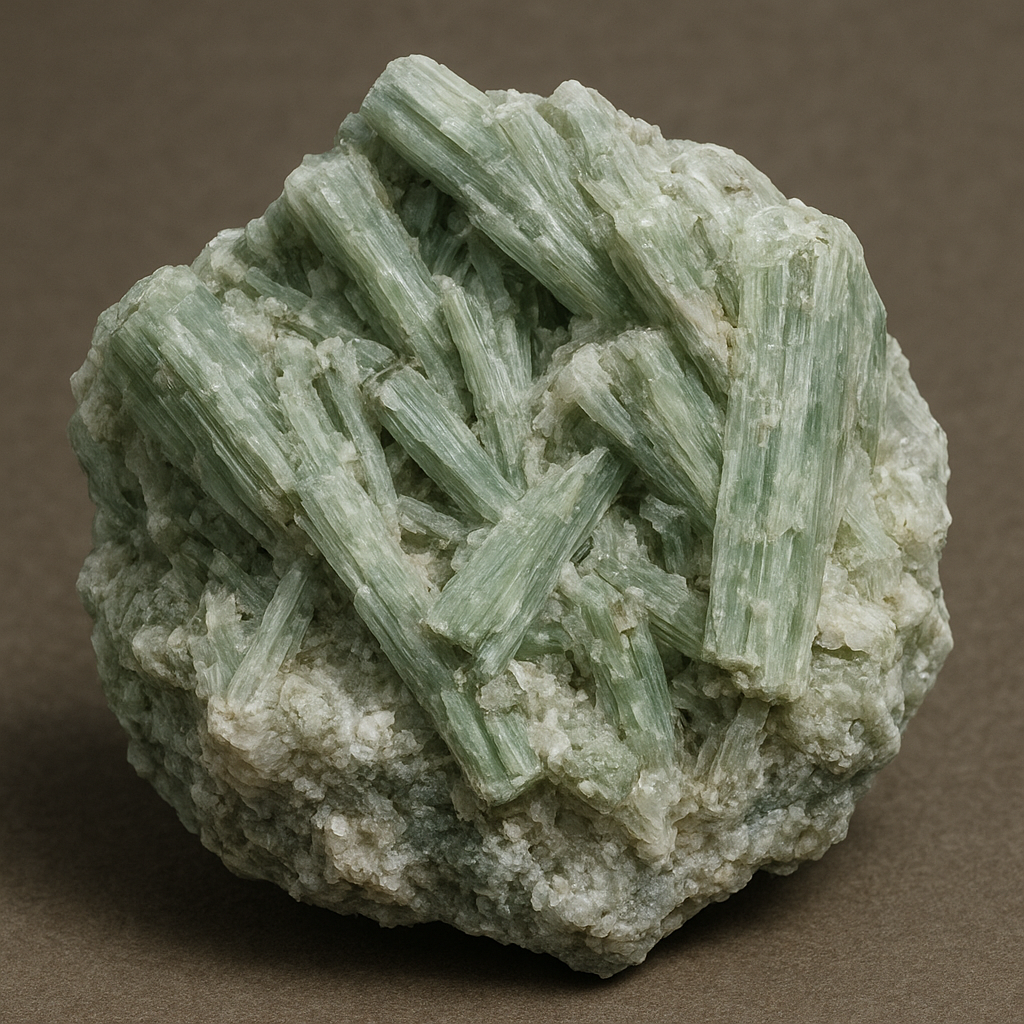
Tremolite is a member of the amphibole group of minerals that attracts attention for both its geological significance and its association with health and industrial concerns. This article explores the mineral’s properties, where it forms, its historical and modern uses, the hazards associated with certain varieties, and the analytical and regulatory frameworks surrounding it. Along the way, several less-known and intriguing aspects of tremolite — from its role in some varieties of jade to the challenges it poses in mineral identification and public health — will be highlighted.
Mineralogy and physical properties
Tremolite belongs to the amphibole family, a group of double-chain silicate minerals characterized by a complex crystal structure and variable chemical composition. Its idealized chemical formula is Ca2(Mg,Fe)5Si8O22(OH)2, where magnesium predominates in the pure endmember. When iron substitutes for magnesium, the mineral grades toward the actinolite endmember; together these form the tremolite–actinolite solid-solution series.
Key physical features
- Crystal system: monoclinic, typically forming prismatic crystals or fibrous masses.
- Color: commonly white, gray, greenish, or pale green depending on iron content; higher iron often produces darker green (closer to actinolite).
- Hardness: around 5–6 on the Mohs scale.
- Cleavage: two perfect cleavages at about 56° and 124°, a diagnostic amphibole property.
- Habit: ranges from compact and bladed to acicular (needle-like) fibrous forms.
The fibrous habit is central to discussions about tremolite because the thin, elongated fibers that some tremolite varieties form are classified as one of the amphibole forms of asbestos. Not all tremolite is fibrous; many samples are crystalline, massive, or microcrystalline and do not carry the same health concerns as the asbestos variety.
Geologic occurrence and formation environments
Tremolite is typically associated with low- to medium-grade regional metamorphism and with contact metamorphism of calcium-rich protoliths. It forms through reactions between silica-bearing fluids and carbonate rocks or within mafic and ultramafic rocks under suitable temperature–pressure conditions.
Common geological settings
- Metamorphosed carbonate rocks (skarns and marbles): Tremolite is common in metamorphosed dolomitic limestones and in skarn zones where silica-bearing magmatic fluids interact with carbonate host rocks.
- Regional metamorphism of pelitic and mafic rocks: Amphibolite-facies rocks can contain tremolite as part of assemblages formed during prograde or retrograde metamorphism.
- Ultramafic and serpentinite-related environments: Tremolite and related amphiboles can appear in metamorphosed ultramafic rocks under specific fluid conditions.
- Talc and soapstone deposits: Some talc deposits contain tremolite as a contaminant; this has important implications for mining and consumer products.
Notable occurrences are widespread: tremolite-bearing rocks appear across many parts of Europe (including metamorphic terranes in Italy and Norway), North America (including certain parts of the Appalachian belt and metamorphosed carbonate units), and in parts of Asia and Australia. Localized deposits historically provided fibrous tremolite for use as an insulating mineral before the hazards of asbestos were fully recognized.
Uses, applications, and economic relevance
Tremolite’s practical roles have shifted over time. Its physical and chemical properties made some fibrous varieties useful in the asbestos industry, while non-fibrous tremolite appears in metamorphic petrology, lapidary uses, and as an indicator mineral in ore exploration.
Historical and industrial uses
- Asbestos applications: Fibrous tremolite was used as a component of asbestos-bearing materials for insulation, fireproofing, and manufacturing of certain brake linings and gaskets. The use diminished and largely ceased with the recognition of health risks and subsequent regulation.
- Contaminant in talc and vermiculite: Tremolite fibers have been found as contaminants in some talc deposits and in vermiculite ores, creating health risks when products are milled or used without adequate controls.
- Indicator in exploration: Geologists use tremolite as an indicator of particular metamorphic conditions or hydrothermal alteration paths, helping to reconstruct metamorphic histories or identify skarn-related ore systems.
Gemological and cultural uses
One of the more intriguing roles of tremolite is its relationship to nephrite jade. Nephrite is not jadeite but a microcrystalline aggregate of fibrous amphiboles, primarily tremolite or actinolite. High-quality nephrite can be robust, with a silky luster valued in carvings and jewelry. Thus, while fibrous tremolite is a health hazard in loose-fiber form, when tightly intergrown as nephrite it forms a highly valued, durable material.
Health risks, asbestos classification, and regulation
Fibrous tremolite belongs to the group of amphibole asbestos minerals. Health concerns arise when durable, respirable fibers are inhaled, because they can lodge in lung tissue and pleura, provoking chronic inflammation, fibrosis, and an elevated risk of malignancies such as lung cancer and mesothelioma.
Pathogenic characteristics
- Biopersistence: Amphibole fibers, including tremolite, are chemically and physically persistent in lung tissue compared with some serpentine-type asbestos (e.g., chrysotile), which can affect pathogenicity.
- Fiber size and shape: Long, thin fibers are more likely to reach deep lung regions and cause harm. The length, diameter, and durability all influence biological effects.
- Exposure routes: Occupational inhalation during mining, milling, and processing is the primary risk, but community exposures can occur through contaminated building materials, talc-based products, or environmental releases.
Regulatory frameworks and control measures
Regulatory agencies including the World Health Organization, the United States Environmental Protection Agency (EPA), and occupational safety bodies such as OSHA have established guidelines and limits for asbestos exposure. Many countries have banned or strictly restricted asbestos use, including amphibole varieties. Specific actions include:
- Airborne fiber limits and workplace exposure standards.
- Restrictions or bans on asbestos-containing products.
- Remediation protocols for contaminated sites and safe handling of asbestos-bearing materials.
- Monitoring and testing requirements for consumables such as talc used in cosmetics and pharmaceuticals.
Because tremolite can occur as an unwanted contaminant in commercially valuable minerals like talc, attention to regulation, testing, and transparency in supply chains remains crucial for public health.
Identification, analysis, and challenges in detection
Distinguishing tremolite from other amphiboles and from non-fibrous minerals is essential in both geological and regulatory contexts. Several analytical techniques are commonly applied, each with strengths and limitations.
Common analytical methods
- Polarized light microscopy (PLM): Useful for initial identification in bulk samples and for differentiating mineral habits and optical properties.
- Scanning electron microscopy (SEM) and transmission electron microscopy (TEM): Provide high-resolution morphological data and, when combined with energy-dispersive X-ray spectroscopy (EDS), elemental composition to distinguish tremolite from other amphiboles.
- X-ray diffraction (XRD): Valuable for identifying crystalline phases in bulk powders and for distinguishing amphiboles from other silicates.
- Infrared spectroscopy (FTIR) and Raman spectroscopy: Helpful for detecting characteristic vibrational modes of amphiboles.
Challenges arise because some methods miss very thin fibers or cannot quantify low concentrations reliably. TEM is generally considered the most sensitive for detecting and sizing respirable fibers in environmental and workplace samples. However, TEM is costly, technically demanding, and requires expert interpretation.
Interesting intersections and lesser-known facts
Tremolite weaves together surprising stories in geology, culture, industry, and public health.
Nephrite versus jadeite: a mineralogical twist
The aesthetic and cultural value of jewelers’ “jade” is most often associated with jadeite in the international gem market, but classical jade artwork in China and Neolithic tools in many regions were commonly made from nephrite — an aggregate dominated by nephrite-group amphiboles, primarily tremolite. The toughness of nephrite derives from the interlocking fibrous microstructure of tremolite-actinolite, an elegant example of how microstructure controls macroscopic properties.
Tremolite in talc controversies
Concerns about tremolite contamination of talc deposits have led to legal and regulatory battles. Because talc and tremolite can be genetically related in some metamorphic settings, mines and talc processors must rigorously test raw material to prevent asbestos contamination in consumer products. The topic intersects geology, industrial quality control, and public health policy.
Environmental legacies and remediation
Former asbestos mines and processing sites can leave persistent environmental legacies where tremolite and other amphibole fibers remain. Remediation strategies can include containment, removal, and ongoing air monitoring. In some regions, naturally occurring asbestos (NOA) complicates land use planning and construction projects because exposures may arise where people live, not just in industrial settings.
Analytical case studies and applied geology
Using tremolite as a metamorphic indicator
Geologists use the presence of tremolite in assemblages to constrain metamorphic temperatures and fluid compositions. For example, tremolite + calcite ± dolomite assemblages suggest metamorphism of dolomitic limestones under specific CO2–H2O conditions. In contrast, tremolite in serpentinites or talc deposits indicates metamorphic reactions in ultramafic protoliths.
Ore deposit implications
In skarn systems, tremolite can be associated with economically important minerals (e.g., magnetite, garnet, and base metal sulfides). Mapping the distribution of tremolite within a skarn can help reconstruct hydrothermal fluid flow and target potential mineralized zones.
Best practices for professionals and communities
Handling sites, materials, or products that may contain tremolite requires careful procedures:
- Rigorous testing of raw materials (e.g., talc) with sensitive techniques (TEM when needed).
- Workplace controls: engineering controls, personal protective equipment, and training.
- Clear, science-based communication with the public about risks and remediation plans.
- Historic site surveys and proper disposal or containment when asbestos-bearing materials are discovered.
For geoscientists, accurate identification and context-specific reporting help prevent mislabeling a benign, crystalline tremolite occurrence as an asbestos hazard — and vice versa.
Further reading and resources
Those seeking more detailed or technical information should consult mineralogical textbooks on amphiboles, regulatory guidance from environmental and occupational agencies, and peer-reviewed literature on asbestos epidemiology and mineral identification. Scientific instrument vendors and specialized analytical labs also publish method notes that clarify detection limits and best practices for fiber analysis.
Selected topics to explore
- Amphibole crystal chemistry and substitution mechanisms (why magnesium vs. iron matters).
- Case studies of remediation of tremolite-contaminated sites and lessons learned.
- Comparative studies of amphibole and serpentine asbestos biopersistence and pathogenicity.
- Geological surveys linking tremolite to talc deposit genesis and implications for mining.
Understanding tremolite requires both careful mineralogical study and a broad appreciation of its environmental and cultural contexts. Whether approached from the perspective of a geologist, a public health official, or a historian of industry, tremolite sits at a productive intersection of disciplines.