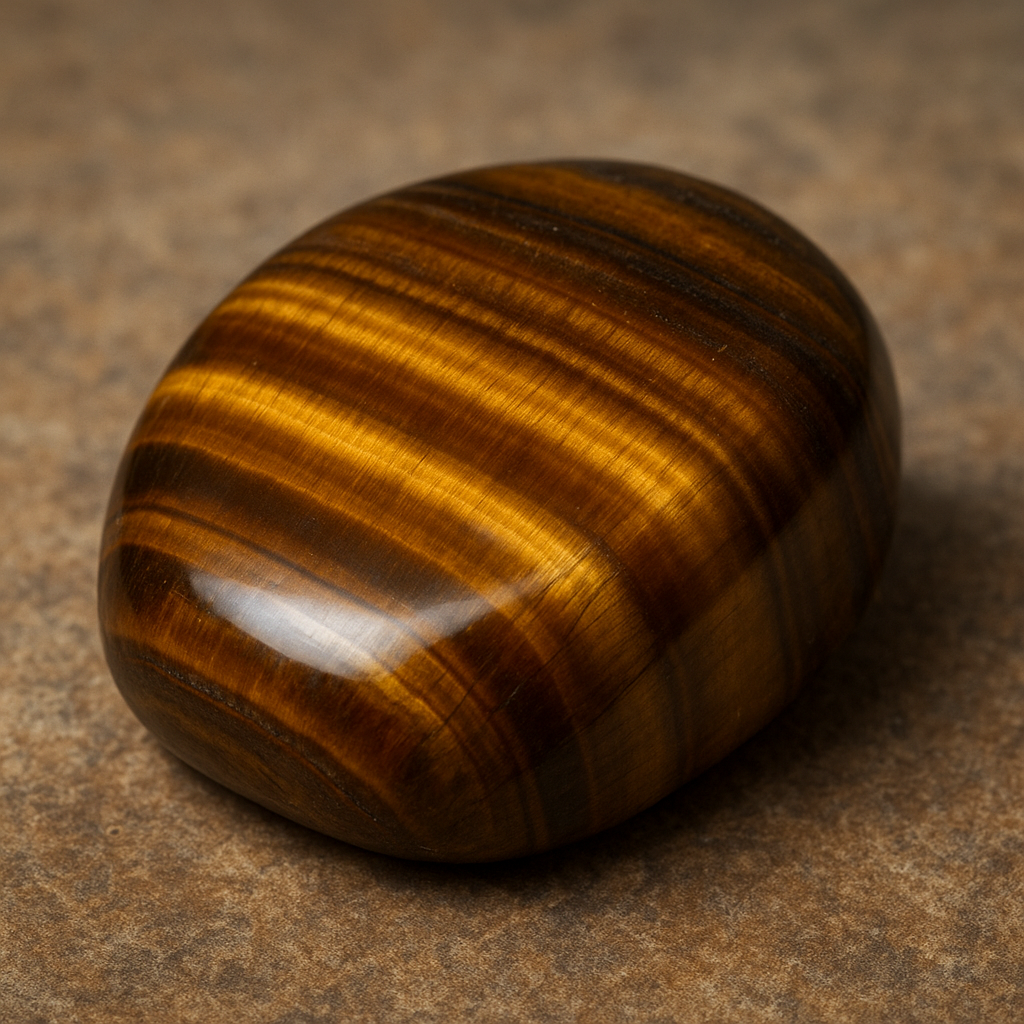
Tiger Eye is a striking and widely admired variety of cryptocrystalline quartz known for its shimmering, silky luster and the optical effect called chatoyancy. Its golden-brown bands, sometimes blue or red variants, have made it a staple in both jewelry and ornamental stone collections. This article explores how Tiger Eye forms, where it is found, how it is used across cultures and industries, and offers practical information for collectors, lapidaries, and anyone intrigued by this luminous stone.
Appearance, Mineralogy and Formation
At first glance, Tiger Eye appears to be a simple brown or golden gemstone, but a closer look reveals a complex story of mineralogical transformation. The stone is essentially a form of fibrous quartz in which original fibrous minerals—often amphiboles like crocidolite—have been replaced by silica while retaining the original fibrous structure. This pseudomorphic replacement preserves the parallel fibrous texture that gives Tiger Eye its signature sheen.
Chatoyancy: the “cat’s eye” effect
The shimmering, banded reflection known as chatoyancy occurs when parallel fibers or needle-like inclusions reflect light in a concentrated band that seems to move as the stone is turned. For Tiger Eye, that band often resembles the slit of a feline eye—hence the name. The effect is strongest when the stone is cut en cabochon (rounded, polished top and flat bottom) with the fibers oriented perpendicular to the base so the sheen can sweep across the dome.
Variants and colors
Various colors of Tiger Eye arise from subtle differences in mineral content and post-formation processes:
- Golden Tiger Eye: The classic warm, honey- to deep-brown tone resulting from iron staining and oxidation of the original fibers.
- Blue Tiger Eye (Hawk’s Eye): When the fibrous structure remains in a bluer, less oxidized state, the stone displays bluish-gray chatoyancy.
- Red Tiger Eye (Oxblood): Achieved naturally in some deposits or artificially by heat and chemical treatment, yielding deep red tones.
- Other treatments: Dyeing and enhancement are used commercially to intensify hues, so buyers should be aware of treated material.
Physical properties
Because Tiger Eye is dominated by silica, its physical properties are similar to quartz. Typical values include a Mohs hardness around 7, a specific gravity in the range of about 2.64–2.71, and durability suitable for most jewelry uses. The presence of microscopic fibrous remnants influences not only appearance but also how the stone responds to cutting and polishing.
Where Tiger Eye Occurs: Geological Settings and Major Sources
Tiger Eye is not tied to a single geological environment; it commonly forms in metamorphosed ultramafic and sedimentary rocks where original amphibole minerals like crocidolite or riebeckite have been replaced by silica-rich fluids. The replacement is typically hydrothermal or metasomatic and often occurs under low- to medium-grade metamorphic conditions.
Major producing regions
Several countries are well-known for producing commercially significant quantities of Tiger Eye. Some of the most important sources include:
- South Africa: Historically one of the largest and most important sources, especially for golden and blue varieties. The Karoo and surrounding regions have yielded abundant material.
- Western Australia: Noted for high-quality specimens, including commercially valuable blue varieties; Australian deposits are significant to global supply.
- India: Often a source of beads and cabochons, particularly for the mass market and for heat-treated red stones.
- Sri Lanka and Myanmar (Burma): Occasional occurrences and small-scale mining sites, supplying local lapidaries and collectors.
- Brazil and the United States: Brazil produces a wide variety of semi-precious stones including Tiger Eye; some U.S. localities have produced attractive specimens though in smaller volumes compared to the major exporters.
Mining and trade
Most Tiger Eye is recovered by relatively low-tech mining methods—open pits, small underground workings, and alluvial collection—followed by sorting and preliminary cutting. Because much of the commercial material is exported as rough or semi-finished cabochons and beads, regional cutting centers in India, Thailand, and China play an important role in shaping the finished market. Trade flows can shift depending on demand for certain colors and sizes.
Uses: Jewelry, Ornament and Beyond
Tiger Eye’s unique visual properties have made it a versatile material in both everyday and artistic contexts. It’s appreciated for its warm tones, durability, and affordability compared with precious gemstones.
Jewelry and lapidary arts
The most common use is in jewelry:
- Cabochons for rings and pendants – the dome-shaped cut showcases chatoyancy best.
- Beads for necklaces and bracelets – popular in both fashion and spiritual jewelry.
- Inlaid items – boxes, watch faces, and decorative panels often use small pieces of Tiger Eye for contrast and sheen.
- Carvings and sculptures – from small figurines to ornate decorative objects, Tiger Eye carves well when care is taken to follow the fibrous orientation.
Industrial and decorative applications
Beyond jewelry, Tiger Eye sees occasional use as a decorative stone in mosaics and tabletop inlays. Its hardness and polishability make it suitable for accent stones in small furniture or ornamental objects. Larger blocks or slabs are rarer in architectural use because of variability in pattern and chatoyancy, but specialty designers will sometimes incorporate cut panels as visual focal points.
Metaphysical and cultural uses
Throughout history and across cultures, Tiger Eye has held symbolic and practical value. It has been used as an amulet and talisman for protection—particularly by warriors and travelers—and is often associated with clarity and courage. In modern metaphysical practices, people attribute grounding, balancing, and protective properties to the stone, making it popular in meditation, crystal healing, and chakra work. While such claims are not scientifically validated, they have a meaningful cultural role for many practitioners.
Working with Tiger Eye: Cutting, Treatments and Care
Lapidaries prize Tiger Eye for the way it responds to skilled cutting and polishing. However, the fibrous structure requires attention to orientation and technique to maximize chatoyancy and minimize fracture.
Best cutting practices
To display the chatoyant band most effectively, cutters align the dome of a cabochon across the fibers so the band crosses the surface. Long, narrow shapes can emphasize sweeping bands; round or oval cabochons create a concentrated, mobile band of light. Careful control of grit progression and final polishing with cerium oxide or tin oxide yields the silky surface that characterizes fine Tiger Eye pieces.
Treatments and enhancements
Several treatments are commonly applied to Tiger Eye:
- Heat treatment: Can enhance or change color, often producing red or deeper tones.
- Dyeing: Less expensive material may be dyed to achieve uniform color or imitate more sought-after varieties.
- Stabilization: Rarely required, but some friable pieces may be impregnated with resin to improve durability and polishability.
Buyers should ask sellers about treatments and expect treated stones to be priced differently from natural, untreated material.
Care and maintenance
Due to its quartz base and solid structure, Tiger Eye is relatively easy to care for:
- Clean with warm, soapy water and a soft brush; avoid strong acids and alkaline chemicals.
- Avoid prolonged exposure to direct sunlight to prevent color fading in dyed materials.
- Ultrasonic cleaners are generally safe for solid pieces but should be avoided for heat-treated or brittle specimens and those impregnated with resins.
- Polished surfaces can be refreshed by professional re-polishing if they become scratched.
Identification, Authentication and Common Imitations
With its popularity comes imitation and treatment, so understanding how to identify genuine Tiger Eye is valuable for buyers and collectors.
Identification tips
A few practical checks help authenticate Tiger Eye:
- Observe the chatoyancy: genuine Tiger Eye shows a sharp, mobile band when rotated under a direct light source, particularly on cabochons.
- Examine under magnification: look for parallel fibrous structure or needle-like inclusions; the preserved orientation is a sign of natural pseudomorphic replacement.
- Hardness test: a simple scratch test consistent with Mohs 7 suggests quartz-based material, though testing should be done carefully to avoid damage.
- Specific gravity and refractive index: gemological instruments can distinguish natural Tiger Eye from glass, plastics, and some dyed stones.
Common imitations and how to spot them
Several materials are used to imitate Tiger Eye:
- Glass and synthetic materials: May show similar color but lack the fibrous structure and will usually have lower hardness and different thermal and optical properties.
- Dye-treated jasper or agate: These can mimic color but do not display true chatoyancy derived from parallel fibers.
- Resin-impregnated material: Can imitate the luster but often reveals bubbles or flow lines under magnification.
Economic and Cultural Context
Tiger Eye occupies an interesting niche in the gem marketplace: it is both inexpensive and highly adaptable. Its relative affordability makes it accessible to mass-market jewelry manufacturers, while fine-cut, high-chatoyancy specimens command higher prices among collectors and designers.
Market demand and sustainability
Global demand fluctuates with fashion trends and interest in crystal healing. The mining is often artisanal, so sustainable sourcing and fair labor practices are important concerns. Consumers increasingly ask about the origin and social conditions of extraction; reputable dealers can often provide sourcing information or certifications.
Traditional beliefs and modern use
Historically, Tiger Eye was worn as a protective talisman in various cultures. Today, it remains popular in both mainstream fashion and niche spiritual communities. Designers often combine Tiger Eye with metals like silver and bronze to enhance its warm tones, or pair it with contrasting stones—such as lapis or turquoise—to create striking visual effects.
Collecting and Appreciating Tiger Eye
For collectors, Tiger Eye offers rewards both aesthetic and educational. High-quality pieces exhibit a sharp, even chatoyant band, consistent color, and minimal fractures. Specimens that display rare color variants, exceptional translucency, or unusual patterns (like swirling chatoyancy or layered effects) are especially prized.
What to look for when buying
- Sharpness of the cat’s-eye effect: a crisp, narrow band is typically more valuable than a diffuse sheen.
- Orientation and cut quality: well-cut cabochons reveal the effect most effectively without sacrificing durability.
- Color uniformity and natural appearance: beware overly saturated or unnaturally vivid pieces that may be dyed.
- Provenance and treatment disclosure: reputable sellers provide clear information about origin and any enhancements.
Display and storage
Store Tiger Eye separately from harder stones to avoid scratches, and keep pieces wrapped in soft cloth if stored together. For display, a neutral background and directional lighting will best showcase the chatoyancy; small LED spotlights angled across the stone emphasize the moving band of light.
Interesting Facts and Lesser-Known Details
Beyond the basics, Tiger Eye has several intriguing aspects that deepen appreciation of the stone:
- Geological history preserved: Because Tiger Eye represents a mineral replacement, each specimen encapsulates a record of fluid-rock interaction, oxidation, and metamorphism—an archive of geological processes.
- Color manipulation: Traditional heat treatments creating red or “oxblood” Tiger Eye have been practiced for decades; modern dyeing and stabilization techniques have broadened the color palette available to designers.
- Cross-overs in gem nomenclature: The terms Tiger Eye and Hawk’s Eye can refer to material from the same source that differs mainly in oxidation state—hawk’s eye being the less oxidized, bluer form.
- Fossil and specimen cross-collections: Because many specimens display striking banding, museums and private collectors often pair Tiger Eye with other chatoyant stones like chrysoberyl cat’s eye and pietersite for comparative displays.
- Scientific interest: Petrologists and mineralogists study Tiger Eye to understand silica mobilization and the mechanics of pseudomorphic replacement—processes relevant to broader questions of metamorphism and mineral stability.
Practical Guidance for Enthusiasts
Whether you are buying your first Tiger Eye pendant, designing with the material, or adding to a mineral collection, a thoughtful approach will enhance satisfaction and value. Seek out reputable dealers who disclose treatments and origins, favor cuts that showcase chatoyancy, and consider the ethical aspects of sourcing when possible. With proper care, Tiger Eye jewelry and objects can offer decades of beautiful wear and study.
This overview highlights the multifaceted nature of Tiger Eye—from its origins in geological transformation to its enduring appeal in jewelry, culture, and collecting. Appreciating both the science behind its shimmer and the skill required to present it at its best transforms a pretty stone into an object of lasting fascination.