
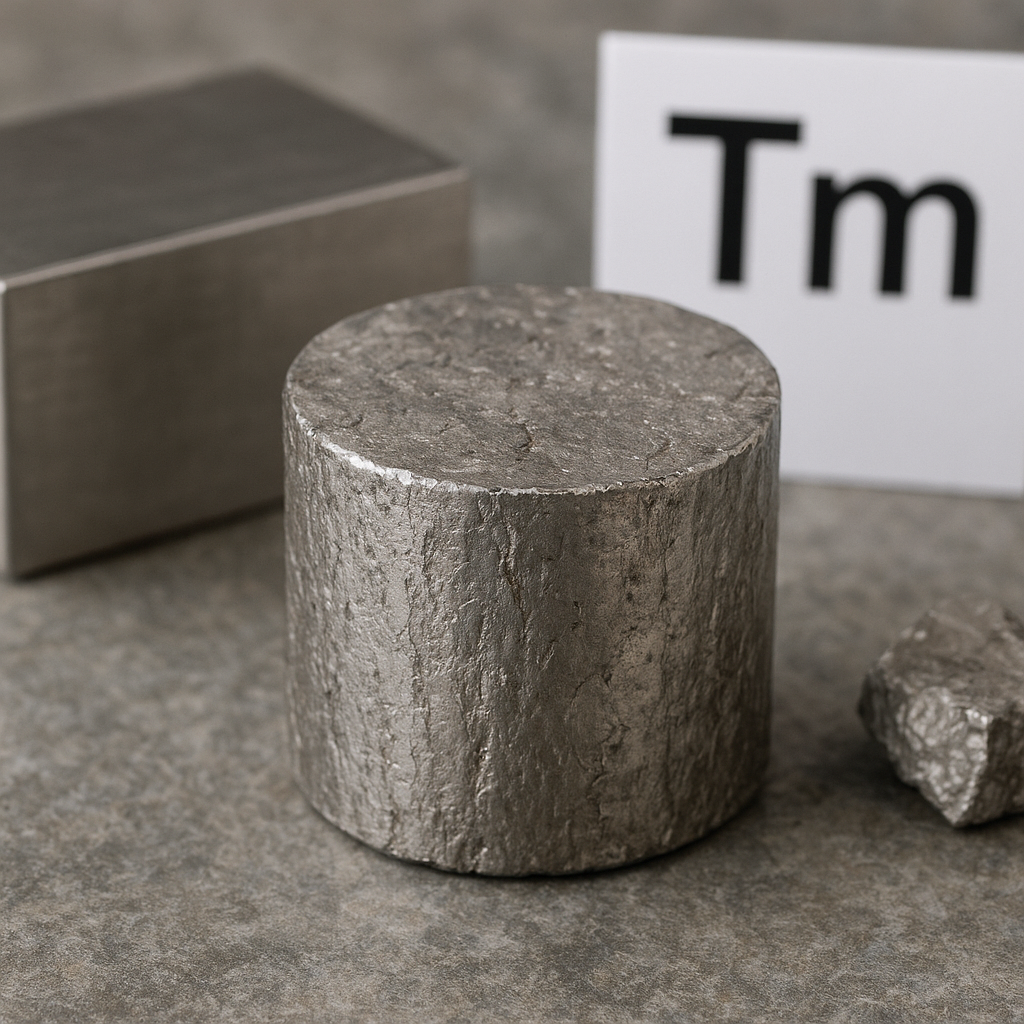
Thulium, a quietly intriguing member of the rare-earth family, sits toward the heavier end of the lanthanide series and combines subtle chemistry with surprising usefulness. Though it seldom appears in everyday conversation, its unique spectroscopic and nuclear characteristics make it valuable in specialized technologies. This article explores where thulium is found, how it is extracted and processed, the main fields in which it is applied, and some of the more curious and forward-looking topics connected with this element.
Natural occurrence and extraction
Thulium is one of the least abundant of the lanthanides in the Earth’s crust, but it is never found as a free element in nature. Instead it occurs dispersed within a variety of rare-earth minerals. The common mineral hosts include monazite and xenotime, as well as mixed oxide minerals such as euxenite and bastnäsite. These minerals typically concentrate a suite of rare-earth elements together; thulium is present only in small proportions compared with heavier and lighter lanthanides.
Industrial recovery of thulium begins with the mining of rare-earth-bearing ores, followed by crushing, physical separation and chemical processing. Because rare-earths display very similar chemical behaviour, the separation of individual elements requires specialized techniques: solvent extraction, ion exchange and selective precipitation are the dominant methods. Solvent extraction processes use organic ligands that preferentially complex certain trivalent rare-earth ions, allowing progressive separation. Modern refiners use multi-stage solvent extraction circuits to isolate relatively pure thulium compounds.
After separation, thulium is typically obtained as salts (e.g., oxides, halides or nitrates) and reduced to the metal with calcium or lithium in high-temperature processes. Because of its scarcity and the complexity of purification, thulium commands a higher price per kilogram than many more common metals.
Physical and chemical properties
Thulium is a silver-gray, soft, malleable metal belonging to the lanthanide series. Its chemistry is dominated by the +3 oxidation state, as with most lanthanides, although +2 compounds are known under certain conditions. The electron configuration of the neutral atom places thulium among the partially filled 4f elements, and this hidden 4f shell causes exceptionally sharp electronic transitions that are the basis for many of its technological applications.
In air, finely divided thulium oxidizes slowly; bulk metal forms a protective oxide layer that slows further corrosion. Its physical and magnetic properties reflect the behaviour of 4f electrons: thulium compounds are commonly paramagnetic at room temperature and exhibit interesting low-temperature magnetic transitions in certain crystal lattices. From a chemical standpoint, thulium forms stable oxides (Tm2O3), halides (TmCl3, TmF3) and coordination complexes with ligands that can tune its optical properties.
Applications in lasers and photonics
One of the most prominent and rapidly expanding uses of thulium is in photonics. When incorporated as an active ion in glass or crystalline hosts, thulium(III) exhibits desirable optical transitions in the near- and mid-infrared. Lasers based on thulium-doped crystals and fibers operate typically around 1.9–2.1 micrometres — an eye-safer, water-absorbing region of the spectrum — which opens several important practical applications.
Fiber and solid-state lasers
Fiber lasers doped with thulium are used for precision materials processing, medical procedures and sensing. Their emission near 2 µm is strongly absorbed by water and biological tissues, enabling controlled cutting, ablation and coagulation in surgical applications with reduced collateral damage. In industry, thulium fiber lasers offer high beam quality and efficiency for tasks such as micro-machining, welding thin metals, and processing polymeric materials that absorb in this spectral band.
Medical and therapeutic uses
In medicine, thulium lasers are valued for urology (e.g., lithotripsy and stone removal), dermatology, and soft-tissue surgery. Their operation in a wavelength range where water absorption is significant allows surgeons to achieve precise cutting with effective hemostasis. Device manufacturers have developed compact, reliable thulium-doped fiber laser systems tailored to clinical environments, improving outcomes and patient recovery times.
Sensing, LIDAR and atmospheric science
The mid-infrared emission of thulium-doped devices also suits remote sensing and LIDAR applications. The relative eye safety and atmospheric transmission windows near 2 µm facilitate the design of systems for topographic mapping, gas detection and range-finding. In these fields, thulium-based sources combine with novel detector technologies to expand capabilities in challenging environments.
Nuclear properties and isotopes
Thulium has one stable isotope, Tm-169, which is non-radioactive and constitutes essentially all naturally occurring thulium. However, many radioactive isotopes can be produced artificially by neutron irradiation in reactors or by particle accelerators. These isotopes have found specialized applications in medicine, industry and research.
For example, neutron activation of Tm-169 produces radioisotopes that emit beta particles and gamma radiation and can be used as sealed sources or for radiotherapy research. In nuclear physics, thulium isotopes are used to study nuclear structure and reaction mechanisms. Because of the element’s neutron-capture characteristics, activated thulium can also serve as a convenient tracer in neutron-irradiation studies and materials testing.
Handling of radioactive thulium requires the usual radiological precautions: shielding, controlled access, proper waste management and regulatory compliance. While the stable isotope poses little hazard beyond normal chemical toxicity concerns, radionuclides must be treated with respect and specialized protocols.
Chemical, electronic and magnetic research uses
Researchers prize thulium for the sharp, well-defined electronic transitions of its 4f electrons, which are shielded from environmental perturbations by outer electrons. These properties make thulium ions useful as probes in spectroscopy, high-resolution optical experiments and quantum materials research.
- In solid-state physics, thulium-doped crystals and glasses are model systems for studying 4f electron behaviour, crystal-field splitting and low-temperature magnetism.
- In quantum optics, narrow-linewidth transitions in thulium ions support work on frequency-stabilized lasers and potential applications in timekeeping or quantum information storage where long-lived coherence is beneficial.
- As dopants in phosphors and upconversion nanoparticles, thulium ions provide distinct emission colours under near-infrared excitation, enabling biomedical imaging and anti-counterfeiting technologies that exploit deep-tissue penetration of NIR light.
Industrial, technological and niche applications
Outside of photonics and nuclear research, thulium has a few specialized industrial uses driven by its scarcity and particular properties:
- As an additive in certain high-performance alloys where specific magnetic or electrical characteristics are desired.
- In portable X-ray sources and miniature radiation devices: some radioisotopes of thulium have been used to create compact gamma emitters for industrial gauging and research calibration, though these uses are limited by regulatory and safety considerations.
- In scientific instrumentation, where thulium-doped detectors, scintillators or spectral calibration standards are needed.
Because thulium is expensive and not abundant, its uses tend to be confined to applications where alternative elements cannot achieve the same performance.
Environmental, economic and supply considerations
Like other rare-earth elements, thulium is affected by the geopolitics and economics of rare-earth supply chains. Concentrations of rare-earth mining and refining in certain regions create vulnerabilities for downstream industries that depend on stable supplies. Recycling of rare-earth elements from end-of-life products and from industrial residues is an area of growing interest; recovering thulium from used lasers, specialty alloys or electronic wastes can help mitigate supply risks, though technical and economic challenges remain.
Environmental concerns center on mining impacts — habitat disruption, tailings management and chemical effluents — and on the energy intensity of separation processes. Advances in greener hydrometallurgical practices, closed-loop solvent extraction and selective sorbents aim to reduce the ecological footprint of rare-earth production.
Toxicology, handling and safety
In its metallic form and common salts, thulium is of moderate chemical toxicity; the principal hazards are those shared with many metals: dust inhalation, reactive fines and potential irritant effects of soluble compounds. Standard laboratory precautions — gloves, eye protection, local exhaust ventilation and careful waste disposal — are normally adequate for handling stable thulium compounds.
Radioactive isotopes demand full radiological controls: monitoring, shielding, contamination prevention and strict regulatory compliance. Users must rely on institutional radiation-safety programs when working with activated thulium.
History, naming and cultural notes
Thulium was discovered in the late 19th century during the period of rapid discovery and separation of the rare-earth elements. It was identified by chemists who were fractionating the closely related mixtures of lanthanide oxides. The element’s name comes from Thule, an ancient name used by Greeks and Romans for a distant northern land; the choice reflects the element’s association with far northern regions in myth and geography and follows the tradition of evocative names among some rare-earth discoveries.
Emerging research and future outlook
Ongoing research highlights several promising directions for thulium applications:
- Improved thulium-doped fiber lasers with higher efficiencies, mode control and power scaling for industrial and medical use.
- Advanced upconversion materials for bioimaging and secure authentication, leveraging thulium’s unique emission lines.
- Quantum and spectroscopic studies that exploit the narrow 4f transitions for metrology, sensing and potential quantum-memory elements.
- More sustainable recovery and recycling techniques to make thulium supply chains more resilient and less environmentally damaging.
Because of its combination of chemical subtlety and distinctive optical properties, thulium occupies an outsized niche: a relatively rare metal that nonetheless enables technologies in medicine, sensing and advanced photonics that would be difficult to reproduce with other elements.