
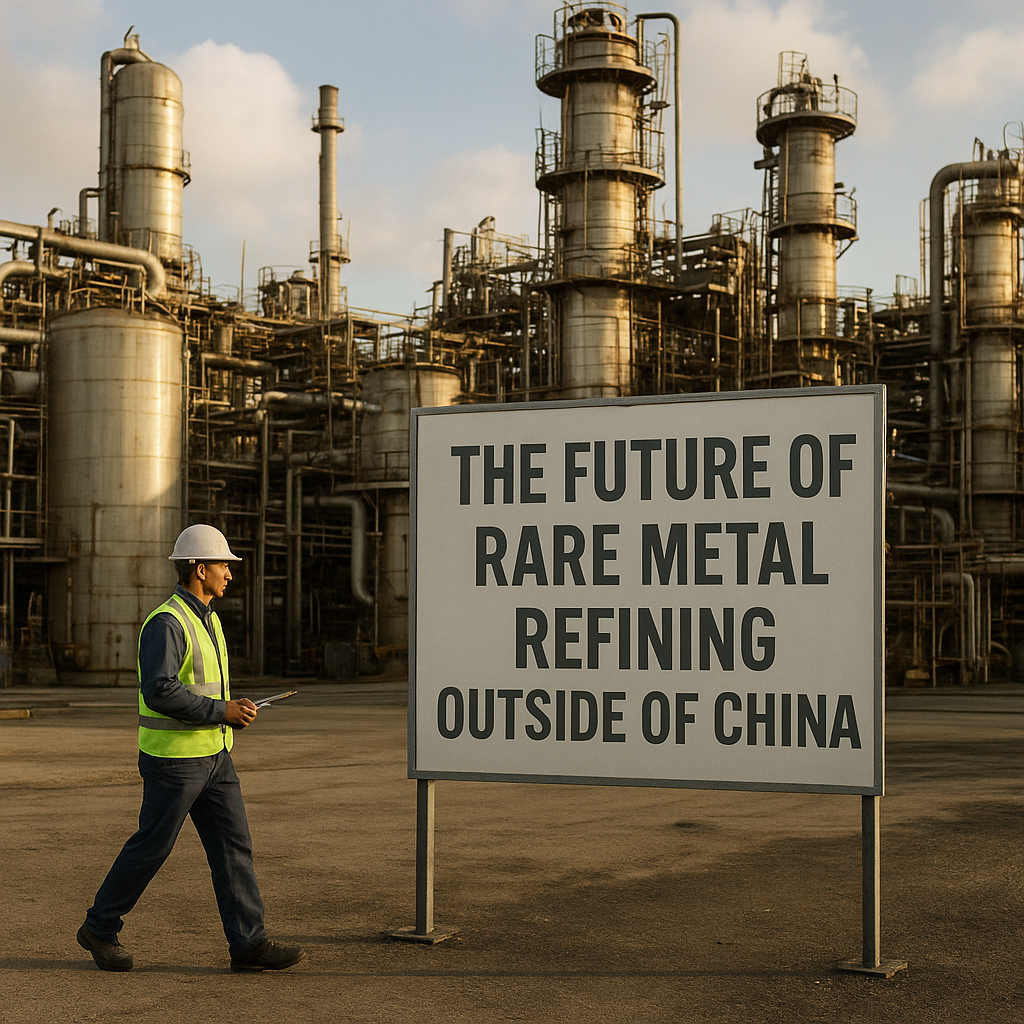
The global landscape for processing and refining critical minerals is at an inflection point. For decades, the concentration of rare metals refining capacity in one country has shaped markets, pricing, and strategic policy. As demand for magnets, batteries, catalysts, and high-performance alloys surges, industries and governments are reassessing where and how material value chains should be built. This article examines the drivers, obstacles, and likely trajectories for developing refining capacity outside of China, emphasizing how policy, investment, technology and environmental factors will interact to define the next decade.
Why refining matters: value, vulnerability, and the role of processing
Raw ores and concentrates possess limited economic value until they undergo processing, separation, and purification. The step from mined ore to high-purity metals and compounds is capital- and knowledge-intensive. Countries that control refining enjoy a disproportionate share of value capture, influence over prices, and leverage in times of geopolitical tension. This structural reality has made the location of refining capacity a strategic question, not merely an economic one.
Concentration of refining creates several systemic risks. A single-source dependency amplifies supply shocks, reduces bargaining power for buyers, and can enable export controls that ripple through downstream industries. Conversely, a distributed refining landscape supports competition, secure supply, and regional industrial development. Efforts to relocate or duplicate refining infrastructure must therefore balance short-term costs against long-term resilience.
Barriers to developing refining capacity outside China
Establishing modern refining facilities confronts a suite of interrelated obstacles:
- Capital intensity: Construction and commissioning of separation plants, smelters, and hydrometallurgical units require significant upfront capital and multi-year timelines.
- Technical complexity: Many rare metals and rare earth elements demand bespoke chemistries and proprietary process know-how that have been refined through decades of operational experience.
- Feedstock logistics: Mines are not evenly distributed, and the economics of concentrating ores and transporting concentrates can be challenging when refining hubs are distant.
- Environmental and regulatory constraints: Processing often involves hazardous reagents and tailings management, raising permitting complexities in jurisdictions with strict environmental standards.
- Market dynamics: Price volatility and long lead times for returns can deter private capital without policy de-risking.
Because of these factors, any strategy to build refining capacity outside China must integrate technology transfer, financing mechanisms, and a pragmatic approach to environmental permitting.
Paths to diversification: strategies and case studies
Several complementary pathways exist to move refining capacity beyond current concentrations. They are not mutually exclusive and are likely to be pursued in parallel by different actors.
1. Greenfield investments and clustered industrial hubs
Governments and developers can incentivize the construction of new refining complexes near raw material sources or within industrial corridors. By aggregating related industries—mining, chemical suppliers, waste treatment, and downstream manufacturers—these clusters can realize economies of scale and shared infrastructure. Such models have been successful in sectors like petrochemicals and could be replicated for battery metals and magnet materials, provided coordinated funding and permitting frameworks are in place.
2. Upstream–downstream partnerships and off-take agreements
Long-term off-take contracts and joint ventures between miners, refiners, and end-users can reduce market risk. Automakers, electronics firms, and defense contractors are increasingly willing to invest near-term capital to secure refined inputs. These strategic investments often combine commercial returns with security-of-supply objectives.
3. Recycling and urban mining
Scaling recycling reduces dependence on primary refining by recovering high-purity materials from end-of-life products. Urban mining initiatives can feed existing chemical separation facilities, shortening supply chains and providing a domestic source of feedstock that is less geopolitically sensitive.
4. Licensing, technology transfer, and human capital development
Acquiring process know-how through licensing, partnerships, and recruitment of experienced personnel accelerates facility ramp-up. Public-private programs that fund R&D and training are critical to cultivate a workforce capable of operating complex refining plants and iterating processes to meet environmental standards.
Technological innovations shaping future refining
Technical progress can lower barriers and change the economics of location decisions. Emerging advancements to watch include:
- Solvent extraction improvements and ion-exchange resins that increase selectivity and reduce reagent consumption.
- Electrochemical separation techniques that enable lower-temperature, lower-emissions processing for certain metals.
- Modular and containerized processing units that shorten deployment timelines and allow incremental scaling.
- Digital process optimization using advanced sensors and machine learning to improve yields and minimize waste.
These innovations make it easier to build smaller, flexible refining operations close to mines or recycling hubs, enabling more distributed and resilient supply chains. Technology will therefore be a decisive enabler of diversification, not just a cost-saver.
Economic, environmental, and policy levers
Shifting refining capacity involves coordinated policy action. Key levers include:
- Targeted subsidies and tax incentives to offset initial capital costs.
- Preferential procurement and strategic stockpiles to guarantee demand for nascent refineries.
- Streamlined permitting for projects that meet environmental benchmarks and community engagement standards.
- Trade measures and export controls that encourage onshoring—but that must be used carefully to avoid retaliation and market fragmentation.
Environmental policy will be particularly influential. Jurisdictions that can permit and monitor high-standard facilities while offering transparent regulatory timelines will attract investment. At the same time, community acceptance hinges on demonstrable commitments to sustainability and local benefit sharing.
Geopolitical and market implications
Decentralizing refining capacity alters global power balances. Countries able to secure domestic or allied refining capabilities gain industrial autonomy and reduced vulnerability to supply disruptions. However, rapid fragmentation of markets could introduce inefficiencies and higher overall costs if global coordination is lacking.
Geopolitics will therefore drive two countervailing trends: strategic stockpiling and diversification on one hand, and potential regionalization of supply networks on the other. Multilateral efforts—alliances for critical minerals, shared standards, and cooperative research programs—can mitigate risks of economic decoupling and preserve open trade while enhancing resilience.
Financial models and risk mitigation
Financing new refining capacity requires structured approaches to allocate and mitigate risk. Instruments that have proven effective include:
- Blended finance: public seed funding combined with private capital to improve project bankability.
- Long-term offtake agreements that provide revenue certainty for lenders.
- Insurance and political risk guarantees from multilateral development banks for projects in challenging jurisdictions.
- Green bonds and sustainability-linked loans that tie financing costs to environmental performance metrics.
These tools can mobilize capital at scale while ensuring that environmental and social safeguards are integrated into project design. Investors increasingly demand transparency on supply-chain ethics and carbon footprints, making robust ESG frameworks a practical requirement for project finance.
Opportunities for downstream industries and innovation ecosystems
Building refining capacity outside concentrated centers creates opportunities beyond commodity processing. Local manufacturing of high-value components—permanent magnets, battery cells, electronics—becomes more attractive when refined inputs are nearby. This vertical integration can catalyze innovation clusters, generate skilled employment, and support broader industrial policy goals.
Startups and research institutions will play vital roles in improving material efficiency, developing substitute chemistries, and creating recycling technologies that further relieve pressure on primary refining capacity. Strategic alignment between academia, industry, and government can accelerate commercialization of breakthroughs.
Implementation timelines and realistic expectations
Refining projects are medium- to long-term endeavors. Permitting, construction, and commissioning often span multiple years. Consequently, achieving meaningful diversification will require sustained commitment, not one-off announcements. Realistic timelines include:
- Short term (1–3 years): pilot plants, recycling scale-up, policy frameworks, initial financing instruments.
- Medium term (3–7 years): construction of first commercial-scale refineries, regional cluster formation, workforce development.
- Long term (7–15 years): mature, diversified global refining landscape with multiple competitive players and integrated downstream industries.
Patience and persistent policy support are essential. Ill-considered rapid buildouts risk stranded assets if market dynamics shift or environmental compliance is inadequate.
Conclusion
The future of rare metal refining outside of China will be shaped by a confluence of strategic policy choices, financial innovation, and technological progress. Pursuing diversification is feasible but requires coordinated action across governments, industry, and research institutions. Investments in diversification, operational excellence, and transparent environmental stewardship can create resilient supply chains that reduce geopolitical risks while enabling the next wave of clean energy and high-tech industrial transformation. Ensuring that these new capacities deliver both economic returns and social license will be the central challenge for stakeholders around the world.
