
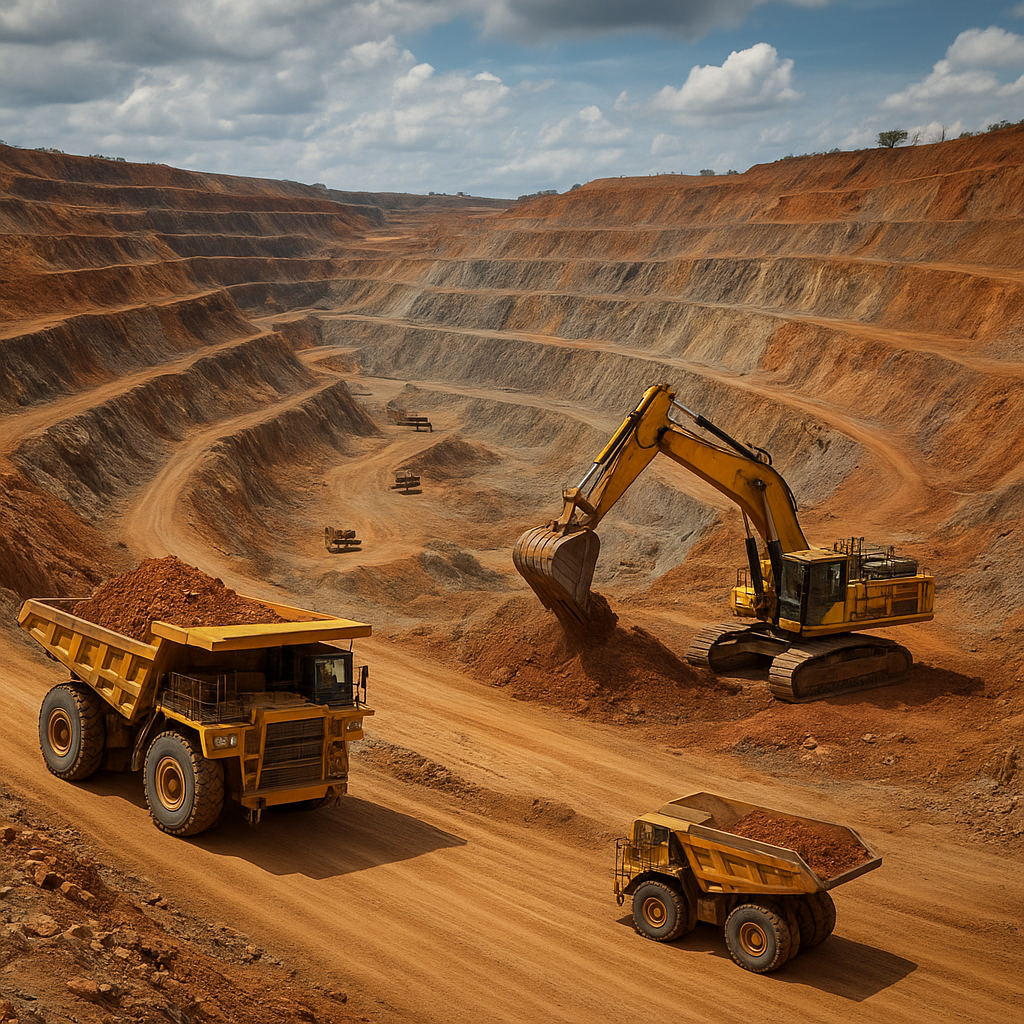
The Tenke Fungurume mining complex is one of the most consequential mineral assets on the African continent. Located in the mineral-rich heart of southern Congo, this operation produces large volumes of copper and cobalt that flow into global industrial and high-tech supply chains. The mine’s geology, production profile, history of ownership, economic footprint and the controversies and innovations surrounding it make Tenke Fungurume a fascinating case study of modern mining in a resource-rich but governance-challenged environment.
Location and Geological Setting
Tenke Fungurume sits in the southern part of the Democratic Republic of Congo, within the expansive Katanga or Shaba mining region. It is geographically placed in the region commonly referred to as the Lualaba Province, close to the towns of Tenke and Fungurume which give the complex its name. The mine occupies ground inside the world-class Central African Copperbelt, an area that stretches from southeastern DRC into northern Zambia and has produced copper and cobalt for more than a century.
Geologically, the deposit is a sediment-hosted stratiform copper-cobalt system. These deposits typically consist of layered sedimentary rocks that were mineralized during ancient geological events. At Tenke Fungurume, ore types include both sulphide-dominated bodies and oxide zones that can be processed differently depending on mineralogy. The presence of cobalt intimately associated with copper is what gives the site special strategic importance today: cobalt remains a critical input for many energy-storage technologies, notably lithium-ion batteries.
What Is Mined: Copper and Cobalt
The core commodities produced by the complex are copper and cobalt. Copper is one of the world’s most important industrial metals — used in electrical wiring, construction, electronics and transportation — while cobalt is a specialty metal essential for certain battery chemistries, superalloys and catalysts. At Tenke Fungurume, the ore is concentrated on site through a milling and flotation process that separates metal-bearing minerals from waste rock. Concentrates containing copper and cobalt are then transported for further refining, either domestically where possible or exported to international smelters and refiners.
Production volumes have varied over time with investment cycles, planned expansions, and market conditions. The operation has delivered significant quantities of both metals, sometimes representing a substantial share of global cobalt output and an important contribution to global copper supply. The exact annual production numbers have changed as processing capacity was expanded, ore grades fluctuated and new areas of the deposit were developed.
History, Ownership and Investment
Tenke Fungurume’s modern life as a major mine stems from exploration and development decisions made over several decades. The project attracted international attention because of its sizable metal endowment and favorable geology. Development required substantial capital investment in infrastructure: roads, power supply, processing plants, tailings storage and a workforce base in a relatively remote area.
Ownership has shifted over time through corporate acquisitions and strategic transactions. In recent history, the operation has been majority-owned by a large Chinese mining group which invested in the site and assumed operational control and expansion responsibilities. The presence of a major global player brought the kind of capital and technical expertise needed to scale up production, but it also brought international scrutiny regarding transparency, tax arrangements and social responsibility.
Mining and Processing Operations
Tenke Fungurume runs open-pit mining operations with a substantial concentrator plant. Mining methods are conventional for large copper-cobalt open pits: drilling, blasting, loading and haulage to crushers and mills. Ore is processed through crushing, grinding and flotation circuits to produce copper-cobalt concentrates. Some of the oxide material historically required different processing approaches; metallurgical test work and plant modifications have been part of the mine’s development to extract the highest possible value from the deposit.
Logistics are a constant operational focus. Concentrates need reliable transport from the mine to export points, often involving long overland haulage to railheads or ports. Infrastructure in the region — roads, rail and power — has been both a constraint and an opportunity. The operator has invested in improving access roads and power supply to reduce operational costs and improve reliability.
Processing and downstream links
- On-site concentration reduces transport volumes but leaves the final refining (to cathode or refined cobalt metal) to downstream smelters and refineries, some of which are located overseas.
- There have been periodic discussions about adding value domestically through local refining and greater vertical integration, but such moves require large capital and stable policy frameworks.
- Market shifts — especially the rise of electric vehicles and renewable energy storage — have increased demand for refined cobalt and put a premium on secure, traceable supply chains.
Economic Significance
At the national and regional levels, Tenke Fungurume carries heavy economic weight. Mining exports are a major source of foreign exchange for the Democratic Republic of Congo, and high-value projects contribute to government revenue through taxes, royalties, and the development of local infrastructure. The mine provides direct employment and supports thousands of indirect jobs through supply chains, transport, services and local commerce.
On a global scale, Tenke Fungurume is strategically important because it helps supply two metals critical to modern industry. Cobalt, in particular, is relatively rare and geographically concentrated; the DRC supplies a large share of the world’s cobalt, and Tenke Fungurume is one of the significant corporate-scale sources of that metal. As battery technologies and electric vehicle adoption accelerate, the economic importance of cobalt-producing mines like Tenke Fungurume is amplified.
The mine’s contributions are not limited to export receipts. Local contracts for services and goods, investments in community projects, and workforce training are part of the economic footprint. The operator has typically undertaken community development programs that include health, education and local infrastructure investments, though the scale and effectiveness of such programs are often debated among stakeholders.
Social and Environmental Considerations
Large-scale mining inevitably brings social and environmental challenges. Tenke Fungurume has been the focus of attention for a range of issues common to the sector: land use, displacement, water management, dust and noise, and the handling of tailings and waste rock. Ensuring that operations meet environmental standards and minimize harm to local ecosystems is a continuing operational priority, and regulators and civil society remain vigilant.
Another pressing social issue in the area is the coexistence — sometimes tenuous — between industrial mining operations and artisanal and small-scale miners. Artisanal miners often operate in and around larger concessions, looking for high-grade pockets or tailings to reprocess. This dynamic can create safety risks, labor conflicts and complications in resource management and revenue capture. It also raises human rights concerns when illegal or informal mining activities intersect with organized production.
Taxation and transparency have been contentious at times. Large mining projects often involve complex contractual arrangements with national and provincial governments, and disputes over royalties, taxes and community obligations have occurred in the past. International attention on the DRC’s extractive industries has led to calls for better governance, clearer contracts, and stronger benefit-sharing mechanisms with communities.
Environmental Management and Technological Responses
To mitigate impacts, modern mining operations use a range of environmental management practices: progressive rehabilitation of disturbed land, water treatment plants to ensure effluents meet standards, dust suppression systems, and careful design and monitoring of tailings storage facilities. Tenke Fungurume’s operators have reported on such measures and invested in technologies and procedures to reduce environmental footprint.
Technological innovation also plays a role in improving efficiency and reducing environmental harm. Improved ore-sorting techniques, more energy-efficient milling, and better tailings management can increase recovery while cutting waste and emissions. Some stakeholders push for the integration of renewable power sources into remote mining operations to reduce reliance on diesel and lower greenhouse gas emissions.
Strategic Importance for Global Supply Chains
Because it produces both copper and cobalt, Tenke Fungurume is more than a local employer or national revenue source: it is a link in global supply chains for electronics, energy storage and electrified transport. Policymakers and industrial buyers increasingly seek supply chain transparency and ethical sourcing. Concerns over child labor, artisanal mining conditions, and environmental degradation in the DRC have prompted international buyers to trace supply chains back to the mine level, increasing scrutiny on sites like Tenke Fungurume.
The mine’s output feeds into battery supply chains that power consumer electronics, electric vehicles and grid storage. This strategic function has political as well as commercial implications: access to critical minerals is a core element of industrial policy for many countries. Consequently, the stability and governance of operations at Tenke Fungurume are of interest not only to mining companies but also to national governments and multinational corporations seeking secure supplies of key metals.
Local Impacts and Community Relations
Community relations are a vital element of the mine’s social license to operate. Employment opportunities, local procurement, and community investment programs are important benefits. Projects may include building clinics, schools, roads, water installations and vocational training programs. However, community expectations can outpace what an operator can sustainably provide, and tensions can arise over land rights, compensation, and perceived inequities in benefit-sharing.
Effective community engagement often requires long-term partnerships, transparent grievance mechanisms, and investments that align with community priorities. Whether through infrastructure projects or business development initiatives, operators that invest in meaningful local capacity-building can help ensure benefits are felt beyond the mine perimeter.
Regulatory Environment and Governance
The Congolese regulatory framework governs resource ownership, licensing, environmental standards and revenue sharing. Reforms over time have sought to increase state participation in the mining sector and ensure that the country captures more value from its natural resources. These reforms can create shifts in contractual relationships, tax regimes and requirements for downstream processing.
International norms and voluntary initiatives — such as responsible sourcing frameworks and investor-driven environmental, social and governance (ESG) standards — also influence operations. Global customers increasingly demand responsibly sourced materials and expect greater due diligence across the supply chain. Compliance with these expectations can be a competitive advantage, but it requires investments in traceability, auditing and community verification.
Interesting Aspects and Lesser-Known Facts
- Tenke Fungurume lies at a geological crossroads: deposits here are part of an ancient basin that has produced mineral wealth for generations, illustrating how geology sets the stage for contemporary geopolitics and industry.
- The co-occurrence of copper and cobalt in the same orebody makes the site particularly valuable: miners can produce base-metal copper while capturing the high-value by-product cobalt, which commands significant interest from battery makers.
- Because cobalt is relatively scarce and geographically concentrated, operations like Tenke Fungurume contribute disproportionately to global reserves accessibility and market stability for critical technologies.
- Supply chain stories around Tenke Fungurume have helped popularize concepts such as “conflict-free” sourcing and the need for traceability in battery metals.
- Local innovations and community entrepreneurship sometimes emerge around large mines: small businesses supply food, services, transport and accommodation to workers and contractors, generating a local economy beyond the core mining activity.
Risks and Future Outlook
Looking ahead, Tenke Fungurume’s fortunes will be shaped by several key forces: global metal prices, demand growth for copper and cobalt driven by electrification and renewables, the stability of regulatory and fiscal regimes in the DRC, and the mine’s ability to manage environmental and social risks. Trends in battery chemistry — such as reduced cobalt intensity in some formulations — could alter long-term cobalt demand, though copper demand is expected to rise with the electrification of transport and power grids.
Operationally, investment in processing capacity, local refining, and infrastructure could increase domestic value capture, but such moves require stable policy and sizable capital. The role of international partners and markets means that geopolitical factors, trade relationships and corporate strategies will continue to influence how Tenke Fungurume evolves.
Concluding Remarks on Significance
Tenke Fungurume stands as a microcosm of the modern extractive industry: a site where geology, global markets, capital flows, governance challenges and local communities intersect. Its production of copper and cobalt connects a remote part of the Democratic Republic of Congo to global technology trends, from electric vehicles to grid storage. The mine’s social and environmental footprint, its contributions to employment and exports, and the debates it sparks about resource governance and ethical sourcing, all make it an important and fascinating subject for anyone interested in the geopolitics and economics of critical minerals.

