
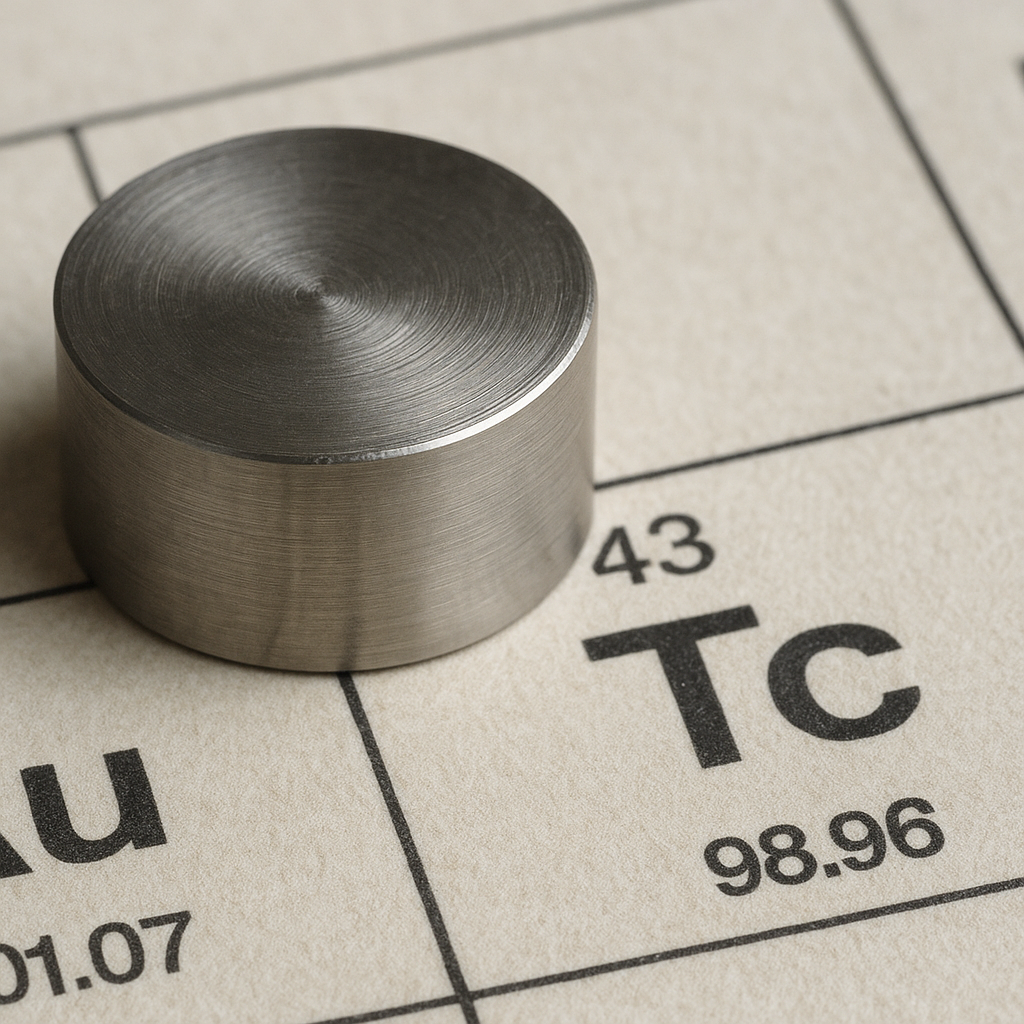
Technetium is an intriguing and unusual element that sits at atomic number 43 in the periodic table. It was the first element to be produced artificially and remains remarkable because it has no stable isotopes. From its role at the heart of modern diagnostic medicine to its curious appearances in stellar atmospheres, technetium spans topics that intersect chemistry, nuclear physics, environmental science and history. This article explores where technetium occurs, how it is produced and used, and several scientifically interesting aspects of its chemistry and behavior.
Physical and chemical properties
Technetium is a silvery-gray, brittle transition metal that shows a mixture of behaviors typical of the middle of the transition series. Its atomic number, 43, places it between molybdenum (42) and ruthenium (44), and its chemistry is in several ways analogous to molybdenum. Key distinguishing features stem from the fact that all of its isotopes are radioactive, which influences how the element is handled and studied.
Common oxidation states span from approximately +7 to 0, with +7 (as the pertechnetate anion) and lower oxidation states such as +4 and +5 encountered in many coordination compounds. The pertechnetate anion, TcO4-, is chemically similar to permanganate and perchlorate: it is tetrahedral, highly soluble in water and relatively inert to complexation in oxidizing conditions. Reduced forms of technetium—such as Tc(IV) species—tend to form low-solubility oxides or hydroxides that are less mobile in the environment.
Technetium metal itself is ductile at elevated temperatures but brittle at room temperature. Like many transition metals, it forms a variety of coordination and organometallic complexes; for instance, the technetium tricarbonyl fragment [Tc(CO)3]+ is an important building block in modern radiopharmaceutical chemistry because it forms stable complexes with a range of ligands.
Occurrence in nature and methods of production
Although technetium was first produced artificially in the laboratory, trace amounts do occur in nature. Tiny quantities are generated in uranium ores and in fissioning materials by spontaneous or induced fission processes. Natural occurrences are extremely scarce because any primordial technetium would have decayed away long ago given the absence of stable nuclides. Most of the technetium humans encounter originates from nuclear reactors or particle accelerators.
There are two principal routes for producing significant amounts of technetium:
- Fission of heavy nuclides such as uranium-235. Nuclear fission of U-235 yields a distribution of fission products including isotopes of technetium. One of these, Tc-99, is produced in large quantities as a long-lived fission product.
- Accelerator-based production, in which protons are directed at enriched molybdenum-100 targets producing technetium isotopes through (p,2n) reactions. This method is particularly valuable for producing short-lived diagnostic isotopes without the reactor-based chain in some circumstances.
A production chain of enormous practical importance is the molybdenum-99/technetium-99m generator system. Molybdenum-99 (produced in fission reactors) decays (with a half-life of about 66 hours) to technetium-99m, which is a metastable nuclear isomer that emits a useful 140 keV gamma photon and has a half-life of about six hours. The decay product, Tc-99m, can be chemically separated (“milked”) from its parent in hospital radiopharmacies using compact generator cartridges, providing on-demand diagnostic radioactivity for medical imaging.
Medical applications and radiopharmaceutical chemistry
One of the most important real-world impacts of technetium is in nuclear medicine. The metastable isotope Tc-99m has ideal physical properties for diagnostic imaging: a short half-life of roughly six hours that limits patient radiation dose, and emission of a single, relatively low-energy gamma photon (140 keV) that modern gamma cameras detect efficiently. For these reasons, Tc-99m is the cornerstone of single-photon emission computed tomography (SPECT) imaging and is used in hundreds of thousands of diagnostic procedures annually worldwide.
Technetium’s usefulness is greatly amplified by its rich coordination chemistry. Radiopharmaceuticals are molecules designed to deliver the radioactive atom to specific biological targets; technetium-labeled compounds are created by binding technetium to chelators or functional molecules that target organs, tissues, or cellular processes. Common clinical applications include:
- Myocardial perfusion imaging to assess coronary artery disease and heart function.
- Bone scans for detecting metastases, infection, or fractures.
- Renal imaging to evaluate kidney perfusion, drainage and relative function.
- Brain SPECT for certain types of neurological diagnostics.
- Sentinel lymph node imaging and targeted tumor studies using specialized ligands.
Commercially available radiopharmaceutical kits are used to label technetium as it is eluted from a generator. Examples include radiolabeled agents such as sestamibi and tetrofosmin (used for cardiac imaging), 99mTc-MDP (methylene diphosphonate, for bone imaging), and MAG3 (for renal scans). The facility to create many different tailored complexes from a single radioactive core is what makes technetium so versatile in medicine.
Industrial, scientific and technological uses
Beyond medicine, technetium finds applications in a variety of industrial and scientific roles, although its presence is often limited by considerations of radioactivity and cost. Some notable applications and research uses include:
- Industrial radiography and process tracing: short-lived isotopes or gamma-emitting forms may be used to trace fluid flows, detect leaks, or study corrosion in closed systems under controlled conditions.
- Catalysis and fundamental chemistry: technetium complexes are used in academic research to explore fundamental aspects of transition-metal bonding, redox chemistry and organometallic reactivity. The element’s position in the periodic table provides valuable comparison points with molybdenum and ruthenium chemistries.
- Nuclear science and forensics: because technetium isotopic signatures and concentrations can indicate specific reactor operations or fuel-cycle events, the element plays a role in nuclear forensics and environmental monitoring around nuclear facilities.
- Materials research: technetium’s alloys and high-temperature compounds have been investigated experimentally, though widespread industrial metallurgical use is limited due to radioactivity and scarcity.
Environmental behavior, waste, and containment
A major concern with technetium, especially Tc-99, is its environmental mobility. Under oxidizing conditions, technetium exists predominantly as the pertechnetate anion, TcO4-, which is highly soluble in water, poorly sorbed by most mineral surfaces, and chemically stable in aerobic environments. These characteristics allow pertechnetate to migrate readily through groundwater, posing challenges for the long-term disposal of nuclear waste and environmental remediation.
Strategies to reduce technetium mobility include:
- Chemical reduction: reducing Tc(VII) to Tc(IV) converts soluble pertechnetate into insoluble TcO2-like phases that precipitate and are less mobile.
- Immobilization in host matrices: incorporation of reduced technetium into glass, ceramic or other engineered waste forms can sequester it for very long periods.
- Geochemical barriers: repository design seeks reducing conditions (for example through engineered or natural backfill materials) to keep technetium in reduced, immobile states.
Understanding technetium speciation under repository-relevant conditions is a rich field of research because Tc-99 has a very long half-life on human timescales (about 211,000 years) and thus is a key radionuclide when assessing long-term safety of radioactive waste disposal. The element’s redox chemistry, complexation with natural organic matter, and sorption behavior on mineral surfaces are all active research areas.
Astronomical significance and stellar nucleosynthesis
One of the most fascinating chapters in the technetium story lies in astronomy. Spectroscopic detection of technetium in the atmospheres of certain red giant stars in the mid-20th century provided concrete evidence that heavy elements are synthesized within stars rather than being exclusively primordial. The presence of technetium—an element with no stable isotopes and relatively short lifetimes compared to stellar ages—means it must have been produced within those stars relatively recently in astrophysical terms.
The detection is linked to the slow neutron-capture process (the s-process) that occurs in asymptotic giant branch (AGB) stars. By identifying absorption lines corresponding to technetium atoms, astronomers confirmed active nucleosynthesis and dredge-up mechanisms that bring freshly created heavy elements from stellar interiors to the photosphere, where they become observable. The discovery was a landmark in merging nuclear physics with observational astronomy and remains one of the clearest pieces of evidence that stars manufacture elements heavier than iron.
History of discovery and naming
The story of technetium’s discovery spans prediction, premature claims, and final confirmation. Dmitri Mendeleev’s periodic system left gaps for undiscovered elements, and the element at position 43 generated interest because no stable natural candidate had been found. In 1925, Ida Tacke Noddack and Walter Noddack reported the discovery of element 43 in mineral samples, proposing the name “masurium,” but their results were not reproducible and the claim was later discounted.
The confirmed discovery came in 1937 when Carlo Perrier and Emilio Segrè identified element 43 among the products of deuteron bombardment of molybdenum in a cyclotron. Because it had been produced artificially, the element was named technetium, from the Greek technetos, meaning “artificial.” The element thereby held the distinction of being the first artificially produced element to be recognized and named. Subsequent development of nuclear reactors and radiochemical techniques enabled production of larger quantities and a blossoming of technetium chemistry.
Chemical curiosities and research frontiers
Technetium supports a range of interesting chemical motifs that are studied both for their intrinsic scientific value and for practical applications in radiopharmacy and waste management. Highlights include:
- The use of tricarbonyl technetium cores and tailor-made chelators to create stable complexes with predictable in vivo behavior and pharmacokinetics.
- Exploration of pertechnetate analogies with other tetrahedral anions and the development of selective sorbents or reducing agents to capture TcO4- from aqueous streams.
- Organometallic chemistry where technetium forms bond types akin to its neighbors, yielding insights into periodic trends across the 4d transition metals.
- Studies of the interaction between technetium and biological molecules, which inform both safety protocols and the design of targeted diagnostic agents.
Another active research area is optimizing non-reactor production routes for diagnostic technetium isotopes. Political and technical fragilities in the aging global reactor fleet that supplies molybdenum-99 have prompted accelerated development of accelerator-based solutions and alternative generator technologies, with implications for medical supply robustness and national infrastructure.
Regulation, safety and practical considerations
Because technetium isotopes are radioactive, handling, transport and clinical use are subject to strict regulatory regimes. Radiopharmaceutical preparation requires licensed facilities, trained staff and radiation-safety protocols to protect patients and workers. From the point of view of patient care, technetium is favored because of the balance between effective imaging and relatively low radiation dose, but proper dosimetry, shielding and waste management remain essential.
Spent radiopharmaceuticals and generator residues must be managed as radioactive waste. The long-lived daughter nuclide Tc-99 contributes to low-level waste inventories and informs strategies for decay-in-storage, segregation, and final disposal. Environmental monitoring around nuclear facilities pays attention to pertechnetate as a potential mobile contaminant, and remediation strategies focus on chemical reduction and sequestration.
Interesting facts and lesser-known aspects
Some intriguing and occasionally poetic details about technetium:
- Technetium was the first element to be produced artificially and given a name that reflects that origin. Its name literally celebrates the human-made nature of its initial discovery.
- The presence of technetium lines in the spectra of giant stars provided some of the earliest direct evidence that heavy elements are formed in stars, linking laboratory nuclear physics to stellar evolution.
- Despite its scarcity in nature, technetium is produced in measurable quantities as a byproduct of nuclear reactors, and its isotopes form the backbone of modern molecular imaging.
- The 140 keV gamma emission of Tc-99m is almost a “Goldilocks” energy for gamma cameras—energetic enough to escape the body and be detected, but low enough to limit patient exposure.
- In environmental contexts, the similarity of pertechnetate to other tetrahedral anions such as perchlorate and permanganate makes selective removal challenging, and this draws continued attention from chemists and engineers.
Conclusion
Technetium occupies a special place among the chemical elements: scientifically rich, practically indispensable in medicine, and environmentally and politically significant because of its role in the nuclear fuel cycle. Its story crosses disciplines and historical eras, from predictions by early periodic chemists through laboratory synthesis, astrophysical revelation and contemporary clinical practice. As research continues into safer waste forms, alternative production methods, and ever more targeted radiopharmaceuticals, technetium will remain a small but potent thread woven through modern science and technology.