
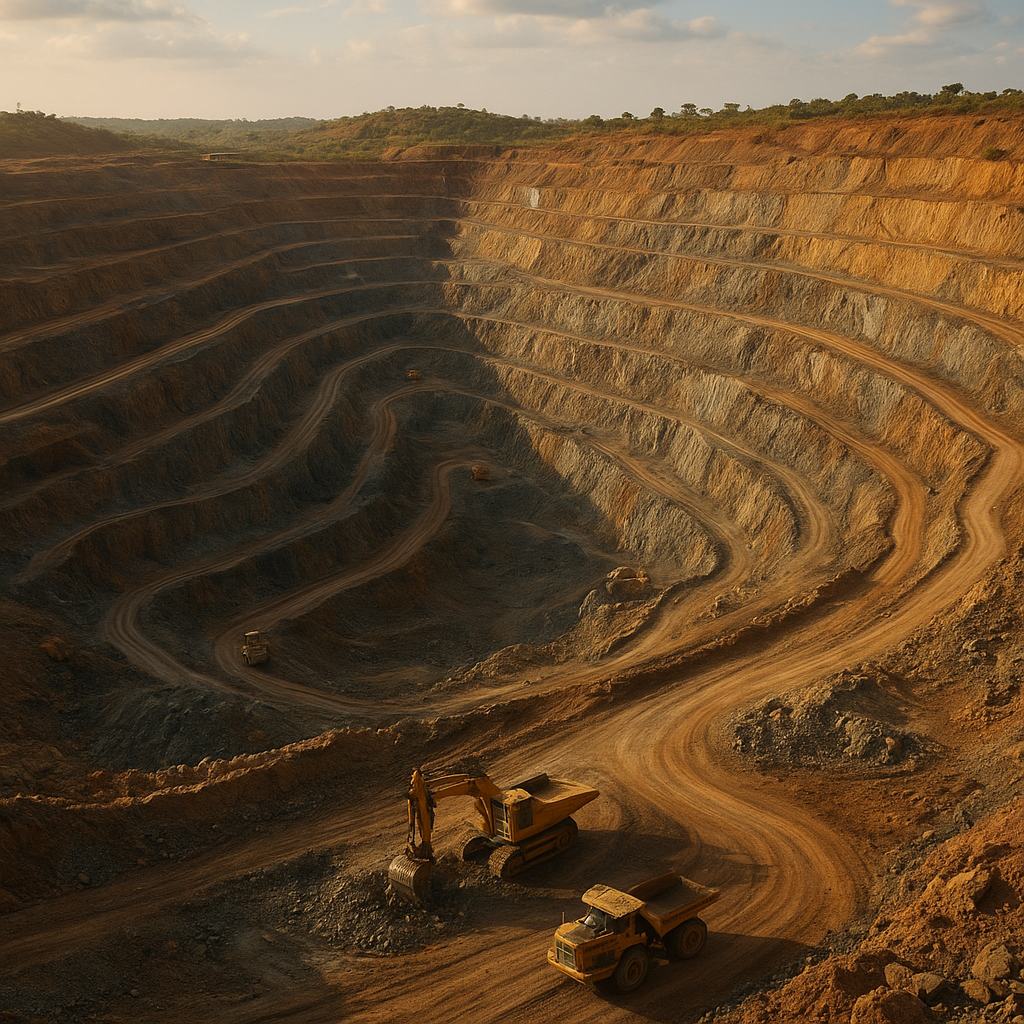
The Tarkwa mining complex, set in the forested lowlands of southwestern Ghana, is one of the country’s most famous and productive gold-producing areas. Its combination of large-scale open pits, processing plants, and a long mining history make it a focal point for discussions about resource-driven development, environmental management, and the evolving technologies of modern gold extraction. This article examines where Tarkwa is located, what is extracted there, the mine’s economic importance, and several noteworthy aspects that give the operation both local and international significance.
Location and Geological Setting
Tarkwa lies in the Western Region of Ghana, roughly 80–100 kilometres inland from the Gulf of Guinea, in the Tarkwa-Nsuaem Municipality. The town of Tarkwa serves as the regional hub for the mining complex and has grown around the operations and the transport routes that support them. The broader area is part of Ghana’s prolific greenstone belts — geological formations that host many of West Africa’s most important gold deposits.
The mineralization at Tarkwa is principally associated with the Tarkwaian and Birimian rock units. These rocks host both oxide and sulphide gold mineralization in shear zones, quartz veins and disseminated systems. Most modern operations in the region exploit relatively near-surface mineralization in extensive open-pit mines, where the geometry of the deposits allows large-scale mechanical excavation followed by conventional gravity, leaching and carbon-in-leach/CIP/CIL processing.
What Is Extracted and How
The principal commodity produced at Tarkwa is gold. The ore types vary from soft, oxide material amenable to heap leaching to harder sulphide ores that require milling and gravity concentration followed by carbon-in-leach processing. The mining complex typically combines several large pits, waste dumps, and processing plants. Crushed and milled ore undergoes cyanidation and adsorption on activated carbon for gold recovery, combined with ancillary circuits for mercury-free gravity concentration where appropriate.
Historically the Tarkwa area has produced both free-milling and refractory gold. Modern treatment plants at the complex are designed to maximize recovery across this spectrum of ore types. Operational elements commonly include high-capacity crushers, SAG and ball mills, gravity concentrators, carbon-in-leach tanks, carbon regeneration circuits, and tailings storage facilities. The operation’s scale and integrated processing logistics enable sustained, high-volume production over decades.
Ownership, Operations and Workforce
The Tarkwa mine complex has been operated in modern times by major international mining firms, and its management and ownership may change through corporate transactions common in the mining industry. The operation employs a multi-disciplinary workforce that includes miners, metallurgists, engineers, environmental specialists, and administrative staff. Direct employment often numbers in the low thousands, with many additional indirect jobs created in services, transport, contracting and supply chains that support mine operations. Through these roles the mine contributes significantly to local employment and regional economic activity.
Local procurement, community employment initiatives and training programs are often part of the mine’s operational commitments, aiming to increase local participation and skills development. The presence of an internationally managed mine also brings technical expertise and capital investment that can transfer knowledge to the wider economy.
Economic Significance
Gold mining is a cornerstone of Ghana’s economy, and Tarkwa is among the country’s most important single-site contributors. The mine generates export revenues through the sale of refined gold, adds to government finances through taxes, royalties and customary payments, and underpins local economies by purchasing goods and services. The cumulative value of these flows includes foreign exchange earnings, direct fiscal contributions, and the stimulation of secondary industries.
Beyond direct monetary contributions, the mine supports infrastructure development: improvements to roads, electrification projects, water supply systems, and healthcare or educational facilities are frequently part of corporate social responsibility programs and local-government partnerships. These infrastructure investments can have multiplier effects on regional economic development long after particular pits have closed.
Social and Environmental Considerations
The scale of modern mining inevitably produces social and environmental challenges as well as benefits. Mining alters landscapes through pit excavation, waste-rock dumps and tailings storage. Effective management of tailings, water usage, and potential chemical contamination (notably cyanide in processing and mercury from informal gold recovery) is essential to protect local ecosystems and community health. Operators at Tarkwa have invested in environmental monitoring, progressive rehabilitation and water-treatment systems, but the legacy of mining and ongoing impacts remain topics of concern and community interest.
Artisanal and small-scale mining, locally referred to as artisanal or “galamsey,” frequently occurs around large mining complexes. Galamsey activity can provide livelihoods for local populations but also creates environmental stress through uncontrolled excavation, mercury use and sedimentation of waterways. The coexistence of industrial mining and artisanal activities presents governance challenges: securing land and equipment from illegal incursion, mitigating water and soil contamination, and integrating artisanal miners into safer, formalized frameworks.
- Environment: Rehabilitation programs focus on regrading pits, revegetation and monitoring of tailings dams.
- Health: Companies and government programs often collaborate on water sanitation and clinic support in mining communities.
- Safety: Large open pits require strict safety protocols to manage slope stability, blasting schedules and haul-road traffic.
Regulation, Taxes and Local Benefits
Ghana’s regulatory framework governs exploration, mine development, environmental protection, and taxation. Royalties, corporate income taxes, and mineral rights fees contribute to national and local government coffers. The precise fiscal contribution of any mine varies with gold prices, production levels, contract terms and applicable incentives, but a major operation such as Tarkwa can represent a meaningful stream of public revenue.
Local benefit programs often include development funds for municipal projects, scholarships, vocational training and support for small and medium enterprises. Transparent mechanisms for allocating benefits and engaging communities help reduce conflict and increase the perceived fairness of resource exploitation.
Historical and Cultural Context
Gold has shaped the Tarkwa area’s human geography for centuries. Pre-colonial and colonial-era mining, trade routes and settlement patterns centered on gold. The region’s long engagement with gold extraction has left a cultural legacy of artisanal mining traditions and local knowledge about mineral occurrences. Modern industrial mining sits atop this deep historical foundation.
The town of Tarkwa itself evolved from a small settlement to a regional centre in large part because of mining activity. Nearby archaeological and anthropological evidence underscores how the search for gold influenced social systems, trade and inter-community relations across the centuries.
Technological Developments and Innovations
As a large-scale, long-life mining complex, Tarkwa has been a site for implementing technological improvements that boost efficiency and reduce environmental footprint. Examples include improved ore-sorting techniques, enhanced gravity concentration to reduce cyanide usage, and advances in tailings management such as dewatering or paste-tailings options that reduce dam heights and seepage risk. Monitoring technologies — remote sensing, drone surveys, water-quality sensors and fleet telematics — increase operational safety and environmental oversight.
Automation and digitalization in mining management systems help optimize haul-road logistics and drill patterns, lowering operating costs and improving recovery. These technologies frequently require skilled local labour and training programs, which can be a pathway to higher-value employment for residents.
Interesting Facts and Lesser-Known Details
- Gold at Tarkwa is produced from some of Ghana’s largest open pits, which are engineered to handle high volumes of ore and waste movement across multiple benches.
- The area’s long mining history means that modern operations often work adjacent to or above old workings and tailings from colonial-era activities.
- Innovative environmental initiatives at some sites focus on turning rehabilitated land into agricultural plots, forestry areas or community recreational spaces.
- Because of the combination of oxide and sulphide ores, processing plants must be flexible; operators often run both heap-leach and CIL circuits concurrently to optimize recovery.
- The social fabric of Tarkwa includes a mix of long-established local families and a rotating population of technical specialists, contributing to a diverse local economy.
Outlook and Future Prospects
The future of mining at Tarkwa will be shaped by geological factors (remaining reserves and ore quality), global gold prices, regulatory changes, and the industry’s ability to manage environmental and social impacts responsibly. Continued investment in resource conversion (exploration to prove-in new reserves) and in processing efficiency can prolong mine life. If companies and government continue to prioritize community engagement, environmental stewardship and skills development, the operation can remain a major contributor to regional development while mitigating many traditional mining risks.
Key considerations moving forward
- Effective integration of artisanal miners into formalized systems to reduce illegal activity and environmental damage.
- Advances in tailings and water management to reduce ecological risks and increase safety.
- Continued local capacity building so that economic benefits penetrate beyond direct employment to lasting community improvements.
- Adaptive fiscal policies that balance national revenue needs with incentives for long-term investment.
Overall, Tarkwa represents a microcosm of modern gold mining in West Africa: a site of significant economic value, technological innovation, and complex social-environmental trade-offs. Its ongoing story will reflect broader trends in resource governance, corporate responsibility and the global metals market.

