
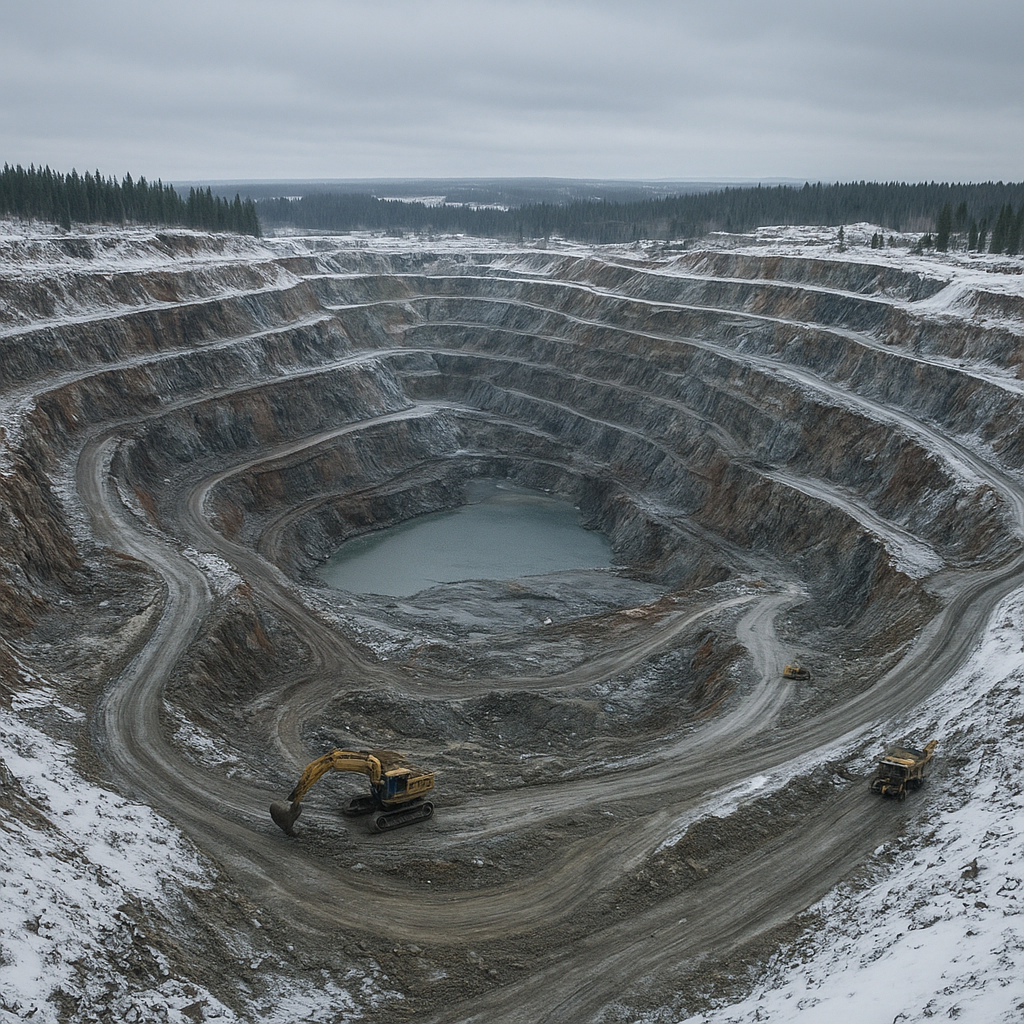
The Talvivaara site in Finland has become one of the most discussed mining operations in Northern Europe over the last two decades. It combined ambitious industrial innovation with contentious environmental episodes, and ultimately played a notable role in debates about how to extract low-grade deposits responsibly while supplying strategically important metals. This article explores where the mine is located, what is produced there, its economic significance, and several aspects that many find especially interesting or instructive.
Location and geological setting
The mine is situated near the town of Sotkamo in the Kainuu region of eastern Finland, roughly in the middle of the Finnish Lakeland area. The landscape around the site is characterized by boreal forests, lakes and wetlands, and the mine sits within a sparsely populated rural region where mining and forestry are important local activities.
Geologically, the deposit at Talvivaara is a large polymetallic sulfide system that contains economically interesting concentrations of nickel and zinc alongside smaller but still valuable quantities of copper, cobalt and other elements. The deposit type and the form in which the metals occur made it suitable for unconventional processing techniques: much of the ore is relatively low-grade compared with traditional sulfide deposits, which pushed operators to adopt innovative extraction methods rather than conventional smelting.
What is mined and how it is extracted
The principal metals extracted from the operation have been nickel and zinc, with copper and cobalt appearing in lower concentrations and occasionally recovered as byproducts. In addition, trace amounts of other elements such as uranium and rare earth elements have drawn attention at various times, although they have not been the primary products.
A distinctive feature of the operation was its use of heap leaching combined with microbiological processes to solubilize metals from the ore. This approach—often referred to as bioheapleaching—relied on bacteria and controlled chemical conditions to break down mineral matrices and move metal ions into solution, from which they could be recovered through conventional hydrometallurgical methods (solvent extraction, electrowinning, etc.). The method was chosen because the ore body contained a very large volume of material at relatively low grades; using heap leaching made it possible to economically extract metals without the higher capital cost of a full-scale smelter.
Over time the site processed ores from open pit mining operations. The process chain included crushing and agglomeration of ore, stacking in heaps where leach solutions circulated, collection of pregnant leach solution, and downstream chemical processing to produce metal concentrates or metal salts. After financial and ownership changes, the operation evolved to emphasize the production of refined products suitable for contemporary markets, including materials used in battery manufacture.
Economic significance
The mine has influenced both the local economy of the Kainuu region and broader Finnish industrial activity. At a local level, the operation created hundreds of jobs in mining, processing, logistics and associated services, providing an employment base in an area with limited alternative industrial employers. For municipalities near the site, tax revenues and infrastructure investments tied to the mine were important for municipal budgets and community services.
At the national and international level, the site has been significant because of its role in supplying critical metals. Nickel is a key input for stainless steel manufacturing and increasingly important for rechargeable battery chemistries used in electric vehicles and grid storage. Zinc is essential for galvanizing and corrosion protection in construction and manufacturing. A domestic source of these metals contributes to supply security for European industry and reduces dependence on imports from more distant suppliers.
- Contributions to local employment and service industries.
- Taxation and royalties that supported municipal and regional budgets.
- Strategic supply of metals relevant to energy transition and industrial resilience.
- Stimulus for regional infrastructure, including roads and processing facilities.
Ownership and corporate history have impacted the economic story. The original operating company faced severe financial and reputational difficulties, which culminated in restructuring and the eventual transfer of operations to a new operator that implemented changes in governance and technical management. The successor company—now state-owned—refocused some activities and invested in stabilizing operations and environmental compliance, which affected the local jobs landscape and long-term planning for the region.
Environmental controversies and remediation efforts
One of the most widely discussed aspects of the Talvivaara operation was its environmental record. Several incidents of leakage and discharge of metal-rich, sulfate-laden process waters into local waterways occurred during the mine’s early operational years. These events provoked public outcry, regulatory scrutiny and a series of corrective measures. The issues highlighted the risks inherent in large-scale hydrometallurgical operations conducted in sensitive boreal landscapes where lakes and streams are readily connected to mining infrastructure.
Key environmental concerns included:
- Escapes of process solution from tailings and waste basins that led to elevated concentrations of sulfates and dissolved metals downstream;
- Contamination of surface waters and sediments, leading to impacts on aquatic organisms and concerns about potential human exposure through fishing or drinking water;
- Long-term management of waste heaps and slurry deposits, including the chemical stability of tailings in cold climate settings;
- Public trust and community relations, which were strained during periods of continuing incidents and litigation.
Remedial responses combined technical fixes, regulatory enforcement and institutional change. Operators invested in improved leak detection, redesigned containment systems, and enhanced water treatment facilities that aimed to capture and treat contaminated water before it left the site. The transition to new ownership placed emphasis on cleaning up legacy impacts and meeting stricter environmental monitoring and reporting standards. Over time, ongoing monitoring programs have been used to map recovery trajectories in affected water bodies and to adjust mitigation measures.
The Talvivaara experience is frequently cited in discussions about the need for rigorous environmental oversight for large hydrometallurgical operations, especially those employing innovative processes at scale. It also illustrates the complexities of balancing economic benefits with ecological safeguards in regions where freshwater ecosystems are central to local livelihoods and cultural practices.
Interesting aspects and lessons learned
Innovation at scale
The attempt to commercialize bioheapleaching at a scale large enough to handle low-grade ore was a major experiment in modern mining. When successful, such technologies can unlock resources that would previously have been considered uneconomical. The technical lessons from the site have been valuable for engineers and scientists studying how bacteria, chemistry and large hydraulic systems interact in cold climates.
Regulatory and governance implications
The mine’s history underscores the importance of adaptive regulation that can respond to new technologies, unforeseen operational challenges and evolving environmental science. The interplay between corporate governance, state oversight and community expectations became a case study in how policy, enforcement and remediation can (and must) work together to manage risk.
Supply chain and strategic metals
As Europe pursues electrification and a shift away from fossil fuels, domestic sources of metals such as nickel and zinc become strategically valuable. The mine’s evolution into a site that contributes to battery raw materials (via processing changes and product lines) made it relevant to broader industrial policy conversations on securing raw material supplies for future technologies.
Community and social dimensions
Local reaction to both the economic opportunities and environmental challenges revealed how mining projects can simultaneously be a source of prosperity and anxiety. Community engagement, transparent reporting, and long-term planning for post-mining land use and rehabilitation have emerged as critical components of socially sustainable mining operations.
Current status and future outlook
Following operational disruptions and corporate restructuring, the site has continued to operate under new management and with enhanced regulatory oversight. The operator, known now as Terrafame, has aimed to stabilize production, improve environmental performance, and reposition products for modern markets, including refined chemicals for battery manufacture. Government involvement—resulting in the company becoming state-owned—was part of a strategy to secure jobs, ensure environmental accountability, and safeguard strategic metal production in Finland.
Looking forward, the mine’s role will likely be shaped by several interrelated forces:
- Global demand for nickel and zinc driven by stainless steel and battery markets;
- Technological advances in hydrometallurgy and waste management that could reduce environmental footprints and cost structures;
- Regulatory requirements and community expectations that set higher standards for water quality, containment and long-term monitoring;
- Market signals about the price and supply of critical metals that determine the economic viability of continued operations and potential expansions.
For policymakers and industry observers, the Talvivaara story remains relevant as an example of how natural resources can be leveraged for regional development while also illustrating the pitfalls that can occur when technical innovation outpaces environmental safeguards. The emphasis on remediation and improved oversight demonstrates a pragmatic approach to resolving conflicts between economic and environmental priorities.
Concluding observations
Talvivaara has been more than a single mine; it has been a complex experiment in modern mineral extraction, an economic driver for a rural region, and a flashpoint for debates about environmental protection and responsible industrial development. Its experience has produced a set of practical lessons for engineers, regulators and communities about how to manage the lifecycle of large-scale metallurgical operations. As the world continues to seek metals essential for the green transition, the technical innovations and governance reforms that emerged from Talvivaara will likely inform future projects—both in Finland and internationally—where the twin goals of resource development and environmental stewardship must be reconciled.

