
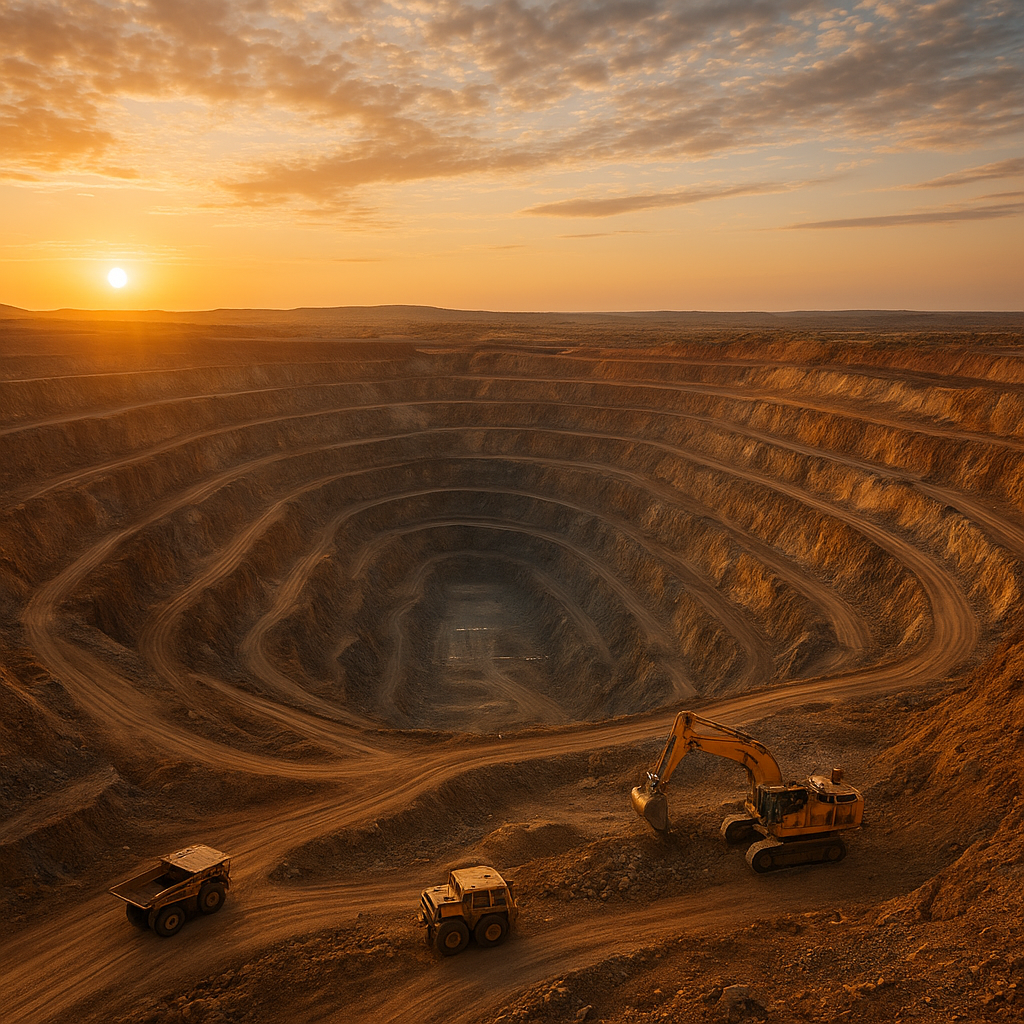
The Sunrise Dam gold mine is one of Western Australia’s long‑running producers, combining decades of exploration, mining and processing in the heart of the state’s eastern goldfields. Located in a remote but geologically rich setting, the operation has evolved through changing technology and economics to remain a significant contributor to regional employment, state revenue and global gold supply. This article outlines where the mine is located, what is extracted there, its economic role, the technical and environmental aspects of its operation, and a selection of particularly interesting facts that illustrate why Sunrise Dam matters.
Location and regional setting
Sunrise Dam sits in the eastern part of the Yilgarn Craton of Western Australia, a region renowned worldwide for its prolific gold endowment. The mine is situated approximately 55 kilometres south of the town of Laverton, within the administrative boundaries of the Shire of Laverton. The nearest major urban centre is Kalgoorlie‑Boulder, several hundred kilometres to the south‑west, and the area is characterised by low, arid scrubland, undulating plains and ancient greenstone belts that host the mineralisation.
The mine’s remoteness is a defining feature of its operation. Logistics for fuel, water, personnel and supplies require careful planning and significant investment in roads, air transport and on‑site accommodation. Despite the isolation, Sunrise Dam is connected to regional service centres by well‑established supply chains, and the mine has helped to anchor a local economy based on mining services, transport and logistics.
Local infrastructure and communities
Although there is no major town immediately adjacent to the mine, the presence of Sunrise Dam has supported regional infrastructure improvements. The mine operates a workforce roster that often uses fly‑in fly‑out (FIFO) arrangements from larger centres, but it also engages with local communities and Indigenous groups for employment and procurement wherever possible. Provisions for health, safety and emergency response form part of the mine’s critical infrastructure, alongside workshops, power generation, water treatment and accommodation camps.
Geology and what is mined
The resource at Sunrise Dam is a classic example of Archaean orogenic gold mineralisation hosted in greenstone‑belt lithologies. The deposit occurs in structurally controlled quartz veins and shears that cut through a package of volcanics and sediments. Gold is found both in fresh sulphide‑bearing veins at depth and as oxidised secondary minerals in near‑surface zones, which influenced the early stages of mining and processing.
The principal commodity produced is gold, recovered from ore through conventional metallurgical routes. Mineralisation commonly occurs alongside sulphide minerals such as pyrite and arsenopyrite, and the ore exhibits variable oxidation states from fully oxidised near surface to fresh sulphide ore at depth. This variability affects grinding, leaching and recovery processes and has driven a history of metallurgical optimisation at the site.
- Deposit type: Archaean orogenic gold, structurally controlled.
- Host rocks: Greenstone belt volcanics and sediments with shear zones and quartz veins.
- Minerals: Native gold with associated sulphides (pyrite, arsenopyrite) and secondary oxide minerals near surface.
Exploration and resource growth
Exploration at Sunrise Dam has been ongoing since discovery, with periodic drilling campaigns aimed at extending both strike and depth of the ore zones. Modern exploration techniques—including detailed structural interpretation, geophysical surveys and targeted infill and extensional drilling—have helped to define multiple lodes and satellite zones. Successful exploration programs are often responsible for converting inferred resources into mineable reserves, thereby sustaining the project’s life of mine.
Mining methods and processing
Operations at Sunrise Dam have transitioned over time in response to geological constraints and economic drivers. The mine initially developed as an open‑pit operation to exploit near‑surface, oxidised ore, but as shallow resources were depleted, mining extended underground to access higher‑grade sulphide ore at depth. The co‑existence of open‑pit and underground mining is a common evolution for greenfields deposits in the Yilgarn region.
The underground mining methods typically used in deposits like Sunrise Dam include mechanised decline access and longhole stoping or sublevel stoping where appropriate. These methods balance productivity and cost, allowing selective extraction of narrow, high‑grade lodes while maintaining safety and dilution control. The surface open pits use conventional drilling, blasting, loading and haulage to move ore and waste to processing and waste storage facilities.
Processing plant and recovery
Ore from Sunrise Dam is processed in a central plant that combines crushing, milling and chemical recovery. A typical flow sheet for this style of operation includes:
- Primary and secondary crushing to reduce feed size.
- Ball milling and classification to produce an appropriate grind for leaching.
- Gravity concentration circuits where coarse free gold is present, capturing a portion of metal early to improve overall recoveries.
- Carbon‑in‑leach (CIL) or carbon‑in‑pulp (CIP) leaching for gold dissolution using cyanide, followed by adsorption onto activated carbon.
- Elution, electro‑winning and refining to produce doré bars for shipment to refineries.
The use of gravity recovery ahead of leaching is an important metallurgical step because it quickly liberates coarse gold and reduces cyanide consumption. CIL remains a widely used, efficient route for recovering gold from both oxide and fresh sulphide ores when combined with appropriate grinding and reagent strategies.
Economic significance
Sunrise Dam contributes to the regional and national economy in several ways. At the national level, gold produced at the mine is a valuable export commodity and a source of foreign exchange. At the state level, royalties and corporate taxes collected from mining companies help to fund public services and infrastructure. At the local level, the mine creates jobs, supports local contractors and stimulates economic activity in service towns and supply chains.
Key economic impacts include:
- Employment: Direct jobs for miners, engineers, geologists, metallurgists and support staff, plus indirect employment in services and supply chains.
- Regional development: Contracts for logistics, catering, maintenance and specialised mining services that often benefit local and regional businesses.
- Government revenue: Royalties and taxes derived from production and corporate earnings, contributing to public finances.
- Export earnings: Gold sales generate foreign exchange and help diversify Australia’s export portfolio beyond commodities like iron ore and LNG.
Beyond the direct monetary figures, mines like Sunrise Dam play a role in sustaining a skilled mining workforce and in driving technology transfer to other projects. The operational experience gained on site—ranging from remote‑site logistics to advanced mine planning—adds intangible value that benefits the broader mining sector.
Environmental management and community engagement
Mining in arid, ecologically sensitive landscapes requires careful environmental management. Sunrise Dam operates under regulatory frameworks that require environmental impact assessment, detailed management plans and progressive rehabilitation. Key environmental focuses for the mine include water use and conservation, tailings management, waste rock containment, dust and noise control, and rehabilitation of disturbed areas.
Water is a critical resource in the area, and mine operations emphasise recycling and efficient use of water in processing and accommodation facilities. Tailings storage facilities are engineered with containment and monitoring systems to protect local groundwater and surface ecosystems. Progressive rehabilitation—backfilling pits where feasible, recontouring batters and reestablishing native vegetation—aims to reduce the long‑term footprint and visual impact.
Engagement with Indigenous and local communities
Engagement with Traditional Owners and local communities is an integral part of contemporary mining practice. Sunrise Dam has developed consultation processes to address land access, cultural heritage management and opportunities for local employment and enterprise participation. Agreements that provide employment, training and business opportunities can form part of the social licence to operate and foster positive, long‑term relationships.
Interesting facts and technical highlights
- Longevity: Sunrise Dam’s sustained production over many years illustrates how ongoing exploration and engineering adaptation can extend the life of a mining project far beyond initial expectations.
- Transition of mining method: The shift from predominantly open‑pit operations to combined open‑pit and underground mining is a textbook example of lifecycle evolution for narrow, high‑grade lodes.
- Metallurgy: The use of gravity recovery ahead of CIL leaching maximises recovery and minimises reagent use — a practical approach to dealing with variable ore character.
- Remote operations: Because of the mine’s isolation, Sunrise Dam has developed robust supply and workforce systems, including on‑site accommodation and fly‑in fly‑out logistics, that allow continuous operation despite the distance from major population centres.
- Adaptive rehabilitation: The mine’s environmental programs demonstrate how modern mines increasingly plan for closure from the earliest stages, integrating rehabilitation into daily operations rather than treating it as an end‑of‑life activity.
Future outlook and challenges
The long‑term future of Sunrise Dam depends on a combination of continued exploration success, commodity prices, operational efficiency and successful environmental and community stewardship. The ongoing search for extensions of known lodes and discovery of new mineralised shoots will determine whether the mine’s life can be extended further. Meanwhile, technological improvements in ore sorting, automation, digital mine planning and energy efficiency offer pathways to reduce costs and lower environmental impact.
Key challenges that will shape the mine’s prospects include:
- Maintaining safe, cost‑effective access to deeper ore at increasing depths.
- Adapting processing to handle variable ore types while maximising recovery and controlling operating costs.
- Meeting increasingly rigorous environmental standards for water, tailings and rehabilitation.
- Managing workforce dynamics, including the balance between FIFO and local employment, and attracting skilled personnel to a remote location.
Finally, the role of mining companies in providing tangible benefits to regional economies and in engaging constructively with Indigenous communities will continue to influence public perception and regulatory expectations. Strong performance across these dimensions enhances the prospects for projects like Sunrise Dam to remain productive contributors to both the local and national economy.

