
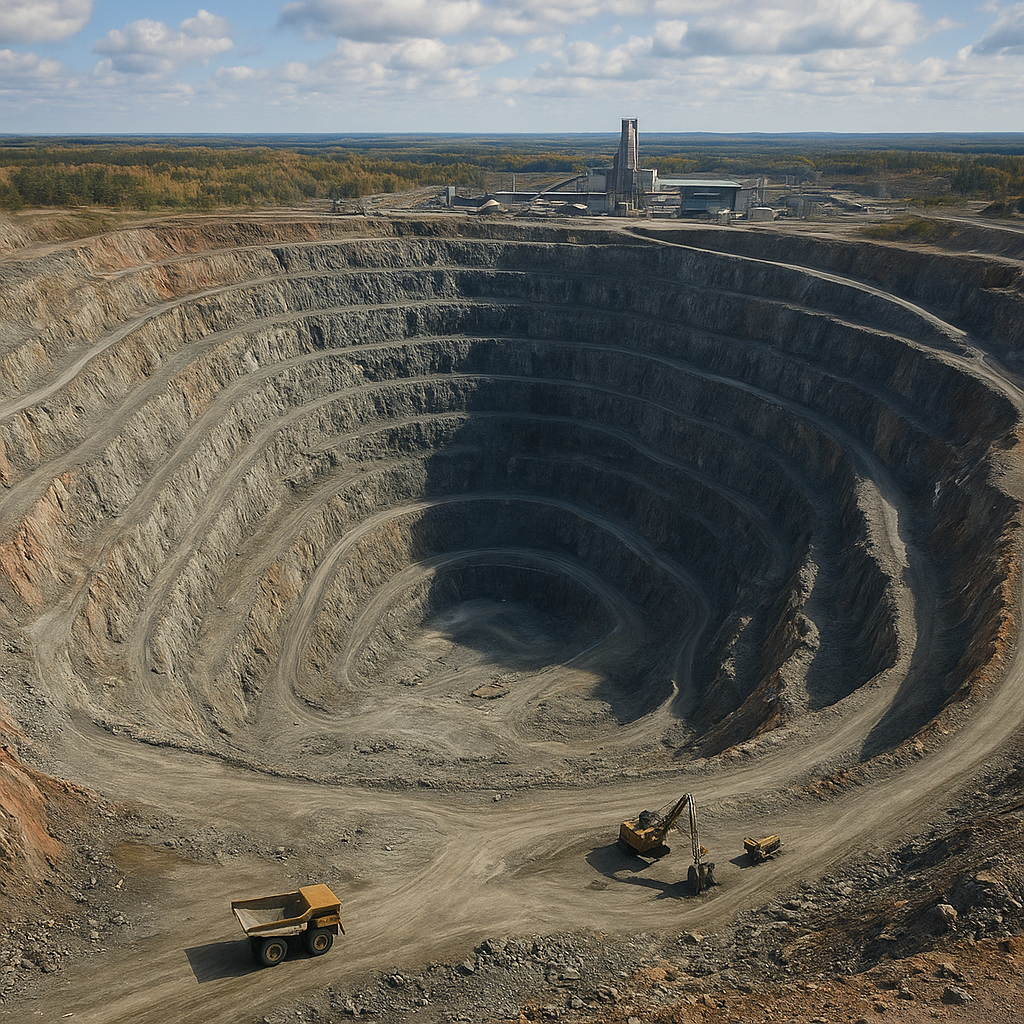
The Sudbury Basin mines form one of the most remarkable mining districts on Earth, where deep geological history, powerful industrial development and ongoing environmental recovery meet. Located in northern Canada, the region has produced vast quantities of metal since the late 19th century and remains central to global supplies of nickel and other strategic elements. This article examines where the basin is located, what is extracted there, its economic role, and a selection of curious and lesser-known facts that make Sudbury unique.
Location and geological origin
The mining district is centered around the city of Sudbury in the province of Ontario, roughly 400 kilometres north of Toronto. The feature people mine is not a typical ore belt but an enormous, roughly circular geological structure—the Sudbury Basin—formed by one of the largest known meteorite impacts on Earth approximately 1.85 billion years ago. The impact generated an extraordinary thermal event that melted the crust, creating an impact melt sheet and complex structural deformation. Over geological time, this melt sheet differentiated and crystallized into a distinctive layered body called the Sudbury Igneous Complex, which hosts the rich sulfide mineralization that miners target today.
The physical expression of the basin is a raised rim and a saucer-shaped depression filled by a variety of rocks: norites, gabbros, granites and brecciated impactites. The concentration of sulphide minerals occurred when dense, immiscible sulfide liquid separated from the silicate melt and pooled along structural traps, fractures and basal contacts. That process created massive sulfide lenses and disseminated mineralization with exceptionally high concentrations of nickel, copper and the valuable platinum group elements (PGEs), including palladium.
What is mined: ore types and minerals
The Sudbury ores are best described as magmatic sulfide deposits hosted within the differentiated impact-related igneous bodies. Miners target both massive sulfide lenses and more disseminated ore. The primary metallic commodities include:
- Nickel — usually present in nickel-iron sulfide minerals such as pentlandite and various solid-solution phases.
- Copper — typically found as chalcopyrite and other copper-bearing sulfides.
- Platinum group elements (platinum, palladium, rhodium and others) — hosted in alloy phases and discrete PGE minerals like sperrylite.
- Gold and cobalt in economic concentrations in some deposits.
Common ore minerals include pentlandite (a primary nickel mineral), chalcopyrite (the chief copper sulfide), pyrrhotite and pyrite. The metallurgical complexity of the ores is high: PGEs occur in trace amounts but are valuable enough that they are recovered as by-products of base metal smelting and refining. The presence of multiple valuable elements makes Sudbury-type deposits particularly attractive because revenue streams are diversified across metals used in steel alloys, electronics and catalytic applications.
Mining methods and metallurgy
Mining in Sudbury combines deep underground operations and surface (open-pit) workings, depending on the orebody geometry. Over the decades the industry developed advanced underground mining techniques to reach deep sulfide lenses, and several of the region’s shafts and ramp systems are among the deepest in North America. Once ore is extracted, it is concentrated by flotation at local mills and then processed via smelting and refining. Historically, large smelters in the Copper Cliff and Coniston areas became integrated hubs that converted concentrates into matte and refined metals.
Smelting and refining in this district required and fostered innovations in metallurgical technology, because the complex mix of sulfides and the presence of PGEs demanded careful separation, environmental controls and high-temperature metallurgical workflows. The integrated nature of extraction, concentration, smelting and refining in one geographic cluster contributed to Sudbury’s long-term industrial strength.
Economic significance
The mining operations around Sudbury have been an economic engine for Ontario and for Canada as a whole. From the earliest commercial extraction in the late 1800s through the 20th century and into the present day, the region supplied a large proportion of North American nickel and a significant share of global PGE production.
Several broad aspects of economic significance stand out:
- Employment and regional development: Mining and processing created towns, transportation links, smelter infrastructure and a broad services economy. The city of Sudbury grew around the industry and became a regional administrative and commercial centre.
- Supply of strategic metals: Nickel is a fundamental alloying element in stainless steel and is increasingly important for battery technologies. The PGEs produced in Sudbury are critical for catalytic converters, electronics and specialized industrial applications.
- Industrial clusters and technology development: Concentrated activity in mining and metallurgy supported innovation in mining engineering, environmental remediation and extractive metallurgy.
Over the long term, revenues from Sudbury ores have contributed to national GDP, export earnings and the growth of multinational mining firms with Canadian roots. The presence of multiple valuable commodities in the ores has given the region resilience: price swings in one metal tend to be offset partly by income from others.
Environmental and social legacy
The industrial scale of Sudbury’s activities left a mixed legacy. For decades, smelter emissions caused severe vegetation damage, soil acidification and lake acidification across large areas. Rock outcrops and landscapes near smelters were denuded, giving early photographs of the area a stark, almost lunar appearance. Those effects were well documented and spurred regulatory and technological responses.
From the late 20th century onward, companies and governments undertook large-scale environmental remediation. Actions included:
- Installing emissions controls on smelters and upgrading processing technology to reduce sulfur dioxide and metal particulate releases.
- Liming of acidified lakes and waterways to aid biological recovery.
- Massive reforestation and soil amelioration programs to restore tree cover and biodiversity on formerly degraded lands.
These efforts have been widely studied as a leading example of industrial environmental recovery. Over decades, many reforested areas have supported renewed wildlife and improved water quality, although legacy contamination and landscape alteration remain management considerations. The social dimension of remediation also involved reconciling community expectations, Indigenous interests and long-term economic planning for a region historically dependent on resource extraction.
Interesting technical and historical facts
The Sudbury Basin is rich in stories that reflect both Earth history and human enterprise. A selection of noteworthy facts:
- Meteorite origin: The basin is interpreted as the result of a giant meteorite impact. This cataclysmic event created the geological conditions necessary for the unusual concentration of ore minerals.
- Age and scale: The impact occurred roughly 1.85 billion years ago, making the structure one of the oldest and largest preserved impact features on the planet.
- Unique geology: The Sudbury Igneous Complex represents a natural laboratory for studying high-temperature differentiation and sulfide segregation in mafic melts, processes that are central to many of Earth’s ore-forming mechanisms.
- Global metallurgy: The smelting facilities that grew around Sudbury were among the first industrial-scale plants to refine complex sulfide ores containing PGEs, helping to establish methods still used in modified form today.
- Community and labour history: The boom-and-bust cycles, union movements and company-town dynamics that shaped Sudbury reflect broader themes in 20th-century industrial Canada.
Notable engineering feats
Reaching deep sulfide lenses required shafts, ventilation and cooling systems built to withstand extreme underground conditions. The concentration and smelting operations demanded continuous improvements in furnace technology and pollution control. The integrated nature of the Sudbury complex—mines, mills, smelters and refineries in close proximity—reduced transportation costs and created synergies that were rare in earlier mining eras.
Modern challenges and opportunities
As the world decarbonizes and electric vehicles proliferate, demand for nickel—especially battery-grade nickel—has renewed interest in established nickel districts. Sudbury’s historical production of nickel places it in a favorable position to contribute to evolving supply chains for batteries and advanced materials, provided ore grades, logistics and refining pathways can meet the specific chemical and environmental standards required for battery metals.
At the same time, modern mining faces multiple challenges in Sudbury:
- Resource maturity: Many high-grade, easily accessible ore lenses have been mined; ongoing operations require deeper mines, more complex processing and higher capital investment.
- Environmental expectations: Stricter emissions standards and community expectations around land use and water quality demand that operators invest in cleaner technology and transparent remediation.
- Social licence: Indigenous partnerships, workforce transition planning and diversified local economies are central to sustaining long-term operations in a socially responsible way.
These factors create opportunities for innovation. Technologies such as electrified underground fleets, improved ore-sorting and in-situ recovery concepts, and closed-loop hydrometallurgical refining methods could reduce environmental footprints and operational costs while opening new pathways to recover critical elements more selectively.
Why Sudbury matters beyond metals
Sudbury’s significance extends beyond the commodities it produces. The region illustrates how a single geological event billions of years ago can influence the course of human economic development millions of times later. It is a case study in the interplay of geology, technology and society: how resource wealth can build communities, how industrial activity alters landscapes, and how science and policy can collaboratively pursue restoration and sustainable development.
Researchers from geology, ecology and engineering disciplines continue to study Sudbury for insights applicable to other mining districts and to planetary science—because impact structures like Sudbury offer analogues for planetary processes on the Moon and Mars. Meanwhile, the industrial heritage—smelters, mills, and the skilled workforce—keeps Sudbury relevant to contemporary global supply chains for alloys, catalysts and battery metals.
Curiosities and cultural notes
- The region’s re-greening efforts are frequently cited in environmental literature as a long-term example of successful landscape remediation on an industrial scale.
- Local museums and interpretive centres document both the meteorite story and the human history of mining, reflecting the dual natural and cultural heritage of the basin.
- Sudbury’s economic transitions highlight the need for diversification in single-industry towns: education, tourism (including geological tourism), and service industries have become important complements to mining.
The Sudbury Basin remains an active, evolving chapter in the story of Earth resources: a place where the power of a prehistoric impact meets modern technology, where the extraction of metals like nickel and copper continues to shape economies, and where lessons in remediation, innovation and resource stewardship have global relevance. Its combination of unique origin, mineral wealth, and socio-environmental dynamics makes Sudbury an enduring subject of interest for geologists, economists and the broader public alike.

