
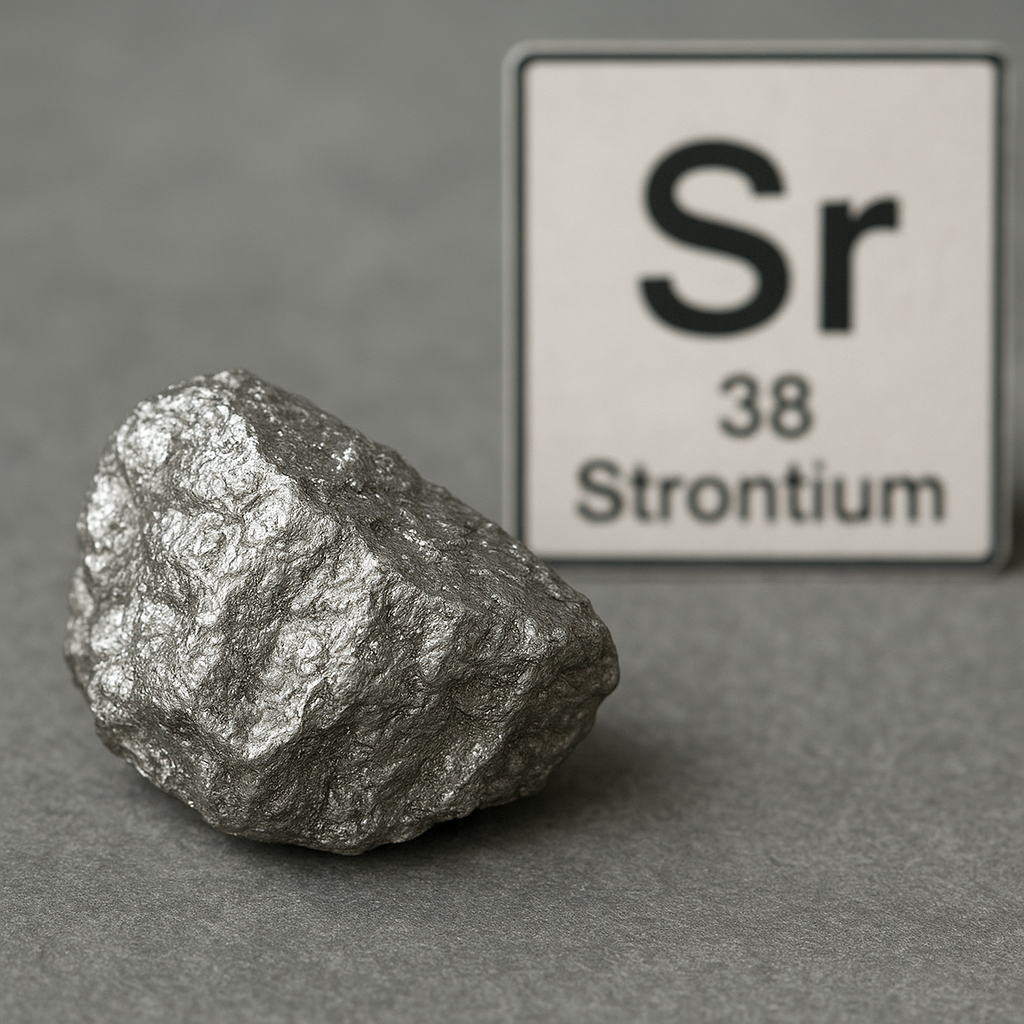
Strontium is an often-overlooked chemical element that quietly influences many aspects of modern life, from the deep history recorded in rocks to the brilliant reds of fireworks. This article explores where strontium is found in nature, how it is processed and used across industry and medicine, and several intriguing scientific and cultural stories connected to this metallic member of the alkaline-earth family.
Basic properties and historical background
The element with atomic number 38 sits in Group 2 of the periodic table and belongs to the family of alkaline-earth metals. As a metal, its appearance is silvery but it tarnishes rapidly in air. Its electron configuration ([Kr] 5s2) gives it chemical behavior similar to calcium and barium: it forms predominantly +2 oxidation state compounds. Key physical properties include a relatively low density for a metal, moderate melting and boiling points, and a reactivity pattern that allows it to combine readily with oxygen, sulfur, chlorine and carbonates.
Discovery and name
The element was recognized in the late 18th century in mineral samples from the small Scottish village of Strontian, and the mineralogical origins of the discovery explain the name. Early chemists identified a new earth (an oxide) in these minerals; the metal itself was later isolated in the early 19th century by electrochemical methods. The mineral roots are still reflected today in the mineral names celestine and strontianite, the primary natural hosts of strontium.
Where strontium occurs and how it is obtained
Strontium never occurs as a free metal in nature. Instead it is bound in minerals and in dissolved or incorporated form in biological and environmental reservoirs.
- Primary minerals: The two most important ores are celestine (strontium sulfate, SrSO4) and strontianite (strontium carbonate, SrCO3). Celestine is the most abundant commercial source because it is widespread and relatively straightforward to process.
- Geographic deposits: Major producers have included China, Spain, Mexico and Turkey, with sizeable historical deposits in the UK (Strontian), India and parts of Africa. China is the dominant modern producer of strontium minerals and processed compounds.
- Trace occurrence: Strontium is present at low concentrations in seawater, soils and many types of rock, substituting for calcium within mineral lattices. It is also taken up by plants and animals because of its chemical similarity to calcium.
Commercial extraction typically starts with mining celestine or strontianite, followed by chemical processing to produce strontium carbonate or other derivatives. For metallic strontium, further reduction methods (such as reducing SrF2 or SrCl2 with calcium or electrolysis of molten salts) are used, though metallic strontium is mainly produced for niche scientific and industrial uses because most applications require strontium compounds rather than the pure metal.
Major industrial and commercial applications
Though not as widely recognized as iron or aluminum, strontium compounds serve critical roles in several industries. The variety of its applications stems from the element’s capacity to influence color, optical properties and magnetic behavior when introduced into compounds.
Pyrotechnics and colorants
One of the most visible uses is in fireworks and flares, where strontium salts (e.g., strontium nitrate, strontium carbonate) produce vivid red hues. The intense red emission arises from electronic transitions in strontium ions excited by the high temperatures of combustion. Pyrotechnic formulations exploit this property for signaling, entertainment and safety flares.
Glass and ceramics
Strontium carbonate is used in specialty glass formulations. Historically, strontium compounds were important in cathode-ray tube (CRT) glass production to reduce X-ray emissions; even today, certain optical glasses incorporate strontium to adjust refractive index and dispersion. Ceramic manufacturing also uses strontium-containing glazes and bodies to modify physical and visual properties.
Permanent magnets and electronics
Strontium ferrite (SrFe12O19) is a widely used permanent magnet material, especially for low-cost, mass-produced applications such as loudspeakers, small motors, and refrigerator magnets. Strontium titanate (SrTiO3), a perovskite oxide, is notable in electronic materials science: it has a high dielectric constant, is used as a substrate for epitaxial thin films, and has been studied extensively for superconductivity, ferroelectricity and oxide electronics. In the mid-20th century, synthetic strontium titanate was also promoted as a diamond simulant because of its high refractive index.
Pigments and corrosion inhibitors
Strontium chromate and related compounds have been used as pigments and corrosion-inhibiting additives in primers and protective coatings. Their bright yellow color and corrosion-preventing chemistry made them useful in aerospace and marine coatings, though environmental and health considerations have reduced the use of some chromate-based materials.
Other technical uses
- Strontium compounds are used in vacuum tubes and cathode-ray technologies (historically).
- Some glass formulations containing strontium are used in radiation shielding and optical applications.
- Specialty ceramics and catalysts sometimes incorporate strontium to tune structural and electronic properties.
Isotopes, nuclear issues and medical applications
Strontium has both stable and radioactive isotopes, and isotopes of strontium play roles ranging from forensic geology to nuclear fallout monitoring and medical therapy.
Stable isotopes and geochemistry
Natural strontium has several isotopes, including the radiogenic 87Sr produced by decay of 87Rb. The ratio of 87Sr/86Sr in rocks, water and biological tissues is a powerful tracer used in geology, archaeology and ecology to determine provenance and migration paths. For example, archaeologists analyze tooth enamel or bone to infer childhood origin or mobility, because strontium isotopic signatures vary with local geology and are recorded in biological tissues.
Radioactive isotopes and nuclear fallout
The most notorious radioactive isotope is Sr-90, a beta emitter produced in nuclear fission and released in nuclear weapons testing and reactor accidents. Because strontium is chemically similar to calcium, radioactive strontium accumulates in bone and bone marrow, increasing long-term cancer risk and bone disorders. Monitoring and remediation of Sr-90 contamination are major environmental health efforts in areas affected by nuclear incidents.
Medical uses
Some radioactive isotopes of strontium have medical utility. Strontium-89 chloride is used as a palliative radiopharmaceutical to relieve bone pain from metastatic cancer; it concentrates in areas of high bone turnover and delivers beta radiation to tumor sites. Separately, certain stable strontium compounds have been investigated as bone-active agents: for example, strontium ranelate was used in some countries to treat osteoporosis because of its dual action on bone formation and resorption, though concerns about cardiovascular side effects led to restrictions and reevaluation of its clinical use.
Environmental behavior and health considerations
The dual nature of strontium—being chemically useful but also capable of entering food chains and bones—means its environmental chemistry and health impacts deserve attention.
- Mobility: Strontium in soils and waters can move with groundwater, especially when associated with soluble salts. Its mobility depends on pH, competing ions (especially calcium), and adsorption to minerals.
- Bioaccumulation: Plants take up strontium from soil; animals ingest it through food and water. Because it can substitute for calcium in bone mineral, chronic exposure to elevated strontium can alter bone properties.
- Health risks: Stable strontium at environmental concentrations is not highly toxic, but elevated intake may affect bone mineralization patterns. Radioactive isotopes such as Sr-90 pose significant health hazards because of their bone-seeking behavior and long biological persistence in skeletal tissue.
Regulatory frameworks for mining, processing and the use of strontium compounds include monitoring for airborne dust, wastewater controls and limits on radioisotope releases. Remediation strategies after contamination events involve removing topsoil, stabilizing sediments, and using chemical amendments that reduce bioavailability.
Analytical and scientific uses
Beyond industrial roles, strontium has found important niches in scientific research and technique development.
Isotope geochemistry and provenance studies
The stable isotopic composition (notably 87Sr/86Sr) is a fingerprinting tool used by geoscientists and archaeologists. High-precision mass spectrometry allows the identification of geographic origins for humans, animals and artifacts. Forensic geologists use strontium isotopic maps (isoscapes) to reconstruct movement and trading networks over both recent and ancient timescales.
Material science research
Strontium-containing perovskites like SrTiO3 and related compounds are central to research on oxide electronics, high-permittivity dielectrics, superconductivity and catalysis. Their well-defined crystal structures make them useful substrates and model systems for studying interfacial physics in thin-film devices.
Interesting anecdotes and cultural connections
Strontium crops up in surprising places beyond labs and factories:
- The name itself preserves a local Scottish heritage: the village of Strontian remains a point of mineralogical interest and is the eponym for the element.
- Fireworks artisans prize strontium salts for their unique red; in traditional celebrations around the world the brilliant reds owe much to this element.
- In archaeological detective work, strontium isotopes have revealed ancient migration paths—identifying people who moved great distances in the Bronze Age or helping to authenticate historical artifacts.
- Material innovations using strontium compounds have led to dazzling synthetic gems (now replaced by better simulants and real diamonds) and to everyday magnets embedded in common devices.
Practical considerations and the future
Looking ahead, demand for strontium will follow trends in specialty glass, magnetics, electronics, and environmental and medical needs. Advances in isotope analytics will broaden its utility in science, while environmental stewardship and careful regulation will shape mining and industrial patterns. Recycling of strontium-containing materials and greener processing technologies could reduce the environmental footprint of production.
For researchers and industry, strontium offers a combination of chemical versatility and unique physical effects that make it more than just another element on the periodic table. Its footprint—from the bedrock of mountains to the spark of a fireworks display—tells a story of geology, technology and human culture intertwined.