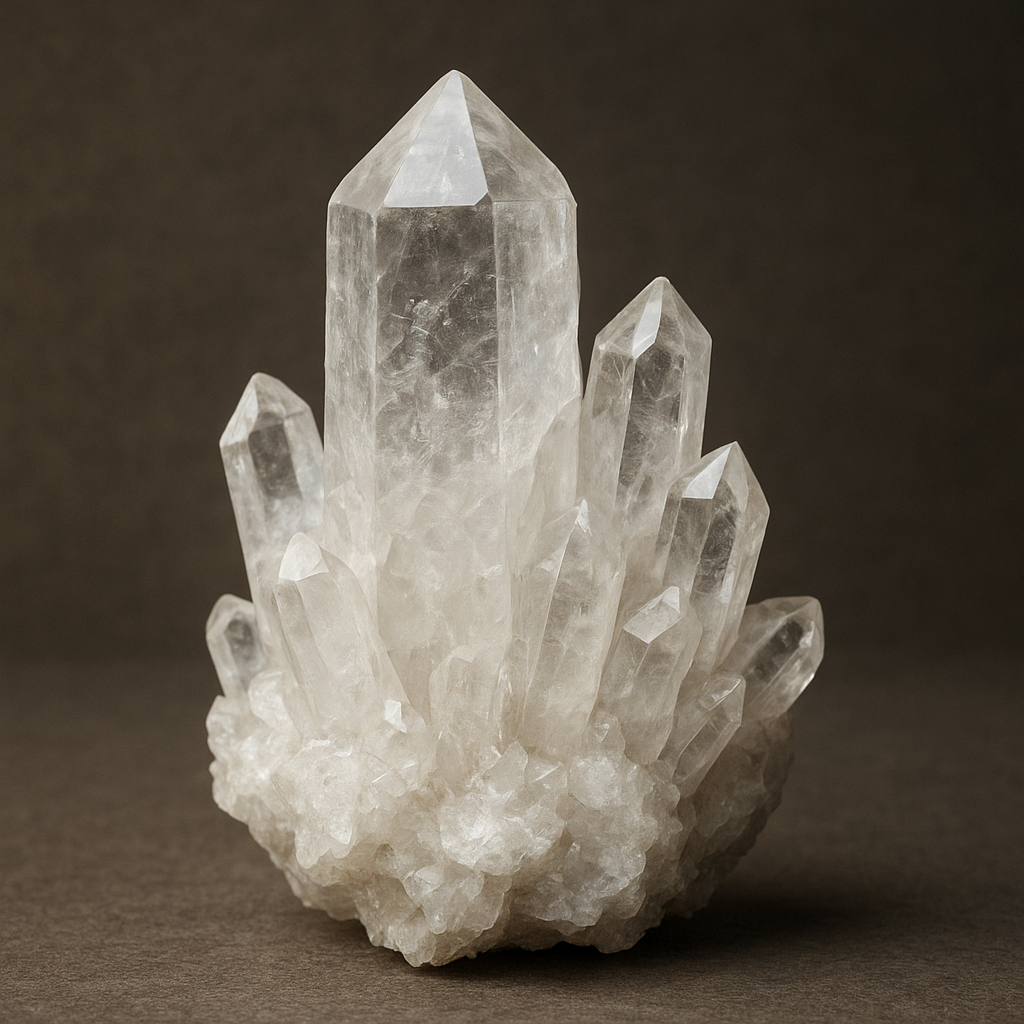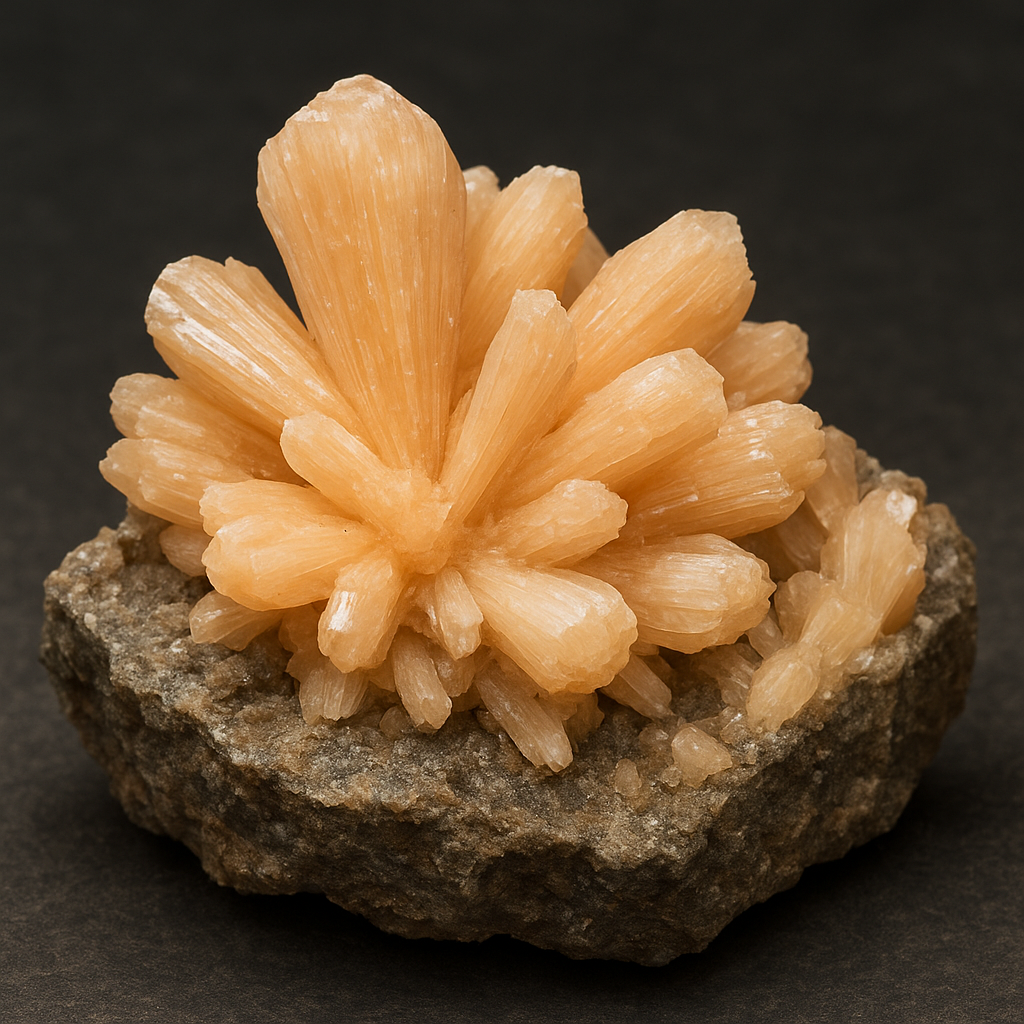
Stilbite is a member of the zeolite group that fascinates collectors, mineralogists and geoscientists alike. Its graceful, often sheaf-like or bow-tie crystal habits, pearly luster and range of soft pastel colors make it visually appealing, while its structural and chemical properties connect it to broader themes in mineralogy, hydrothermal geology and materials science. This article explores where stilbite forms, how to recognize and care for it, its scientific and practical significance, and a few curiosities that make it stand out among zeolites.
Occurrence and geological environment
Stilbite typically forms in cavities and fractures of volcanic rocks, most commonly in basaltic lavas and related silicate host rocks. After volcanic eruptions, gases and hydrothermal fluids percolate through cooling lava, depositing minerals in open spaces. Over time, zeolites like stilbite crystallize from these low-temperature hydrothermal solutions, often together with other zeolite-group minerals.
Common geological settings where stilbite is found include:
- Vesicles and amygdales in basalt flows, where zeolitic minerals fill gas bubbles that were trapped in lava.
- Tuffs and volcanic breccias, where percolating fluids produce mineral-rich coatings and fillings.
- Low-grade metamorphic zones and hydrothermal veins, where silica-aluminum-rich fluids alter preexisting rocks.
Notable localities for high-quality and well-crystallized specimens include parts of western India (notably the Pune/Jalgaon areas), Iceland (where zeolites form in basaltic cavities), the Isle of Skye and other parts of Scotland, certain New Jersey and Oregon sites in the United States, and Nova Scotia in Canada. In these settings, stilbite is often associated with other zeolites and secondary minerals such as heulandite, apophyllite, natrolite, calcite and chalcedony.
Crystallography, appearance and diagnostic features
Stilbite belongs to the zeolite family and crystallizes in the monoclinic system. Its typical habit is distinctive: tabular, flattened crystals that aggregate into radiating sprays or sheaf-like groups. These aggregations sometimes form delicate bow-tie or wheat-sheaf shapes that are immediately recognizable to many collectors.
Key identification features include:
- Crystal habit: radiating clusters, sheaf-like bundles, and thin, platy crystals.
- Luster: pearly to vitreous on cleavage surfaces, giving specimens a silky sheen.
- Color: commonly white or colorless, but often tinted pale pink, peach, orange, yellow, or even reddish due to trace elements or inclusions.
- Hardness: relatively soft, typically around 3.5–4 on the Mohs scale.
- Density: low for a silicate mineral, reflecting the open, hydrated framework typical of zeolites.
- Cleavage: good to perfect cleavage reflecting layered aspects of the crystal structure.
Under the microscope, stilbite shows typical zeolitic framework features: channels and cavities in the aluminum-silicate lattice that host water molecules and exchangeable cations (such as Na+ and Ca2+). The presence of these water molecules means that stilbite can dehydrate and rehydrate under changing temperature and humidity conditions, sometimes causing subtle changes in appearance or minor cracking if specimens are heated.
Chemistry, structure and related zeolites
Stilbite is a hydrated aluminosilicate whose framework contains channels and cages occupied by water molecules and exchangeable cations. The general composition can be represented as a calcium-sodium aluminosilicate hydrate, with stoichiometry often written in simplified form. The presence of variable cations has led to recognition of compositional varieties within the stilbite group.
Because stilbite is a zeolite, it shares the defining characteristic of a porous three-dimensional framework built from linked tetrahedra of SiO4 and AlO4. The Al-for-Si substitution creates negative charges balanced by cations, while water molecules occupy the channels. This structural openness underlies several functional properties of zeolites in general, including ion-exchange behavior, molecular sieving and reversible dehydration.
Stilbite is often grouped or compared with related zeolites such as heulandite, which is chemically similar but typically differs in crystal habit and subtle structural parameters. Mineralogists pay close attention to these distinctions, using X-ray diffraction, optical properties and chemical analysis to discriminate closely related zeolite species.
Uses and practical significance
While many synthetic and natural zeolites are exploited industrially for water purification, gas separation, catalysts and molecular sieves, stilbite itself is not a major commercial zeolite in large-scale industrial processes. That said, stilbite and zeolites broadly are important in several arenas:
- Scientific research: Stilbite specimens are valuable for research on zeolite crystal chemistry, dehydration-rehydration mechanisms, and low-temperature hydrothermal processes. Their relatively straightforward occurrence and well-formed crystals make them useful model minerals.
- Teaching and education: Because stilbite displays classic zeolite characteristics and attractive habits, it is commonly used in teaching mineralogy and petrology.
- Collector and aesthetic uses: Stilbite is a highly sought-after collector mineral. Its delicate radiating sprays and pastel colors make it a favorite for display specimens in museums and private collections.
- Local and artisanal uses: In regions with abundant zeolite occurrences, local communities may use zeolitic rock for small-scale water filtration or soil amendment, though stilbite-rich material is rarely the chosen industrial feedstock due to variable purity and crystal habit.
In short, the broader class of zeolites is industrially vital, while stilbite’s main role is scientific, educational and ornamental rather than large-scale industrial exploitation.
Collecting, care and lapidary use
Collectors prize stilbite for its delicate forms, but its relatively low hardness and hydrated structure demand careful handling. Practical advice includes:
- Cleaning: Use gentle mechanical cleaning with soft brushes. Avoid prolonged soaking in water for fragile specimens; some collectors rinse briefly and allow slow drying. Ultrasonic cleaners and chemical treatments can damage both the crystal surfaces and the internal water content.
- Storage: Keep specimens in stable environments with moderate humidity. Avoid extreme drying or direct heat that might drive off structural water and cause cracking or shrinkage.
- Display: Support delicate sprays on padded mounts or inside display cases to protect them from knocks and excessive handling. Avoid exposure to bright, direct sunlight for long periods, which can sometimes alter color intensity.
- Lapidary use: Because stilbite is soft and brittle, it is rarely used in jewelry. Occasional cabochons or small polished pieces exist, but they require protective settings and are recommended only for careful wear.
These care practices protect both the aesthetic and scientific value of specimens. For museum-quality pieces, conservation techniques emphasize minimal intervention and stable microclimates.
Scientific insights and environmental importance
Studying stilbite contributes to understanding fluid-rock interactions and low-temperature hydrothermal systems. Because zeolites incorporate water and exchangeable cations in their frameworks, they can record information about the chemical environment in which they formed. For example, the composition of cations in stilbite can provide clues about the composition of the mineralizing fluids and the temperatures of formation.
Zeolites are also important in environmental geology. Their capacity to trap and exchange ions makes them relevant in natural attenuation of contaminants. While stilbite itself is not often harvested for large-scale remediation, its study helps scientists understand how natural mineral barriers can influence water chemistry in volcanic terrains.
On the nanoscale, investigations of stilbite and other zeolites inform the design of synthetic zeolites with tailored pore sizes for catalysis, gas separation and adsorption applications. Research into framework flexibility, dehydration kinetics and ion mobility in natural zeolites provides inspiration and validation for engineered materials used in industry.
Associations, varieties and curiosities
Stilbite is commonly found alongside a suite of minerals that commonly populate basaltic cavities. These associations often include apophyllite, calcite, prehnite, natrolite, chabazite and heulandite. In some classic finds, thin coatings of stilbite drape over other mineral crystals, producing particularly attractive contrast in texture and color.
Historically, the name stilbite has roots in Greek etymology referring to a shining or glimmering appearance, a nod to the pearly sheens seen on many specimens. Collectors sometimes differentiate between “stilbite” and other zeolites by eye, but analytical confirmation relies on more rigorous methods such as X-ray diffraction and chemical assays.
Some curiosities and points of interest:
- Color variations: Trace amounts of iron, manganese or organics trapped during formation can impart peach, pink, or orange hues to stilbite, producing visually striking specimens.
- Radiating habits: The elegant radiating aggregates can form delicate, almost botanical-looking structures—hence the common term “wheat-sheaf” used in some collecting circles.
- Thermal sensitivity: Heating can cause reversible or irreversible loss of water from the structure; in controlled settings this property is used to study zeolite framework dynamics.
How to recognize authentic stilbite and avoid confusion
Several minerals can superficially resemble stilbite, particularly other zeolites such as heulandite. Tips for recognition include:
- Observe habit: Stilbite’s flattened, tabular crystals in radiating sheafs are a strong visual clue.
- Test hardness: A Mohs hardness around 3.5–4 helps separate stilbite from harder silicates.
- Look for pearly luster: Not all zeolites show the same pearly sheen on cleavage faces.
- Check associations: The mineral friends found with a specimen can suggest a zeolite suite typical of basaltic cavities.
- Use analytical tools: X-ray diffraction and basic chemical analysis will reliably distinguish stilbite from close relatives.
These practical steps protect buyers and collectors from misidentification and help preserve scientific value by ensuring accurate labeling.
Final curiosities and cultural notes
Beyond its geological and scientific roles, stilbite has captured the imagination of many collectors for its delicate beauty. It is sometimes used in metaphysical circles, where zeolites broadly are valued for alleged energetic properties, though such uses fall outside scientific endorsement. In mineral shows and museums, stilbite often draws attention because of its graceful crystal arrangements and soft pastel palette.
Whether admired for its form, studied for its chemistry, or used as a model for synthetic porous materials, stilbite occupies an appealing niche at the intersection of natural beauty and scientific relevance. Its place among the zeolites makes it not only an object of aesthetic appreciation but also a window into the subtle processes of hydrothermal mineral formation and the wider technological importance of porous aluminosilicates.