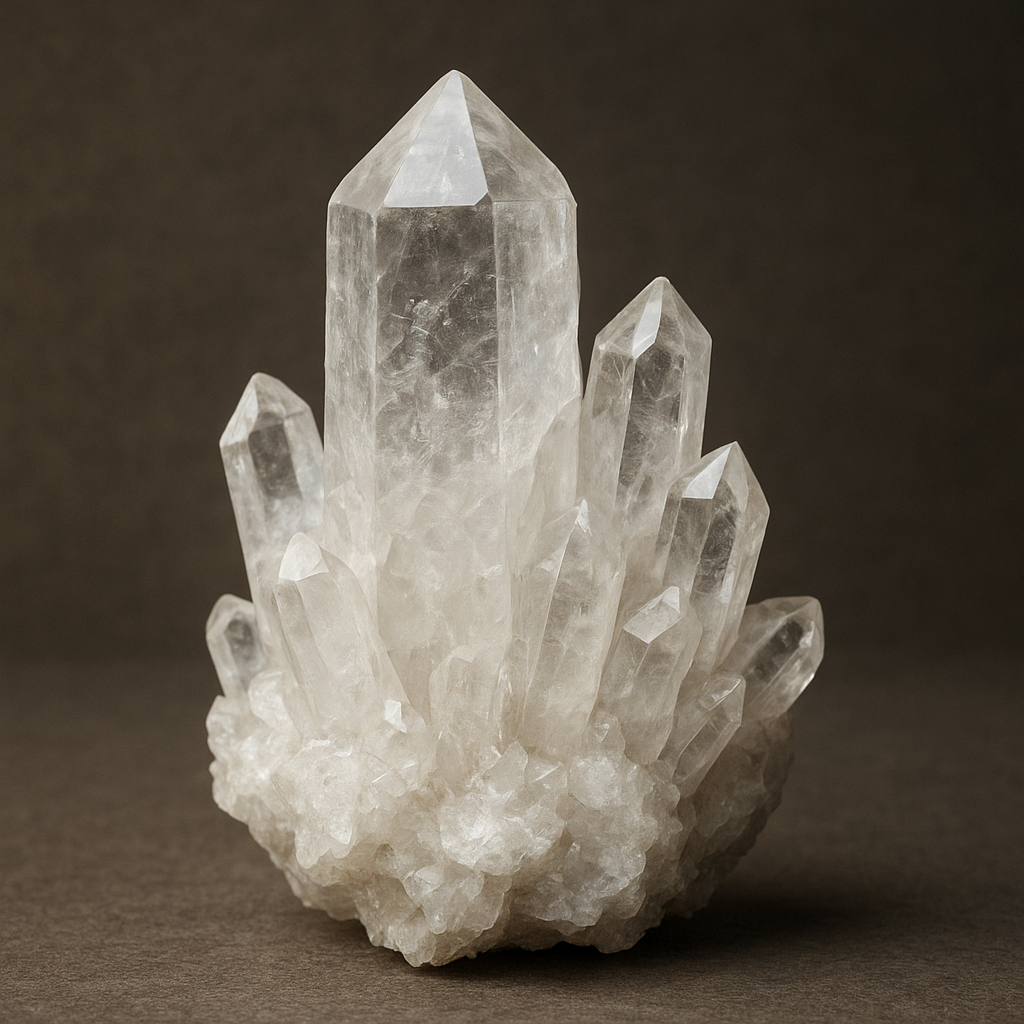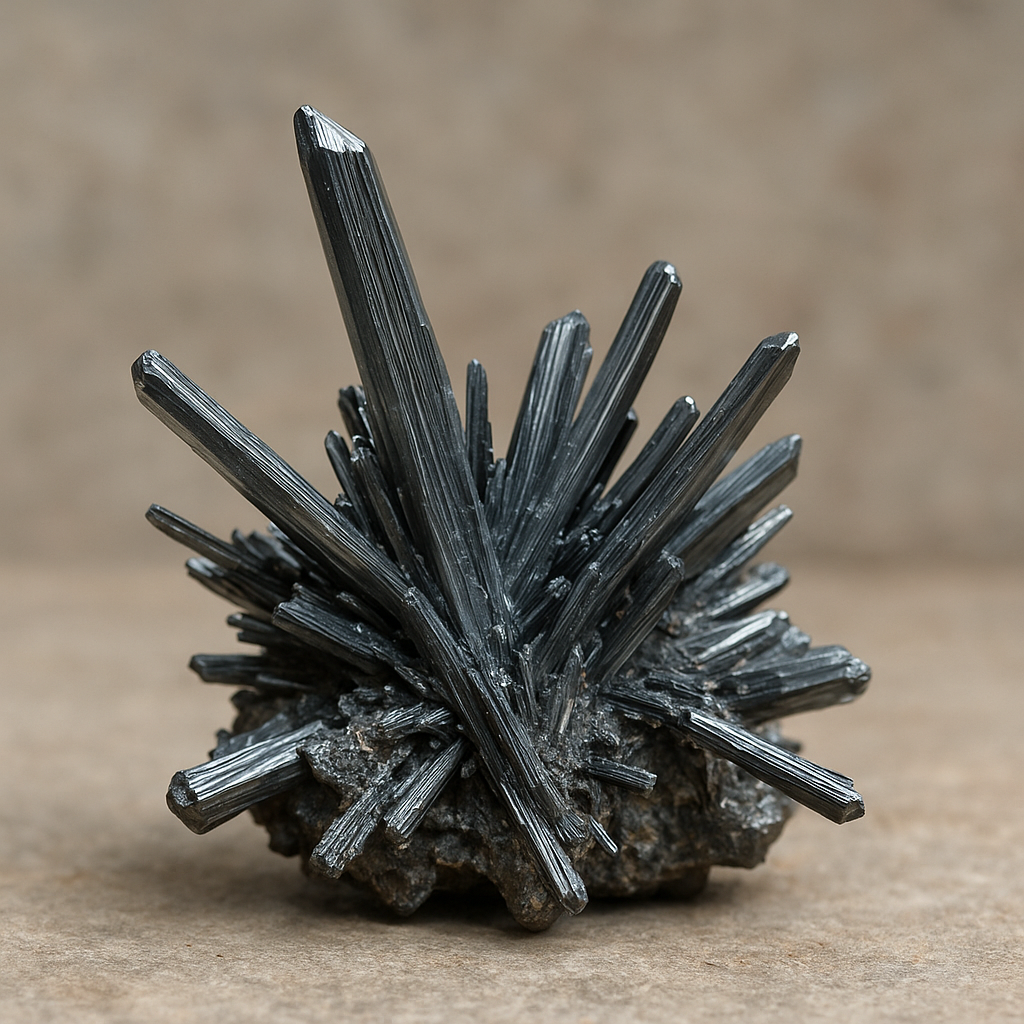
Stibnite is a striking and historically significant mineral that has fascinated miners, chemists and collectors for centuries. Its elongated, metallic crystals and deep lead-gray color make it easily recognizable, while its chemical role as the principal ore of antimony gives it a lasting industrial importance. This article explores the geology, chemistry, history, uses and modern relevance of stibnite, with attention to notable localities, mining and environmental concerns, and interesting cultural and technological connections.
Occurrence and Geological Formation
Stibnite (chemical formula Sb2S3) forms primarily in low-temperature hydrothermal veins, often associated with other sulfide minerals and native antimony. The typical environment of formation includes epithermal systems and replacement deposits where mineral-laden fluids move through fractures and pore spaces in host rocks. Over time, the precipitation of antimony sulfide produces the familiar slender, bladed crystals that collectors prize.
Common gangue and associated minerals found with stibnite include quartz, calcite, galena, pyrite and realgar. Its presence can also be related to mineral systems that include gold and other base metals, making stibnite sometimes an indicator of more complex ore assemblages. Stibnite’s formation conditions—relatively low temperatures and reducing environments—favor its stability compared with oxidized antimony phases.
- Hydrothermal vein systems: narrow fractures filled by late-stage mineralizing fluids.
- Replacement deposits: where antimony-bearing solutions replace carbonate or other host rocks.
- Metamorphosed sedimentary sequences: less common, but possible where original sulfide minerals survive metamorphism.
Notable Localities and Global Distribution
Stibnite occurs worldwide, but certain regions are particularly famous for large, well-formed crystals or extensive antimony production. Historically and presently, these deposits have shaped local economies and mining practices.
- China: The largest global producer of antimony and stibnite, with major deposits in Hunan, Guangxi and Guizhou provinces. Many of the world’s modern antimony supplies derive from Chinese mines.
- Bolivia and Peru: Historically important in South America, with numerous mines producing antimony ores alongside silver and other metals.
- Romania: The Baia Sprie and Herja mines and other Carpathian locations provided significant supplies to Europe historically.
- Stibnite Ridge, Idaho, USA: Noted for spectacular crystal specimens and significant antimony resources.
- Japan, Russia, and parts of Africa: additional contributors to global production and mineral specimens.
Collectors often cite specific localities for the quality of crystal specimens—long, lustrous blades from certain Chinese or Japanese mines, or massive botryoidal forms from other regions. Understanding a specimen’s origin can enhance its geological and historical value.
Physical and Chemical Properties
Stibnite is chemically antimony trisulfide (Sb2S3). It is soft (with a Mohs hardness around 2), has a high specific gravity for a non-metallic mineral, and displays a metallic luster with a lead-gray to black color. Crystals are commonly elongated, acicular or bladed, and can form impressive radiating or parallel aggregates.
- Crystal system: orthorhombic
- Color: lead-gray to black
- Luster: metallic
- Hardness: ~2 on Mohs scale
- Streak: grayish-black
From a chemical standpoint, the most important element in stibnite is antimony, a metalloid with uses ranging from flame retardants to alloys. The mineral’s reactivity with oxygen and acids determines how it is processed in metallurgical operations, and its sulfide nature influences environmental behavior when mine wastes are exposed to weathering.
Historical Uses and Cultural Significance
Stibnite has a long cultural history. In ancient times, powdered antimony minerals were used as cosmetics, pigments and medicinal preparations. The term “stibium,” from which the chemical symbol Sb is derived, reflects the mineral’s long association with human technologies.
In ancient Egypt and the Near East, finely ground antimony compounds were used as kohl—an eye cosmetic applied for both aesthetic and purported antiseptic effects. Medieval and later European sources mention antimony in alchemical texts and early metallurgical recipes. The metal extracted from stibnite played a role in relatively obscure but important alloys and compounds through the centuries.
The Roman and pre-Roman trade in antimony and antimony-bearing minerals connected distant mining regions to centers of craft and medicine. Historical mining records, trade documents and archaeological finds attest to the mineral’s early economic and cultural impact.
Modern Applications and Industrial Uses
Today, the primary industrial use of stibnite is as the main ore for producing metallic antimony. Antimony itself is an enabling material in several important modern technologies:
- Flame retardants: Antimony trioxide (Sb2O3) is used synergistically with halogen-containing flame retardants to reduce flammability in plastics, textiles and electronics. This application consumes a large fraction of global antimony production.
- Alloys: Small additions of antimony improve the hardness and mechanical properties of lead alloys, useful in batteries, bearings and solder.
- Electrical components: Antimony contributes to semiconductor and electronic applications in specialized compounds.
- Glass and ceramics: Certain antimony compounds are used as clarifying or opacifying agents.
- Batteries: Historically, antimony-containing lead alloys were used in lead-acid battery grids; although modern designs seek to reduce antimony to limit gassing, some battery technologies still rely on it.
Beyond direct industrial uses, stibnite and its antimony derivatives are subjects of research—for example, in thermoelectrics, novel semiconductors and nanostructured materials where antimony’s electronic properties can be exploited.
Mining, Processing and Economic Considerations
Extraction of stibnite involves both conventional hard-rock mining and simpler open-cut methods depending on deposit geometry. Once mined, ores undergo crushing and concentration—often by gravity and flotation—to produce a concentrate high enough in Sb content for smelting.
Smelting transforms Sb2S3 into antimony metal or intermediate compounds. Roasting in controlled conditions converts sulfide to oxide, which can then be reduced chemically (for example, by carbon or iron) to yield metallic antimony. Alternative hydrometallurgical routes have been developed to reduce emissions and treat complex concentrates.
The economics of antimony production are shaped by:
- Global supply concentration: With a substantial share of production coming from a few countries, supply security and trade dynamics influence price and availability.
- Demand from flame retardants and other industries: Regulatory changes and material substitutions can affect consumption levels dramatically.
- Recycling: Antimony can be recovered from industrial wastes and end-of-life products, providing a secondary supply stream.
Policy and geopolitical considerations sometimes lead to strategic stockpiles or import restrictions for critical minerals like antimony. For nations that lack domestic supply, secure sourcing of stibnite-derived antimony is a planning concern.
Environmental Issues and Remediation
Like many sulfide minerals, when stibnite is exposed to air and water during mining and weathering it can oxidize, potentially mobilizing antimony into surrounding soils and waters. Antimony is toxic to aquatic life and can be harmful to humans at sufficient concentrations, so environmental management of mines and tailings is important.
- Acid mine drainage: While stibnite itself does not always produce strongly acidic drainage, associated sulfide minerals can generate acidity that mobilizes metals.
- Toxicity: Antimony species vary in toxicity; inorganic antimony compounds are of concern for ecological and human health, and strict regulations may apply to discharges and soil concentrations.
- Remediation strategies: Stabilization, containment, water treatment and phytoremediation are among approaches used to manage contaminated sites. Removing or converting mobile antimony species to insoluble forms is a priority.
Modern mining operations use environmental impact assessments, tailings management plans and water treatment systems to minimize releases and to comply with regulatory frameworks. Research continues into more effective and lower-cost remediation technologies for antimony-contaminated environments.
Collecting, Specimens and Aesthetic Appeal
Stibnite crystals are prized by mineral collectors for their dramatic, bladed habit and metallic shine. Large, well-formed specimens can command high prices and often become centerpieces in museum collections.
Collectors value attributes such as crystal size, luster, completeness, matrix association and locality provenance. Some specimens form impressive radiating sprays or long parallel blades that reflect light in spectacular ways. Because stibnite is soft and brittle, specimens must be handled with care; conservation mounts and careful transport are common practices.
- Display tips: Keep specimens dry and away from acids or sulfide-reactive environments; avoid frequent handling to preserve luster.
- Identification: Sharp, metallic, elongated crystals with gray-black color and a relatively low hardness point to stibnite; confirmatory tests include streak and association with antimony-rich ores.
- Market: Historic and large specimens from famous localities remain in demand among institutions and serious collectors.
Safety, Toxicity and Handling
Although mineral specimens are often admired at arm’s length, it’s important to recognize safety issues with stibnite. Fine dust from grinding or crushing can be hazardous if inhaled, and prolonged skin contact with antimony compounds is not advisable. Museums and collectors follow standard mineral-handling guidelines:
- Avoid crushing or pulverizing specimens; do not attempt to cut or polish stibnite without professional controls.
- Wash hands after handling, and do not eat or drink near specimens that may leave residues.
- Use personal protective equipment when working with concentrates or ores in a laboratory or industrial setting.
Workplace exposure limits and environmental regulations govern how antimony-bearing materials are handled in industrial contexts. Awareness and training reduce risk for miners, lab workers and others who may encounter stibnite in bulk.
Research Frontiers and Technological Interest
Beyond traditional uses, antimony and stibnite inspire research in materials science and geochemistry. For example, antimony-based compounds are investigated for their roles in thermoelectric devices, where electronic and heat-transport properties can be tuned for waste-heat recovery. Nanoscale antimony sulfide materials are explored for photovoltaic and photodetector applications, leveraging band-gap properties that differ from metallic antimony.
Geochemists study stibnite to understand hydrothermal fluid evolution, ore formation processes and the mobility of antimony in the crust. Techniques like isotopic analysis and fluid inclusion studies reveal temperature, pressure and compositional histories of stibnite-bearing veins, contributing to broader knowledge of ore genesis.
Interesting Facts and Cultural Tidbits
Some intriguing facets of stibnite’s story:
- The name stibnite comes from stibium, an old name for antimony; the chemical symbol for antimony, Sb, stems from this root.
- Long, needlelike crystals of stibnite were sometimes mistaken for lead or native mercury to early mineralogists due to their metallic luster.
- In Asia, certain historic mines produced specimens so aesthetic that they were used as decorative objects as well as ore sources.
- Stibnite’s association with cosmetics goes back millennia, making it one of the earliest minerals directly linked to human cultural practice.
From shimmering mineral specimens to essential industrial feedstocks, stibnite occupies a unique place at the intersection of geology, history and technology. Its continued relevance—both as an object of scientific curiosity and as a source of antimony for modern industries—ensures that interest in this mineral will persist as long as the applications that depend on it remain important.