Spessartine is a member of the garnet group that fascinates both mineralogists and gem collectors with its vibrant hues and geological variety. In this article I explore its chemical nature, where it forms, how it is used as a gemstone and industrially, and several related topics that illuminate why this mineral holds an important place in earth sciences, jewelry markets, and mineral collecting. The following sections provide detailed information on occurrence, physical and optical properties, notable localities, cutting and valuation, treatment and care, and a selection of interesting facts and research developments.
Composition and Physical Properties
Spessartine belongs to the garnet family and is specifically the manganese-rich end-member of the solid-solution series between pyrope and almandine. Its idealized chemical formula is Mn3Al2Si3O12, where manganese occupies the X-site of the garnet crystal structure and aluminum occupies the Y-site. The presence of manganese is the defining chemical trait that gives spessartine its characteristic shades.
Key physical and optical characteristics include:
- Crystal system: Isometric (common cubic crystals and dodecahedra)
- Hardness: 6.5–7.5 on the Mohs scale, making it suitable for many jewelry uses
- Specific gravity: Typically between 3.8 and 4.2, depending on composition
- Refractive index: Moderate to high; garnet is singly refractive in appearance because of its isotropic nature
- Luster: Vitreous to resinous
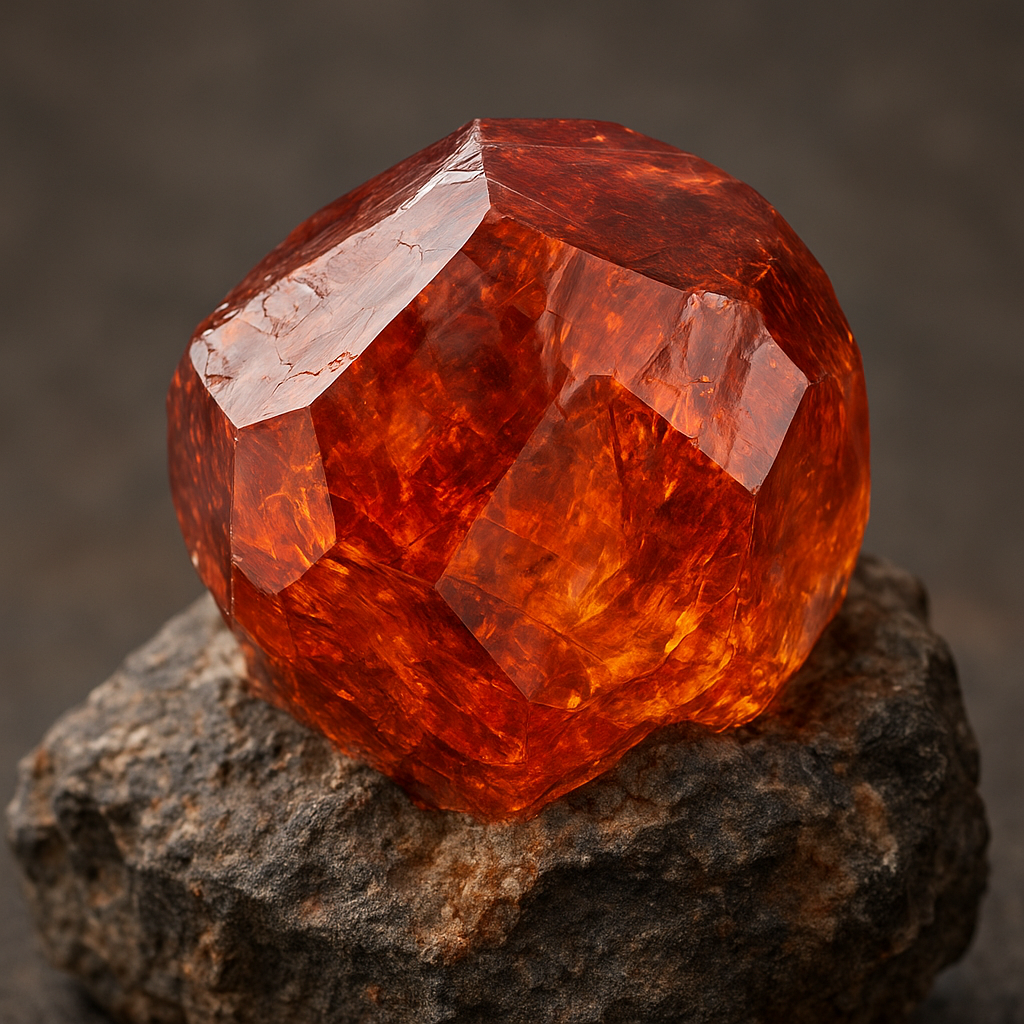
Because garnets are isometric, they do not show double refraction, which impacts how they are examined and evaluated in gemology. The color range produced by manganese-dominance spans from pale yellow-orange to deep orange-red, with many collectors favoring richly saturated specimens.
Where Spessartine Occurs
Spessartine forms in a variety of geologic environments, often where conditions allow manganese to concentrate and crystalize. It typically appears in:
- Metamorphic rocks — particularly in manganese-rich shales and schists where regional metamorphism leads to garnet growth.
- Granitoid pegmatites — coarse-grained igneous pockets that permit large crystal development.
- Hydrothermal veins — where mineral-bearing fluids precipitate manganese and aluminum-bearing minerals.
Notable localities that have produced gem-quality and collector spessartine include:
- Brazil — produces bright orange spessartine crystals and gem material from several pegmatite districts.
- Madagascar — known for intensely colored stones and large crystals that have entered international markets in recent decades.
- Pakistan and Afghanistan — alpine-type pegmatites and metamorphic contacts yield fine specimens.
- United States — historically significant localities include Maine and California, where gem and specimen-quality spessartine have been recovered.
- Namibia and Nigeria — African localities producing a range of colors and sizes.
In many of these localities spessartine occurs alongside other garnet species and accessory minerals: rutile, mica, quartz, and beryl in pegmatites; and chlorite, graphite, and other silicates in metamorphic rocks. The geological context often influences crystal habit, size, and color zoning.
Gemstone Use, Cutting, and Valuation
Spessartine is prized as a gemstone for its vivid oranges and reds that are distinct from the more familiar red of pyrope garnets or the green of demantoid garnet. When evaluating spessartine as a gem, several factors determine value:
- Color — pure, saturated orange or intense orange-red command the highest prices. Secondary brown or muddy tones decrease value.
- Clarity — transparent, eye-clean stones are more valuable. Inclusions may be present in many specimens but can also create attractive optical effects when oriented favorably.
- Cut — well-cut stones maximize brilliance and show the jewel-like character of the stone. Because garnet is isotropic, cutters focus on maximizing face-up color and weight retention.
- Size — larger faceted stones of high saturation are rarer and therefore more sought after by collectors and designers.
Common cuts include brilliant and step-cuts, cabochons for heavily included material, and freeform cuts for specimens exhibiting color zoning or unique internal features. Some clarity characteristics, such as small needle-like inclusions or crystal inclusions, can be diagnostic of origin for experienced gemologists and collectors.
Treatments, Enhancements, and Stability
Most spessartine on the market is untreated, which is a selling point for many buyers. Treatments known in the trade for garnets are limited compared to other gemstones because garnet is stable to heat and light. Nevertheless, a few interventions are relevant:
- Heat-treatment — not commonly applied to spessartine; when attempted it may alter color, but results are unpredictable and not widely practiced.
- Impregnation and coating — occasionally used for lower-quality material to enhance appearance, but such treatments reduce value and should be disclosed.
- Composite stones — assembled pieces that combine spessartine with other materials exist but are niche and require disclosure.
Because spessartine is relatively hard and chemically stable, everyday wear with reasonable care is safe. However, as with any colored gemstone, exposure to harsh chemicals, sharp blows, or extreme temperature changes should be avoided to prevent chipping or surface damage.
Identification and Distinguishing from Other Garnets
Garnets are a complex group, and differentiating spessartine from other members requires observation and testing. Some useful identification points:
- Color and hue — spessartine’s orange to orange-red tendency is distinctive, but it can be confused with mandarin garnet (trade name) or hybrid garnets.
- Density and refractive index — laboratory tools (specific gravity and refractive index measurements) help distinguish manganese-rich garnets from iron- or magnesium-rich species.
- Spectroscopy — absorption spectra can show diagnostic features for manganese-bearing garnet, helping separate spessartine from similar-looking gems.
- Inclusions and internal features — certain inclusion types, growth zoning, and associated minerals can point to particular geological origins.
For conclusive identification, gemological labs use a combination of instruments: refractometers, spectrometers, specific gravity balances, and occasionally electron microprobe analysis to determine elemental composition.
Notable Localities and Their Characteristics
Understanding where spessartine forms helps collectors and scientists appreciate its diversity.
Brazil
Brazil has produced vivid orange spessartine crystals from pegmatitic environments. Brazilian stones often show excellent saturation and are significant in the commercial market both as facetable gems and as museum-quality crystals.
Madagascar
Madagascar has become famous for producing large and richly colored spessartines. These specimens can show clarity and color that make them competitive with top gem material from other regions. The island’s varied geology has yielded both transparent facetable stones and striking mineral specimens.
United States
In the U.S., Maine and parts of California have produced spessartine in pegmatites and associated metamorphic rocks. American specimens are often favored by collectors due to their locality history and crystal forms.
Africa
Namibia and Nigeria are notable African sources. African spessartines can present a range of hues and crystal habits, sometimes accompanied by other gem species making these localities important for multi-mineral studies.
Mining, Economics, and Sustainability
The extraction of spessartine occurs both on small scales by artisanal miners and on larger, mechanized operations in pegmatite districts. Economic considerations include the rarity of gem-quality material, market demand, and the scale of production at each locale. Two important themes in modern mining are:
- Sustainability — responsible mining seeks to minimize environmental damage, rehabilitate sites, and ensure safe working conditions for miners.
- Traceability — buyers increasingly demand information about origin and ethical sourcing, encouraging some producers to provide provenance documentation.
Because many spessartine occurrences are in remote or geologically sensitive areas, sustainable practices and community engagement are important for long-term access and market reputation. In some regions, fair-trade and cooperative models have been explored to support local miners and ensure equitable distribution of profits.
Care, Setting, and Jewelry Design
Spessartine’s hardness and stability make it suitable for rings, pendants, and other pieces intended for regular wear, provided attention is paid to the setting and protection of the stone. Best practices include:
- Protective settings — bezel or halo settings can protect edges from knocks and reduce risk of chipping.
- Regular cleaning — warm soapy water and a soft brush usually suffice; avoid harsh chemicals.
- Inspection — periodic checks by a jeweler ensure settings remain secure and prongs are intact.
Designers value spessartine for its strong color contrast with metals: deep orange and orange-red stones pair well with both yellow gold and sterling silver. For collectors who prefer minimalistic jewelry, single-stone pendants featuring a well-cut spessartine can highlight its color without distraction.
Collecting, Display, and Scientific Interest
Collectors prize spessartine specimens for crystal form, color, and size. Good crystal faces, undamaged terminations, and rich color are the hallmarks of prized specimens. Museums and universities also collect spessartine for scientific research: its composition and growth textures can reveal conditions of formation, fluid chemistry, and metamorphic histories.
Scientific techniques applied to spessartine include:
- Electron microprobe and LA-ICP-MS — for detailed chemical analysis and trace-element mapping.
- Isotopic studies — to investigate the age and origin of the host rocks and mineral-forming fluids.
- Fluid inclusion analysis — to understand the temperature and composition of hydrothermal systems that produced gem-bearing veins.
Interesting Facts and Cultural Notes
Several aspects of spessartine make it interesting beyond its gemological value:
- The name spessartine comes from the Spessart region in Bavaria, Germany, where manganese-rich garnets were first described. This historical link emphasizes the long tradition of mineral description linked to locality.
- Spessartine is sometimes marketed under trade names such as mandarin garnet, particularly when the color closely matches the vivid orange of mandarins; trade names can influence consumer perception but should be used carefully to avoid confusion.
- Collectors value large crystal clusters and well-formed dodecahedra that display natural terminations and striations — such specimens can be eye-catching display pieces in private and public collections.
- Because of its manganese content, spessartine has been of interest in geochemical studies that track manganese distribution during metamorphism and pegmatite formation.
Research Directions and Modern Developments
Recent research on spessartine and garnets in general includes refined geochronology and geochemistry that improve our understanding of crustal processes. Current topics include:
- Using trace elements in garnets as geothermometers and geobarometers to reconstruct metamorphic conditions.
- Studying fluid inclusions within spessartine to understand the role of saline or volatile-rich fluids in pegmatite formation.
- Investigating the role of manganese during high-grade metamorphism and how it partitions into different mineral phases.
Advances in analytical techniques continue to reveal subtle variations in garnet chemistry that can be linked to specific environments and localities, aiding both scientists and gemologists in origin determination and academic interpretation.
Practical Tips for Buyers and Enthusiasts
If you are considering buying spessartine as a gemstone or specimen, keep these practical tips in mind:
- Ask for provenance — reliable information about origin supports value and ethical purchasing decisions.
- Request gemological reports for high-value stones — independent lab verification of identity and any treatments is important.
- Compare colors under standardized lighting — color can shift between daylight and artificial light; choose a stone that pleases you under typical wearing conditions.
- For specimens, inspect crystal faces and terminations — intact, undamaged crystals are significantly more valuable to collectors.
Whether approached from a scientific, commercial, or collecting perspective, Spessartine offers a compelling combination of beauty, diversity, and geological significance. Its striking appearance and range of occurrences assure it a continuing place among sought-after garnets, while ongoing research and market interest continue to reveal new dimensions to this manganese-rich gem.