
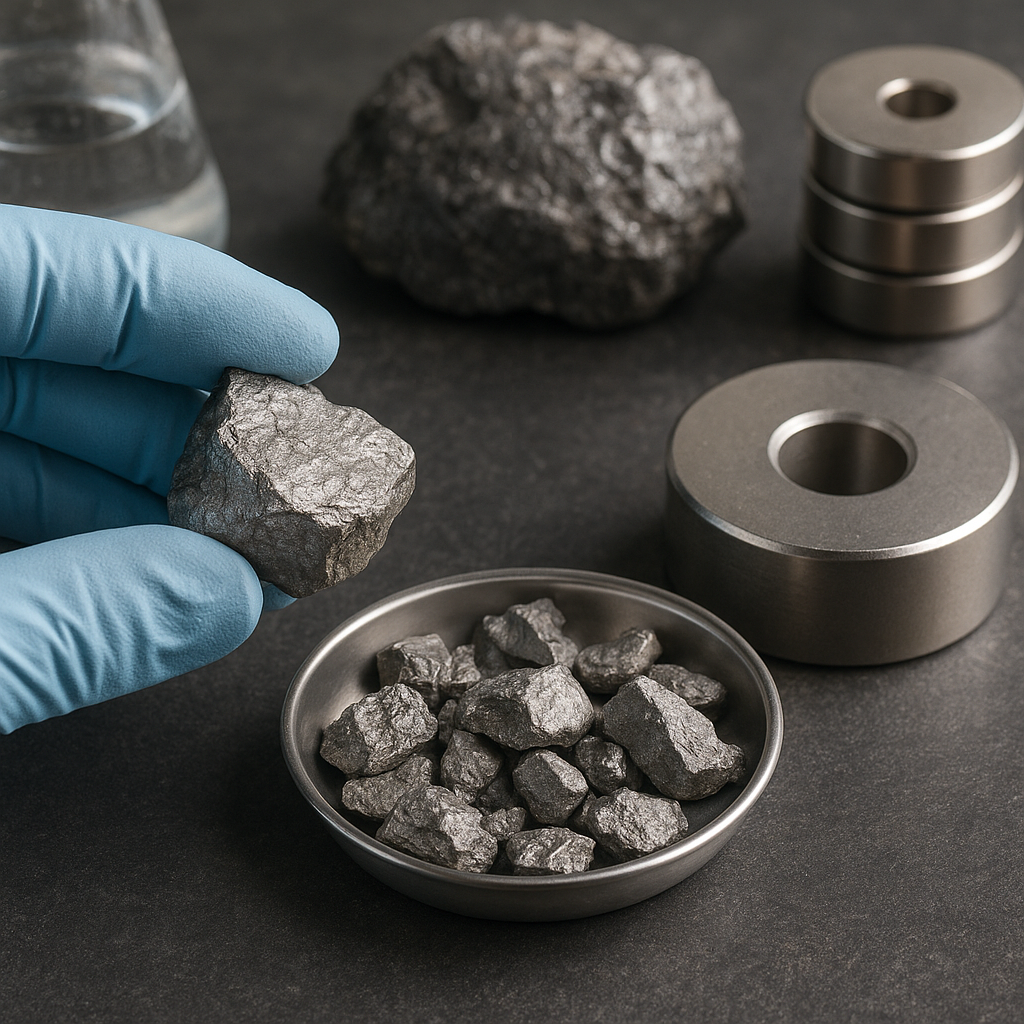
The demand for high-performance permanent magnets has risen sharply as industries from electric vehicles to wind energy push for greater efficiency and miniaturization. Meeting this demand depends on securing a reliable supply of one critical element: dysprosium. This article examines the geological sources, processing challenges, market dynamics, and technological strategies involved in sourcing dysprosium for next-generation magnet applications, with attention to economic, environmental, and policy dimensions.
Why dysprosium matters for high-performance magnets
Permanent magnets used in motors and generators rely on a family of alloys commonly referred to as rare-earth magnets, particularly those based on neodymium-iron-boron (NdFeB). While neodymium imparts the bulk of the magnetic moment, dysprosium plays a crucial role in maintaining magnetic performance at elevated temperatures and in demanding operating environments. By substituting part of the neodymium in the grain boundary or forming Dy-enriched shells around magnetic grains, manufacturers can markedly improve coercivity and thermal stability.
Performance drivers
- Coercivity enhancement — Dysprosium increases the resistance of magnets to demagnetization under high temperature and high-field conditions.
- Reliability — Critical in applications such as traction motors in electric vehicles and direct-drive wind turbines where consistent performance over time is required.
- Miniaturization — Higher coercivity enables smaller magnets with equivalent performance, reducing weight and space.
Primary sources and global supply dynamics
Dysprosium is not found as a standalone mineral; it occurs as part of mixed deposits of rare-earth elements (REEs). The primary mineral hosts include bastnäsite, monazite, and ion-adsorption clays. Recovering dysprosium requires mining ores containing a spectrum of REEs followed by complex separation processes.
Major producing regions
- China — Historically dominant in both mining and refining of REEs, particularly ion-adsorption clay deposits in southern China that are rich in heavy rare earths like dysprosium.
- United States, Australia, and parts of Africa — These regions host bastnäsite- and monazite-type deposits that contain varying concentrations of heavy REEs, and several projects are under development to expand non-China supply.
- Recycling streams — End-of-life magnets represent an emerging secondary source of dysprosium as recycling infrastructure improves.
The concentration of processing capacity in a few countries creates supply chain vulnerabilities. Export controls, environmental regulation, and geopolitical tensions can quickly affect availability and price volatility.
Extraction and processing challenges
Unlike base metals, the extraction of rare-earth elements involves several distinct technical and environmental hurdles. Ore grades for heavy rare earths are often low, and dysprosium is typically a minor component of mixed-REE ores, making its extraction resource- and energy-intensive.
Mining and beneficiation
- Ore handling — Bulk mining of REE-bearing ore requires careful beneficiation to concentrate REE minerals while reducing gangue.
- Flotation and gravity separation — Commonly used to produce a REE-rich concentrate, but efficiencies vary by mineralogy.
Separation and refining
Separation of dysprosium from other REEs is technically demanding. Methods include solvent extraction, ion-exchange, and precipitation techniques. These processes must achieve high purity for magnet-grade dysprosium while minimizing waste streams.
- Solvent extraction — Widely used but generates large volumes of chemical waste and requires tight process control.
- Ion-adsorption clay processing — Particularly relevant in some Chinese deposits; leaching and selective adsorption can mobilize heavy REEs but raise environmental concerns.
- Metallurgical refining — Converting dysprosium-bearing intermediates into metal or master alloys suitable for magnet production involves reduction processes (e.g., metallothermic reduction) and careful alloy control.
Processing yields, reagent availability, and the cost of environmental compliance significantly influence the final price and sustainable availability of dysprosium.
Strategies to secure dysprosium supply
Industry and governments pursue multiple avenues to reduce risk and secure the dysprosium needed for strategic magnet applications.
Diversification of supply
- Developing non-traditional sources — Exploration for heavy-REE-rich deposits outside the current dominant regions.
- Investing in domestic refining capacity — Building integrated value chains to convert ore to magnet-grade metals within consuming countries.
Improved extraction technologies
- Innovations in hydrometallurgy and solvent systems that increase selectivity and reduce waste.
- Biotechnological approaches — Using microbes or bio-leaching to mobilize REEs selectively from low-grade ores or tailings.
Material efficiency and substitution
Reducing the amount of dysprosium required per magnet is a key strategy. This can be achieved through advanced microstructure control (Dy diffusion into surface regions), and alloy engineering that maximizes coercivity with minimal heavy REE content. Research into partial substitution with other REEs or non-REE approaches remains active, though trade-offs in temperature stability often persist.
- Dy-lean magnet designs — Optimized grain boundary chemistry and nanostructuring to retain coercivity without full Dy loading.
- Alternative magnet chemistries — Ferrites and AlNiCo are unsuitable for many high-performance applications but are used where cost and weight permit.
Recycling and circular economy approaches
Recovering dysprosium from end-of-life products is both an economic opportunity and an environmental imperative. Magnet recycling can reduce dependence on virgin mining and ease supply pressures.
Recycling routes
- Direct reuse — Recovering whole magnets for refurbishment or re-application in less demanding contexts.
- Material recovery — Demagnetization, dissolution, and REE separation to produce feedstock for new magnet production.
- Pyrometallurgical and hydrometallurgical hybrid approaches — Combine thermal demagnetization and chemical separation to recover dysprosium and other REEs.
Barriers to large-scale recycling include the dispersed nature of magnets across many products, complex assemblies that make separation costly, and the need for high-purity end products to feed magnet manufacturers. Policy incentives, standardized design for disassembly, and economies of scale in collection systems can help overcome these obstacles.
Environmental and social considerations
Mining and processing of REEs, including dysprosium, can have significant environmental impacts if not managed responsibly. Issues include landscape disturbance, water use, and the generation of radioactive or toxic residues associated with certain ore types.
- Environmental safeguards — Proper wastewater treatment, tailings management, and dust control are essential to limit impacts.
- Community engagement — Ensuring local communities share benefits and that impacts on livelihoods are minimized.
- Regulatory frameworks — Robust environmental and labor regulations encourage best practices and help stabilize markets by setting predictable compliance costs.
Policy levers and industrial collaboration
Governments can influence the resilience of dysprosium supply through strategic stockpiles, research funding, trade policy, and standards that encourage recycling and material efficiency. Collaborative initiatives between automakers, turbine manufacturers, magnet producers, and recyclers create demand signals that justify investments in upstream capacity and innovation.
Market mechanisms
- Long-term offtake agreements — Provide revenue certainty for new mines and processors.
- Public-private partnerships — De-risk early-stage projects and accelerate commercialization of cleaner extraction technologies.
- Standards and labeling — Encourage magnet designs that facilitate recycling and material transparency.
Strategic foresight combined with technological innovation and responsible stewardship will determine how successfully industry meets the growing demand for high-performance magnets while minimizing environmental footprint and geopolitical risk.
Technological outlook and research priorities
Future research that can meaningfully reduce dependency on high volumes of dysprosium includes:
- Advanced magnet microstructures that minimize heavy-REE content while preserving high-temperature performance.
- New separation chemistries with lower waste intensity and higher selectivity for heavy REEs.
- Scalable recycling technologies that integrate with product design and waste management systems.
- Exploration and characterization of unconventional deposits, including deep-sea nodules and ion-adsorption clays in underexplored regions.
By aligning research priorities with industrial needs and regulatory incentives, stakeholders can build a more secure, sustainability-driven supply chain for dysprosium and the critical magnets that depend on it.
