Smithsonite is a striking and often overlooked mineral that combines aesthetic appeal with geological importance. As a natural form of zinc carbonate, it sits at the crossroads of mineralogy, ore geology and gemology. Collectors prize its range of colors and smooth habits, while scientists and miners value it as an indicator of zinc-bearing deposits and as a secondary ore mineral. In the following sections you will find an exploration of smithsonite’s geology, uses, physical characteristics, notable localities and the contemporary research and practical roles it plays.
Occurrence and geological setting
Smithsonite (chemical formula ZnCO3) typically forms in the oxidized zones of zinc-bearing sulfide deposits, where primary minerals such as sphalerite have been weathered and transformed by near-surface fluids. It is one of the common secondary minerals that characterizes the gossanous weathering profile of polymetallic veins and carbonate-hosted deposits. Smithsonite often occurs together with other secondary zinc minerals and carbonates, including hemimorphite, hydrozincite and cerussite, and is frequently found in association with galena, chalcopyrite and various iron oxides.
Geologically, smithsonite appears in a variety of rock types:
- Oxidized zones above sulfide ore bodies, particularly where zinc sulfides are abundant.
- Carbonate-hosted replacement deposits, where metasomatic fluids replace limestone or dolostone.
- Hydrothermal vein systems, when post-depositional, low-temperature fluids carry carbonate and zinc components.
- Lateritic and supergene environments where prolonged weathering can concentrate secondary carbonates.
Classic smithsonite formation involves neutral to slightly acidic, carbonate-rich solutions that react with zinc-bearing phases to precipitate ZnCO3. The mineral’s stability field is controlled by pH, carbonate activity and the presence of competing ions like lead, copper and iron, which can favor other carbonate or oxide minerals. Because smithsonite forms at relatively low temperatures, it is an important mineral for reconstructing near-surface geochemical conditions.
Physical and optical properties
Smithsonite’s distinguishing physical characteristics are central to both identification and appreciation:
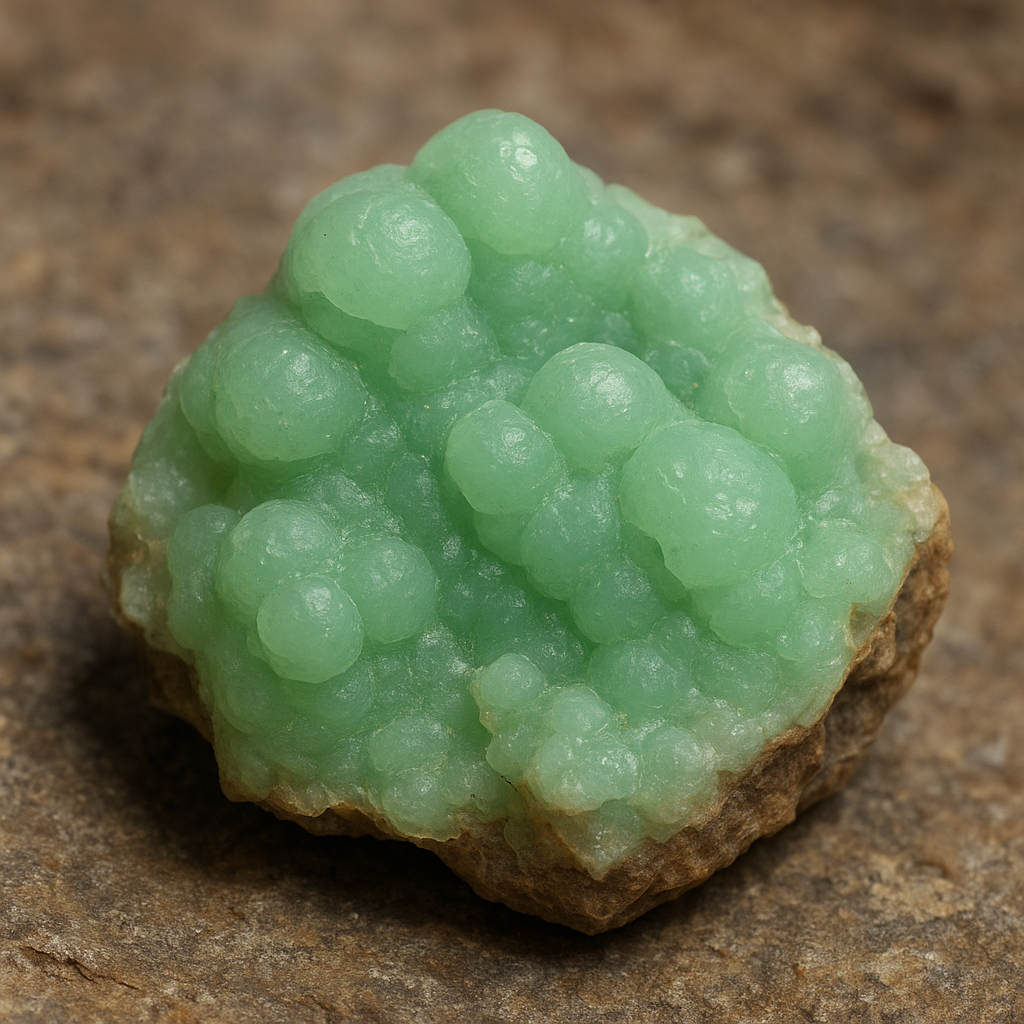
- Crystal habit: It most commonly forms smooth, botryoidal or globular coatings and crusts, but can also occur as rhombohedral crystals in cavity linings.
- Color: The mineral displays a wide palette — from white and pale green to blue, pink, lavender, yellow and brown — colors that often result from trace element substitution (for example, cobalt producing pink hues or copper producing blue-green shades).
- Luster: Usually vitreous to pearly, especially on shell-like surfaces.
- Hardness: On the Mohs scale smithsonite is relatively soft, typically between 4.5 and 5.
- Cleavage: It exhibits perfect rhombohedral cleavage, a diagnostic physical feature.
- Specific gravity: Higher than many non-metallic minerals, around 4.4 to 4.5, reflecting its zinc content.
- Fluorescence: Many smithsonite specimens show fluorescence under ultraviolet light, often producing attractive colors that aid collectors and researchers.
Microscopically and chemically, smithsonite is a true carbonate (ZnCO3). Trace element substitution (Mn, Co, Cu, Fe) is common, giving rise to a continuum of composition and color variation that sometimes leads to intermediate names (e.g., manganese-rich smithsonite). Because of its carbonate nature, smithsonite reacts with acids to effervesce weakly, a helpful field test when combined with other observations.
Uses and economic importance
Though not the primary source of zinc in most modern mining operations (that title belongs to sphalerite, ZnS), smithsonite has played and continues to play several economic and practical roles:
- Ore of zinc: In some deposits where smithsonite is abundant, it has been mined as a direct source of zinc. Historic and smaller-scale mines, especially where oxidized zones predominate, may exploit smithsonite-bearing horizons.
- Metallurgical feed: Smithsonite can be processed to extract zinc through conventional hydrometallurgical and pyrometallurgical routes, though beneficiation is determined by impurity content and economics.
- Gem and ornamental use: Translucent and colorful smithsonite specimens, when cut and polished, are used as collector’s gems and cabochons. Their softness limits everyday jewelry usage, but as set stones and for display pieces they are valued for unique colors and luster.
- Specimens for museums and collectors: High-quality botryoidal or crystalline examples command significant interest in the mineral market and fetch premium prices at auctions and among private collectors.
- Educational and scientific material: Smithsonite’s role as a secondary mineral makes it useful for teaching mineral paragenesis, ore weathering and supergene processes.
Because smithsonite is sensitive to acid and is often porous or thinly crystalline, its direct industrial applications beyond zinc extraction are limited. Nevertheless, the mineral’s presence is a practical exploration guide: finding smithsonite at surface or near-surface levels commonly points to zinc-enriched sulfide bodies at depth.
Notable localities and remarkable specimens
Some of the world’s most celebrated smithsonite occurrences are known for unusually intense colors, large botryoidal coatings or well-formed crystals. Collectors and museums often highlight these localities:
- Tsumeb, Namibia: Famous for richly colored and highly lustrous smithsonite specimens, often occurring with secondary copper minerals. Tsumeb material is among the most prized in collections.
- Mapimí, Durango, Mexico: The Ojuela Mine and surrounding localities have produced attractive green and blue smithsonite specimens, sometimes associated with hemimorphite and other zinc minerals.
- Broken Hill, Australia: Historic mining district with notable smithsonite occurrences tied to complex silver-lead-zinc mineralization.
- Laurium and Lavrion, Greece: Ancient mining centers where smithsonite has been reported alongside a wide suite of secondary minerals.
- Tri-State District, USA (Missouri-Oklahoma-Kansas): Classic localities for smithsonite and other oxidized zinc minerals in carbonate host rocks.
These localities illustrate smithsonite’s global distribution and the mineralogical variety it can present. Exceptional specimens — large botryoidal clusters, translucent nodules with vibrant color zoning and fluorescing pieces — are especially sought after by collectors and institutions.
Collecting, care and preparation
Because smithsonite is relatively soft and can be friable or porous, collectors should handle specimens with care. Some practical recommendations:
- Keep specimens dry and avoid prolonged exposure to acidic environments or household cleaners that can damage carbonate minerals.
- Store individual pieces cushioned and separated to prevent abrasion and chipping.
- For display, avoid direct sunlight for intensely colored specimens to reduce potential fading in some cases.
- Use soft brushes and distilled water for gentle cleaning; avoid ultrasonic cleaners and strong chemical treatments unless performed by a conservation professional.
- Label locality and provenance carefully — this greatly increases scientific and market value.
Collectors should be aware that smithsonite can be superficially similar to other carbonate minerals and some silicates. Confirming identification may require specific gravity measurements, simple acid tests, observation of cleavage and fluorescence under UV light, or, for conclusive determination, X-ray diffraction or microprobe analysis.
Historical background and naming
The mineral was named in honor of the English chemist and mineralogist James Smithson, who lived from 1765 to 1829 and is better known for his bequest that established the Smithsonian Institution in the United States. Smithson’s contributions to mineralogy and chemistry in the early 19th century helped found mineralogical nomenclature traditions; naming ZnCO3 as smithsonite commemorates his scientific legacy. Early scientific references often discuss smithsonite in the context of mine supergene zones and the oxidation of primary sulfide ores.
Scientific research and contemporary relevance
Smithsonite is not only a collector’s gem but also a subject of modern research in several fields:
- Geochemical indicators: Smithsonite’s formation records the chemistry of surface and near-surface fluids, so it can be used to interpret weathering processes, paleohydrology and the mobility of zinc during oxidation.
- Isotope studies: Zinc isotope fractionation recorded in smithsonite may provide insights into redox processes and biological influences on mineral formation.
- Remediation and environmental science: Understanding the stability and solubility of smithsonite can be useful for controlling zinc mobility in contaminated mine sites and for designing remediation strategies.
- Materials science and synthetic analogues: Synthetic zinc carbonates related to smithsonite serve as precursors for catalysts, pigments and zinc oxide production, and as models for crystal growth studies.
Because smithsonite can sequester zinc in relatively stable carbonate form, it plays a minor but interesting role in the natural attenuation of metal-contaminated waters. Researchers examine factors that control smithsonite precipitation in engineered wetlands and passive treatment systems, though practical deployment depends on site chemistry and long-term stability.
Interesting facts and lesser-known aspects
Beyond basic mineralogical descriptions, smithsonite has a number of intriguing traits and stories:
- Color drivers: Trace amounts of transition metals such as cobalt and copper substitute for zinc in the smithsonite structure, producing delicate pinks, blues and greens that make individual pieces highly collectible.
- Botryoidal masterpieces: Some of the most famous pieces are perfectly formed botryoidal crusts — rounded, grape-like surfaces that demonstrate rhythmic precipitation from rolling fluid films.
- Caretakers of history: In classic mining regions, smithsonite and associated secondary minerals help curators interpret the lifecycle of ore bodies from formation through weathering and human extraction.
- Rare crystals: Well-formed, sharp rhombohedral crystals are uncommon, so when they do appear they are often reported in mineralogical literature and sought after by museums.
Field identification checklist
- Observe color and habit — botryoidal or globular crusts are common.
- Test hardness — around 4.5–5 on Mohs scale.
- Check specific gravity — relatively high compared with common non-metallic minerals.
- Look for rhombohedral cleavage planes.
- Try ultraviolet light — many specimens fluoresce.
- Confirm with simple acid reaction (weak) and, if needed, laboratory methods.
Smithsonite remains a mineral that bridges scientific interest and aesthetic appeal. It tells stories about ore formation, surface chemistry and the mineralogical processes that transform primary sulfide ores into the colorful secondary assemblages so admired by collectors. Whether you are a student of mineralogy, a collector seeking a striking specimen, or a geoscientist using mineral clues to explore subsurface ore systems, smithsonite offers a rewarding subject of study.