
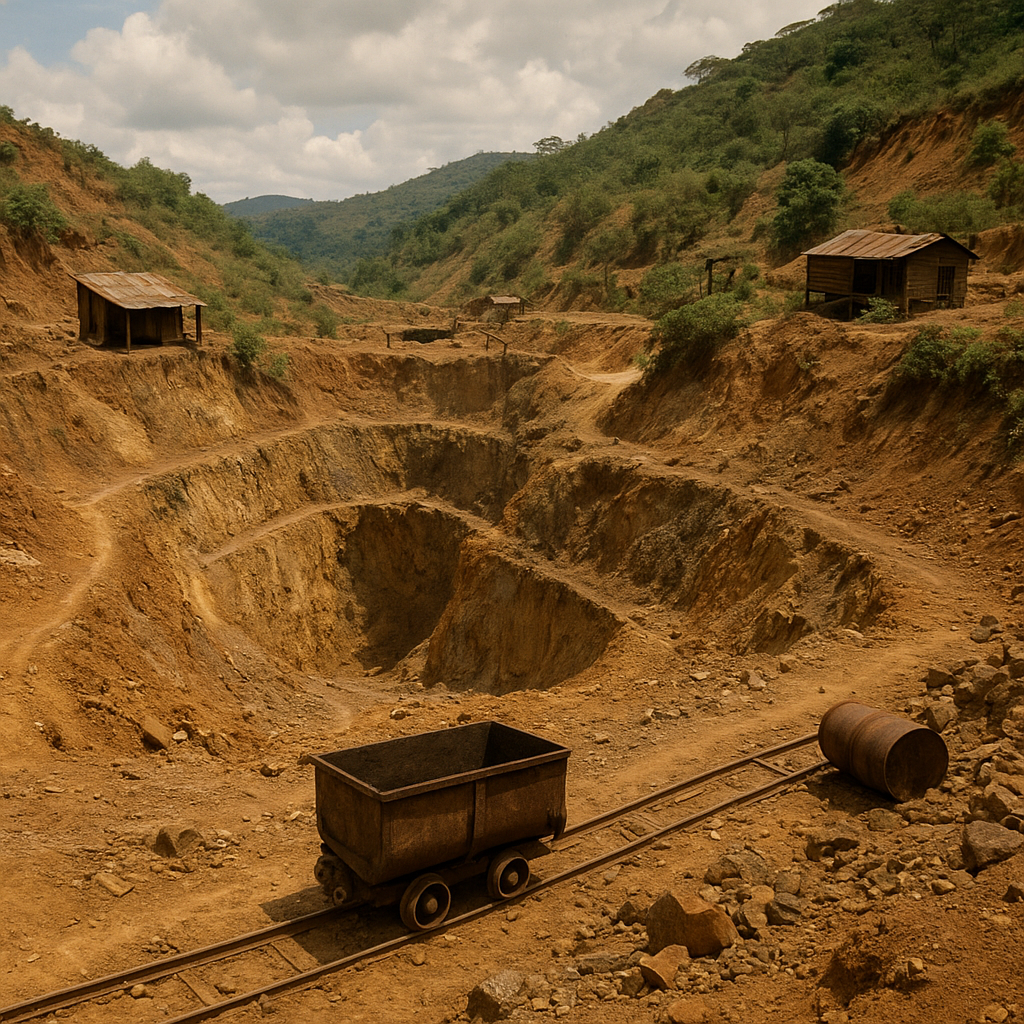
The Shinkolobwe mine, located in southeastern Democratic Republic of the Congo (DR Congo), is one of the most notorious and historically significant mineral sites of the 20th century. Renowned for producing extraordinarily rich deposits of uranium and associated minerals, the mine played an outsized role in global geopolitics, colonial economics, and the development of nuclear technology. This article explores where the mine is, what was extracted there, its economic and strategic importance, and several less obvious and compelling aspects of its legacy.
Location and geological setting
The mine sits in the Katanga region—today largely corresponding to the Haut-Katanga province—of southeastern DR Congo, in a district historically dominated by copper and cobalt operations. It is situated near small settlements and mining towns that grew up around mineral extraction, and its exact workings were carved into a complex of underground shafts and adits that penetrated the ancient rock. The deposit characteristically contains high concentrations of pitchblende (uraninite), a dense, dark ore mineral that carries most of the region’s uranium content.
Geology in broad terms
Geologically, the Shinkolobwe deposit formed in hydrothermal systems and veins associated with the Katanga sedimentary and metamorphic sequence. Mineralization is unusual for the area because of the exceptional grade of the ore. The occurrence of uraninite in visible, compact masses, often in association with other heavy minerals, meant that extraction yielded ore that was far richer than many other uranium sources worldwide.
Accessibility and setting
Although situated in a mineral-rich province, the mine’s location is relatively remote and, during its main period of operation, dependent on colonial-era infrastructure—railways and roads built to serve copper and other mines. The proximity to larger mining towns allowed companies to mobilize labor and logistics, but the mine itself remained a somewhat secluded and secretive place, especially during times when the resource was of strategic interest.
What was extracted and how it was valued
The primary commodity of value at Shinkolobwe was uranium, extracted principally in the form of pitchblende and uraninite. In addition to uranium, the ores contained various secondary minerals and trace elements, some of which had localized commercial value, but none matched uranium in strategic importance. The unusually high concentration of uranium in the ore made Shinkolobwe exceptionally valuable compared with most other deposits worldwide.
- Ore quality: The deposit yielded ore of very high grade by the standards of the time, making it an efficient source of metal after processing.
- By-products: Small amounts of other metals and radioactive daughters were present, but these were typically of secondary economic interest.
- Processing: The ore was shipped to processing facilities—often outside the region—for chemical treatment and refinement into forms suitable for industrial or military use.
Because of its quality, even relatively modest tonnages of Shinkolobwe ore could supply proportionally large quantities of extractable uranium. That made the mine extremely attractive to state actors and mining companies alike.
Historical and strategic significance
Shinkolobwe’s historical importance cannot be overstated. During the mid-20th century, at a time when nuclear materials were scarce and coveted, the mine supplied a significant portion of the uranium used by foreign powers. Ownership and control of the deposit rested with companies operating under colonial-era concessions, and this combination of corporate and state interests shaped how ore was allocated and exported.
Colonial control and commercial exploitation
Under colonial administration, mining rights were concentrated in the hands of large companies. The Belgian firm that dominated mining operations in Katanga exercised tight control over extraction and shipments, and the commodity was handled with secrecy when declared strategically important. The link between industrial companies and state actors meant that access to the ore was governed by political as well as commercial considerations.
Role in global nuclear history
During the period when nuclear weapons and reactors were first being developed, high-grade uranium supplies were a limiting factor. The ore from Shinkolobwe entered international supply chains and contributed to atomic energy projects and military programs. Because the mine’s output fed into those programs, Shinkolobwe occupies a central place in the story of how natural resources from Africa influenced global technological and military transformations.
Economic impact and local effects
At the macroeconomic level, revenue from Shinkolobwe flowed through corporate and state channels that underpinned the regional mining economy. Earnings from uranium, in addition to copper and cobalt produced in the district, were a major element of the colonial and post-colonial mining complex. For local economies, the mine created employment and infrastructure, but these benefits were uneven and often accompanied by exploitative labor conditions typical of extractive industries in colonial settings.
- Local employment: The mine provided wages and drew migrant labor from surrounding areas, reshaping demographics in mining towns.
- Infrastructure: Rail and road links built to serve mineral exports supported other economic activity, though primarily oriented to extraction rather than local development.
- Unequal returns: Much of the financial value left the region, and communities bore many environmental and health costs without equivalent long-term investments.
Post-colonial dynamics
After independence, control of mining assets became politically charged. Nationalization, changes in corporate ownership, and conflicts affected how the mine was managed. At times the mine’s production was curtailed or closed, and during periods of weak governance, informal and artisanal mining activity increased, driven by poverty and the continuing value of residual ore.
Environmental, health and security concerns
Mining for radioactive ores carries intrinsic risks, and Shinkolobwe’s legacy includes significant environmental and public health concerns. Tailings, dust, and contaminated water sources have posed long-term challenges for nearby communities. Radiation exposure risks to miners—especially unprotected artisanal miners working after formal operations ceased—have been reported, and the management of legacy waste remains a complex problem for authorities.
Illicit activity and safety
Following formal closures or restrictions, the site attracted illegal mining activity. Artisanal miners often operated without protective equipment or regulation, increasing their risk of exposure to radioactive materials. The combination of high-value ore and lax oversight created a hazardous environment, and periodic reports of unauthorized extraction and smuggling highlighted the security dimension of the mine’s legacy.
Remediation challenges
Containing and remediating radioactive mine waste is technically and financially demanding. Authorities and international organizations have sometimes been involved in efforts to secure the site and safeguard remaining materials, but long-term remediation requires sustained resources, monitoring, and community engagement. The interplay of governance capacity, funding, and local needs complicates recovery efforts.
Compelling and lesser-known aspects
Shinkolobwe is surrounded by narratives that range from geopolitical intrigue to local social history. Several features of its story are especially striking:
- High-grade rarity: The deposit’s exceptional ore quality made it uniquely important at a moment when few other sources could meet demand.
- Secrecy and corridors of supply: Because uranium was both commercially valuable and strategically sensitive, shipments and contracts were often executed with secrecy and diplomatic discretion.
- Cultural impacts: Mining altered social structures, movements of people, and settlement patterns in the region—effects that last for generations.
- Myths and memory: The mine has inspired local stories—some cautionary, some conspiratorial—about its power and the outsiders who profited from it.
- Ongoing relevance: Even after official closure, the mine remains relevant to discussions about resource governance, environmental justice, and the global history of nuclear materials.
Stories from the site
Anecdotes from miners, engineers, and local residents reveal human dimensions often missing from technical accounts. Tales of dangerous underground work, explosive growth of mining camps, and the arrival of foreign agents and representatives all illustrate how a single mineral deposit can ripple through lives and nations.
Contemporary status and lessons
Today, Shinkolobwe stands as a case study in the complex interplay between natural endowment and political power. While the mine’s peak production belongs to an earlier era, its consequences—environmental, geopolitical, and social—continue to inform debates about how resource-rich regions should manage extraction, share benefits, and protect communities. The site underscores the need for transparent governance, rigorous environmental safeguards, and attention to the long-term health of those who live near mines.
In examining Shinkolobwe’s history, one sees how a relatively small geographic feature—a vein of high-grade ore—can have global repercussions, shaping industrial capabilities, military projects, and economic relationships across continents. It remains a powerful reminder of both the potential wealth in the Earth and the responsibilities that come with exploiting it.

