
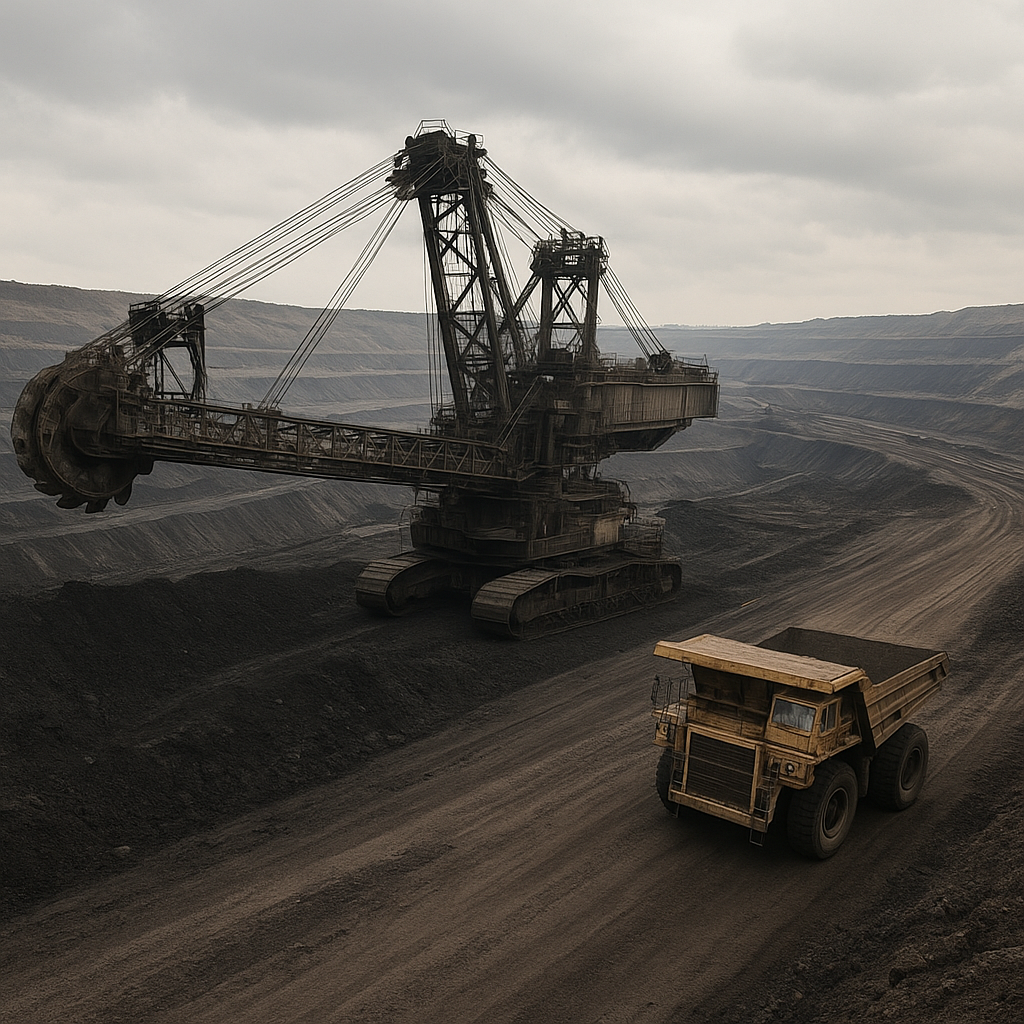
The Shenhua Haerwusu mine is one of the most prominent coal extraction sites in northern China, notable for its sheer scale and role in the country’s energy landscape. Operated by Shenhua, the project combines modern open-pit engineering with massive logistical systems to move millions of tonnes of fuel each year. This article examines where the mine is located, what type of coal it produces, how the operation works, its economic importance, and some less obvious but compelling aspects of the site and its future challenges.
Location and geological setting
The mine sits in the vast steppe and desert margins of Inner Mongolia in northern China, within a region that has long been recognized for abundant mineral resources. The local geology is dominated by Mesozoic and Cenozoic sedimentary basins where thick sequences of coal-bearing strata accumulated. These coal measures are part of larger basinal systems that have been economically exploited across Inner Mongolia and adjacent provinces.
Haerwusu itself occupies an arid to semi-arid landscape, with sparse vegetation and wide expanses of loess and alluvial deposits. The accessibility of the coal seams near the surface made open-pit mining both technically feasible and economically attractive. The mine’s position also benefits from relative proximity to domestic power demand centers and the national rail network, facilitating large-scale dispatch of fuel.
What is mined: coal type and quality
The primary product from Haerwusu is thermal coal intended for electricity generation and industrial heating. The coal is generally characterized as low- to medium-grade thermal coal (ranging from sub-bituminous to lignite in different benches), with qualities that make it best suited for combustion in large power plants rather than for metallurgical purposes. Because of this, most of the output is consumed domestically to supply electricity and heat to Chinese cities and industrial complexes.
Although the calorific value and moisture content vary across the seam profile, the mine’s product is valued for its stable supply rather than premium quality. Consequently, much of Haerwusu’s commercial role is to provide consistent bulk fuel to meet baseload power requirements, especially in northern and northeastern regions of China where winter heating demands are high.
Mining operations and logistics
Haerwusu operates as a large-scale surface mine employing heavy machinery: hydraulic shovels, electric rope shovels, large haul trucks, and extensive conveyor systems. The operational model emphasizes continuous, high-throughput removal of overburden and systematic extraction of coal benches. Significant investment in material handling and processing infrastructure ensures that extracted coal is crushed, screened and prepared to meet power-station feed specifications before shipment.
- Overburden removal: Layered stripping using high-capacity earthmoving fleets enables efficient exposure of coal seams.
- Coal extraction: Large excavators and shovels load haul trucks or transfer coal to conveyors that feed on-site preparation plants.
- Coal preparation: Crushing, washing and sizing operations improve combustion characteristics and reduce contaminants for power plant use.
- Transport: Dedicated transport corridors, frequently including heavy-duty railway links and trunk conveyors, carry coal to domestic markets and connecting nodes on the national network.
Robust maintenance regimes and workflow automation are important because even brief interruptions in such high-throughput operations reduce overall efficiency. The mine also uses digital monitoring and fleet management systems to track equipment health, optimize dispatching, and limit idle time.
Economic significance
Haerwusu contributes to regional and national economies in multiple ways. As a major source of thermal coal, it supports energy security by supplying fuel to power plants that underpin industry, commerce, and residential heating. The stability of supply from large mines like Haerwusu helps dampen price volatility in domestic coal markets and reduces reliance on imports for certain regions.
- Employment: Direct jobs at the mine, plus indirect employment in transport, maintenance, services and supply chains, create economic opportunities in an otherwise sparsely populated region.
- Revenue and investment: Tax receipts, royalties and corporate investment fund infrastructure and public services at local and provincial levels.
- Industrial supply chain: Coal feedstock supports power generation, which in turn enables manufacturing, mining and other industries to operate reliably.
- Regional development: Infrastructure associated with the mine—roads, rail, power and worker housing—can act as catalysts for further economic activity.
The mine’s scale means it can achieve economies of scale that smaller operations cannot, lowering per-tonne extraction and delivery costs. For a country where coal remains a major component of the energy mix, large, integrated operations such as Haerwusu are strategically important for planning and managing supply.
Environmental and social impacts
Large open-pit coal mines bring substantial environmental challenges, and Haerwusu is no exception. Surface disturbance alters landscapes and local hydrology; dust generation and particulate matter impact air quality; and combustion of the mined coal contributes to greenhouse gas emissions at power plants where it is burned.
Key environmental concerns include:
- Land disturbance: Thousands of hectares are stripped and stockpiled during the life of an open-pit mine, requiring progressive reclamation plans to restore vegetation and function.
- Water use and quality: In arid and semi-arid zones, mining consumes significant water for dust suppression, processing and equipment cooling. Groundwater drawdown and contamination are risks that must be managed.
- Air quality: Dust and emissions from operations and associated transport can affect local communities and ecosystems unless controlled by modern suppression systems and monitoring.
- Carbon footprint: The coal extracted is a source of CO2 when burned. While mitigation at the mine level can limit methane leaks and efficiency losses, the ultimate climate impact depends on end-use combustion.
Socially, large mines generate both positive and negative effects. Employment opportunities and local investments improve livelihoods and services in remote regions. Conversely, worker safety concerns, shifts in traditional land use (especially for pastoral communities), and resettlement can create tensions. Over the life of the operation, companies and authorities typically implement community engagement, compensation schemes and retraining programs to manage these issues.
Interesting aspects and technological innovations
Several features make Haerwusu notable beyond its scale. The mine exemplifies how modern heavy-industry projects are organized to achieve continuous, reliable output in challenging environments.
- Scale and integration: The mine functions as part of an integrated supply chain that includes on-site processing, dedicated transport arteries and direct linkages to power generation hubs. This vertical integration reduces transaction costs and delivery times.
- Mechanization and digitalization: Adoption of GPS fleet tracking, predictive maintenance, and process-control software has increased efficiency and reduced unplanned downtimes.
- Progressive reclamation: Best-practice sites plan reclamation in tandem with extraction, contouring waste dumps and re-establishing vegetation to reduce erosion and restore ecosystem services over time.
- Dust and water management: Specialized suppression systems, sealed conveyors, and closed-loop water circuits minimize environmental impacts in an otherwise fragile setting.
Another interesting socio-technical aspect is how such a mine affects regional labor markets. High degrees of mechanization reduce some manual labor needs but create demand for skilled technicians, operators and engineers. Training centers and workforce development initiatives are commonly supported by operators to ensure a sustained talent pipeline.
Regulatory context and corporate responsibility
Operations at Haerwusu are governed by national and provincial regulations concerning mining safety, environmental protection, land use and labor rights. In recent decades China has tightened environmental requirements and pushed large companies to adopt cleaner production practices and emissions controls. As a major state-linked operator, Shenhua is typically subject to both market scrutiny and public policy directives that encourage improved environmental performance and social responsibility.
Corporate responsibility initiatives commonly associated with such operations include investments in local infrastructure (schools, clinics, roads), targeted environmental projects (reforestation, wetland restoration where feasible), and transparent reporting on emissions and reclamation progress. The degree to which these measures are implemented and enforced varies, and they remain areas of active attention by regulators, NGOs and local communities.
Future outlook and challenges
Looking forward, Haerwusu faces multiple intersecting pressures. On one hand, domestic energy demand—especially for heat in northern China—means coal will continue to play a role in the near term. On the other hand, national and international climate commitments and a policy emphasis on cleaner energy create incentives to reduce coal dependence over time.
Some of the principal challenges include:
- Adapting operations to stricter environmental standards and carbon-control frameworks.
- Maintaining economic viability as markets shift and as alternative energy sources gain share.
- Managing the social transition for workforces and communities as production profiles change.
- Investing in reclamation and biodiversity measures that are credible and effective over long timelines.
Potential pathways include increased efficiency in mining and logistics to lower emissions per tonne delivered, diversification of local economies to reduce dependence on coal employment, and trialing carbon-management technologies at associated power stations (such as efficiency upgrades or, where feasible, abatement technologies). How these pathways are pursued will shape the mine’s legacy in the region.
Concluding observations
Haerwusu stands as a striking example of large-scale coal extraction in a country that has built industrial capacity around abundant domestic fossil-fuel resources. The mine’s contribution to energy supply, local economies and infrastructure is significant, but it also highlights the trade-offs between economic development and environmental stewardship. Understanding sites such as Haerwusu requires attention to geology, engineering, logistics, policy and the lived experience of local populations—components that together define the complex role coal mines continue to play in the 21st century.

