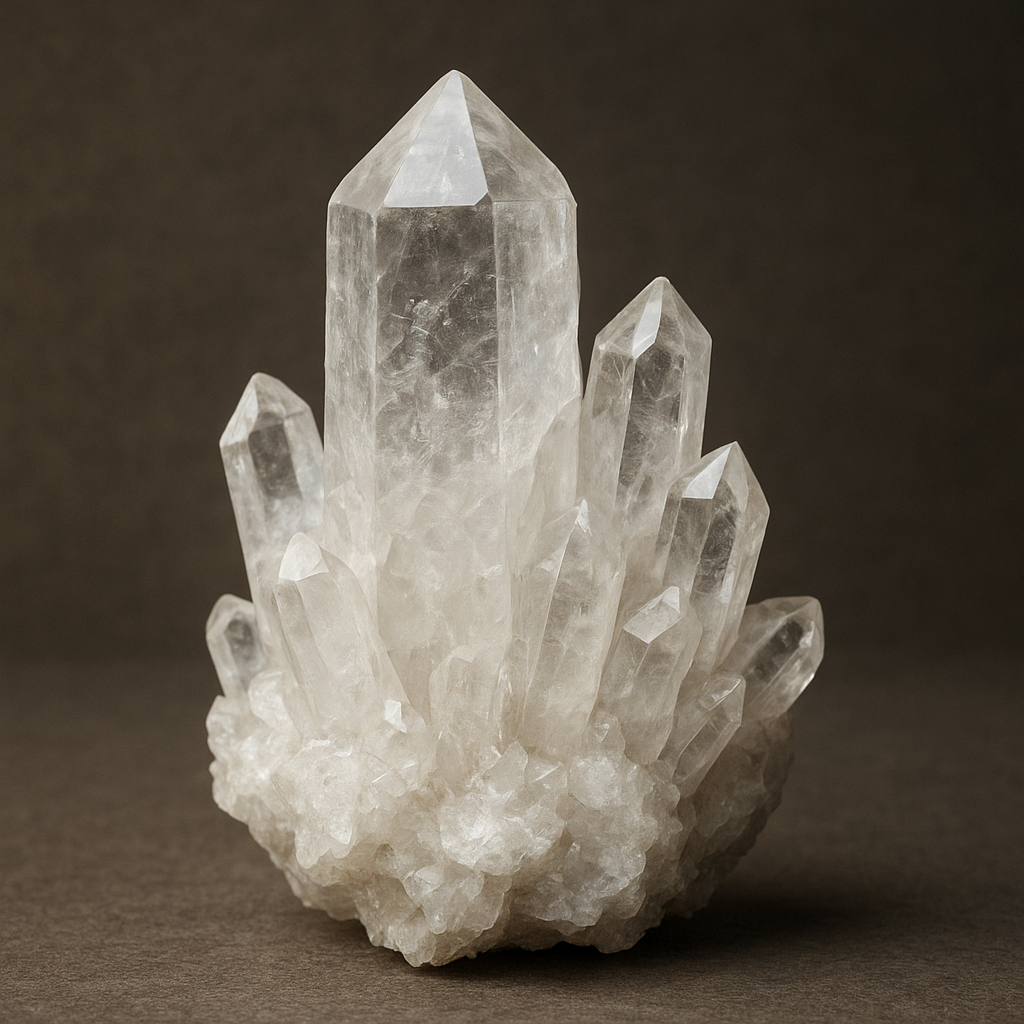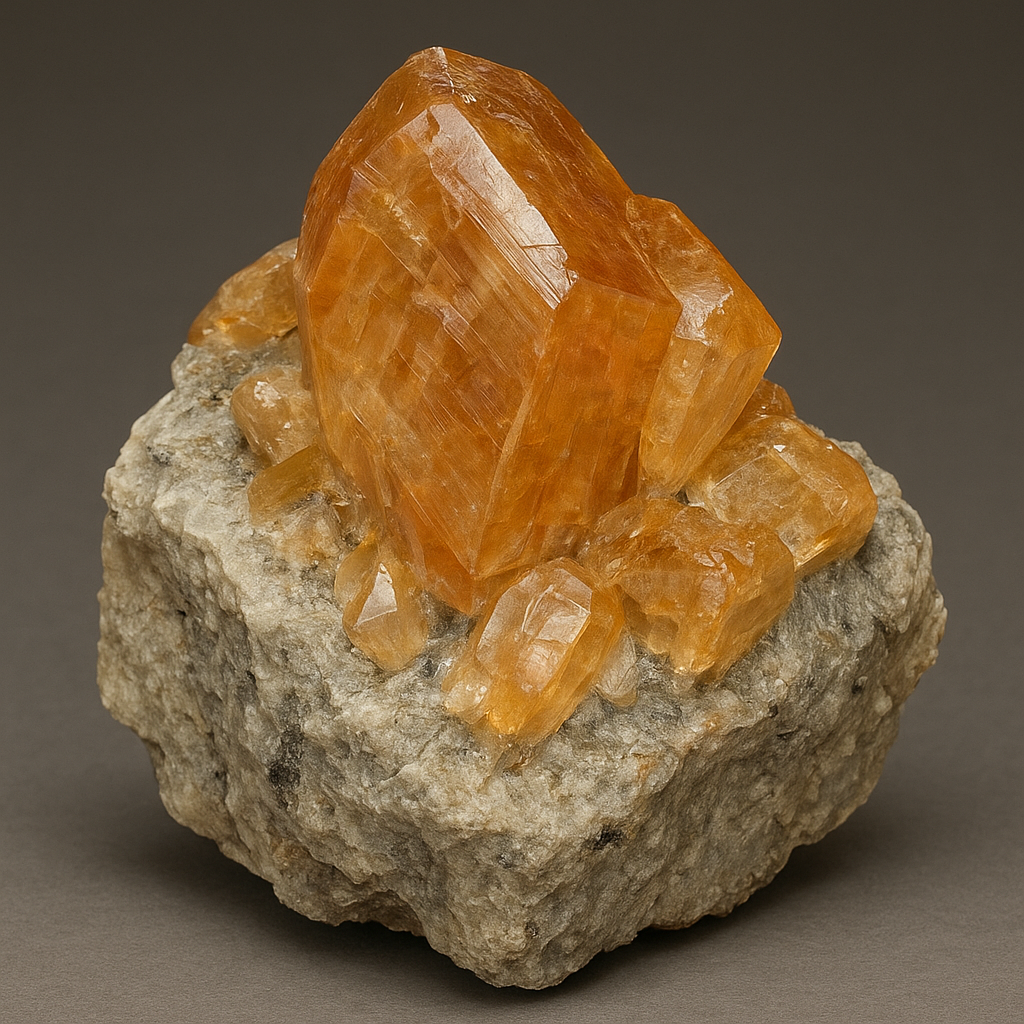
Scheelite is a striking and scientifically important mineral best known as one of the primary ores of tungsten. Its bright luster, high specific gravity and characteristic blue-white fluorescence under ultraviolet light made it a favorite of collectors and prospectors alike long before its industrial significance was fully appreciated. Chemically simple yet geologically versatile, scheelite appears in a variety of host rocks and deposit types and has played roles that range from the practical — supplying a metal essential to modern industry — to the cutting edge of research into materials for physics experiments. This article surveys the mineral’s properties, geological settings, economic importance, identification methods and some of the more intriguing applications and stories associated with it.
Chemical and Physical Properties
Scheelite is a calcium tungstate with the formula CaWO4. It crystallizes in the tetragonal system, typically forming dipyramidal or prismatic crystals, compact granular aggregates and sometimes well-shaped barrel- or wedge-shaped crystals. The mineral’s appearance varies from colorless and white to yellow, brown, orange, green, and even blackish, depending on impurities and surface alteration. Its common luster is adamantine to resinous.
- Density and hardness: Scheelite has a relatively high density (about 5.9–6.1 g/cm3 for pure material), a product of the heavy tungsten atom in its structure. Its hardness is moderate, about Mohs 4.5–5, which makes faceted scheelite a delicate but attractive gem when encountered in clear crystals.
- Optical properties: Scheelite is uniaxial (+) and shows moderate birefringence. It has relatively high refractive indices, which contribute to its brilliance and dispersion when cut as a gem.
- Fluorescence: One of scheelite’s most diagnostic and celebrated properties is its often intense fluorescence under short-wave UV light, commonly showing a vivid blue to blue-white glow. Variations in color and intensity occur depending on trace element content (e.g., molybdenum, uranium, or rare-earth elements) and structural defects.
- Streak and cleavage: The streak of scheelite is white, and cleavage is imperfect to distinct in one direction, with a conchoidal to uneven fracture.
Geological Occurrence and Mineral Associations
Scheelite occurs in a range of geological environments but is most commonly associated with hydrothermal and metasomatic processes related to granitic intrusions and contact metamorphism. Its common modes of occurrence include skarns, greisens, quartz veins, and replacement deposits where tungsten-bearing fluids interact with carbonate or silicate host rocks.
- Skarns: Skarn deposits form by metasomatic exchange at the boundary between intruding felsic plutons and carbonate-rich country rock. The heat and fluid flow mobilize tungsten and deposit scheelite alongside minerals such as garnet, pyroxene, epidote and magnetite. The term skarn is closely linked in prospecting to scheelite-rich ore bodies.
- Hydrothermal veins and greisens: Scheelite commonly precipitates from hydrothermal fluids in veins and greisenized zones of granite and granitic pegmatites, often accompanied by quartz, fluorite, tourmaline, cassiterite (tin oxide) and molybdenite.
- Metamorphic and secondary contexts: In some settings scheelite forms during contact metamorphism or as a secondary mineral in reworked deposits where tungsten is remobilized.
Because tungsten is a relatively scarce element in the Earth’s crust, economically viable scheelite deposits are uncommon but can be large and highly prized. Major modern tungsten-producing regions that commonly host scheelite-rich deposits include parts of China, Russia, Bolivia, Portugal, and North America, though the distribution and economic importance of specific localities have varied through history with the discovery and depletion of ores and changes in demand.
Mining, Processing and the Path to Metal
Scheelite is an important ore mineral because it contains concentrated tungsten. Recovering tungsten from scheelite involves several stages, from initial mining to chemical processing that yields a marketable tungsten compound or metal.
Extraction and concentration
- Mining methods: Scheelite-bearing rocks are mined by conventional underground or open-pit methods depending on the deposit geometry and depth.
- Physical concentration: Because scheelite is dense, gravity separation techniques (jigs, spirals, shaker tables) are excellent for initial concentration. Scheelite’s high density relative to gangue minerals makes gravity separation economical and effective. Froth flotation is also widely used to concentrate scheelite when fine particles or complex mineral associations are present.
Chemical processing to tungsten products
- The concentrated scheelite is roasted or chemically treated to convert the tungstate component into soluble or otherwise processable forms. Historically and commonly, scheelite is converted to ammonium paratungstate (commonly abbreviated APT), (NH4)10[H2W12O42]·xH2O, through alkaline leaching and purification steps.
- APT is a key intermediate that can be further calcined to tungsten oxide (WO3) and then reduced to metallic tungsten using hydrogen or carbothermal processes. The final tungsten metal is used to manufacture tungsten carbide, hard alloys, filaments, and other high-temperature or wear-resistant products.
Economic and historical notes
Tungsten has been strategically important during industrialization and conflict because of its extremely high melting point and its role in producing hard, wear-resistant alloys. The demand for tungsten surged during the late 19th and 20th centuries as steel alloying and cutting-tool technologies advanced. During World War II, control of tungsten resources was a geopolitical concern. Modern demand continues for high-performance applications such as aerospace, electronics, and sustainable energy technologies.
Gemological and Collector Interest
Although not as well known as diamonds or sapphires, scheelite ranks as an attractive gem material when transparent, well-colored and carefully cut. The mineral’s high refractive index and dispersion can produce lively brilliance, and its range of colors — including colorless, yellow, and honey tones — allow for attractive faceted stones. However, its moderate hardness (4.5–5) makes it less suitable for everyday jewelry that is subject to abrasion. Collectors prize scheelite crystals for their forms, luster and especially their fluorescence.
- Gem cutting: Gem cutters must work cautiously; scheelite’s cleavage and relative softness require careful cutting and setting to avoid damage.
- Collector specimens: Display-quality scheelite crystals — particularly those that fluoresce strongly under UV — are of high interest to mineral collectors. Well-crystallized examples from skarn deposits or historic mines command premiums.
Identification and Prospecting Techniques
Field and laboratory identification of scheelite rely on a suite of tests and observations. For prospectors seeking tungsten deposits, recognizing scheelite’s physical and optical signatures is critical.
- UV fluorescence: Portable short-wave UV lamps are among the most effective prospecting tools for scheelite. Many scheelite specimens glow a conspicuous blue-white or bluish color under UV light, making it straightforward to spot mineralized rocks in the field or on sluice concentrates at night.
- Specific gravity: Simple heavy-liquid tests or density measurements can confirm that a mineral fragment is unusually dense, consistent with scheelite rather than lighter gangue minerals.
- Hardness and streak: A hardness test (4.5–5) and white streak on scratched porcelain help distinguish scheelite from metallic sulfides or other dense minerals like wolframite (which is typically darker and non-fluorescent).
- Associations: Finding scheelite in association with skarn indicator minerals (garnet, pyroxene), quartz veins, or greisen alteration near granitic intrusions strengthens the interpretation of a tungsten-bearing system.
Scientific and Technological Applications
Beyond its role as an ore of tungsten, scheelite and related tungstate materials have drawn scientific interest for specialized technological uses.
- Scintillation and particle physics: Large, high-purity CaWO4 crystals are used as scintillators in sensitive low-temperature detectors for rare-event physics, including dark matter search experiments (for example, CRESST and related technologies). CaWO4’s combination of high atomic number constituents and measurable scintillation yield makes it useful for detecting tiny energy deposits from particle interactions.
- Optical and phosphor research: The luminescent properties of tungstates encourage ongoing research into phosphors, optical materials and doped crystals with tailored emission spectra. Substitutions in the crystal lattice (e.g., molybdate or rare-earth doping) can tune emission colors and lifetimes for potential use in sensors and lighting technologies.
- Analytical uses: Because scheelite contains tungsten in a stable crystalline matrix, small scheelite crystals can act as natural standards in geochemical studies or as carriers of trace elements useful to reconstruct the thermal and fluid histories of mineral deposits.
Environmental, Economic and Social Considerations
Mining and processing scheelite raise environmental issues similar to those associated with other metal ores, including landscape disturbance, waste rock and tailings management, and potential leaching of trace elements. For tungsten specifically, environmental and health hazards are generally lower than for some heavy metals, but mining operations must still manage dust, control water quality and monitor tailings to prevent long-term contamination.
- Regulation and remediation: Modern mining projects are increasingly subject to environmental permitting, monitoring and reclamation requirements, designed to reduce impacts from scheelite and tungsten extraction.
- Socioeconomic impact: In many regions, tungsten mines provide important employment and infrastructure but can also spark community concerns over water use and land access. Responsible mining practices and community engagement help reconcile resource development with social license to operate.
Historical Anecdotes and Interesting Facts
Scheelite’s name commemorates the Swedish chemist Carl Wilhelm Scheele, reflecting the mineral’s historic identification with early chemistry. Over the centuries, scheelite has been linked to several notable mining booms and strategic resource stories, especially when tungsten became a critical material for military and industrial technologies.
- Prospecting lore: Prospectors have long relied on a simple flashlight trick: exposing suspected rock concentrates to a portable UV lamp at night to reveal scheelite’s telltale fluorescence. This dramatic blue glow has almost cinematic appeal and continues to be a practical exploration method.
- Scientific curiosity: The use of natural CaWO4 crystals in low-temperature physics demonstrates how a commonplace ore mineral can find a second life at the frontier of fundamental science, bridging geology and particle physics in an unexpected way.
Practical Notes for Collectors and Enthusiasts
For mineral collectors interested in scheelite, a few practical tips are useful. Use care when handling and storing faceted scheelite gems because of the mineral’s moderate hardness and cleavage. If you plan to use UV lamps to reveal fluorescence, short-wave UV is usually most effective; avoid exposing specimens to strong light for prolonged periods if preservation of color is a concern.
- Storage: Store scheelite specimens away from abrasive materials and avoid repeated mechanical shocks to protect fragile crystals.
- Display: A small UV display can dramatically enhance a scheelite specimen’s appeal. Many museums and collectors create exhibits that contrast visible light appearance and fluorescence under UV to educate viewers.
Final Remarks on Value and Future Outlook
Scheelite remains an economically and scientifically important mineral. As an ore of tungsten, it underpins technologies that demand high-temperature performance and extreme hardness. As a material, CaWO4 and related tungstates find specialized roles in advanced physics, optics and photonics research. Ongoing exploration, improved extraction techniques and attention to environmental stewardship will shape the future of scheelite production, while the mineral’s striking physical properties — particularly its fluorescence — ensure its continuing popularity among collectors and educators.