
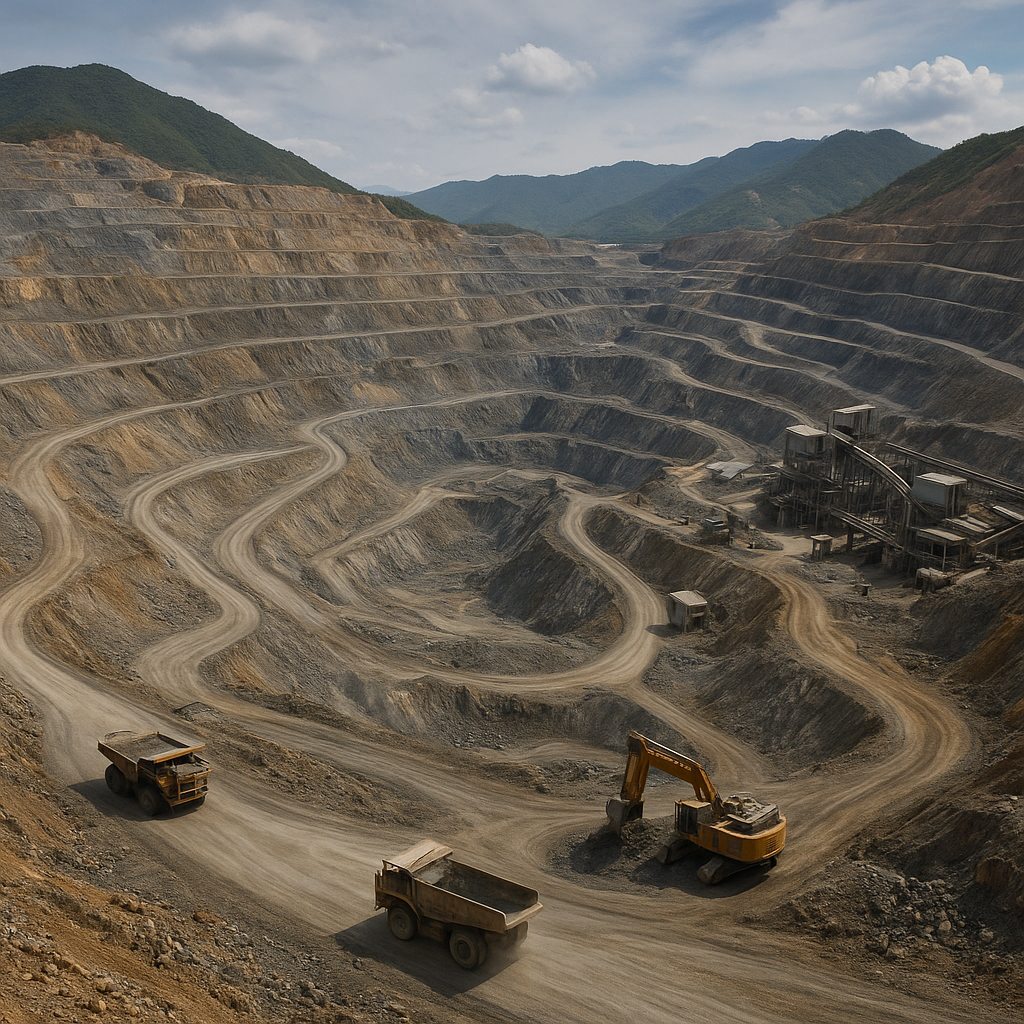
The Sandaozhuang Mine is an important Chinese operation focused primarily on the production of molybdenum. Situated within one of the country’s mineral-rich districts, the mine has attracted attention for its role in supplying molybdenum concentrates to domestic and international markets, for its integration of modern mining and processing techniques, and for its influence on local economy and industry. This article examines where the mine is located in broad terms, what is extracted and how it is processed, its economic importance, and several technical and historical aspects that make Sandaozhuang noteworthy.
Location and regional context
Sandaozhuang Mine is located in the People’s Republic of China, within a regional belt known for porphyry and skarn mineralization that commonly hosts molybdenum and associated metals. While administrative boundaries and naming conventions vary, the mine sits in a district where mining and mineral processing have long been part of the local landscape. Proximity to transport corridors—roads, rail links and, in many cases, river or coastal access—helps integrate the mine into broader supply chains that serve both domestic manufacturing and export markets.
The surrounding area combines industrial zones and agricultural land, a typical pattern around many mid-size mining operations in China. Municipal centers provide administrative services and logistics, and the mine’s workforce is drawn from nearby towns and villages as well as from specialized technical staff who may commute from larger cities. Local infrastructure investments, often co-funded by mining companies and government entities, improve utilities, road quality, and sometimes telecommunications, reflecting the mutual dependence between the mine and its host region.
Ore types and what is extracted
Sandaozhuang’s primary product is molybdenum, most commonly recovered as molybdenite (MoS2) which is then concentrated and either sold as a concentrate or further processed into chemical and metal forms. In many deposits of this type, molybdenite occurs within vein, porphyry, or skarn systems and can be associated with copper, gold, lead, zinc and iron mineralization. At Sandaozhuang, the mineral assemblage typically includes molybdenite along with quartz, pyrite, and various sulfides, making flotation and mineral separation key steps in the processing chain.
Products produced from the mine include:
- Molybdenum concentrate: the primary commercial product, shipped to smelters or processing plants for conversion to molybdenum oxide or metal.
- Byproduct concentrates: where present, copper or other sulfide concentrates can be produced and sold.
- Value-added derivatives: some operations integrate downstream processing to produce molybdenum trioxide (MoO3), ferromolybdenum, or chemical precursors for catalysts and lubricants.
Geology and mineralization
The geological setting that hosts Sandaozhuang is typical of many molybdenum-bearing districts: intrusive igneous activity has introduced metal-bearing fluids into surrounding host rocks, creating zones of hydrothermal alteration and sulfide mineralization. The deposit style may include disseminated molybdenite in porphyry systems or more concentrated veins and skarns where favorable chemistry and permeability focused mineral deposition.
Important geological controls at such deposits include the chemistry and timing of igneous intrusions, structural conduits such as faults and fractures, and the composition of host rocks that influence the formation of skarn or replacement bodies. Understanding these factors allows exploration geologists to delineate ore zones, estimate resources, and plan efficient extraction sequences. Modern exploration techniques—geophysics, geochemical surveys, and 3D geological modeling—play an important role in upgrading the resource base and identifying expansion targets around existing pits or underground workings.
Mining methods and processing
Most molybdenum mines use a mix of open-pit and underground mining depending on ore geometry, depth and grade. At Sandaozhuang, conventional mining equipment such as hydraulic shovels, loaders and haul trucks are likely used for open pit operations, while cut-and-fill or sublevel stoping methods may be applied to higher-grade, narrower underground zones. Safety, ventilation and ground control are major considerations in any underground portion of the operation.
Processing typically begins with crushing and grinding to liberate molybdenite grains from host rock, followed by froth flotation to concentrate sulfide minerals. Flotation circuits are optimized to produce a high-grade molybdenum concentrate with low deleterious elements. Further metallurgical steps depend on the final product: smelting and roasting transform concentrates into oxide or metallic forms, while hydrometallurgical methods can produce specialty chemicals for catalysts and electronics.
- Key process stages:
- Crushing and comminution
- Grinding to target liberation size
- Flotation for sulfide separation
- Concentrate thickening and filtration
- Smelting/roasting or chemical processing for refined products
Economic importance and market links
The economic significance of Sandaozhuang stems from several channels. The most direct is employment: mining and processing create jobs for miners, engineers, technicians and administrative staff. In addition, the operation supports a supply chain including equipment suppliers, logistics providers and local service businesses. Taxes, royalties and other payments contribute to municipal and regional revenues, financing public services and infrastructure improvements.
On a national level, the mine feeds into China’s position as a major player in the global molybdenum market. Molybdenum is essential in high-strength steels, corrosion-resistant alloys, and specialized chemical applications. Demand drivers include the construction and automotive sectors, energy and oil and gas industries, and increasingly, high-tech applications such as catalysts for petrochemical processes and components for electronic devices. As such, operations like Sandaozhuang help secure domestic supply chains for strategic industries and reduce reliance on imports.
Internationally, molybdenum concentrates and refined products from Chinese mines are traded worldwide. Price fluctuations on the London Metal Exchange and other commodity markets influence the mine’s economic performance, investment decisions, and potential for expansion. Long-term contracts with smelters and fabricators, coupled with flexible spot-market strategies, typically balance risk and revenue for producing companies.
Environmental management and community relations
Responsible mines implement environmental management systems to mitigate impacts on water, air and land. At Sandaozhuang, best-practice measures would include tailings management, water recycling in processing plants, dust suppression at crushing and handling facilities, and progressive land reclamation. The mine must monitor water quality in nearby streams and groundwater and maintain contingency plans for extreme weather events.
Community engagement is another critical area. Modern operations often establish community liaison offices, invest in local education or health programs, and procure goods and services from local businesses when possible. These initiatives can create shared benefits and reduce social friction. Conversely, unresolved concerns over noise, dust, or land use can create tension; transparent communication and third-party audits of environmental performance help build trust with local stakeholders and regulators.
Technical innovations and efficiency
Advances in mining and mineral processing are shaping how mines like Sandaozhuang operate. Digitalization, automation and real-time monitoring enhance productivity and safety: fleet management systems reduce fuel use and emissions, automated drills and loading equipment improve precision and lower personnel risk, and process control software optimizes flotation circuits to increase recovery and concentrate grade.
Metallurgical research aims to extract higher value from low-grade ores and reduce the environmental footprint. Examples include improved reagents for flotation that increase selectivity, hydrometallurgical methods that avoid high-temperature smelting, and tailings dewatering technologies to minimize storage volumes. Adoption of renewable energy sources for power-hungry processing plants also reduces greenhouse gas emissions and operating costs over time.
Interesting facts and broader significance
Several aspects of molybdenum mining and Sandaozhuang’s place within the sector are particularly striking:
- Strategic metal: Molybdenum’s role as a strengthener and corrosion inhibitor in steel makes it strategically important for infrastructure, defense and industrial applications.
- High value in small volumes: A relatively small mass of molybdenum can impart significant performance improvements, meaning that molybdenum mines like Sandaozhuang produce commodities with outsized industrial impact relative to tonnage.
- Byproduct potential: Many molybdenum deposits also contain copper or gold, which can improve project economics when recovered efficiently.
- Technological crossovers: Research into molybdenum-based catalysts and lubricants links mining to advanced manufacturing and green technologies, such as cleaner fuels and improved energy systems.
- Sustainability challenges are a live concern: tailings and water stewardship require continuous improvement, prompting pilot projects in circular water use and tailings reprocessing to recover residual metals.
Future prospects and challenges
Looking ahead, mines like Sandaozhuang face both opportunity and challenge. Demand for molybdenum is expected to track infrastructure growth, manufacturing trends, and new applications that favor stronger, lighter and more corrosion-resistant materials. Investment in mine life extension—through resource expansion, improved metallurgy and more efficient processing—can sustain production for decades.
Challenges include market volatility, regulatory changes, and increasing expectations around environmental and social performance. Companies that invest in community partnerships, emissions reductions, and transparent governance position themselves to operate with a social license to mine. At the same time, exploration and geological risk remain intrinsic to mining; new discoveries or better delineation of existing deposits can pivot a local economy and alter regional industry patterns.
Conclusion
The Sandaozhuang Mine is a notable element within China’s molybdenum industry: it produces a metal that is critical for modern manufacturing and infrastructure, contributes to local and national economies, and showcases a blend of geological complexity, technical processing, and social-environmental considerations. As markets, technologies and regulations evolve, operations like Sandaozhuang illustrate how resource extraction and value-added processing continue to shape industrial capacity and regional development in China and beyond.

