
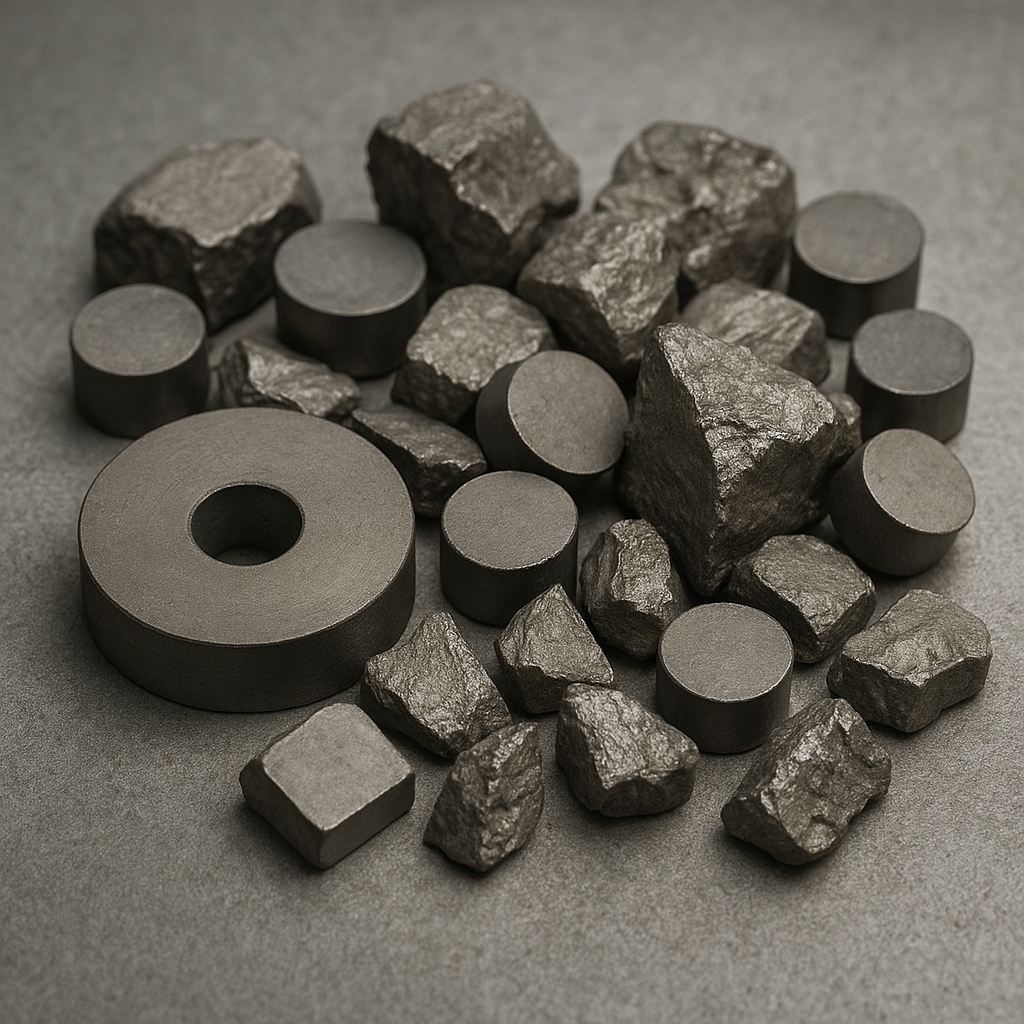
Samarium–Cobalt is one of the most important families of permanent magnet materials developed in the 20th century. These alloys combine the rare-earth element samarium with cobalt to produce magnets that offer exceptional thermal stability, strong magnetic performance, and notable mechanical and chemical resilience. This article examines where Samarium–Cobalt materials occur and how they are produced, surveys their principal applications, and explores related technical, economic, and environmental themes that make them both valuable and intriguing in modern technology.
Composition, structure and physical properties
Samarium–Cobalt magnets are typically grouped into two major alloy systems: SmCo5 (sometimes written SmCo5 or Sm1Co5) and Sm2Co17 (Sm2Co17 or SmCo7 in historical notation). Each has a distinct crystalline structure and magnetic behavior. The SmCo5 phase has a hexagonal structure that supports high uniaxial anisotropy, while the Sm2Co17-based alloys are multiphase systems engineered for very high energy products and outstanding temperature coefficients.
Key magnetic parameters
- Remanence (Br): Samarium–Cobalt magnets exhibit moderate to high remanence compared with other permanent magnets, providing useful magnetic flux density in compact forms.
- Coercivity: One of the defining strengths of Sm–Co magnets is their very high coercivity (resistance to demagnetization), which makes them reliable in strong external fields and at elevated temperatures.
- Maximum energy product (BHmax): SmCo grades span a range of energy products; while not reaching the absolute peak of the latest Neodymium (NdFeB) grades, SmCo magnets offer a superior performance-to-temperature ratio.
- Temperature coefficients: Sm–Co magnets have low reversible temperature coefficients for Br and Hc, meaning their magnetic properties change little with temperature compared to most other permanent magnets.
Thermally, Sm–Co magnets operate across a broad window. Many SmCo grades retain useful magnetization at temperatures above 200 °C and can function reliably up to 300 °C or more in demanding applications. Their Curie temperatures (where magnetism is lost) are substantially higher than those of NdFeB, which is one reason SmCo is selected for high-temperature roles.
Occurrence, raw materials and production
Samarium is one of the lanthanide or rare-earth elements, typically obtained as a by-product of mining rare-earth-bearing minerals such as monazite, bastnäsite and xenotime. Cobalt is a transition metal mined primarily from laterite and sulfide deposits, often associated with nickel and copper ores. The supply chain for Sm–Co magnets therefore spans multiple mining and refining steps: ore extraction, rare-earth separation and purification, cobalt production, alloying, and magnet manufacturing.
Geography and supply chain
- Rare-earth production is concentrated in a handful of countries; China has historically dominated extraction and processing, though other countries (Australia, the United States, Myanmar, and parts of Africa) also contribute.
- Cobalt mining is heavily concentrated in the Democratic Republic of Congo, with significant further processing in China and other refiners worldwide.
- Because Sm–Co relies on both a rare-earth and a critical metal, its supply chain can be sensitive to geopolitical, environmental and market fluctuations.
Manufacturing methods
Sm–Co magnets are produced by powder metallurgy techniques. The general steps include alloy melting and casting, crushing and milling into fine powders, pressing (often with orientation in a magnetic field), sintering to densify the magnet, heat treatments to develop microstructure, and final machining or coating. Two major processing routes are:
- Sintered SmCo: Fine powders are pressed into the desired shape, sintered at high temperatures to form a dense magnet, then magnetized. Sintered magnets offer high magnetic performance and are used when maximum properties are needed.
- Bonded SmCo: Powder is mixed with a polymer binder and formed by injection molding or compression. Bonded magnets have lower magnetic performance but can be produced in near-net shapes with complex geometries and fine tolerances.
Manufacturing Sm–Co requires careful control of composition and microstructure. For instance, Sm2Co17 magnets commonly incorporate small amounts of Fe, Cu, Zr and other elements, which tune magnetic and mechanical properties, enhance coercivity and control temperature behavior. The multiphase microstructure in Sm2Co17 is deliberately engineered to produce pinning centers that resist domain wall motion, improving stability.
Applications and industries that benefit from Samarium–Cobalt
The strengths of Samarium–Cobalt—thermal stability, high coercivity, and corrosion resistance—make it indispensable in niches where alternatives (like NdFeB) fall short. Major application areas include:
Aerospace and defense
In aerospace and military systems, magnetic components often face wide temperature swings, vibration, radiation exposure and the need for long-term stability. Sm–Co magnets are used in actuators, sensors, gyroscopes, and other components where reliability at high temperature is critical. Their resistance to demagnetization under stress and in hostile environments is a decisive advantage.
High-performance motors and generators
Electric motors and small generators that operate at elevated temperatures or in compact, high-speed designs often use Sm–Co to maintain torque and efficiency when NdFeB’s temperature limits would cause degradation. Applications include specialized traction motors, aircraft auxiliary systems, and deep-sea or geothermal power devices.
Scientific and medical devices
Laboratory instruments, particle accelerators and certain medical devices require stable fields at variable temperatures or in strong backgrounds. Sm–Co magnets are found in NMR shims, specialized sensors, and other instruments where field stability and material longevity are essential.
Sensors and precision instruments
Precision encoders, torque sensors, and small position-sensing devices benefit from SmCo’s stability. Where small positional errors over time or temperature would degrade system performance, Sm–Co magnets provide consistent magnetic reference points.
Automotive niche uses
While mainstream automotive electrification favors NdFeB because of higher energy density and lower cost, Sm–Co remains present in specialized automotive systems exposed to high-temperature zones, such as certain turbocharger actuators or sensors placed near exhaust components.
Advantages, limitations and comparative considerations
Understanding when to choose Sm–Co requires balancing material benefits against costs and alternatives.
- Advantages
- Excellent thermal stability and operational capability at high temperatures.
- High intrinsic coercivity, good resistance to demagnetization and radiation.
- Superior corrosion resistance compared to many high-performance magnets (NdFeB often needs protective coatings).
- Long-term stability: Sm–Co can retain calibration and magnetic life in critical systems without elaborate maintenance.
- Limitations
- Higher material cost, driven by the content of cobalt and refined samarium.
- Lower maximum energy product than the best modern NdFeB grades, which means larger or heavier magnets are sometimes necessary to achieve the same flux in space-constrained designs.
- Machining and加工: While mechanically robust, Sm–Co is brittle and requires care when being machined or assembled; bonded variants can ease manufacturing but at the expense of magnetic strength.
Because of these trade-offs, designers often compare Sm–Co with NdFeB and ferrite magnets. NdFeB leads when raw performance per volume and cost-efficiency are primary concerns, but Sm–Co wins in high-temperature, high-reliability or chemically aggressive contexts.
Environmental, economic and strategic issues
The production and use of Samarium–Cobalt has environmental and strategic dimensions that influence technology choices and policy.
Resource and supply chain risks
Rare-earth and cobalt supply chains are subject to geopolitical concentration, export policies, and mining ethics. Because Sm–Co depends on both a rare-earth and a strategic metal, purchasers must consider potential bottlenecks, price volatility and the environmental footprint of extraction and refining.
Recycling and circularity
Recycling permanent magnets presents technical challenges but also opportunities. Sm–Co magnets are less common than NdFeB in consumer products, making widespread recycling streams less developed. However, recycling of Sm–Co from industrial scrap, end-of-life aerospace components and electronic waste is both technically feasible and increasingly attractive. Improved recovery technologies, such as hydrometallurgical separation and direct reuse of powders, are under development to reduce reliance on primary mining and to improve lifecycle sustainability. Investment in recycling could also buffer industry against supply shocks.
Environmental impacts
Mining of cobalt and rare-earth ores can create large environmental disturbances if not managed responsibly: tailings, acid drainage, heavy-metal contamination and high energy consumption during separation and refining. Because Sm–Co production is less volume-dominant than NdFeB, its relative environmental footprint per kg can be higher, though total global burden depends on scale and regional practices. Responsible sourcing and improved processing technologies are important for reducing impacts.
Manufacturing challenges and handling
Working with Sm–Co requires specialized knowledge across alloying, sintering, magnetization and assembly.
- Alloy handling: Samarium is reactive; powders are pyrophoric in fine form and must be handled under controlled atmospheres during milling and pressing.
- Orienting fields: Achieving maximum remanence often requires pressing powders in a strong magnetic field so grains align along an easy axis prior to sintering.
- Heat treatment: Post-sintering anneals can be critical for developing coercivity and controlling microstructural features; small additions of elements such as Cu, Zr and Fe in Sm2Co17 grades are tuned during heat treatment to optimize performance.
- Coatings: While Sm–Co is more corrosion resistant than NdFeB, surface protection and adhesives selection remain important for long-term assembly reliability in certain environments.
Research trends and future directions
Academic and industrial research into Samarium–Cobalt materials pursues several objectives: improving magnetic performance, reducing use of critical elements, enhancing manufacturability, and enabling better recycling.
- Alloy engineering: New microstructures and minor alloying additions are investigated to increase energy product and coercivity while controlling cost.
- Nanostructured and composite magnets: Research explores combining Sm–Co phases with other magnetic or non-magnetic phases to tailor properties such as toughness, thermal conductivity and flux shaping.
- Processing innovations: Advanced powder production, additive manufacturing and binder-based methods promise better near-net-shape capabilities and lower machining waste for complex parts.
- Recycling science: Improved separation methods, direct reuse of alloy powders and closed-loop manufacturing are active areas to secure material supply and reduce environmental footprint.
Interesting facts and historical notes
The discovery and development of Sm–Co magnets in the mid-20th century represented a breakthrough in permanent magnet technology. Before rare-earth magnets became available, engineers relied on Alnico and ferrite magnets for many tasks. The arrival of Sm–Co enabled compact, stable, high-field magnets that opened new possibilities in aerospace, instrumentation and specialty motors.
Beyond permanent magnets, samarium has other technological roles: certain samarium isotopes are strong neutron absorbers used in nuclear reactors as control materials, while cobalt plays critical roles in battery technologies, superalloys and catalysis. These multiple industrial uses link the markets for Sm–Co magnets to broader strategic materials dynamics.
One practical observation for design engineers: when a magnet must survive extreme conditions — high temperature, radiation, corrosive chemicals or long service life with minimal maintenance — Sm–Co is often the first material to consider despite its higher price. Its consistent performance in such scenarios explains why it retains a vital niche in modern engineering even as cheaper high-performance alternatives have emerged.
Final notes on selection and design
Choosing Samarium–Cobalt as the magnetic material in a product implies deliberate trade-offs: accept premium material cost in exchange for durable performance where temperature resilience, demagnetization resistance and chemical stability are essential. In many precision, defense and aerospace contexts, these trade-offs are not only justified but necessary.
Designers, procurement specialists and environmental managers should evaluate Sm–Co options alongside lifecycle costs, supply chain resilience and recyclability strategies. Where feasible, adopting practices that increase material recovery and reduce virgin material demand will strengthen both commercial resilience and sustainability.