The vivid red gemstone known to many as ruby has fascinated humans for millennia. Valued for its color, durability, and symbolic power, the stone occupies a special place in both the scientific study of minerals and in cultural history. This article explores the stone from multiple angles: its geological origins, physical and optical characteristics, principal sources and mining regions, cultural and historical roles, modern gemological practices including synthetics and treatments, practical uses in jewelry and industry, and intriguing phenomena that make it unique.
Formation and Mineralogy
At its chemical core the ruby is a variety of corundum, an aluminum oxide (Al2O3) that forms under specific pressure and temperature conditions in the Earth’s crust. When trace amounts of chromium substitute for aluminum within the crystal lattice, the result is the characteristic red color that distinguishes ruby from other corundum varieties.
Rubies typically form in metamorphic rocks such as marble and in some igneous environments. The necessary conditions include an aluminum-rich, silica-poor environment where aluminum oxide can crystallize. Metamorphism, often from regional tectonic activity or contact metamorphism, can create the right setting for corundum crystals to grow. In many classic deposits, rubies are found in marble-hosted systems where surrounding limestone or dolomite has been subjected to heat and pressure.
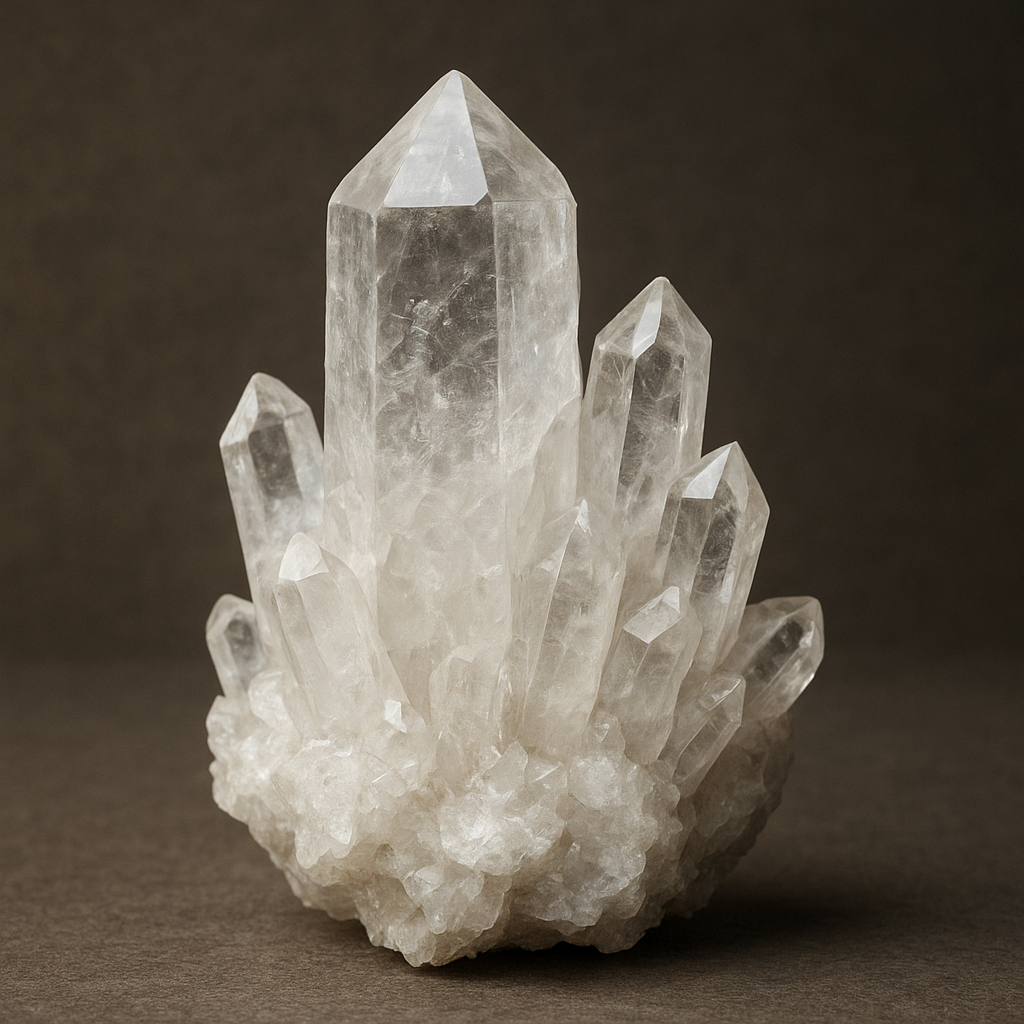
From the perspective of crystallography, corundum crystallizes in the trigonal system, often forming hexagonal tabular or barrel-shaped crystals. Habit and size vary depending on growth conditions—some crystals remain small and granular, while others can grow into large, gemstone-quality pieces. Inclusions and zoning patterns within rubies are records of the environmental conditions during growth; they are crucial in distinguishing natural from synthetic stones in gemological examinations.
Physical and Optical Properties
Rubies are prized not only for color but for their impressive physical properties. On the scale of mineral hardness, ruby scores a 9 on the Mohs scale—second only to diamond among natural gemstones—making its hardness one of the most important practical qualities. This high hardness contributes to excellent wearability in jewelry as well as use in certain industrial applications.
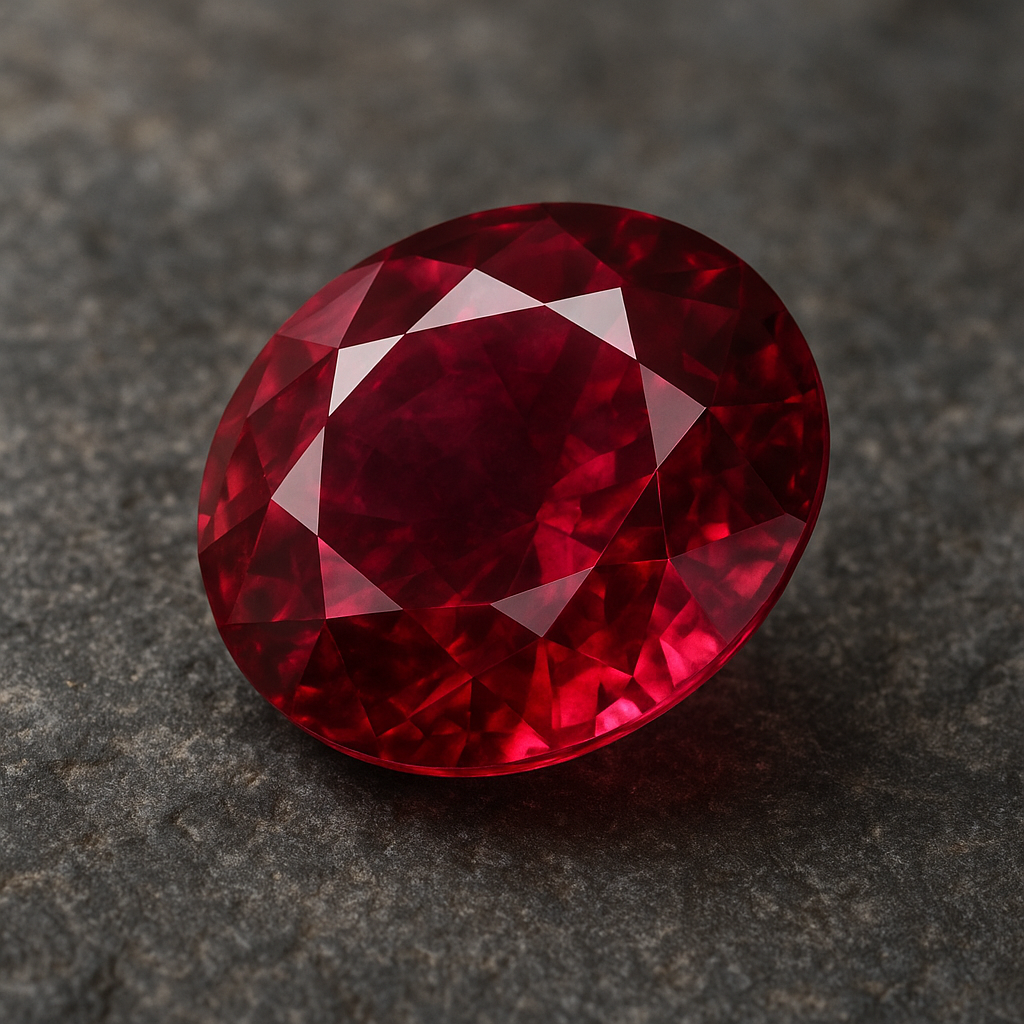
Optically, the presence and concentration of chromium determine hue, saturation, and tone. The most sought-after rubies display a vivid, slightly bluish-red known historically as “pigeon’s blood.” Color zoning and pleochroism (the display of different colors when viewed from different angles) may occur in some specimens. Many fine rubies also show strong red fluorescence under ultraviolet light due to chromium, which can intensify perceived color and make stones appear more lively in daylight.
Other optical characteristics include high refractive index and strong dispersion, contributing to brilliance and sparkle when stones are well cut. Inclusions, such as rutile silk (tiny needle-like inclusions), can create a velvety appearance and sometimes produce asterism—star effects—when the stone is cut en cabochon.
Global Occurrences and Mining Regions
Rich ruby deposits are distributed across the globe, each yielding stones with distinct characteristics. Historically and today, certain localities are renowned for producing gem-quality material.
- Myanmar (Burma) — The Mogok Valley has produced many of the world’s most celebrated rubies, famed for their deep, saturated “pigeon’s blood” color and exceptional clarity.
- Thailand — Historically a major trading and cutting center; rubies from the Chanthaburi and Trat regions often show darker tones and are notable in the market.
- Sri Lanka — Known for lighter, pinkish rubies and high-quality sapphires from the same deposits.
- Madagascar — A newer source that yields a wide range of colors and sizes, increasingly important in the global supply chain.
- Tanzania — Including the Winza and Tuli regions, Tanzania produces rubies with diverse hues and attractive properties.
- Vietnam — Luc Yen and Quy Chau regions have produced fine rubies with notable color and clarity.
- Other occurrences exist in Afghanistan, Pakistan, Mozambique, and the United States (notably North Carolina and Montana), each contributing unique material to the market.
Mining methods range from artisanal and small-scale operations to larger industrial projects. Alluvial deposits—where weathering has liberated crystals from host rock and concentrated them in rivers and streams—are commonly worked by hand in many traditional regions. In contrast, hard-rock mining in marble or metamorphic belts requires more industrial approaches.
Historical and Cultural Significance
Rubies have been treasured across civilizations for thousands of years. In South and Southeast Asia, they were prized as protective and status-bearing gems. Ancient texts and travelers’ accounts mention rubies in the courts of kings and embedded in ceremonial regalia. Across cultures, rubies were often associated with power, vitality, and protection against misfortune.
In medieval Europe, rubies were believed to confer health and wisdom and were often set into crowns, scepters, and ecclesiastical objects. In some Asian traditions, rubies were offered as tribute and worn by monarchs to symbolize authority. Today, they maintain strong symbolic value in engagement rings, anniversary gifts (traditionally the 15th and 40th anniversaries), and birthstone associations (July).
Culturally significant examples include celebrated historical rubies set into European royal jewelry, as well as famed stones from Burma and Mogok that have become legendary within gemological and auction circles. The narrative of a ruby—its origin, journey, and craftsmanship—often increases its cultural and monetary value through provenance and story.
Gemological Treatment, Synthetics and Imitations
Because gem-quality rubies are relatively rare, treatments and synthetic production have played major roles in meeting demand. Heat treatment is the most common practice and is widely accepted in the trade when disclosed. Heating at controlled temperatures can improve color and clarity by dissolving inclusions or modifying color centers.
Other treatments include flux healing, where a flux material introduced during high-temperature treatment heals internal fractures; glass filling, which fills cavities and fractures with a glass-like substance (this is less accepted and can significantly affect durability); and surface diffusion, which attempts to alter color by introducing coloring agents near the surface (often viewed skeptically by gemologists if undisclosed).
Lab-grown rubies are produced by several methods:
- Flame fusion (Verneuil process) — produces large crystals economically but often with characteristic curved growth features visible under magnification.
- Flux growth — yields stones with inclusions similar to natural rubies and is considered higher quality among synthetics.
- Hydrothermal synthesis — can produce excellent crystals that mimic natural growth patterns and are difficult to distinguish without advanced testing.
Imitations such as red spinel, garnet, or glass can mimic ruby’s color but not its hardness or other properties. Professional gemological testing—using refractive index, spectroscopy, magnification, and advanced methods like Raman spectroscopy and inclusion analysis—is essential to establish authenticity and treatment history.
Uses in Jewelry, Industry and Art
The predominant use of ruby is in jewelry: rings, necklaces, earrings, bracelets, and high-end statement pieces. Its combination of hardness, brilliance, and color makes it ideal for pieces worn daily, such as engagement rings, as well as for elaborate museum-quality settings.
Beyond ornamentation, corundum’s hardness endows it with industrial applications. Synthetic ruby components are used in precision instruments, such as in watchmaking for bearings and in certain lasers—neodymium-doped or chromium-doped synthetic corundum has been central to the development of early solid-state lasers. The resilience and wear resistance of corundum make it useful as abrasives and in components requiring stable, hard materials.
Art and design also incorporate rubies and ruby-colored glass for symbolic and aesthetic reasons. Historical jeweled artifacts incorporate rubies not only for their beauty but for their status symbolism; their inclusion in religious objects reflects cultural reverence spanning centuries.
Cutting, Setting and Care
Lapidary choices for ruby depend on color, clarity, and intended use. Faceted cuts—round, oval, cushion, and brilliant variations—are common to maximize brilliance and color. When a ruby has strong inclusions or shows phenomena like asterism, cutting en cabochon (smooth and rounded) is often preferable to accentuate the effect.
Settings for rubies are designed to protect the stone and display its color. Prong settings allow maximum light exposure but require careful design to avoid chipping at the girdle. Bezel settings offer greater protection for everyday wear. Because rubies are robust, they can be set with diamonds and other gems in complex designs without high risk of damage, but attention to mounting and wear patterns remains important.
Care is straightforward compared with softer gems: warm, soapy water and a soft brush are generally safe. Ultrasonic cleaners can be used for many rubies but should be avoided if the stone has glass fillings or certain other treatments. Routine inspection by a jeweler can catch loose settings or damage early.
Appraisal, Provenance and Value Factors
The value of a ruby is determined by multiple interrelated factors: color (hue, saturation, tone), clarity, cut, carat weight, treatment, and provenance. The market traditionally rewards intense, vivid colors with moderate tone and high saturation. Clarity is important, but certain inclusions may be acceptable or even desirable if they contribute to a velvety appearance or asterism.
Provenance enhances value—stones from famed localities with historical pedigree often command premium prices. Certification from reputable gemological laboratories documenting origin and treatment is increasingly important in the modern marketplace. Appraisal for insurance or sale requires careful documentation of these attributes, along with high-quality photographs and disclosure of any treatments.
Interesting Phenomena and Rarity
Rubies can exhibit several phenomena that increase their scientific and market interest. Asterism—the six-rayed star effect—is produced by oriented needle-like rutile inclusions and is highly prized in star rubies. Color change rubies, though rare, may shift hue under different lighting conditions, adding to their intrigue.
Large, high-quality rubies are exceptionally rare compared to other gemstones, especially above several carats with vivid color and minimal treatment. Because of this scarcity, high-grade rubies often outpace diamonds on a per-carat basis in top auctions and private sales.
The interplay between geological rarity, human taste, and technological advances in synthesis and treatment creates a dynamic field around this gemstone. Collectors, scientists, jewelers, and cultural historians all approach rubies with different priorities but share an appreciation for what makes these stones enduringly fascinating.
Further Reading and Resources
For those who wish to explore deeper, consider seeking out specialized gemological literature, peer-reviewed mineralogical research on corundum genesis, and auction catalogues which often provide detailed provenance and treatment histories for notable rubies. Museums and university geology departments can also be rich sources of information, while certified gemological laboratories offer testing services and educational materials for buyers and collectors.