
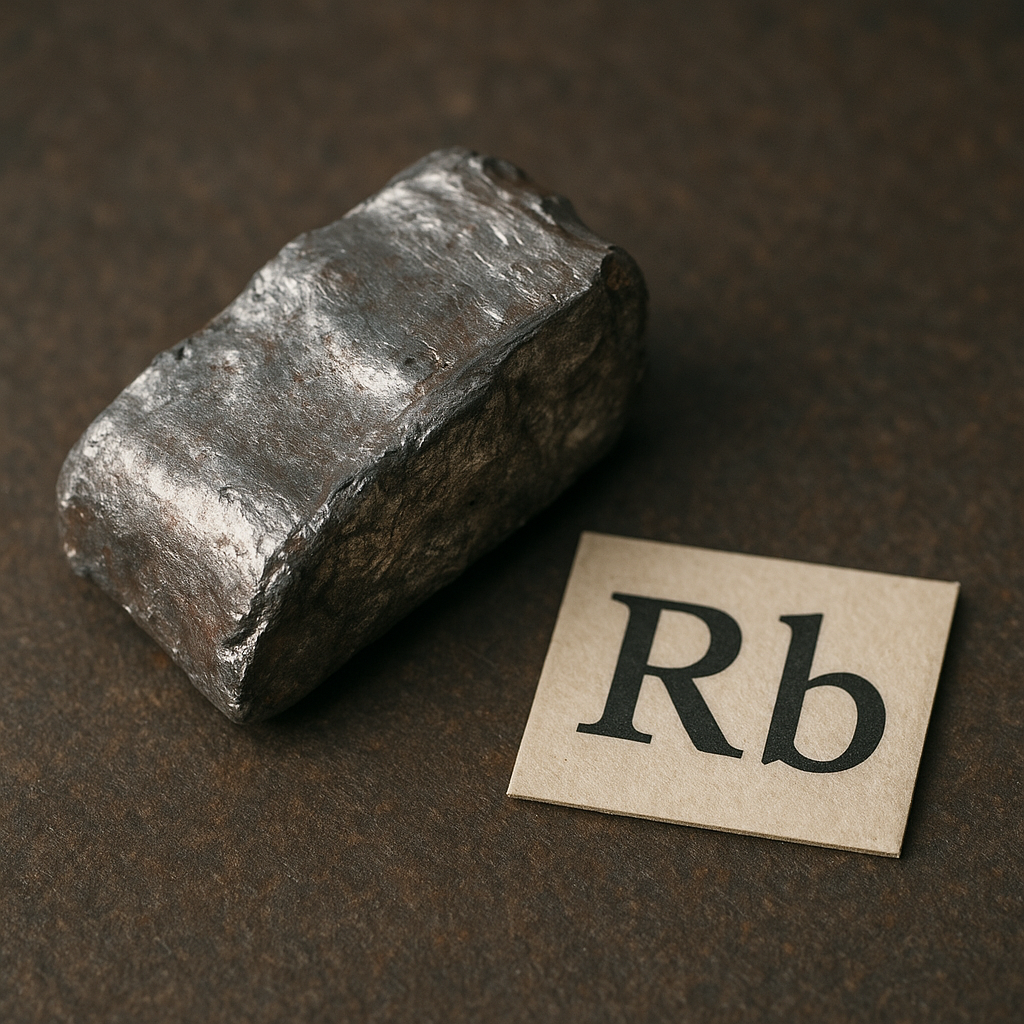
Rubidium is an intriguing and versatile element that sits among the alkali metals and quietly supports many modern technologies. Named for the deep red lines seen in its spectrum when it was discovered, rubidium’s physical and chemical traits make it both a challenge to handle and a powerful tool for researchers and engineers. This article explores where rubidium occurs in nature, how it is used across industries and science, and several fascinating facets of its isotopes, applications, and handling.
Fundamental characteristics and natural occurrence
Rubidium (symbol Rb, atomic number 37) is a soft, silvery-white metal with a low melting point that places it among the few metals that can be liquid near room temperature under warm conditions. Like its alkali neighbors sodium and potassium, rubidium reacts vigorously with water and tarnishes quickly in air. Its chemistry is dominated by the +1 oxidation state, forming salts that resemble their potassium and cesium counterparts.
In the Earth’s crust rubidium is not a trace element in the strictest sense; it is moderately abundant compared to many other metals. It most commonly associates with minerals rich in alkali elements. Commercial sources of rubidium are typically byproducts of mining operations for other alkali metals and lithium. Important mineral hosts include lepidolite (a lithium-bearing mica), zinnwaldite, and various potassium-rich ores. Because rubidium ions fit into the crystal lattices that normally host potassium and cesium, they are often found as minor constituents within potash deposits and certain pegmatites.
Rubidium is also present, at low concentrations, in brines and seawater, and can be recovered from some industrial waste streams. The economics of rubidium production therefore depend heavily on the value of companion elements (like lithium and cesium) and the availability of efficient separation techniques.
Extraction, isolation and common compounds
Extracting rubidium typically involves concentrating its salts from ores or brines and separating them from sodium and potassium analogs by fractional crystallization, ion exchange, or solvent extraction. The isolated rubidium compounds are often converted to rubidium metal by chemical reduction methods when elemental metal is required for specialized applications.
- Rubidium chloride (RbCl): a frequently used salt in research and a precursor for other rubidium compounds.
- Rubidium carbonate (Rb2CO3): used in specialty glass formulations and chemical syntheses.
- Rubidium hydroxide (RbOH): a very strong base, handled with care in laboratories.
- Other nitrates, sulfates and organometallic rubidium species used in niche chemical applications.
Because of rubidium’s reactivity, its metal is generally stored under an inert atmosphere or in hydrocarbon solvents. Handling and storage protocols resemble those for potassium and cesium but are stricter because of rubidium’s tendency to ignite on contact with air or moisture.
Key applications: from clocks to quantum gases
One of rubidium’s most impactful roles in modern technology is as a reference for timekeeping and frequency standards. Compact rubidium atomic clocks exploit the hyperfine transition of the rubidium atom to provide stable and accurate microwave frequencies. Though not as precise as the primary cesium standards used to define the second, rubidium standards offer a compact, energy-efficient, and cost-effective solution for synchronization in telecommunication networks, satellite systems, and portable timekeeping devices.
In atomic, molecular, and optical physics, rubidium has become a workhorse element. The common isotope Rb-87 is particularly amenable to laser cooling and trapping because its electronic transitions lie at convenient wavelengths for diode lasers (notably around the 780 nm D2 line). This has made rubidium the element of choice in many experiments that explore quantum phenomena:
- Bose-Einstein condensates (BECs): Rubidium atoms were among the first to be cooled to quantum degeneracy, enabling the study of superfluidity, quantum vortices, and many-body physics.
- Optical lattices and quantum simulators: Rb atoms trapped in laser-created potentials mimic solid-state systems and provide insights into condensed-matter problems.
- Atomic interferometry: precision sensors for gravity, acceleration, and rotation frequently rely on cold rubidium atoms.
Rubidium vapor is also used in atomic magnetometers, devices capable of detecting extremely small magnetic fields. These magnetometers have applications ranging from geophysical surveying to biomedical imaging research and searches for new physics beyond the standard model.
Rubidium isotopes, geochronology and medicine
Rubidium has several isotopes of interest. Natural rubidium consists mainly of two isotopes: Rb-85 (stable) and Rb-87 (radioactive with a very long half-life). The decay of Rb-87 to strontium-87 (Sr-87) underpins the rubidium-strontium dating method used by geologists to determine the ages of rocks and minerals over geological timescales. Because Rb-87 has a half-life many times the age of the Earth, it serves as a useful chronometer for ancient processes and helps constrain planetary evolution.
In medicine, a short-lived isotope, Rb-82, is produced in generators from Sr-82 and used as a positron emitter for PET myocardial perfusion imaging. Its chemistry as an alkali analog of potassium allows it to act as a tracer for blood flow and cellular uptake in cardiac tissue, making rubidium-based imaging a valuable noninvasive diagnostic tool for coronary artery disease. The short half-life of Rb-82 (on the order of a minute) makes it suitable for clinical use when supplied by on-site generators.
Industrial and material uses
Although rubidium is never used on the scale of iron or aluminum, it contributes in specialized ways to materials and industrial chemistry. Some applications include:
- Specialty glass and infrared optics: addition of rubidium oxides can modify refractive index and infrared transmission properties for niche optical components.
- Catalysis and chemical synthesis: rubidium salts sometimes serve as catalysts or reagents in organic and inorganic syntheses, offering unique selectivity in a few specific reactions.
- Electronics and vacuum devices: rubidium vapor has been used in some photoelectric cells and as a getter for vacuum tubes, although these uses are rare today.
Because rubidium salts have ionic radii and chemical behavior similar to potassium, they occasionally find niche roles in research-grade electrolyte studies and in the development of battery and energy-storage concepts, though potassium and lithium dominate commercial battery technologies.
Safety, environmental considerations and handling
Elemental rubidium is highly reactive. It can ignite spontaneously in air and reacts explosively with water to produce rubidium hydroxide and hydrogen gas. For this reason, metallic rubidium must be handled under an inert atmosphere (argon or nitrogen) or submerged in mineral oil. Protective protocols similar to those for sodium and potassium are standard in laboratories and industrial settings.
Most rubidium compounds are not acutely toxic in the way heavy metals are; however, soluble rubidium salts can disturb electrolyte balance because rubidium ions can compete with potassium in biological systems. Laboratory exposure limits and waste-disposal rules should be followed. Radioactive isotopes, such as Rb-82 or enriched Rb-87, are handled under strict radiological controls appropriate for their activity and half-lives.
Historical notes and spectroscopic legacy
Rubidium was discovered in 1861 by Robert Bunsen and Gustav Kirchhoff using flame spectroscopy. The element was named from the Latin word rubidus, meaning deep red, because of the distinctive red spectral lines that hinted at a previously unknown element. That discovery exemplified the power of spectroscopic methods and began a long tradition of atomic spectroscopy where elements are recognized and characterized by their line spectra.
Spectroscopy continues to be central to rubidium’s role in science. The well-characterized atomic transitions of rubidium make it a reliable testbed for laser stabilization, atomic clocks, and quantum optics experiments. Its convenient transition wavelengths support the widespread use of economical diode lasers, which helped democratize access to cold-atom experiments across many university laboratories.
Frontiers and current research directions
Rubidium remains at the cutting edge of several research domains. Examples include:
- Quantum information and quantum computing: cold rubidium atoms trapped in optical tweezers or lattices serve as qubits and mediators for entanglement experiments.
- Precision measurement: rubidium-based devices are being refined for portable, robust sensors to measure time, magnetic fields, and gravitational gradients with increasing sensitivity.
- Fundamental physics tests: atom interferometry with rubidium probes inertial effects and may help test the equivalence principle and search for physics beyond established theories.
Researchers also explore novel hybrid systems combining rubidium atoms with solid-state devices to create interfaces between photons, phonons, and atomic excitations—potential building blocks for future quantum networks.
Practical curiosities and everyday traces
Although you are unlikely to encounter metallic rubidium in everyday life, traces of rubidium are present in the environment and may enter consumer goods through the use of mineral-derived ingredients. Its tendency to substitute for potassium means that biological systems can take up rubidium in small amounts. This property is exploited in research studies that use rubidium uptake as a proxy for certain cellular processes.
A simple and longstanding classroom demonstration is the flame test: rubidium salts color a flame a characteristic violet to purple—distinct from sodium’s intense yellow or potassium’s lilac. Such visual signatures contributed historically to element discovery and remain useful pedagogical tools.
Concluding perspective
Rubidium occupies a remarkable niche: not ubiquitous in industrial bulk materials but indispensable across a range of high-precision scientific and medical technologies. From the historical spectroscope to the contemporary quantum laboratory, rubidium continues to enable discoveries and applications that touch timekeeping, imaging, and the frontiers of quantum science. Its unique combination of chemical reactivity, convenient optical transitions, and isotopic variety ensures that rubidium will remain a valuable and fascinating element for researchers and technologists alike.