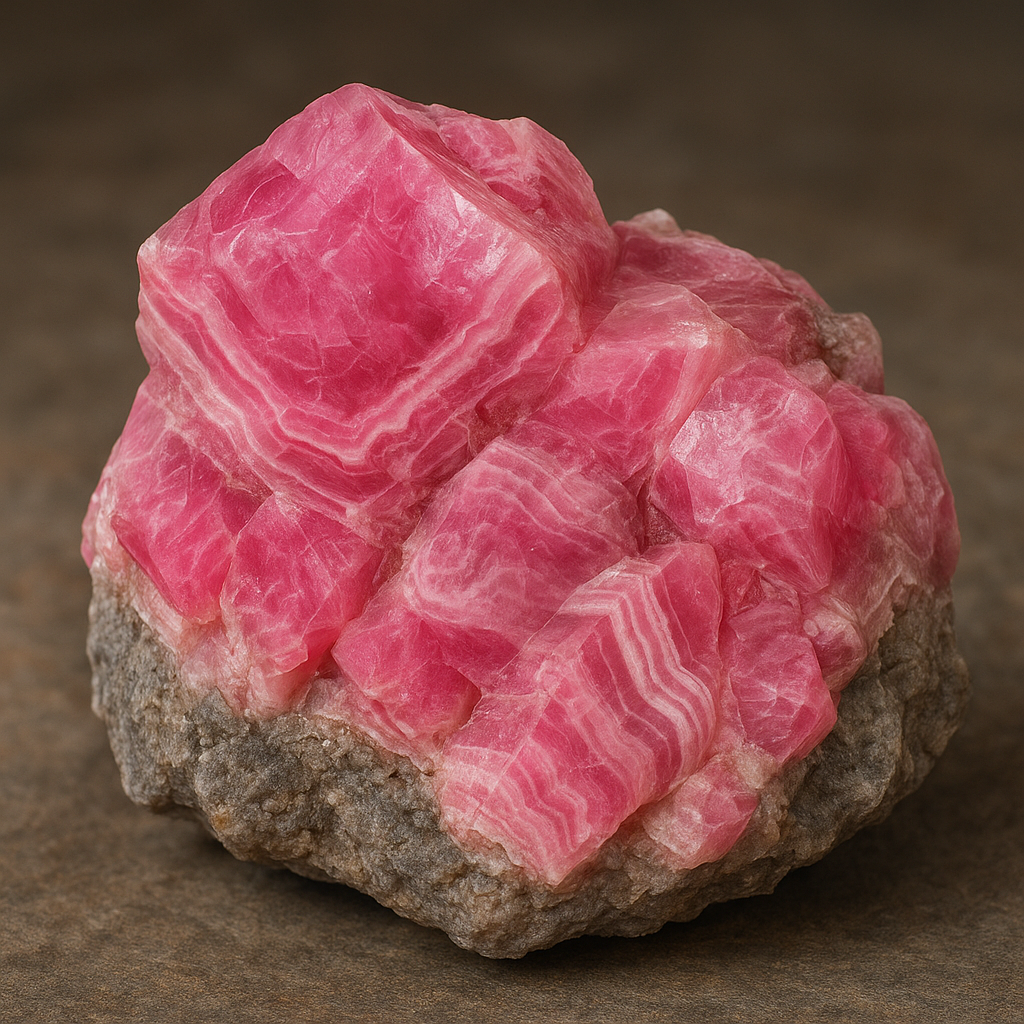
Rhodochrosite is a striking and often sought-after mineral celebrated for its range of pink to deep red hues and its elegant crystal forms. With the chemical composition of manganese carbonate, this mineral occupies a special niche at the intersection of geology, gemology and industrial chemistry. Below are detailed explorations of its properties, global occurrences, uses, and fascinating facets that make rhodochrosite an enduring subject of interest to scientists, jewelers and collectors alike.
Occurrence and geological settings
Rhodochrosite typically forms in low-temperature hydrothermal veins, in sedimentary manganese deposits, and as a product of metamorphism or supergene alteration of manganese-bearing minerals. Its preferred environments are those where manganese can accumulate and react with carbonate-bearing fluids. The mineral may occur as massive, banded, stalactitic or botryoidal aggregates, and as well-formed rhombohedral crystal groups.
Primary geological processes
- Hydrothermal deposition: Warm, manganese-rich fluids moving through fractures deposit rhodochrosite in veins, often alongside quartz, fluorite, sphalerite, galena and other sulfides.
- Replacement and metasomatism: Carbonate-rich fluids interact with manganese oxides or hydroxides in host rocks, replacing them and producing banded or concentric rhodochrosite structures.
- Sedimentary accumulation: In some manganese-rich marine or lacustrine settings, rhodochrosite can precipitate directly as a manganese carbonate phase in sediments.
- Supergene enrichment: Weathering processes can remobilize manganese and concentrate rhodochrosite near the surface.
Notable localities
Rhodochrosite is found on multiple continents, with several localities producing material of particular scientific and aesthetic value:
- Sweet Home Mine, Colorado, USA — world-famous for exceptionally red, transparent crystals and fine cabinet specimens; many of the most iconic specimens in museums and private collections originate here.
- Argentina — the Capillitas and Catamarca regions produce large stalactitic and banded masses of rhodochrosite, often used for decorative stone and carvings.
- Uchucchacua and other silver-lead-zinc mines in Peru — yield attractive pink to red crystals and aggregates.
- Romania (e.g., Cavnic and older mining districts) — historically produced good specimens associated with polymetallic veins.
- South Africa (Kalahari manganese field and associated mines) — important industrial manganese deposits with rhodochrosite occurrences.
- China, Mexico, Russia and various European localities — contribute a steady supply of specimens with varied appearance and quality.
Physical and chemical properties
At the heart of rhodochrosite’s identity is its simple chemical formula, MnCO3, which places it within the calcite group of carbonate minerals. Substitution of other cations — iron, magnesium, calcium and others — is common and affects color, density and other properties.
Crystallography and morphology
- Crystal system: Trigonal (rhombohedral) — crystals often show rhombohedral faces and cleavage indistinguishable from calcite-like three-directional cleavage.
- Habit: Transparent to translucent rhombohedral crystals, botryoidal or stalactitic masses, and banded agate-like forms commonly found in Argentine localities.
- Hardness: Relatively soft, typically 3.5 to 4.0 on the Mohs scale — requires careful handling when used in jewelry.
- Specific gravity: Generally around 3.5 to 3.7, depending on impurity content.
Color and optical properties
Color ranges from pale pink to intense cherry-red; the deepest reds are most prized by gem and specimen markets. Variations arise from the manganese concentration and the presence of trace iron or other substituting elements. Some rhodochrosite shows banding with concentric zones of differing color and transparency—features that make rhodochrosite particularly attractive when cut en cabochon or polished as decorative slabs.
Chemical behavior and substitutions
Manganese (Mn2+) is the dominant cation, but partial substitution by iron or calcium can occur, producing brownish tints or paler hues. Rhodochrosite dissolves in acids, like other carbonates, often fizzing when exposed to dilute hydrochloric acid. Thermal treatment and exposure to light can alter color in some specimens, and heating may cause dehydration-related changes or darkening.
Uses and economic importance
Although rhodochrosite is not a major ore of manganese on a global scale (compared to manganese oxides such as pyrolusite), it has several notable economic and cultural uses. Its value can be divided between industrial utility and ornamental/gemological appreciation.
Industrial aspects
- Manganese extraction: In some localities, rhodochrosite-bearing deposits are mined as a source of manganese for steelmaking and alloy production, though carbonates are less common ores than oxides.
- Research and materials science: Manganese carbonates, including rhodochrosite, are relevant to studies on battery materials and manganese-based catalysts. While synthetic manganese compounds are more important industrially, natural rhodochrosite can provide samples for fundamental research.
Gemstone and ornamental uses
Rhodochrosite is widely used as an ornamental stone and in jewelry, especially when material displays attractive banding or translucency. Because of its relative softness and perfect cleavage, it is most often fashioned as cabochons, beads, or carved decorative objects rather than as faceted stones for rings that receive heavy wear.
- Cabochons and beads: Banded and stalactitic patterns polish well and are popular in pendants and brooches.
- Carvings and inlays: Large Argentine stalactites are often sliced and polished to make striking display pieces and tabletops.
- Museum and teaching specimens: High-quality crystals are prized by institutions for display and education.
Notable specimens, collecting and lapidary considerations
For mineral enthusiasts and collectors, rhodochrosite offers diverse collecting goals: transparent gemmy crystals, sculptural stalactitic pieces, and decorative slabs. The market values both aesthetic qualities and crystal perfection.
Famous finds
- Specimens from the Sweet Home Mine are legendary for bright red, transparent crystals occurring with associated sulfides; many top museum pieces and auction highlights derive from here.
- Argentine pieces, often sold as polished slabs or carvings, are prized for their banded stalactitic appearance and large size.
Buying and grading tips
- Color intensity and uniformity: Deep, saturated pinks and reds command higher prices, but translucent clarity and attractive banding also increase value.
- Crystal habit and condition: Well-formed rhombohedral crystals free of damage are especially prized among collectors.
- Origin labeling: Provenance from Sweet Home Mine or notable Argentine localities can significantly affect price and desirability.
- Care considerations: Avoid ultrasonic cleaners and harsh chemical cleaners; rhodochrosite should be cleaned gently with a soft cloth and mild soap. Protective settings are recommended for jewelry to minimize abrasion and cleavage-related breakage.
Formation processes in more detail
An appreciation of rhodochrosite’s elegance benefits from understanding its formation. The mineral’s genesis ties closely to manganese mobility in geological environments and the availability of carbonate ions.
Hydrothermal vein deposition
Hydrothermal fluids that have leached manganese from surrounding rocks can precipitate MnCO3 when conditions allow carbonate to combine with manganese. This often occurs in lower-temperature veins where sulfides such as galena and sphalerite are present. Rhodochrosite crystals in these settings can be well-formed and highly transparent when growth conditions are slow and unobstructed.
Secondary and replacement processes
In many manganese deposits, initial manganese minerals such as oxides and hydroxides form under oxidizing conditions. Later, when reducing or carbonate-rich fluids percolate through the rock, those manganese oxides can be replaced by rhodochrosite, producing banded or nodular forms. Such replacement textures are common in Argentine stalactites and in some sedimentary manganese layers.
Cultural and historical notes
Rhodochrosite has attracted attention beyond scientific circles. Its vivid hues and association with love and healing in various cultures have made it a popular gemstone in metaphysical communities. Several nations and regions celebrate local rhodochrosite finds as part of their mineral heritage; for instance, carved Argentine slabs are frequently used in local crafts and exported worldwide.
- Symbolism and metaphysical use: Often associated with compassion, emotional healing and heart-centered energy in alternative belief systems.
- Historic mining: In many old mining towns, rhodochrosite occurrences are part of local history and tourism, with mines sometimes offering educational tours.
Scientific and conservation perspectives
From a scientific standpoint, rhodochrosite specimens can yield information about fluid chemistry, temperature of formation and ore-forming processes. Detailed geochemical and isotopic studies on rhodochrosite help reconstruct paleo-fluid histories and ore genesis models. Conservation-minded collectors and museums emphasize careful documentation of provenance and stable storage conditions, given the mineral’s sensitivity to mechanical stress and some chemical changes.
Analytical uses
- Stable isotope analysis of oxygen and carbon in rhodochrosite can provide information about the temperature and source of the carbonate-bearing fluids.
- Trace-element studies can help fingerprint localities and understand substitution patterns in natural rhodochrosite.
Whether admired as a gemstone, studied for its geochemical story, or displayed as a natural work of art, rhodochrosite continues to fascinate across disciplines. Its visual beauty, combined with links to important manganese cycles and mining histories, ensures that this mineral remains an attractive subject for researchers, artisans and collectors worldwide.