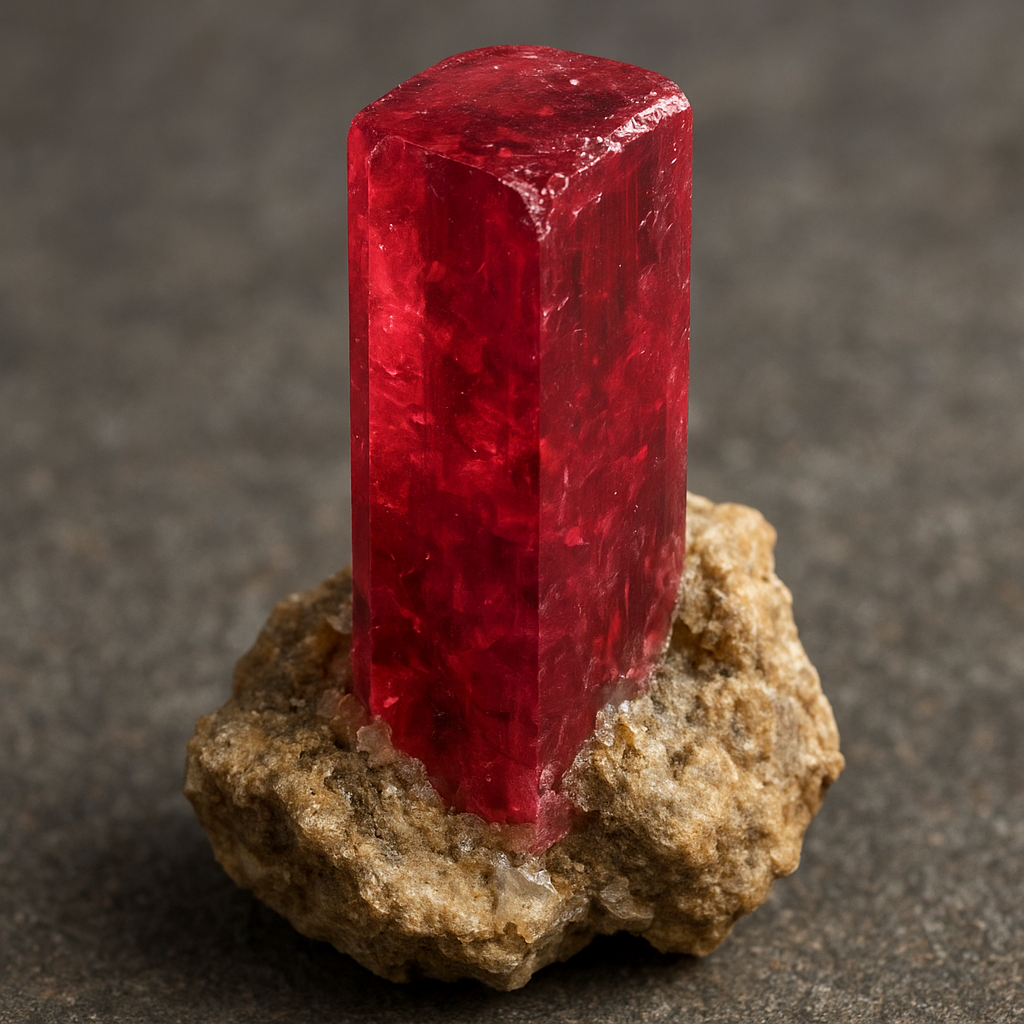
The mineral known to gem dealers and collectors as red beryl occupies a unique niche between scientific curiosity and high-value gemstone. Its striking red hue, extreme rarity, and geological specificity make it one of the most sought-after and least understood members of the beryl family. This article explores the mineral’s identity and origins, where it occurs, how it is used and valued, and several intriguing aspects that surround its study and trade.
Identity, Chemistry and Color
At its chemical core, red beryl is a variety of beryl — a beryllium aluminium cyclosilicate with the general formula Be3Al2Si6O18. Like other beryls (emerald, aquamarine, heliodor), it crystallizes in the hexagonal system, often forming prismatic crystals with well-developed faces in suitable environments. The distinguishing feature is its deep to raspberry red color, which sets it far apart from the more familiar blue and green beryls.
The red hue is caused primarily by the presence of manganese ions, primarily in the +3 oxidation state, substituting into the crystal structure at sites normally occupied by aluminium. This chromophore produces absorption in the visible spectrum that yields the characteristic red coloration. Unlike emerald — where chromium and vanadium are the color agents — or aquamarine — where iron plays a role — red beryl’s coloration is a case study in how subtle chemical substitutions in the same mineral framework can produce dramatically different visual and physical properties.
Physically, red beryl shares many properties with its beryl cousins: it has good hardness (typically near 7.5–8 on the Mohs scale), excellent durability for use in jewelry, and a vitreous luster. Optical properties are close to other beryls, making refractive indices and birefringence metrics useful but not always definitive for identification without supporting tests.
Geology and Mode of Formation
Red beryl forms in a very specific geologic setting, which explains part of its extraordinary scarcity. The most important context is late-stage, topaz-bearing rhyolite volcanic rocks that have developed open cavities known as miarolitic cavities. These are small vugs or pockets produced during the final stages of volcanic cooling and degassing. In such pockets, volatile-rich fluids can precipitate well-formed crystals of a variety of minerals.
During the final evolution of a rhyolitic magma, residual fluids become enriched in rare elements, including beryllium and manganese. Under favorable temperature and pressure conditions, these elements concentrate in the vapor- or fluid-filled cavities and crystallize as beryl with manganese incorporation. The process is delicate: it requires a specific chemistry (a combination of beryllium, silicon, aluminium, and manganese), a suitable physical environment (open cavities and low-pressure vapor-dominated conditions), and a sequence of cooling and chemical changes that allow manganese to be stabilized in the +3 state within the beryl lattice.
Because these exact conditions are rare, large volumes of red beryl simply do not form. When they do, crystals can be gemmy and well-shaped, yet the overall yield from any given deposit tends to be extremely low.
Where It Occurs
The most famous and productive locality for gem-quality red beryl is the Wah Wah Mountains of Beaver County, Utah, USA. Here, a combination of appropriate rhyolitic host rocks and favorable late-stage geochemistry produced high-quality crystals discovered in the early 20th century. Subsequent mining and prospecting in nearby ranges have recovered additional material, but gem-grade crystals remain localized to a handful of pockets within these volcanic complexes.
Beyond the Wah Wah Mountains, occurrences have been reported intermittently in a few other places — mostly in the western United States and marginally in parts of Mexico. However, most of these reports refer to either very small crystals or material that’s sub-gem in quality. To date, commercially viable quantities of facetable red beryl are essentially restricted to limited production from Utah localities. That geographic concentration contributes both to the mineral’s mystique and to its market value.
Mining, Recovery and Typical Output
Red beryl is rarely mined by large-scale open-pit or underground operations; the scarcity and typically small pocket sizes mean that operations tend to be small, selective, and sometimes seasonal. Miners search for miarolitic cavities within rhyolite outcrops, and when a promising pocket is found they work it carefully to recover crystals intact. Blast mining or heavy ripping is ill-advised because the crystals can be fragile along cleavage planes and can shatter under heavy shock.
Because most pockets produce only a few crystals — often tiny — the typical output of even an active claim is modest. Facetable stones above one carat are uncommon; gems in the 0.1–1.0 carat range are far more typical. This inherently low yield has economic implications, driving prices up and making the raw mineral primarily a collector and jewelry market material rather than an industrial ore (unlike other beryllium-bearing minerals, which are exploited separately for metal extraction).
Gemological Characteristics and Identification
For gemologists and jewelers, distinguishing red beryl from visually similar red gems is essential. At first glance, some specimens might resemble ruby or red spinel, but several tests clarify identity:
- Crystal habit and cleavage: Beryl’s hexagonal prismatic habit and lack of prominent cleavage planes can be diagnostic in crystal specimens.
- Hardness and wear characteristics: Beryl is relatively hard and wears well in jewelry.
- Optical properties: While refractive indices are similar to other beryls, careful measurement and polarization tests can help differentiate red beryl from singly refractive gemstones like ruby.
- Spectroscopy: Visible and near-infrared spectroscopy can reveal absorption features associated with manganese that are distinct from chromium- or iron-induced spectra.
Inclusions often assist identification. Red beryl formed in miarolitic cavities commonly contains fluid inclusions, tiny crystals of associated minerals, and delicate growth zoning. Many faceted stones show internal features typical of volcanic cavity growth rather than the inclusion suites seen in metamorphic rubies or spinels.
Treatments that alter color or clarity are not common for red beryl, largely because most material is already untreated and because commercial incentive for treatment is limited by the small sizes and high value of natural stones. Consumers and appraisers should still request laboratory certification for high-value purchases, especially for rare larger gems, since misidentification or mislabeling can occur in any high-end market.
Uses, Value and Market Considerations
The primary use for red beryl is as a gemstone: faceted into rings, pendants, and other jewelry, or kept as crystal specimens for collectors. Its combination of rarity and distinctive color commands high prices. Small, eye-clean stones of attractive color can fetch prices that rival or exceed many other colored gemstones on a per-carat basis. Because large sizes are so uncommon, a single large faceted stone can represent years of market demand and often becomes a centerpiece in a private collection or museum display.
Several factors govern value:
- Color intensity and uniformity — the most valuable stones exhibit a saturated raspberry to purplish-red color without brownish overtones.
- Clarity — eye-clean gems are rare and prized.
- Carat weight — due to scarcity, prices rise steeply with size beyond a certain threshold.
- Cut quality — well-cut gems that display color evenly and maximize brilliance command premiums.
Unlike common beryls that may serve industrial uses as a source of beryllium in certain contexts, red beryl has no such applications because it simply does not exist in sufficient quantity. Its value is therefore almost entirely cultural and aesthetic: jewelry, collecting, and scientific study.
Collecting, Museums and Notable Specimens
Collectors prize red beryl both as faceted gems and as natural crystal specimens. Because many crystals are well-formed, they photograph and display beautifully under controlled lighting — enhancing interest among museums and private collectors. Rare larger specimens are sometimes sold at auction or exhibited in mineral shows where they attract enthusiastic attention from both gemologists and hobbyists.
Collectors often seek provenance: a red beryl with clear documentation of origin, mining history, and minimal treatment is more desirable. The limited number of producing localities means that institutional collections often highlight specimens from the Wah Wah Mountains or explicitly note the mining claim where a piece originated.
Confusions, Misnomers and the Trade Names
Over the decades the mineral has gathered several nicknames. In the trade, terms like “bixbite” and “red emerald” have been used; however, these names are misleading. The term “bixbite” is sometimes encountered historically but has been largely deprecated because it can be confused with the mineral bixbyite (a manganese iron oxide) and because the International Mineralogical Association recognizes the name red beryl as the correct term. “Red emerald” is a marketing label and not a scientific name, and it can cause confusion with true emeralds, which are a different beryl variety colored by chromium and vanadium.
Buyers should be cautious of aggressive marketing that borrows emotionally resonant names. Insist on accurate gemological descriptions and, for valuable pieces, laboratory reports from reputable institutions that confirm species, color cause, and whether any treatments were applied.
Scientific Interest and Research Topics
Beyond its gemological appeal, red beryl is of interest to geologists and mineralogists because it represents a natural experiment in trace element substitution and low-pressure mineral growth. Studies of red beryl touch on broader themes:
- How volatile-rich rhyolitic magmas concentrate incompatible elements like beryllium and manganese into late-stage fluids;
- How oxidation states of transition elements (e.g., manganese) are controlled by local redox conditions in vapor-dominated cavities;
- How growth zones and inclusions in crystals record the changing chemistry of mineral-forming fluids.
Advanced analytical techniques — electron microprobe, laser ablation ICP-MS, and synchrotron spectroscopy — have been used to quantify trace elements and map their distribution within crystals. Such work not only elucidates the story of red beryl formation but contributes to broader models of how rare-element deposits form in volcanic terrains.
Caring for Red Beryl Jewelry and Specimens
Given its gem-quality status and frequently small size, red beryl is often set into delicate jewelry. Practical care advice is similar to that for other beryls and colored gemstones:
- Avoid harsh chemicals and extreme heat; while beryl is generally stable, certain inclusions or fractures might be sensitive.
- Ultrasonic cleaning is often safe for gem-quality, inclusion-free stones, but is not recommended if the stone contains extensive fluid inclusions or cleavage-like planes.
- Store faceted stones and crystal specimens separately to avoid scratching (beryl can be scratched by harder gems such as corundum).
- Insure high-value pieces and keep documentation, including any laboratory reports, with the insurance paperwork.
Cultural and Commercial Notes
As a high-value collectible, red beryl animates a small but dedicated market segment. Dealers who specialize in rare gems, museums with strong mineral collections, and serious private collectors are the main participants. Because of the small market size and the difficulty in obtaining specimens, prices can be volatile and highly dependent on a few significant sales that set perceived value for subsequent transactions.
Ethical considerations — such as responsible mining practices, accurate disclosure, and respect for land use and local communities — are increasingly important. Because production is concentrated geographically, careful stewardship of producing sites and transparent business practices can help ensure that local benefits and environmental protections are balanced with the commercial interests of mining and selling rare gems.
Concluding Thoughts
Red beryl remains one of the world’s most fascinating gem-quality minerals: visually arresting, scientifically informative, and economically exclusive. Its story is a reminder of how geology can produce wonders in the smallest of spaces — tiny volcanic cavities that, under rare and precise conditions, yield crystals with global appeal. For gemologists, collectors, and mineral scientists alike, red beryl continues to offer both practical challenges and enduring allure.