Realgar is a mineral that has fascinated collectors, chemists and historians for centuries. Bright, reddish-orange and distinctly eye-catching, it carries a dramatic mixture of usefulness and hazard: a striking appearance linked to its chemical identity as an arsenic sulfide, and a long history of both practical applications and toxic consequences. This article explores where realgar occurs, how it has been used across cultures and industries, and some of the scientific curiosities and contemporary concerns that surround this unusual substance.
Occurrence and Mineralogy
Realgar is a sulfosalt mineral with the chemical composition As4S4, classically grouped among arsenic sulfides. It typically forms in low-temperature hydrothermal veins, in volcanic fumaroles and in hot-spring deposits. It is commonly associated with other sulfide and native-element minerals such as orpiment (arsenic trisulfide), stibnite, galena, pyrite and calcite.
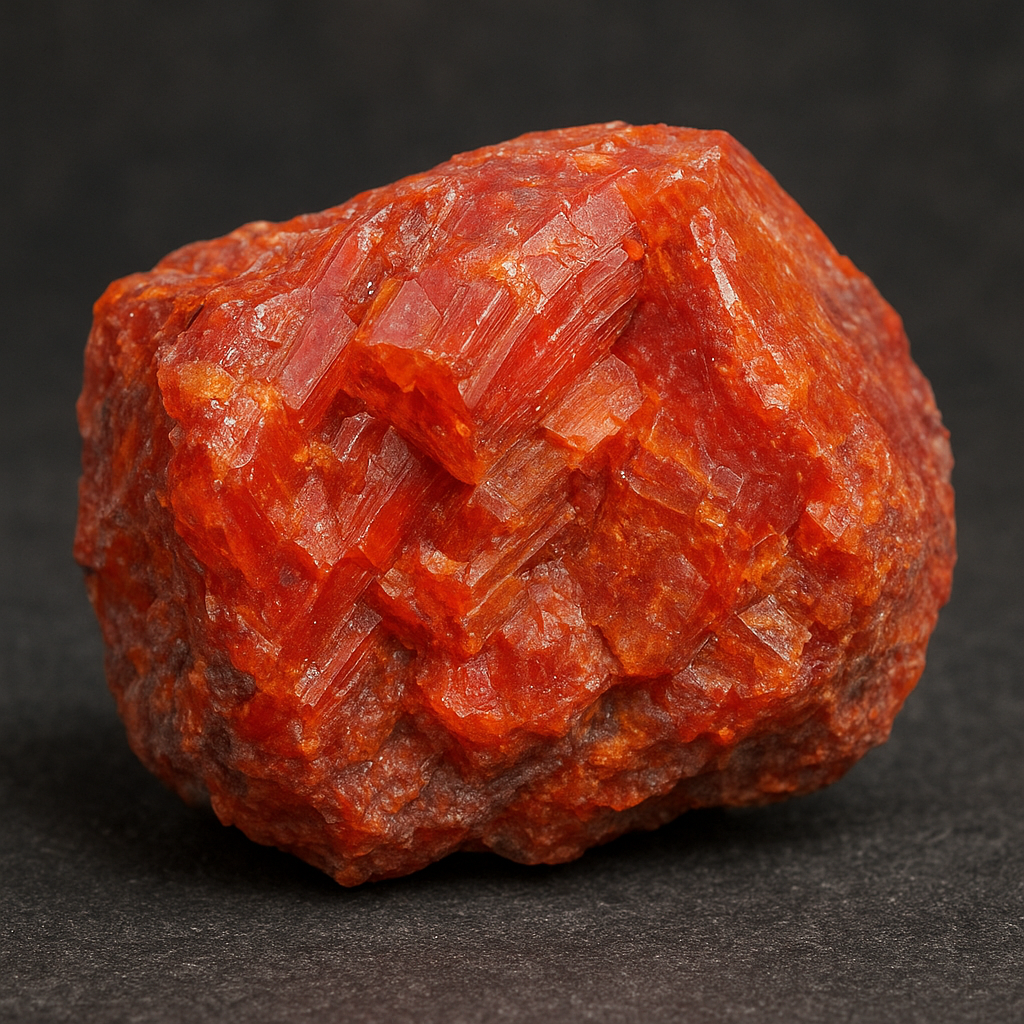
Physically, realgar is recognized by its deep red to orange-red color, resinous to subadamantine luster and relatively low hardness (about 1.5–2 on the Mohs scale). It often occurs as granular masses, prismatic crystals, or in stalactitic and massive habits. The mineral is relatively dense for a non-metallic mineral, with specific gravity roughly in the mid-3 range.
Crystallographically, realgar is commonly described as belonging to a low-symmetry system; it is well known for its proclivity to alter when exposed to environmental conditions. One of the most characteristic features of realgar is its sensitivity to light: prolonged exposure causes it to degrade into a yellow powdery alteration known as pararealgar. This photochemical transformation changes not only the color and appearance but can affect the physical integrity of specimens—collector-grade realgar must therefore be kept in subdued light or in darkness to retain its original coloration.
Notable localities for realgar include regions with active or fossil hydrothermal activity. Large and historic occurrences have been reported in parts of China, Peru, Mexico, Romania, and the western United States. Because the mineral often occurs in veins associated with other valuable sulfide ore minerals, it is frequently encountered during mining operations and has historically served as a minor ore of arsenic.
Historical and Practical Uses
Across time and cultures, realgar has been used for a variety of purposes, marked by a tension between its attractive properties and inherent hazards.
Pigment and Decorative Use
One of the earliest uses of realgar was as a pigment. The vivid red-orange color made it attractive for paints, dyes, and decorative applications. Natural arsenic sulfide pigments (both realgar and the yellow orpiment) were used in manuscripts, folk art, and cosmetics in certain cultures. However, their use declined as more stable, less toxic pigments became available and as the light-induced alteration of realgar proved problematic for durable artworks.
Fireworks, Pyrotechnics and Industry
Because of its distinctive color and properties as an arsenic-bearing compound, realgar and related arsenic sulfides found niche uses in pyrotechnics and the formulation of certain chemical processes. Historically it provided a source of arsenic for smelting or for producing arsenical compounds used in tanning and wood preservation. In modern industrial practice pure arsenic is now produced by more controlled metallurgical methods rather than by direct use of mineral realgar.
Traditional and Folk Medicine
Realgar has a long and complex presence in traditional healing systems. In traditional Chinese medicine it is known as xióng huáng and has been used for topical and internal remedies in very small controlled forms and mixtures. It has appeared in formulations intended for parasitic infections, skin diseases and other ailments. Similar uses appear in other folk medical practices around Asia and parts of Europe.
These historical uses, however, come with severe caveats: arsenic compounds are inherently toxic and can cause acute and chronic poisoning. Modern medical practice and toxicology have dramatically reduced and regulated such uses; many former traditional applications are now considered unsafe, and regulatory agencies restrict or ban the medicinal application of raw arsenic minerals.
Toxicity, Environmental Impact, and Handling
The defining practical issue with realgar is its status as an arsenic-bearing mineral. Arsenic is a well-documented environmental toxicant and human carcinogen. When realgar weathers or is processed, it can release arsenic into soils, surface waters and groundwater, creating serious health risks for humans, livestock and ecological systems.
- Acute toxicity: Exposure to soluble arsenic compounds can produce severe gastrointestinal symptoms, cardiac effects, neurologic disturbances and multiorgan failure in high doses.
- Chronic exposure: Long-term arsenic ingestion—commonly associated with contaminated drinking water—can lead to skin lesions, peripheral neuropathy, cardiovascular disease, and increased risks of various cancers (skin, lung, bladder).
- Environmental mobility: In oxidizing conditions, arsenic released from arsenic sulfide minerals can form arsenate or arsenite species, which have differing mobilities and toxicities. Groundwater contamination from mine tailings containing realgar or related minerals is a documented hazard.
Handling realgar requires strict precautions: collectors and researchers should avoid inhalation of dust, prevent ingestion, use gloves, and store specimens away from light to both limit photodegradation and reduce the likelihood of dispersing fine particles. Museums and display contexts often keep realgar specimens in darkened, sealed cases and use barrier materials to prevent contact.
From an environmental perspective, remediation of arsenic contamination linked to arsenic sulfides involves multiple strategies. These may include:
- Engineering controls to limit oxidation and leaching of tailings (capping, water management).
- Chemical stabilization by promoting formation of less soluble arsenic-bearing phases.
- Adsorptive removal technologies using iron oxides, activated carbon, or novel sorbents.
- Bioremediation and phytoremediation approaches exploiting microbes and plants that can immobilize or take up arsenic under managed conditions.
Because arsenic behavior depends strongly on redox conditions and pH, site-specific assessments and tailored remediation plans are essential.
Scientific Curiosities and Contemporary Research
Beyond its historical uses and environmental challenges, realgar continues to interest researchers in mineralogy, materials science and environmental chemistry. A few areas of ongoing research and curiosity include:
Photochemistry and Structural Transformation
The light-driven conversion of realgar into pararealgar and other alteration products fascinates mineralogists because it is both visually striking and chemically informative. The photochemical process involves breaking and rearrangement of As–S bonds, producing microcrystalline or amorphous phases with different optical and physical properties. Understanding these transformations helps in preservation of historic artifacts containing arsenic pigments and informs broader questions of solid-state photochemistry.
Semiconductor and Optical Properties
Arsenic sulfide phases display semiconducting behavior and interesting optical properties, especially in thin-film and nanostructured forms. Researchers have explored arsenic sulfide glasses and compounds for applications in infrared optics, photonic switching and phase-change materials. These studies usually focus on synthetically produced arsenic sulfide materials under controlled conditions rather than raw mineral specimens, but the natural mineral forms provide a conceptual and compositional foundation.
Arsenic Biogeochemistry
Realgar and related minerals serve as natural laboratories for studying arsenic cycling in the environment. Microbial communities can mediate the oxidation, reduction and methylation of arsenic species, influencing mobility and toxicity. Field studies of realgar-bearing deposits, mine-impacted watersheds and geothermal systems contribute to a richer understanding of arsenic dynamics and to improved mitigation strategies for contaminated water supplies.
Cultural and Historical Anecdotes
Realgar’s vivid color and toxic mystique have led to fascinating cultural roles. In parts of China, at festivals such as the Lunar New Year, a traditional paste containing arsenic sulfides was sometimes applied to doors or children’s foreheads to ward off evil spirits—an example of how toxic materials can become embedded in ritual. In medieval and early-modern alchemy, arsenic compounds including realgar figured in experiments seeking to transform or preserve materials, often with catastrophic health consequences for practitioners.
Collectors prize exceptionally well-formed crystals of realgar for their rarity and beauty, but museums face difficult conservation problems: realgar’s sensitivity to light and its toxicity force curators to balance display against preservation and safety. High-quality specimens kept in archival darkness can retain their spectacular coloration for decades, while those exposed to museum lighting progressively “go yellow” and friable as they convert to altered phases.
Practical Advice for Collectors, Students and the Interested Public
If you encounter realgar in the field or in a museum display, keep a few practical guidelines in mind:
- Respect its toxicity—do not touch your face or eat while handling specimens; use gloves and wash hands afterward.
- Limit light exposure to preserve color—store or display specimens in low-light or dark enclosures.
- Avoid grinding, heating or performing chemical tests that could generate dust or vapors.
- When acquiring specimens, seek information on provenance and storage history; responsible sellers will provide handling guidance.
Scientists studying realgar often work in fume hoods, use respirators when dry processing is required, and apply strict waste-disposal controls. Environmental monitoring around mining operations or geothermal fields remains essential to detect and mitigate arsenic mobilization.
Concluding Thoughts
Realgar is a mineral of contrasts: visually spectacular and culturally resonant, yet chemically perilous. Its story weaves together geology, history, art conservation, toxicology and environmental science. Whether encountered as a bright crystal in a collector’s cabinet, as a pigment in an old manuscript, or as a geochemical signal in a mining district, realgar continues to prompt careful curiosity. Understanding its formation, transformation and impacts helps us appreciate not only the mineral itself but also broader lessons about how natural materials can be both valuable and hazardous—and how human societies adapt their use and management over time.