
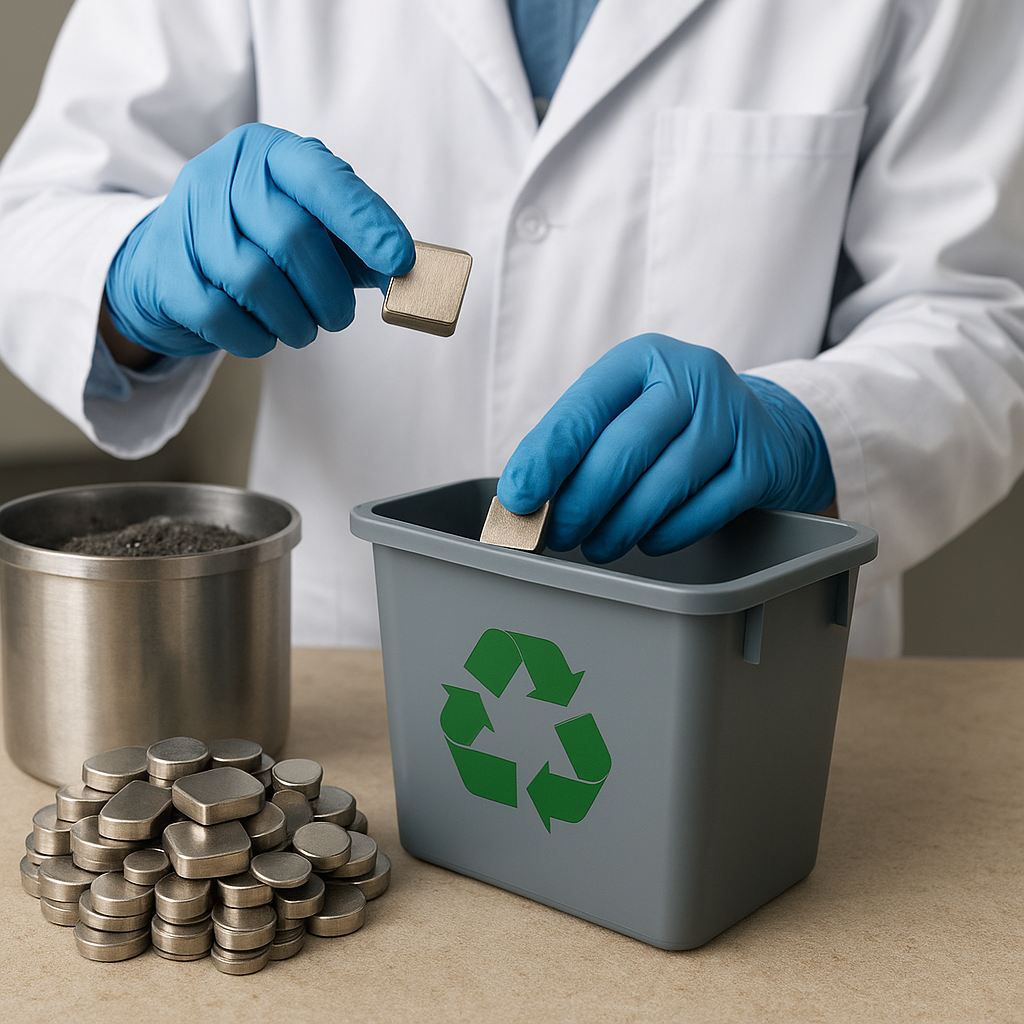
The global shift toward electrification and low-carbon technologies has put rare earth magnets at the center of modern industry. These compact, powerful components—especially magnets based on neodymium and praseodymium alloys—are critical to electric vehicles, wind turbines, consumer electronics and industrial motors. Meeting growing demand sustainably requires innovative approaches to recycling and recovery that reduce environmental impact, lower dependence on volatile suppliers, and close material loops in a circular economy.
Context and challenges
Rare earth permanent magnets, particularly NdFeB (neodymium-iron-boron) types, offer exceptional magnetic performance per unit mass. That performance makes them indispensable, but the supply chain for the underlying elements is constrained by geographic concentration, complex extraction processes and environmental concerns associated with conventional mining. As demand outpaces primary production growth, recycling becomes not only economical but strategically necessary.
Recycling rare earth magnets faces several technical and logistical challenges. Many magnets are embedded deep inside products—electric motors within appliances or vehicles, or small magnets in hard drives and consumer electronics—making disassembly labor-intensive. Magnets are often coated and bonded, requiring chemical or thermal treatment to separate and purify magnetic phases. End-of-life streams are also heterogeneous: automotive drives, wind-turbine generators, and electronic waste (or e-waste) each present different material mixes and contamination profiles.
Environmental and regulatory dimensions complicate the landscape further. Conventional smelting and refining of rare earth ores can generate hazardous waste and emissions; any recycling route must demonstrate lower lifecycle impacts. At the same time, policy incentives and producer responsibility mechanisms vary across jurisdictions, influencing how and whether collection and recycling systems are established. Enhancing supply chain resilience requires integrated technical, policy and market solutions.
Innovative recycling technologies
A variety of emerging technologies aim to recover rare earth elements (REEs) from magnets more efficiently and with reduced environmental footprint. Many approaches fall into four broad categories: mechanical pre-processing, pyrometallurgical methods, hydrometallurgical processing, and direct magnet-to-magnet or component-level reuse.
Mechanical and pre-treatment
Initial steps typically involve disassembly, shredding and mechanical separation. Advances in automated sorting—using sensors, eddy-current separators and robotic systems—improve throughput and reduce labor costs. Pre-treatment also includes coating removal and debonding. Controlled heating cycles or targeted chemical baths can remove polymer binders and surface layers to expose magnetic alloys for further processing.
Pyrometallurgy and high-temperature routes
Traditional pyrometallurgical techniques use high temperatures to separate metals, often followed by electrolysis. Recent innovations include optimized smelting fluxes and energy recovery systems to lower emissions. While effective at scale, these methods may still require significant energy and produce slag and off-gases that demand careful handling.
Hydrometallurgy and solvent-based extraction
Hydrometallurgy has become a cornerstone of many recycling strategies. Leaching dissolved rare earths from magnet powders enables selective precipitation and solvent extraction to isolate individual elements. Process intensification and greener reagents—such as organic acids or recyclable ionic liquids—are being developed to reduce hazardous waste and improve selectivity for neodymium and associated elements. Closed-loop solvent systems and acid recovery technologies further reduce environmental burdens.
Hydrogen-based methods and direct reuse
Hydrogen decrepitation (HD) is a notable breakthrough enabling magnet recovery without full element separation. Introducing hydrogen causes the NdFeB matrix to fragment along grain boundaries, producing a powder that can be re-sintered or reprocessed. This method supports near-direct reuse of the magnetic phase, which drastically reduces energy and chemical demands compared with full refining. Combining HD with magnetic separation and realloying can yield high-performance recycled magnets.
Bioleaching and biotechnologies
Biological approaches use microbes, enzymes or bio-derived chelators to solubilize REEs from shredded magnets or electronic waste. Although often slower than chemical leaching, bioleaching can operate at lower temperatures and with fewer toxic reagents. Research is improving rates, scalability and selectivity, and coupling biological steps with conventional hydrometallurgy shows promise for hybrid, low-impact processes.
Magnet-to-magnet and component-level recycling
Perhaps the most resource-efficient pathway is direct reuse: extracting intact magnets or remanufacturing magnet components to avoid melting and separating elements. This requires careful design for disassembly and quality assessment to ensure performance after reuse. Techniques include demagnetization/remagnetization cycles, mechanical refurbishment and localized re-sintering. When feasible, magnet-to-magnet recycling minimizes losses and energy consumption.
Policy, economics and business models
Technological options must be paired with supportive policies and viable business models. Economic feasibility hinges on collection rates, scale, feedstock consistency and market prices for virgin rare earths. Public policy can mitigate market failures by internalizing environmental costs of primary mining, funding pilot plants, and mandating recycling targets.
Key policy instruments include extended producer responsibility (EPR), deposit-return schemes for electronics, and incentives for design for recycling. Governments can underwrite front-end investments through grants or loan guarantees, especially where national security concerns motivate domestic REE recovery. Standardized labeling of magnet-containing components and end-of-life reporting would assist recyclers in identifying valuable streams.
Business models range from centralized industrial recyclers to localized service providers embedded within manufacturing networks. Partnerships between automakers, wind-turbine OEMs, electronics manufacturers and recyclers enable closed-loop supply chains: manufacturers reclaim magnets from returned products, refurbish or remanufacture them, and reintroduce them into production. These circular models can reduce raw-material costs and buffer companies against supply shocks.
Implementations, pilots and best practices
Several pilot programs and commercial ventures demonstrate the viability of rare earth magnet recycling. Industrial pilots in Europe and East Asia combine automated disassembly lines with hydrometallurgical recovery to produce market-grade neodymium oxide. Other initiatives focus on urban mining of hard drive magnets and automotive motor cores—streams with relatively high magnet content and simpler separation profiles.
Best practices for scaling up recycling include:
- Establishing robust collection networks that target high-yield streams (e.g., traction motors, HDDs).
- Designing products for disassembly and magnet accessibility at end-of-life.
- Deploying mixed processing trains that allow direct reuse where possible, and full element recovery when necessary.
- Investing in local or regional recycling hubs to reduce transport emissions and maintain material traceability.
- Applying life cycle assessment (LCA) to validate environmental benefits and guide process optimization.
Emerging collaborations between research institutions and industry accelerate technology transfer. Universities and national labs develop separation chemistries and process models, while startups focus on automation and plant-scale engineering. Corporations are beginning to internalize recycling as part of supply risk management, contracting recyclers or building in-house facilities.
Technical and environmental trade-offs
No single recycling approach is universally best; trade-offs exist between energy intensity, chemical usage and recovery rates. For example, pyrometallurgical routes can be fast and robust but energy-intensive, while hydrometallurgy and bioleaching are lower temperature but may involve complex wastewater streams. Direct reuse and hydrogen-based methods often show the best lifecycle metrics but require high-quality feedstocks and careful process control.
Comprehensive environmental assessment is therefore critical. Metrics should include greenhouse gas emissions, water and chemical use, hazardous wastes generated and the potential for secondary pollution. Social dimensions—such as labor impacts of automated vs. manual disassembly and implications for mining communities—are also part of a full sustainability evaluation.
Future directions and research priorities
Key areas for ongoing innovation include process integration, reagent recycling, and advanced sensing for automated sorting. Improving selectivity in hydrometallurgical separation reduces downstream purification needs. Scaling bio-based methods and combining them with chemical or thermal steps could unlock low-impact recovery for complex waste streams. Advancements in materials science—such as developing magnets with reduced critical element content or that are easier to recycle—will complement recycling technologies.
Finally, economic instruments that reflect the full societal cost of resource extraction will accelerate adoption of recycling. When primary production prices reflect environmental and social externalities, recycled materials become more competitive. Integrating policy, technology and design changes promises resilient, lower-impact supply chains for the magnets that power modern electrified systems.
