
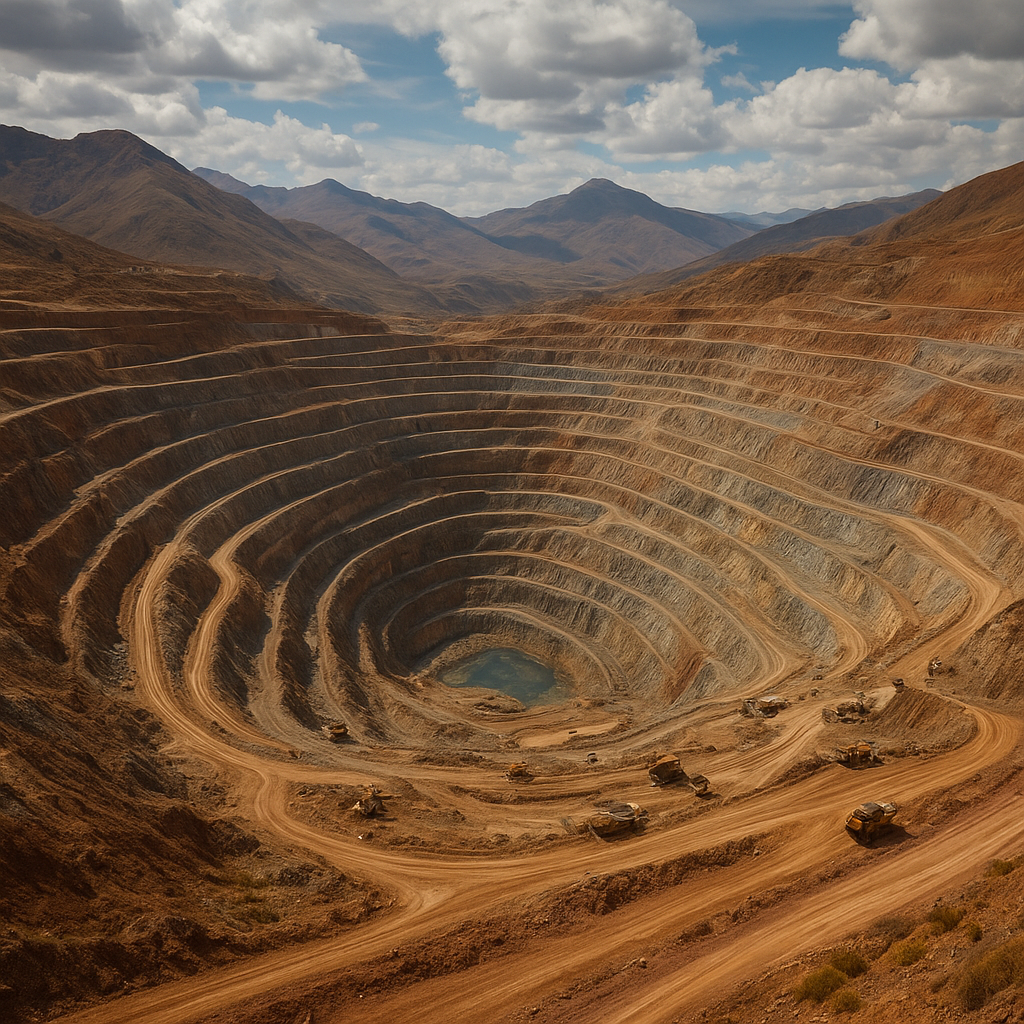
The Quellaveco project in southern Peru represents one of the most significant recent additions to the global copper supply chain. Conceived and built in the challenging Andean environment, it combines large-scale industrial engineering, complex logistics and modern social and environmental commitments. The mine has attracted international attention not only because of its size and anticipated output but also because of its role in the energy transition, local development and Peruvian export earnings.
Where Quellaveco is located and what the geology tells us
Quellaveco is situated in southern Peru, within the highland districts of the Moquegua region. The deposit lies in the Andean cordillera, an area characterized by rugged topography and a long history of mineralization related to the subduction of the Nazca Plate beneath the South American Plate. The project exploits a large porphyry-style system, a typical geological setting for major accumulations of copper and associated metals such as molybdenum and silver.
Porphyry deposits like Quellaveco form when magmatic-hydrothermal fluids interact with host rocks at intermediate crustal levels, producing disseminated copper mineralization over large volumes. This results in an ore body that is amenable to large-scale, open-pit mining and bulk processing. The deposit’s geology has allowed developers to design a concentrator plant to recover copper as concentrate, which is the primary product shipped to smelters and refineries worldwide.
Development history and ownership
The journey from discovery to production at Quellaveco spanned several decades of exploration, feasibility studies and negotiations. International mining companies and local stakeholders were involved at multiple stages. The project moved decisively into construction following favorable feasibility outcomes and when market conditions for copper supported the capital commitment.
Quellaveco’s development phase attracted substantial foreign direct investment and involved contracts with engineering, procurement and construction firms from around the world. Large-scale infrastructure works—including access roads, power connections, a processing plant and tailings facilities—were built to modern standards. The mine’s commissioning followed a multi-year construction program and staged ramp-up intended to optimize plant performance and integrate community relations and environmental management plans.
Operations: what is mined and how it is processed
At Quellaveco, the primary commodity produced is copper, recovered in the form of a copper concentrate. The mineralized material is extracted from large open pits using a fleet of heavy mining equipment. Once ore is transported to the processing plant, it undergoes crushing, grinding and flotation to separate the copper-bearing minerals from waste rock.
- Copper: The main metal recovered and the core of the mine’s economic value.
- Molybdenum and other by-products: Present in smaller quantities and recovered when economically feasible, adding to project revenues.
- Concentrate product: Shipped to downstream smelting and refining facilities for further processing.
The processing circuit at Quellaveco is designed for high throughput, with a focus on maximizing metal recovery while managing water and reagent use. Plant automation and monitoring systems are used to sustain consistent performance, reduce downtime and optimize energy consumption. Initial production projections were set to deliver significant annual output for the first decades of operation, reflecting the deposit’s large size.
Infrastructure and logistics
Constructing and operating a mine of Quellaveco’s scale required substantial supporting infrastructure. This includes haul roads, material handling systems, a concentrator complex and facilities for tailings management. One notable element of the project’s logistics is its approach to water supply, an often sensitive issue in arid and semi-arid regions.
To reduce reliance on scarce freshwater, the project incorporated a strategy using coastal resources: a coastal desalination plant and an associated pipeline network supply water to the mine site. This approach aims to protect local freshwater sources and align operations with regional water-management priorities. The facility also relies on grid power connections and on-site energy management to ensure stable supply for milling and processing equipment.
Economic significance
Quellaveco is an important contributor to both regional and national economies. The mine’s large-scale copper production supports:
- Export earnings: Copper is one of Peru’s top export commodities; additional output from Quellaveco increases foreign-exchange inflows.
- Government revenues: Taxes, royalties and other fiscal contributions finance public spending at national and local levels.
- Employment and local business development: The construction and operation phases created thousands of jobs directly and indirectly, stimulating the supply chain for goods and services.
The project’s scale means that its operations influence regional infrastructure development and can catalyze improvements in roads, communications and social services. For the global copper market, Quellaveco adds incremental supply at a time when demand for copper is buoyed by electrification trends, renewable-energy deployment and expanding transmission and manufacturing sectors.
Social and environmental considerations
Large mining projects in the Andes have heightened scrutiny regarding environmental impacts and social license to operate. Quellaveco implemented a range of measures to address these concerns, including community engagement programs, environmental monitoring and investment in local development projects. Efforts to reduce the project’s water footprint, such as the use of desalination and efficient recycling in processing, were emphasized to limit impacts on regional water resources.
Other environmental activities include progressive rehabilitation of disturbed areas, biodiversity studies and programs intended to mitigate air, noise and visual impacts. The company operating the project has committed to environmental compliance and to working with communities to build mutually beneficial relationships. Nonetheless, as with many large-scale mines, there have been moments of tension and negotiation regarding land use, employment priorities and local benefits; ongoing dialogue and transparent monitoring remain essential.
Ownership, partnerships and finance
Quellaveco attracted international partners and financial backers necessary to mobilize the significant capital required for construction. The project’s financing structure combined company equity, project loans and long-term offtake arrangements that helped underwrite the investment. Major international mining firms and institutional investors were involved in the project’s development, bringing technical expertise and management capacity.
Partnerships extended into engineering, procurement and construction contracts, with global suppliers providing specialized equipment and services. Local and regional contractors also played key roles in building roads, camps and supporting infrastructure, helping to channel economic benefits into the host communities.
Technological and operational innovations
Several features of Quellaveco reflect modern mining practices designed to increase efficiency and reduce environmental footprint. These innovations include:
- Advanced process controls and real-time plant monitoring to optimize production and improve recoveries.
- Water-conserving technologies and recycling systems to minimize freshwater withdrawals.
- Use of digital tools and predictive maintenance to lower downtime and extend equipment life.
- Commitment to progressive rehabilitation and improved tailings management approaches.
Emphasis on automation and digitalization aims to bolster safety and operational predictability. Training programs for local workers help transfer technical skills, enabling a greater share of the workforce to participate in higher-skilled roles.
Role in the global copper market
As an addition to the portfolio of large copper mines, Quellaveco contributes to meeting growing demand driven by the green transition. Copper’s role as a conductor in electrification — from power grids to electric vehicles and renewable-energy systems — makes large, sustainably produced supplies particularly valuable. The mine’s projected multi-decade lifespan offers market stability, while its timing has been notable because it came online at a moment of rising global interest in securing reliable metal supplies.
Investors, smelters and governments observe projects like Quellaveco for their ability to deliver long-term metal flows. The mine’s economics depend not only on copper prices but also on operating costs, metal recoveries and by-product credits. In a world increasingly focused on lower-carbon supply chains, the environmental and social performance of such projects influences market access and investor appetite.
Community engagement and local impact
Community relations are a central part of the project’s social strategy. Programs typically involve multi-year commitments to education, healthcare, small-business development and workforce training. Local procurement policies aim to maximize the economic spillovers into the regional economy while formal grievance mechanisms provide channels for addressing concerns.
Mining projects can transform local labor markets and public service demand. For Quellaveco, authorities and the operator have had to coordinate to align infrastructure and service expansion — for example, in transport, water and housing — ensuring that growth is managed responsibly. Continued attention to inclusive hiring, fair compensation and transparent benefit-sharing has been part of the project’s public communications.
Interesting facts and broader context
Quellaveco is interesting for several reasons beyond its size:
- It exemplifies a new generation of large copper projects that combine high capital investment with modern environmental mitigation strategies.
- The use of coastal water infrastructure for an inland Andean mine demonstrates cross-regional planning to address water scarcity.
- Its construction during recent global supply chain interruptions and a pandemic tested project management and procurement resilience.
- Quellaveco’s output feeds a global manufacturing system increasingly sensitive to the sustainability credentials of raw materials.
- Local employment and training programs create pathways for long-term economic diversification in the host region.
From a technical perspective, exploiting a porphyry deposit of Quellaveco’s size requires integrating geology, geometallurgy and mine planning to ensure consistent ore supply and metallurgical performance. From a policy perspective, it also underscores how resource projects intersect with national development goals, export strategies and environmental stewardship.
Looking forward: challenges and opportunities
Quellaveco’s future will be shaped by several interrelated factors. Market dynamics for copper—including demand from electrification and potential supply-side disruptions—create both opportunities and risks for long-term returns. On the operational side, optimizing recoveries, managing costs and maintaining reliable infrastructure are ongoing priorities.
Environmental stewardship will remain a focal point, particularly water management, emissions reductions and biodiversity protection. Innovations in energy use, including greater integration of renewable sources, could reduce the mine’s carbon footprint and enhance its social license. Continued collaboration with local communities, government entities and other stakeholders will determine how equitably benefits are shared and how risks are managed.
Ultimately, Quellaveco is a case study in balancing large-scale mineral development with environmental and social commitments in a resource-rich but ecologically sensitive region. Its progress and evolving practices will be observed by industry peers, policymakers and market participants interested in how new mines can meet the twin demands of commodity supply and responsible development.
Quellaveco remains a landmark project in southern Peru, illustrating the complexities and potential of modern mining. Its presence in the Moquegua highlands is reshaping local economies and contributing to a global supply chain where copper plays an increasingly strategic role. Supported by global partners such as Anglo American and significant investment from companies like Mitsubishi, the project underscores how finance, engineering and community engagement combine to bring a major resource into productive use. Attention to sustainability measures, including desalination, technology-driven efficiency and social programs, will be central to the mine’s long-term legacy and to how it is perceived by future generations.

