Quartz is one of the most familiar and versatile minerals on Earth, present in everything from mountain peaks to glass factories and high-precision electronics. This article explores its formation, physical and chemical character, geographic occurrence, practical uses, and several intriguing facets that make quartz both scientifically significant and culturally resonant. Readers will find descriptions of its common varieties, industrial roles, and safety considerations, along with curiosities about synthetic growth and historic uses.
Formation and Global Occurrence
At its core, quartz is a crystalline form of silicon dioxide (SiO2). It forms in a wide range of geological environments and is one of the dominant constituents of the continental crust. Because of its chemical stability and relative hardness, quartz survives weathering and accumulates in sediments, while also growing as well-formed crystals in igneous and metamorphic settings.
Primary geological settings
- Igneous rocks: Quartz is a major component of felsic igneous rocks such as granite and rhyolite. In these environments, silica-rich melts crystallize to produce both massive quartz and intergrown mineral aggregates.
- Pegmatites: Large, coarse-grained crystals often occur in pegmatites, where slow cooling and fluid-rich conditions allow enormous crystals to develop.
- Hydrothermal veins: Many gem-quality and clear quartz crystals grow from silica-rich hydrothermal fluids that precipitate quartz in fractures and cavities. Such environments are also responsible for mineralization of metals like gold and copper.
- Metamorphic rocks: Quartz is common in schists and gneisses and forms growths and recrystallized aggregates under heat and pressure.
- Sedimentary deposits: Quartz grains, being chemically resistant, dominate many sandstones and beach sands and are the main raw material for many industrial applications.
Notable localities
Where to find remarkable specimens: Brazil (Minas Gerais and Bahia) is famous for gem and large rock-crystal specimens; Arkansas (USA) has long produced striking clear crystals from pegmatites; Madagascar yields colorful varieties and unusual forms; the Swiss Alps provide well-terminated alpine quartz; and locations in Namibia, India, Russia, and China contribute significant gem and industrial material. Herkimer County, New York, is known for its doubly-terminated “Herkimer diamonds” (actually quartz).
Physical and Chemical Properties
Quartz’s identity is defined by its chemistry and crystal structure. The mineral crystallizes in the trigonal system and exhibits properties that make it useful in diverse technical applications.
- Chemical formula: SiO2 (silicon dioxide) — a continuous framework of SiO4 tetrahedra.
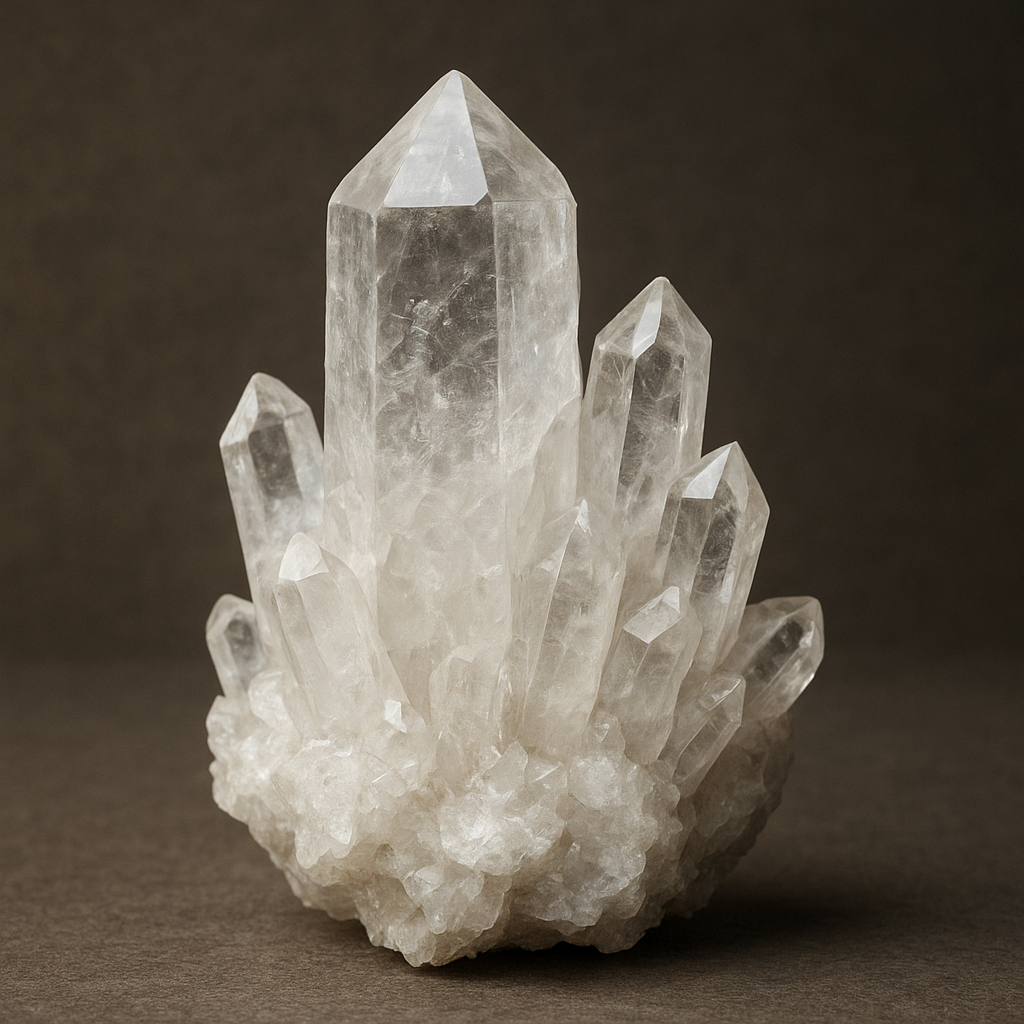
- Crystal system: Trigonal (hexagonal crystal family); common habit includes prismatic crystals with a six-sided cross-section ending in a six-faced pyramid.
- Hardness: About hardness 7 on the Mohs scale, making it sufficiently durable for many uses while still being workable.
- Specific gravity: Around 2.65, relatively light compared to many ore minerals.
- Optical properties: Uniaxial positive with modest birefringence (δ ~ 0.009). Refractive index ranges near 1.544–1.553.
- Fracture: Conchoidal (smooth, curved surfaces) like glass, a feature exploited in ancient tool-making.
- Polymorphs: SiO2 has other forms such as cristobalite and tridymite (stable at high temperatures) and amorphous silica (opal).
Piezoelectricity and related effects
One of quartz’s most extraordinary physical properties is its piezoelectric behavior. When mechanical stress is applied to a properly oriented crystal, it produces an electrical voltage across its faces; conversely, applying an electric field causes mechanical deformation. This reversible electromechanical coupling underpins quartz’s role in oscillators, resonators, and timing devices. The stability and reproducibility of quartz’s oscillation frequencies make it a cornerstone of precision electronics.
Varieties and Gemstone Use
Quartz occurs in many varieties, ranging from colorless and transparent to richly colored, banded, or included forms. Several common and prized varieties are used in jewelry and ornamentation.
- Rock crystal: The pure, colorless form prized for clarity and historically used in lenses and carvings.
- Amethyst: Purple quartz colored by irradiation and trace iron, a popular gemstone with ancient cultural significance.
- Citrine: Yellow-to-orange quartz often produced naturally or by heat-treating amethyst.
- Rose quartz: Pink translucent masses, colored by trace elements or microscopic inclusions.
- Smoky quartz: Brown-to-black due to natural irradiation; used as a gem and ornamental stone.
- Aggates, onyx, and jasper: Microcrystalline forms of quartz (chalcedony group) that form banded and opaque decorative stones.
Gem-cutting and lapidary work exploit quartz’s hardness and relative abundance; well-cut quartz gems can be attractive and affordable alternatives to other gemstones.
Industrial and Technological Applications
Beyond jewelry, quartz’s physical and chemical traits have enabled myriad industrial uses. Its ubiquity in modern technology makes it economically invaluable.
Electronics and precision instruments
- Quartz crystal oscillators: Widely used in watches, clocks, radios, computers, and telecommunication equipment to provide stable timekeeping and frequency control. Synthetic, high-purity quartz grown hydrothermally is standard for these applications.
- Piezoelectric sensors and transducers: Employed in sonar, microphones, and pressure sensors.
- Optical components: Rock crystal and synthetic quartz are used to make lenses, prisms, and windows with excellent transparency in the visible and ultraviolet ranges.
Glass, ceramics, and metallurgy
- Glass manufacturing: High-purity silica sand is the primary raw material for glass production.
- Foundry sand: Quartz sand is used in molds and cores.
- Silicon production: Silica is reduced to produce elemental silicon, the base material for semiconductors and photovoltaic cells. While quartz itself is not directly transformed into chips, the silica feedstock is a fundamental starting point.
Construction and abrasives
- Sand and gravel: Quartz-rich sand is ubiquitous in concrete and mortar aggregates.
- Abrasives: Ground quartz serves as an abrasive in sandpaper and grinding media.
- Frac sand: High-purity quartz sands are used in hydraulic fracturing as proppants.
Emerging and specialized uses
Advanced optical fibers, high-temperature insulation, and specialized ceramic components rely on forms of silica. Synthetic quartz is important in photonics, microelectronics, and precision optics where natural impurities would interfere with performance.
Synthetic Quartz and Crystal Growth
To meet the purity and dimensional requirements of modern technologies, quartz is often synthesized. The hydrothermal growth process mimics nature’s high-temperature, high-pressure formation of quartz by dissolving natural silica in an alkaline solution and recrystallizing it on seed plates. This yields large, defect-minimized crystals tailored for electronic resonators, optical blanks, and other precision devices.
- Advantages of synthetic quartz: Controlled impurity levels, exact orientations, consistent sizes, and minimal internal stresses.
- Applications: Frequency-control devices, UV-grade optical components, and research-grade single crystals.
Health, Safety, and Environmental Concerns
While bulk quartz and beach sand are benign to handle, airborne crystalline silica poses significant health risks. Inhaling fine silica dust can cause silicosis, a chronic and potentially fatal lung disease, and is associated with increased risks of lung cancer and chronic obstructive pulmonary disease.
- Occupational exposure: Mining, quarrying, construction (cutting concrete, sandstone), sandblasting, and foundry work can generate dangerous respirable silica dust.
- Precautions: Proper ventilation, water suppression during cutting, respirators, and regulatory exposure limits are critical to protect workers.
- Environmental impact: Extraction of quartz sand and industrial waste from silica processing can affect landscapes and water systems if unmanaged.
Cultural, Historical and Miscellaneous Fascinations
Quartz has long held a place in human culture, from prehistoric tools to religious artifacts. Its glass-like fracture made it useful for early stone tools. Clear crystal often symbolized purity, and carved rock-crystal objects were prized in antiquity for luxury and ceremonial purposes.
- Ancient uses: Crystal balls, carved amulets, and early containers and lenses were fashioned from quartz.
- Art and ornamentation: Elaborate Baroque and Renaissance carvings in rock crystal demonstrate both the aesthetic and technical value of large quartz masses.
- Folklore and beliefs: Many cultures attributed healing and protective powers to various quartz varieties. While such uses are widespread in modern metaphysical communities, they are not supported by scientific evidence.
Natural curiosities
Quartz can display unusual phenomena that fascinate collectors and researchers: inclusion of other minerals or fluids forming “phantom” crystals, dendritic patterns, and the development of skeletal or hopper crystals. Some quartz specimens show luminescence under ultraviolet light; others contain minute bubbles and growth zoning that reveal the history of crystal formation.
Collecting and Care of Quartz Specimens
Quartz is a favorite of mineral collectors because of its aesthetic variety, crystal habits, and accessibility. Collectors often seek clarity, size, unusual forms, and rare combinations of inclusions or colors.
- Handling and cleaning: Most quartz is robust; cleaning can usually be done with warm water and mild detergent. Caution with heat: sudden temperature changes can fracture crystals.
- Storage: Store cut gemstones and delicate specimens away from prolonged sunlight to prevent fading in some colored varieties (e.g., heat or light can alter amethyst hues over time).
- Labeling and provenance: Good records of locality and any treatments (e.g., heat-treated citrine) add value to specimens and maintain scientific usefulness.
Connections to Related Topics and Industries
Quartz links geology, materials science, industry, and culture. Some related themes worth exploring include:
- Silicon technology: The pathway from silica to silicon to semiconductors and solar photovoltaics.
- Mineral polymorphism: How different crystal structures of the same chemical composition (SiO2 polymorphs) form under varying conditions.
- Optics and photonics: The use of quartz in precision optical systems and fiber-optic technology.
- Geochronology and thermobarometry: Using quartz inclusions and growth features to deduce the pressure-temperature history of rocks.
A final intriguing note
Quartz’s combination of abundance, durability, and special physical effects (especially piezoelectric behavior) makes it a mineral that bridges the natural world and modern technology. From the glittering veins in a mountain to the tiny oscillator inside a wristwatch, quartz demonstrates how a common substance can serve extraordinary roles across scientific disciplines, practical industries, and human culture.