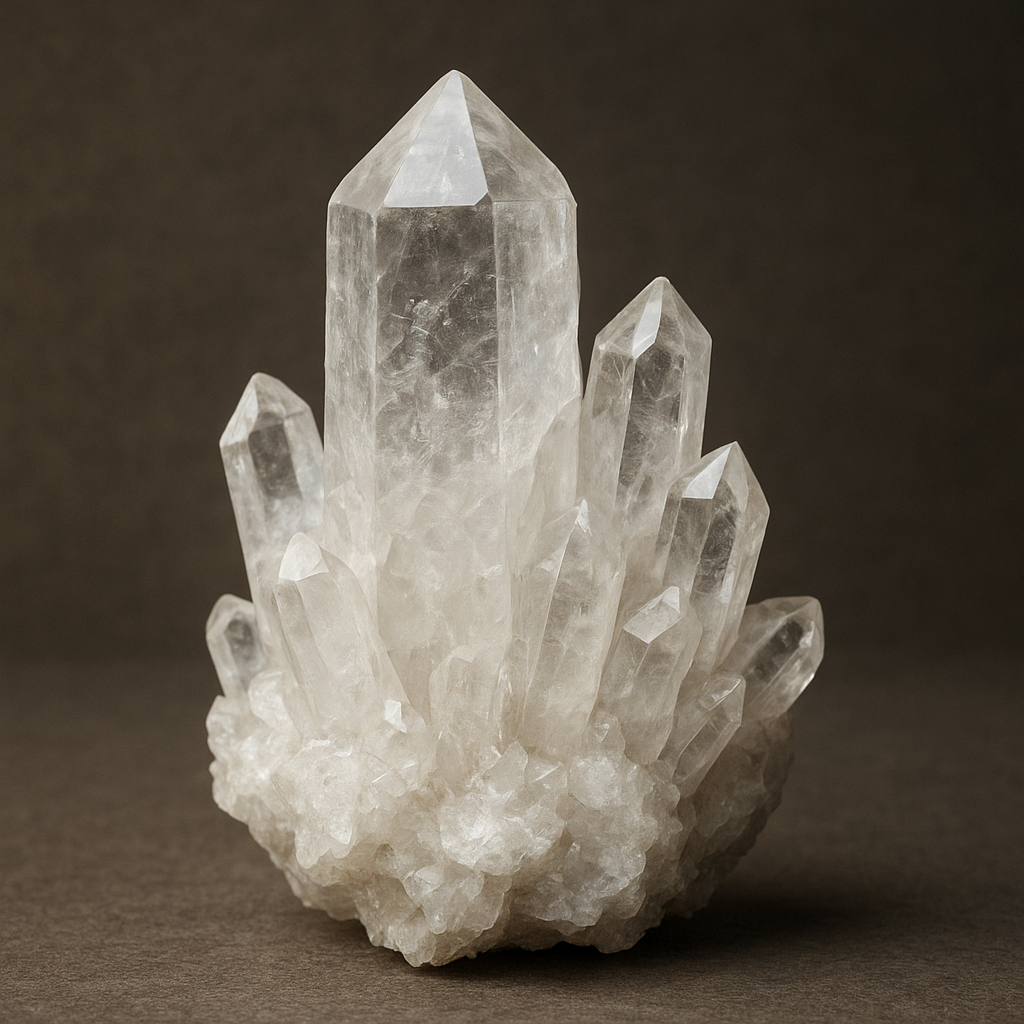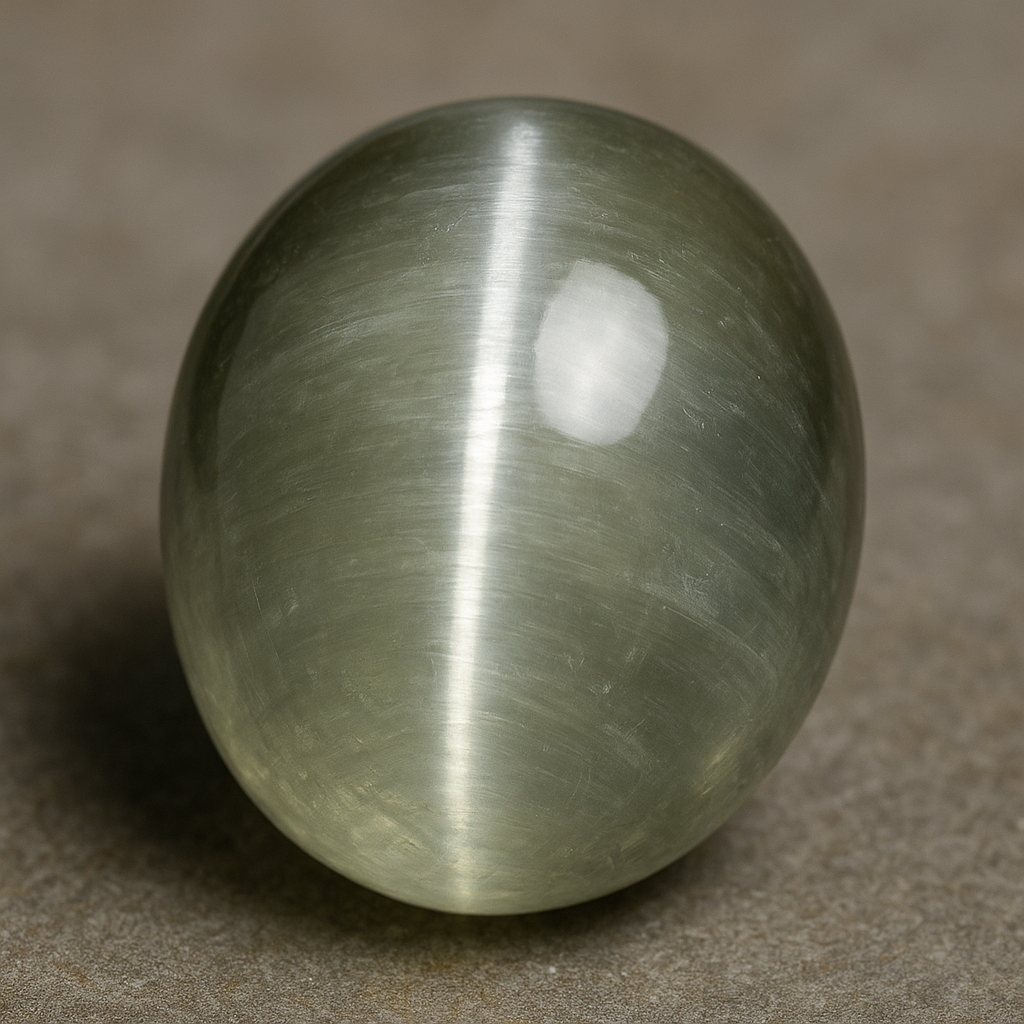
Quartz Cat’s Eye is a fascinating variation of quartz that displays a narrow, moving band of reflected light reminiscent of a cat’s pupil. This optical phenomenon, known as chatoyancy, turns an otherwise ordinary mineral into an eye-catching gemstone prized by collectors and jewelers. In the paragraphs that follow, we will explore how this effect forms, where cat’s-eye quartz is found, how it is used in lapidary and jewelry, and some curious scientific and cultural notes that make this material particularly interesting.
Origin of the Effect and Mineralogy
The defining characteristic of a cat’s-eye gemstone is a bright, linear highlight that moves across the surface when the stone or the light source is moved. This feature is caused by aligned, needle-like or fibrous inclusions within the host mineral. In the case of quartz, these inclusions are often composed of minerals such as rutile, amphibole fibers (including crocidolite in the formation of tiger’s eye), or microscopic tube-like cavities. When these minute inclusions are parallel and densely packed, light reflecting from their surfaces creates a single narrow band of light.
Quartz itself is a silicon dioxide (SiO2) polymorph with a hexagonal crystal system. Unlike chrysoberyl, which is famous for producing the finest cat’s-eye effect and is a different chemical species altogether, quartz is relatively abundant and mechanically robust. The way a cat’s-eye appears in quartz depends on both the orientation of the fibers and the way the stone is cut. To maximize the optical effect, a lapidary cuts the stone into a domed cabochon with the fiber direction perpendicular to the base so the band runs across the dome.
Types of Inclusions That Produce Chatoyancy
- Rutile needles: fine, hair-like crystals of titanium dioxide aligned in parallel bundles
- Crocidolite: amphibole fibers that can be replaced by silica to form tiger’s eye, preserving the fibrous structure
- Hollow tubes or fluid inclusions: tiny aligned cavities can also scatter light into a band
- Other mineral fibers: including actinolite or asbestos-group minerals in rare cases
Under magnification, cat’s-eye quartz will reveal the alignment of these inclusions. In some specimens the fibers are so fine they appear as blurred, silky chatoyancy; in others the band is razor-sharp and visibly contrasty, greatly increasing the gem’s appeal and market value.
Where Quartz Cat’s Eye Occurs
The geological environments that produce quartz cat’s eye are diverse but share common themes: conditions that promote the growth or preservation of aligned fibers, and later infilling or crystallization by silica. Cat’s-eye quartz can be found in regions with hydrothermal activity, metamorphic host rocks, or in silica-rich pegmatites where oriented inclusions may develop.
- Brazil — One of the most important sources of gem-quality quartz varieties, Brazil yields many specimens displaying chatoyancy, including cabochon-grade material.
- Sri Lanka — Long known for its gem trade, Sri Lanka supplies different chatoyant gemstones, including quartz and chrysoberyl varieties.
- India — Notable for a variety of chatoyant stones, India produces cat’s-eye quartz that is used locally and exported.
- Madagascar — Known for producing interesting and collectible mineral specimens, including chatoyant quartz.
- Uruguay and parts of Africa — Occasional sources of chatoyant quartz and related materials.
- United States and Russia — Sporadic localities produce collector-grade chatoyant specimens.
Within deposits, cat’s-eye quartz is often associated with silica-rich veins cutting through metamorphic schists or in pockets within pegmatites. The original fibrous minerals might form under amphibolitic conditions and later become coated or replaced by quartz, preserving the fibrous geometry needed for the effect.
Lapidary Techniques and Grading
Successful lapidary work is essential for transforming rough cat’s-eye quartz into a gemstone with a dramatic moving band. The cabochon cut is the universal standard for chatoyant stones; faceting would break the continuous reflection and ruin the optical band. Two factors are crucial during cutting:
- Orientation: the cutter aligns the fiber direction so the band will run across the dome.
- Dome height and symmetry: a properly proportioned dome enhances the motion and focus of the band.
Grading a cat’s-eye quartz depends on several visual attributes. Collectors and gemologists commonly assess:
- Band sharpness — How defined and crisp the light stripe is.
- Band contrast — The difference between the bright band and the surrounding material.
- Color and body tone — Colors range from golden brown and gray to greenish or honey hues; the body color affects perceived clarity of the band.
- Symmetry and placement — Centered bands are more desirable; off-center bands may still be attractive but typically less valuable.
- Movement — A lively, fast-moving band is preferred to a sluggish or diffuse one.
Top specimens have a single, sharp, centered band that appears to float on the surface and slide smoothly when the stone is rotated. Because quartz is relatively common, the highest prices go to stones with unusual colors, exceptionally sharp bands, or large sizes with excellent visual qualities.
Typical Treatments and Enhancements
Natural cat’s-eye quartz is often used untreated. However, some lower-grade material may be dyed or heat-treated to improve color. As with all gemstones, any treatment should be disclosed by reputable dealers. Unlike some softer or porous chatoyant materials, quartz tolerates standard gem-setting and polishing techniques well because of its hardness (around 7 on the Mohs scale).
Applications in Jewelry and Design
Cat’s-eye quartz is primarily used in jewelry where its unique optical behavior can be showcased, most commonly in rings, pendants, brooches, and statement cabochons set in precious metals. Designers prize the stone for its ability to convey motion and life; a well-cut cat’s-eye can appear to follow the viewer as it moves.
- Rings — The rising dome and single band draw attention; protective settings such as bezels are common.
- Pendants and necklaces — Larger cabochons work well as focal pieces.
- Men’s jewelry — The typically subdued colors and strong optical effect make cat’s-eye quartz popular in masculine designs.
- Collectors’ pieces — Unusual colors or museum-quality specimens are prized by mineral collectors.
Practical considerations for jewelry include the stone’s durability and cleaning. Quartz is hard and relatively resistant to abrasion, but sudden impacts and harsh chemicals should be avoided. Warm, soapy water and a soft brush are generally safe for routine cleaning.
Science, Testing, and Imitations
For gemologists, distinguishing natural cat’s-eye quartz from imitations involves a combination of visual inspection and instrumental testing. Quartz has a refractive index (RI) typically around 1.544–1.553 and is uniaxial positive. Under magnification, the aligned fibrous inclusions producing chatoyancy are visible; their morphology helps determine whether the stone is quartz or another host. Polariscope and dichroscope tests, plus spectroscopy, can further help separate quartz from chrysoberyl and synthetic imitations.
Common imitations include glass with embedded fibers or synthetic materials engineered to mimic chatoyancy. Some assembled stones glue a thin layer of material with fibers onto a base—these are generally lower value and less durable. Careful buyers look for:
- Natural growth patterns of inclusions under a microscope
- Consistent physical properties matching quartz
- Disclosure from reputable sellers
It’s also worth noting that the name cat’s-eye is used across different mineral species. The famous and more valuable cat’s-eye chrysoberyl is chemically and optically distinct from quartz but shares the same chatoyant visual effect. Understanding these differences is essential for accurate identification and valuation.
Cultural Significance and Metaphysical Beliefs
Throughout history, chatoyant stones have attracted mystique. The phrase chatoyancy itself comes from the French oeil de chat, literally cat’s eye. Different cultures have assigned protective and healing properties to cat’s-eye stones. In some traditions the cat’s-eye is seen as a talisman against the evil eye or bad luck; in others it is associated with heightened intuition and warding off negativity.
Among metaphysical practitioners, cat’s-eye quartz may be used for focusing intention or promoting clear vision metaphorically and spiritually. While these beliefs are not scientifically supported, they continue to influence consumer interest and design motifs in jewelry and decorative arts.
Interesting Connections and Comparisons
Comparing cat’s-eye quartz to other chatoyant materials reveals both scientific and aesthetic relationships. For instance, tiger’s eye (a variety of quartz) displays a broad, wavy chatoyant band resulting from the replacement of crocidolite fibers by silica; the effect looks like shifting golden stripes rather than a single line. Chrysoberyl cat’s eye, on the other hand, often forms a very sharp, highly valued eye and is chemically beryllium aluminum oxide, not silica. These comparative differences underline how a single optical phenomenon—light reflecting from aligned fibers—can yield a range of visual effects depending on the host mineral and inclusion type.
Scientific analogies:
- Fiber optics — The way light reflects and is channeled by aligned inclusions is reminiscent, on a micro-scale, of how modern fiber optic cables guide light.
- Materials science — Understanding and replicating chatoyancy informs research into engineered materials with directional light-scattering properties.
Market, Collectibility and Value Factors
Because quartz is abundant, most cat’s-eye quartz is affordable, making it accessible for everyday jewelry. However, rarity, aesthetic appeal, and size can command higher prices. Factors that increase value include an intense, well-centered band, unusual or attractive body colors, and large flawless cabochons. Collector demand for unusual localities or historic pieces may further raise prices for specific specimens.
When purchasing, consider these practical tips:
- Inspect the band under direct, focused lighting to judge sharpness and movement.
- Ask about treatments and whether any dye or enhancement has been applied.
- Buy from sellers who provide clear return policies and demonstrable expertise.
Conservation, Care and Ethical Considerations
Mining of gem materials can have environmental and social impacts. While many quartz deposits are small-scale and lower-impact compared to large-scale industrial mining, buyers concerned with sustainability can seek ethically sourced stones. Certifications and transparent supply chains are increasingly available in the gem trade.
As for maintaining the gem itself, standard care for quartz cat’s eye involves avoiding prolonged exposure to chemicals, removing jewelry during rigorous activities, and storing pieces away from direct sunlight for extended periods if the body color is delicate or treated.
Final Observations and Further Reading
The elegance of a perfectly cut cat’s-eye quartz lies in its simplicity: ordinary silica transformed into a gem with a moving, lifelike band. Whether appreciated for its aesthetic value, its geological story, or its cultural symbolism, cat’s-eye quartz occupies a charming niche among gemstones. For those who want to delve deeper, gemological textbooks on chatoyancy, laboratory reports distinguishing quartz from chrysoberyl, and regional mineralogical surveys of Brazil, Sri Lanka, and Madagascar offer detailed technical and locality-specific information.