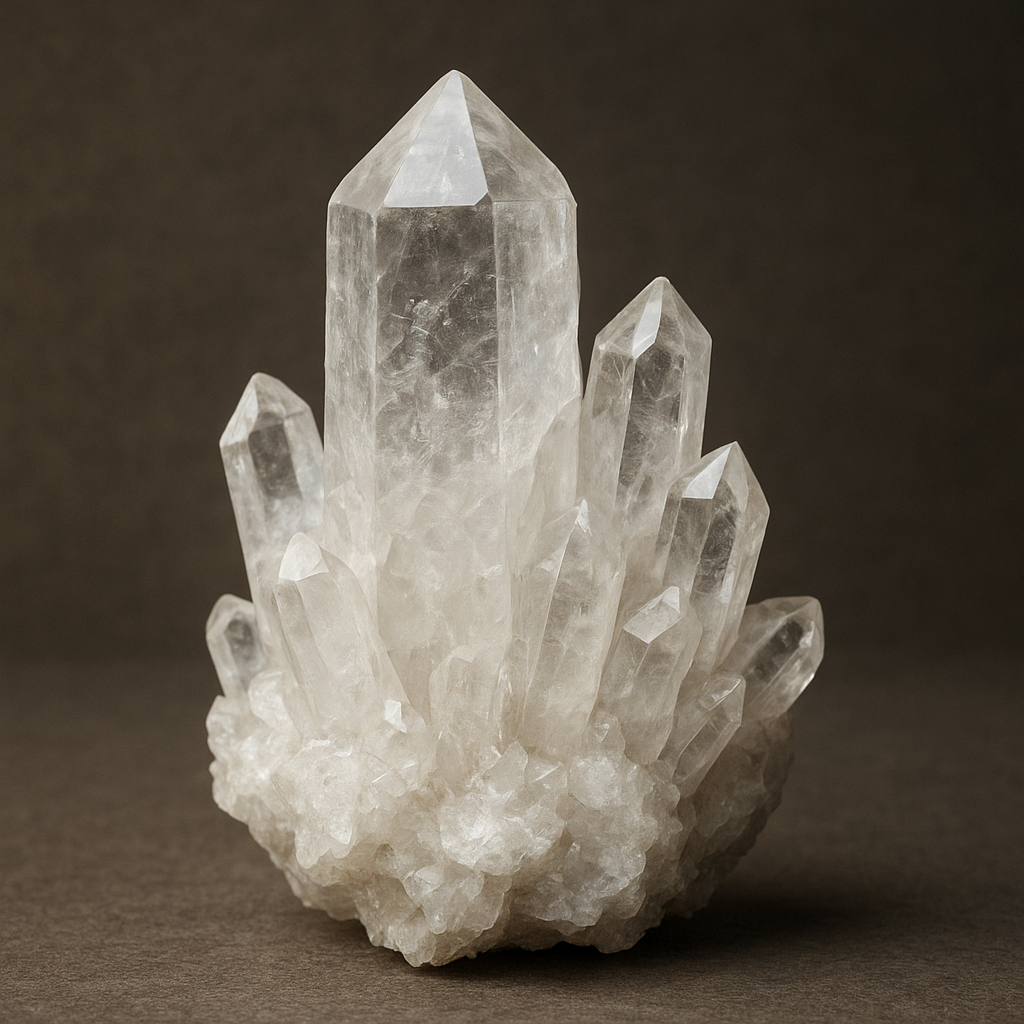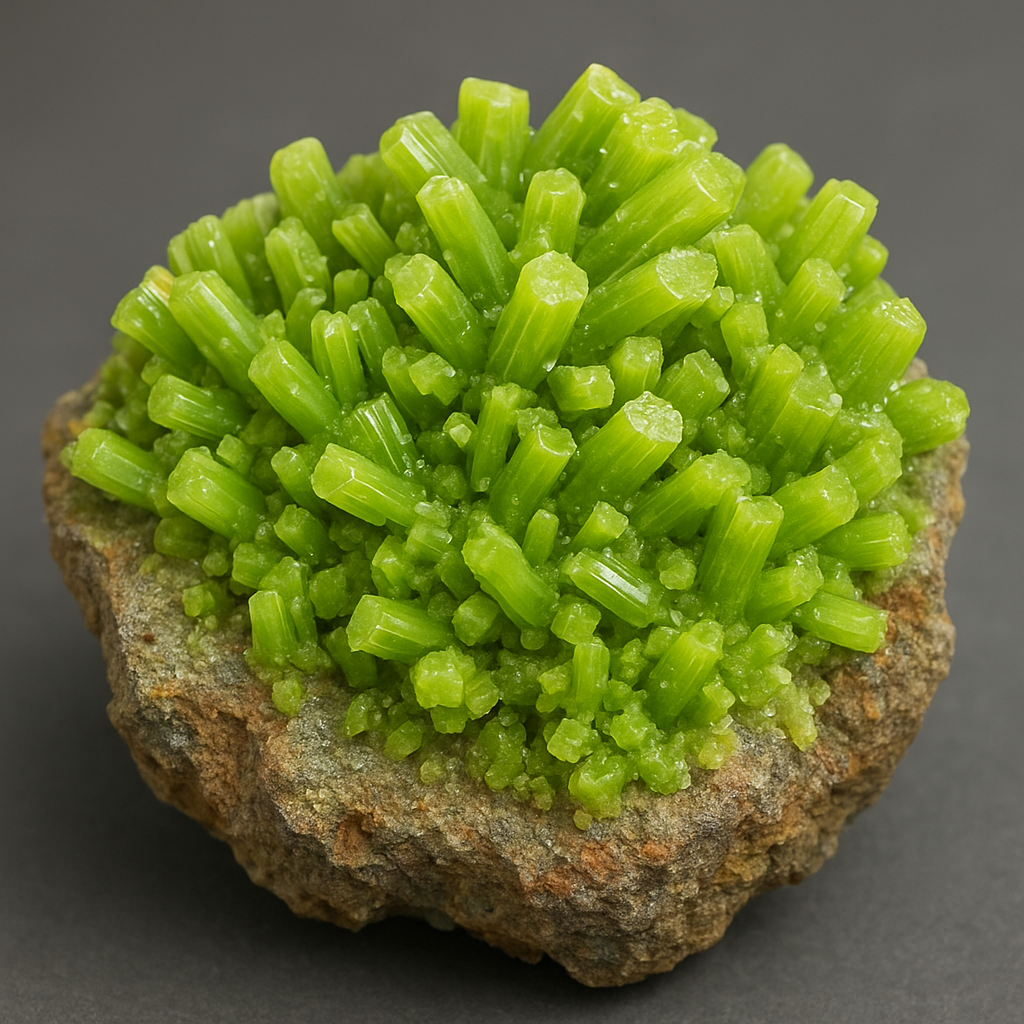
Pyromorphite is a captivating and often brilliantly colored secondary lead phosphate mineral that has fascinated mineralogists, collectors, and environmental scientists alike. Its striking crystalline forms, range of vivid hues, and important role in immobilizing toxic lead in the environment make it both scientifically significant and visually appealing. In this article, we will explore pyromorphite’s chemistry and physical properties, where it forms and where the best specimens come from, how it is used (including its role in remediation), collecting and safety considerations, and several intriguing aspects that make this mineral worth studying and admiring.
Chemical and Physical Characteristics
At the core of pyromorphite’s identity is its chemical formula, Pb5(PO4)3Cl: a lead-rich member of the apatite group. This structure places it among minerals that share a general formula of A5(TO4)3X, where A = large cation (here lead), TO4 is a tetrahedral anion group (here phosphate) and X is a halogen (chlorine for pyromorphite). The mineral’s hexagonal crystal system produces a host of aesthetic habits, from stout barrel-shaped prisms to delicate acicular sprays and compact botryoidal masses.
Key physical properties
- Crystal system: hexagonal (a subset of the apatite group)
- Hardness: 3.5–4 on the Mohs scale (relatively soft)
- Specific gravity: high, typically around 6.5–7.1 (due to lead content)
- Luster: resinous to subadamantine
- Color: commonly shades of green, yellow, brown, orange, and sometimes gray or white
- Streak: white
- Transparency: transparent to translucent
Pyromorphite forms a solid-solution series with mimetite (Pb5(AsO4)3Cl) and with vanadinite (Pb5(VO4)3Cl), where the tetrahedral anion (phosphate) is substituted by arsenate or vanadate. This substitution not only influences color and crystal habit but is also a subject of interest for mineral chemists studying substitution mechanisms and ionic radii effects in crystal lattices.
Occurrence and Notable Localities
Pyromorphite is a secondary mineral typically found in the oxidation zones of lead-bearing ore deposits. It forms when primary lead minerals such as galena (PbS) are weathered and react with phosphate-bearing fluids. These fluids can be derived from organic matter decomposition, the alteration of phosphate minerals, or even from anthropogenic sources such as phosphate-rich wastes. The mineral is commonly associated with other secondary lead minerals such as cerussite, anglesite, and occasionally with copper or zinc secondary minerals in complex oxidation environments.
Typical geological settings
- Oxidation zones of hydrothermal lead deposits
- Surface or near-surface environments where groundwater circulates and reworks primary ores
- Old mine dumps and tailings, where secondary mineralization continues long after active mining ends
Notable localities for fine pyromorphite specimens are spread across continents. Historically important and prolific areas include parts of Europe, North America, Africa, and Australia. Some regions have produced exceptionally well-formed and richly colored crystals prized by collectors and museums. Because pyromorphite often forms in pockets and vugs within oxidized zones, classic showpieces often come from specific, well-documented sites where such microenvironments were common.
Uses, Applications, and Environmental Relevance
Although pyromorphite itself is not typically mined as a primary ore of lead (it usually occurs in limited quantities relative to primary lead ores), its significance goes beyond simple economics. Two main areas of practical interest stand out: specimen collecting and environmental science, especially soil and water contamination control.
Collector and scientific value
- Pyromorphite ranks highly among mineral collectors because of its brilliant colors, well-formed hexagonal prisms, and the variety of habits it exhibits.
- Specimens are often displayed in museums and private collections; museum-quality pieces can command high prices at auctions and among specialty dealers.
- Academically, pyromorphite is valuable for studying crystal chemistry, isomorphism (with mimetite and vanadinite), and secondary mineral paragenesis in oxidation zones.
Environmental and remediation uses
One of the most compelling modern uses of pyromorphite is its role in environmental remediation. Lead contamination of soils and sediments is a persistent public-health and ecological problem associated with past mining, smelting, and industrial activities. A remediation strategy known as “phosphate immobilization” seeks to convert bioavailable and mobile lead species into low-solubility minerals such as pyromorphite. In practice, phosphate amendments (e.g., apatite rock, soluble phosphates, or engineered phosphate compounds) are introduced to contaminated soils or waste, encouraging chemical reactions that precipitate lead as pyromorphite or pyromorphite-like phases.
This is attractive because pyromorphite is extremely insoluble under many environmental conditions; once lead is locked into its crystal structure, its mobility and bioavailability decrease significantly, reducing risks to humans and ecosystems. Research into this method considers factors such as pH, competing ions (e.g., carbonate, chloride), phosphate source, and the potential for formation of mixed clays or fluoro/oxide phases. Field trials and laboratory studies have shown that phosphate amendments can be effective, especially when applied with an understanding of local geochemistry and long-term stability considerations.
Collecting, Handling, and Safety Considerations
For collectors and researchers, pyromorphite’s beauty is compelling, but safety must be a priority because of its high lead content. Lead-bearing minerals pose risks if dust is inhaled or ingested, and careless handling can transfer lead particles to skin or surfaces.
Practical handling tips
- Always wash hands thoroughly after handling specimens; avoid eating or touching your face while handling minerals.
- Do not attempt to clean collected pyromorphite with acids at home—acidic treatments can dissolve the mineral and release lead into solutions.
- When cutting or preparing samples, use appropriate respiratory protection and containment to prevent inhalation of fine particles.
- Store specimens in labeled, sealed containers to minimize dust spread and accidental contact, particularly in homes with children or pets.
These precautions ensure the longevity of your specimens and reduce health hazards. Museums and serious collectors often encapsulate valuable pieces behind glass and use gloves when handling to prevent oils and contamination from degrading delicate crystals.
Interesting Aspects and Ongoing Research
Pyromorphite is an engaging subject for research across mineralogy, environmental science, and materials chemistry. Several themes stand out.
Etymology and historical notes
The name pyromorphite derives from Greek roots meaning “fire” (pyro) and “form” (morph), a reference to changes observed in the mineral’s appearance when heated—early mineralogists noted that it sometimes changes form or shows altered morphology under strong heat. Historically, pyromorphite was recognized and described in the context of lead ore deposits and later became a focal point for classification within the apatite group.
Solid solutions and mineral relationships
Pyromorphite’s ability to form continuous or partial solid solutions with mimetite and vanadinite opens inquiries into how anionic substitutions (PO4 vs AsO4 vs VO4) affect crystal chemistry, stability, color, and physical properties. Such studies have implications for interpreting paragenesis in ore deposits and for synthesizing lead-phosphate analogues for remediation or material science applications.
Role in long-term stability of remediated sites
Long-term studies examine whether pyromorphite formed in situ from phosphate amendments remains stable over decades, especially under changing redox conditions, flooding events, or acidification. Results so far are encouraging: pyromorphite tends to be one of the more stable lead compounds under many environmental regimes, but site-specific studies are recommended before large-scale applications.
Optical and spectroscopic properties
Because pyromorphite can host various minor elements (e.g., Ca, Zn) and accommodate different anions, it has been a target for spectroscopic studies (Raman, infrared, X-ray diffraction) to better understand lattice vibrations, substitution patterns, and trace-element incorporation. These analyses not only help identify specimen provenance but also inform remediation strategies by revealing how impurities influence solubility.
Practical Examples and Demonstrations
To illustrate pyromorphite’s formation and significance, consider two practical contexts: a natural oxidation scenario and an engineered remediation effort.
Natural oxidation pockets
In the oxidized cap of a lead-rich vein, groundwater oxygen and mildly acidic conditions mobilize lead from galena. If phosphate is present—perhaps derived from the breakdown of organic matter or the weathering of apatite—the chemical environment can favor precipitation of pyromorphite within small cavities. Over time, well-formed hexagonal prisms may line vugs, producing attractive specimens. Collectors prize these pockets because the crystals are often isolated and undamaged by the surrounding rock.
Engineered soil amendment
On a contaminated shooting range or near old smelting operations, soil tests reveal elevated bioavailable lead. Environmental engineers might apply a phosphate amendment (such as rock apatite or a soluble phosphate) mixed into the affected upper soil layer. With time and appropriate moisture and pH conditions, lead binds with phosphate and can precipitate as pyromorphite-like phases, reducing its uptake by plants and mobility into groundwater. Follow-up monitoring checks for changes in lead speciation and bioavailability over months and years.
Visual Variety and Collector Appeal
Perhaps the most immediate appeal of pyromorphite is its visual diversity. Specimens range from tiny, sparkling microcrystals to large, stout, barrel-shaped prisms visible to the naked eye. Colors stem from minor elemental substitutions and the nature of inclusions or surface tarnishing. Bright apple-green specimens are particularly sought after, as are deep olive, amber, and honey tones.
- Typical crystal habits: barrel-shaped hexagonal prisms, botryoidal aggregates, acicular sprays, crusts
- Color influencers: trace elements (e.g., chromium, iron), substitution with arsenate or vanadate, surface alteration
- Specimen preparation: collectors prefer minimal mechanical cleaning to preserve delicate terminations
Photographic documentation and careful lighting can dramatically enhance a specimen’s perceived color and structure, which is why museum displays often use targeted illumination and neutral backgrounds to emphasize pyromorphite’s geometry.
Final Thoughts on Appreciation and Responsibility
Pyromorphite sits at a fascinating intersection of beauty and responsibility. Its dazzling forms capture the imagination of collectors and scientists, while its chemistry offers practical pathways for mitigating environmental lead hazards. Appreciation of this mineral should always be paired with respect for the potential health risks associated with lead-bearing specimens and with acknowledgment of the broader environmental contexts in which pyromorphite forms.
Whether admired under a loupe by a dedicated collector, studied in a laboratory by a mineralogist, or used in carefully designed remediation trials by environmental engineers, pyromorphite continues to deliver scientific insight and aesthetic reward. Its study weaves together crystallography, geochemistry, environmental science, and practical stewardship—an intersection that keeps this modest but remarkable mineral firmly in the spotlight.