Pumpellyite is a lesser-known but scientifically valuable mineral that often appears as green, bladed or fibrous crystals in low-grade metamorphic rocks and altered volcanic terrains. Although it rarely reaches the public fame of quartz or feldspar, it plays a key role in the interpretation of metamorphic conditions and fluid-rock interactions. In this article I will describe the mineral’s composition and crystal structure, outline typical geological environments where it forms, summarize its practical and scientific uses, and highlight some interesting aspects of ongoing research and collecting.
Mineralogy and crystal chemistry
Pumpellyite belongs to a small group of complex silicate minerals characterized by chains and sheets of tetrahedra combined with octahedral layers that incorporate divalent and trivalent cations. The group is compositionally variable. A commonly used general formula is Ca2(Mg,Fe2+,Al)Al2(SiO4)(Si2O7)(OH)2·H2O, which reflects its mixed occupancy by calcium, magnesium, iron and aluminium in multiple structural sites. Several recognized species include pumpellyite-(Mg), pumpellyite-(Fe2+), and pumpellyite-(Al), named according to the dominant cation in a particular site.
Crystallographically, pumpellyite is typically monoclinic and forms prismatic, bladed or fibrous aggregates. Its structure can be described as a sorosilicate framework in which both single tetrahedral groups (SiO4) and double tetrahedral groups (Si2O7) coexist. The hydrogen-bearing components and interlayer water molecules influence stability and often make pumpellyite sensitive to metamorphic overprinting and weathering. Microscope and microprobe investigations reveal that pumpellyite commonly shows solid-solution behavior across Mg-Fe-Al substitutions, and zoning at micro-scales can record changes in fluid composition or temperature during growth.
Where pumpellyite occurs: geological settings and notable localities
Pumpellyite is a classic indicator of low-grade metamorphism and is commonly associated with the greenschist and prehnite-pumpellyite facies. It forms in a range of environments where relatively low temperatures and modest pressures prevail, typically in the presence of water-rich fluids that facilitate metamorphic reactions.
Most common geological environments
- Metamorphosed basaltic and mafic volcanic rocks — Pillow lavas and flows altered by burial or hydrothermal fluids often show cavities and veins filled with pumpellyite together with chlorite, prehnite and zeolites.
- Contact and regional low-grade metamorphic zones — Pumpellyite appears in the outer, cooler portions of thermal aureoles and in regional metamorphism that does not exceed greenschist facies conditions.
- Hydrothermal alteration and vein systems — In some ore-related systems, pumpellyite forms as an alteration mineral in fractures and as coatings on sulfide grains.
- Metasedimentary rocks — Rarely, pumpellyite can occur in carbonate-rich or clay-bearing metasediments where fluids supply the necessary calcium and silica.
Notable localities
Pumpellyite was first described from localities linked historically with early mineralogical exploration in North America and Europe. It is named after the American geologist Raphael Pumpelly. The Lake Superior region (including Isle Royale and surrounding Michigan copper districts) is famous for early descriptions of the mineral in basaltic host rocks. Other classic occurrences include Iceland, parts of Italy, and various metamorphosed mafic terranes worldwide. Collectors and researchers also report pumpellyite from altered volcanic terrains in New Zealand, Japan, and other regions where low-grade metamorphism or hydrothermal alteration of basalts is common.
Physical and optical properties relevant to identification
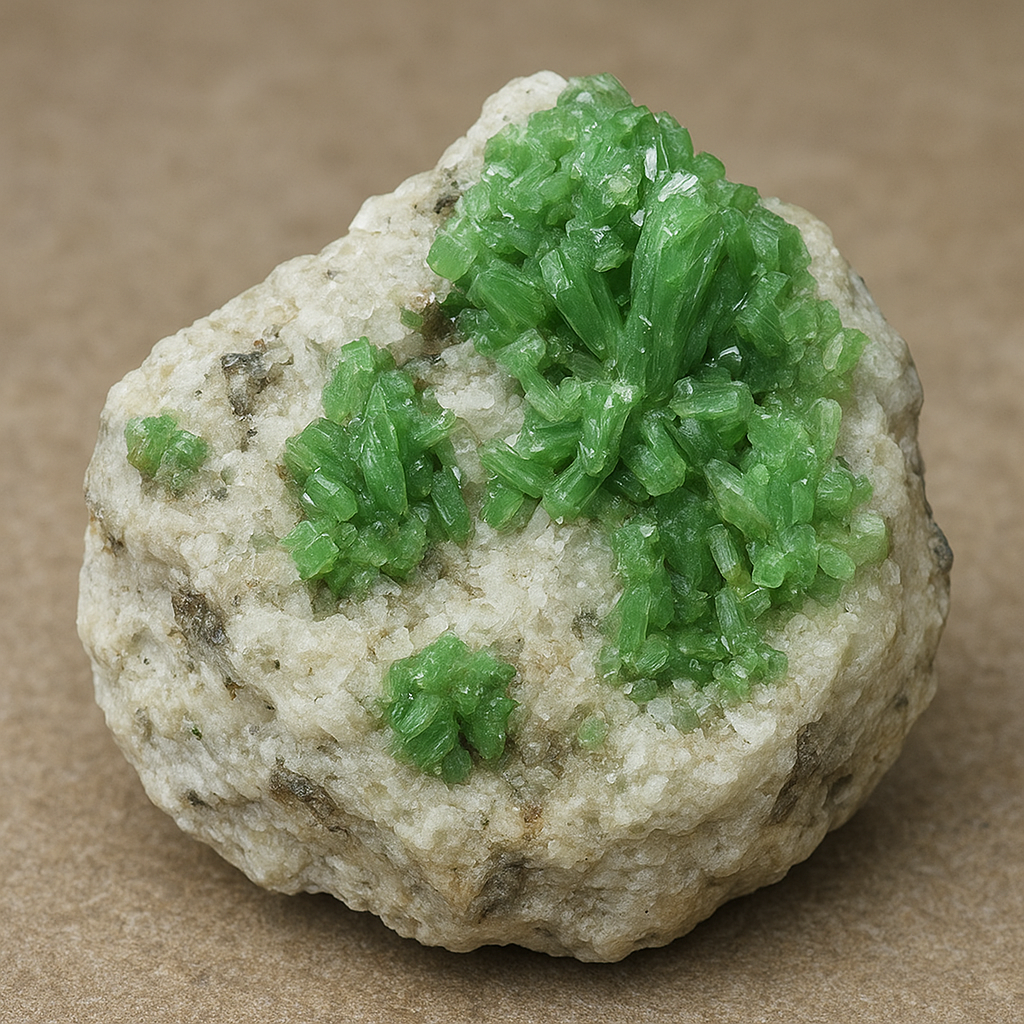
In hand sample pumpellyite typically presents as green to olive or yellow-green masses, sometimes forming bladed crystals or radiating fibrous aggregates. The color and association with other green metamorphic minerals (for instance, chlorite or epidote) can aid field recognition, but optical and analytical techniques are required for confident identification.
- Crystal habit: bladed, prismatic or fibrous aggregates; often intergrown with chlorite and prehnite.
- Color and luster: green to olive-green; vitreous to subresinous luster on fresh surfaces.
- Hardness and density: intermediate hardness (moderate on the Mohs scale) and a specific gravity that reflects Ca- and Fe-content; values vary with composition.
- Optical properties: under the petrographic microscope pumpellyite is biaxial and displays characteristic interference colors and pleochroism that help distinguish it from similar green minerals.
Because pumpellyite frequently occurs as fine-grained aggregates, X-ray diffraction (XRD), electron microprobe analyses, and Raman spectroscopy are commonly used to determine species and composition. Scanning electron microscopy (SEM) imaging combined with energy-dispersive X-ray (EDX) analysis can reveal growth zoning and compositional variations that are important for interpreting metamorphic histories.
Applications and scientific significance
Pumpellyite’s primary value is scientific rather than industrial. It functions as an indicator mineral recording low-temperature metamorphic conditions and the presence of aqueous fluids during rock evolution. Several specific uses include:
- Metamorphic facies mapping — The presence of pumpellyite in mafic rocks commonly identifies the prehnite-pumpellyite or lower greenschist facies, helping geologists map metamorphic grade across a region.
- Thermobarometry and fluid studies — Compositional variations, zoning and mineral associations offer constraints on temperature, pressure and fluid chemistry during metamorphism. Pumpellyite stability is sensitive to water activity and can therefore record fluid-rock interaction processes.
- Ore deposit studies — Where pumpellyite forms in hydrothermal systems, it can indicate the thermal evolution of mineralized zones and the nature of altering fluids.
- Educational and collector interest — Well-formed pumpellyite specimens are appreciated by mineral collectors and used in teaching metamorphic petrology because they illustrate facies relationships and low-grade metamorphic mineral assemblages.
Industrial uses of pumpellyite are limited. It is not mined as an ore of any major metal, and commercial applications are minimal because the mineral commonly occurs in fine-grained, intergrown forms rather than as large, pure crystals. Occasional use as a minor gem material or cabochon for collectors exists when attractive, translucent pieces are available, but this is rare.
Associations and related mineralogy
Pumpellyite typically coexists with a characteristic low-grade metamorphic assemblage. Important associated minerals include prehnite, chlorite, epidote-group minerals, actinolite, zeolites and sometimes calcite or fine-grained quartz. The exact assemblage depends on the bulk chemistry of the rock and the composition of metamorphic fluids.
In many basalts and similar rocks, vesicles and fractures are successively filled by zeolites, pumpellyite, and prehnite as the rock evolves from zeolite facies conditions into the prehnite-pumpellyite facies. This paragenetic sequence is widely used to interpret the thermal and hydrothermal history of volcanic piles and oceanic crust analogues.
Interesting research directions and field observations
Several aspects of pumpellyite continue to be interesting foci for research:
- Micro-scale compositional zonation — High-resolution electron probe and micro-analytical techniques reveal growth zoning that can record transient changes in temperature, oxygen fugacity and fluid composition during metamorphism.
- Fluid-rock interaction experiments — Laboratory experiments that synthesize pumpellyite under controlled conditions help constrain its stability limits and the role of fluids, including how varying CO2/H2O ratios affect formation.
- Paleoenvironmental reconstruction — In some tectonic settings, pumpellyite-bearing assemblages serve as clues to burial depths and the history of fluid circulation in ancient oceanic crust or island-arc sequences.
- Analogue studies for planetary geology — While direct evidence for pumpellyite on other planets is limited, the study of low-grade alteration minerals provides useful analogues for interpreting hydrothermal alteration and aqueous alteration processes on planetary bodies.
From a practical perspective, field geologists use simple petrographic observations of pumpellyite-bearing rocks to infer metamorphic gradients. For collectors, well-crystallized pumpellyite specimens, especially from classic localities, are prized for their distinctive green color and interesting habits.
Collecting, conservation and ethical considerations
Collectors should be aware that pumpellyite is often a fine-grained, fragile mineral that can be altered by weathering when exposed to surface conditions. Careful extraction, proper cleaning, and stable storage are important to preserve specimen quality. Because pumpellyite occurrences are frequently associated with sensitive geological sites (for example, national parks or protected historic mining districts), collectors must follow local regulations and practice ethical collecting. High-quality scientific samples are best obtained through collaboration with universities and museums, where thin-sectioning and microanalysis can provide valuable data without unnecessarily depleting rare localities.
Finally, pumpellyite’s modest visual appeal belies its scientific richness. Whether used to map the subtle transitions of metamorphic grade in an orogenic belt or to unravel the history of hydrothermal systems in a volcanic pile, this mineral offers a direct window into fluid-driven geological processes operating at relatively low temperatures. For petrologists, mineralogists and informed collectors alike, pumpellyite remains a quietly important constituent of the Earth’s crustal story.